Church of Santa Margherita: Mother Church of Licodia Eubea
Site at a Glance
- Popularity
- Very Low
- Country
- Italy
- Primary era
- Early Modern
- Eras represented
- Early Modern, Modern
- Civilizations
- Italian, Kingdom of Sicily, Spanish
- Site type
- Religious
- Remains
- Basilica
On this page11 sections
History
The Church of Santa Margherita is the Roman Catholic parish and mother church of Licodia Eubea, Italy. It is dedicated to St Margaret of Antioch of Pisidia and belongs to the Diocese of Caltagirone, an ecclesiastical district overseen by a bishop. The active church existed before the sixteenth century, and its architecture reflects late Renaissance and Baroque styles.
Early church and mother-church status
Santa Margherita was probably altered and enlarged from the second half of the sixteenth century. After priest and Syracuse Cathedral canon Martino La Russa died in January 1584, money from his bequest was directed toward the church’s construction. A canon was a member of a cathedral chapter.
In 1625, Santa Margherita became Licodia’s mother church, taking over a position held for centuries by the Church of St Anthony Abbot. That church stood on Santapau castle hill, near the seat of feudal power.
Earthquake and restoration
The 1693 earthquake, which struck the wider Val di Noto, heavily damaged Santa Margherita and completely destroyed the Church of St Anthony Abbot, which was never rebuilt. Local tradition, supported by records, holds that one nave of Santa Margherita remained almost intact, allowing the sacraments to be celebrated there for several years. Soon after the earthquake, the Eucharist, St Margaret’s ancient statue, and her relics were transferred to the undamaged Church of the Crucifix, also known as the Hospital Church.
After restoration, Santa Margherita reopened and was reconsecrated in 1738.
Patronage and later changes
After decades of local devotion to St Margaret as patron, the Holy See approved her as Licodia’s principal patron in 1905. Francesco Lo Bartolo, a Capuchin friar from the town and a member of a branch of the Franciscan order, promoted the initiative. St Anthony Abbot, the former patron, is also recognized as a co-patron.
Extensive alterations took place during the nineteenth and twentieth centuries. Later work around the presbytery, the area around the main altar, followed a superficial interpretation of the Second Vatican Council’s liturgical provisions. The council, held from 1962 to 1965, considered changes to Catholic worship; the alterations included removal of the polychrome-marble altar rail.
Giovanni Verga, an Italian writer associated with realism, mentioned the church’s tower in his novella Jeli il pastore.
Remains
Setting, plan, and exterior
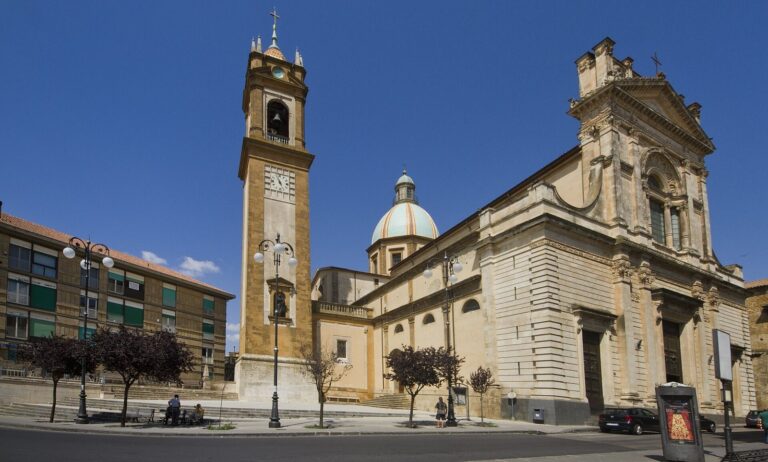
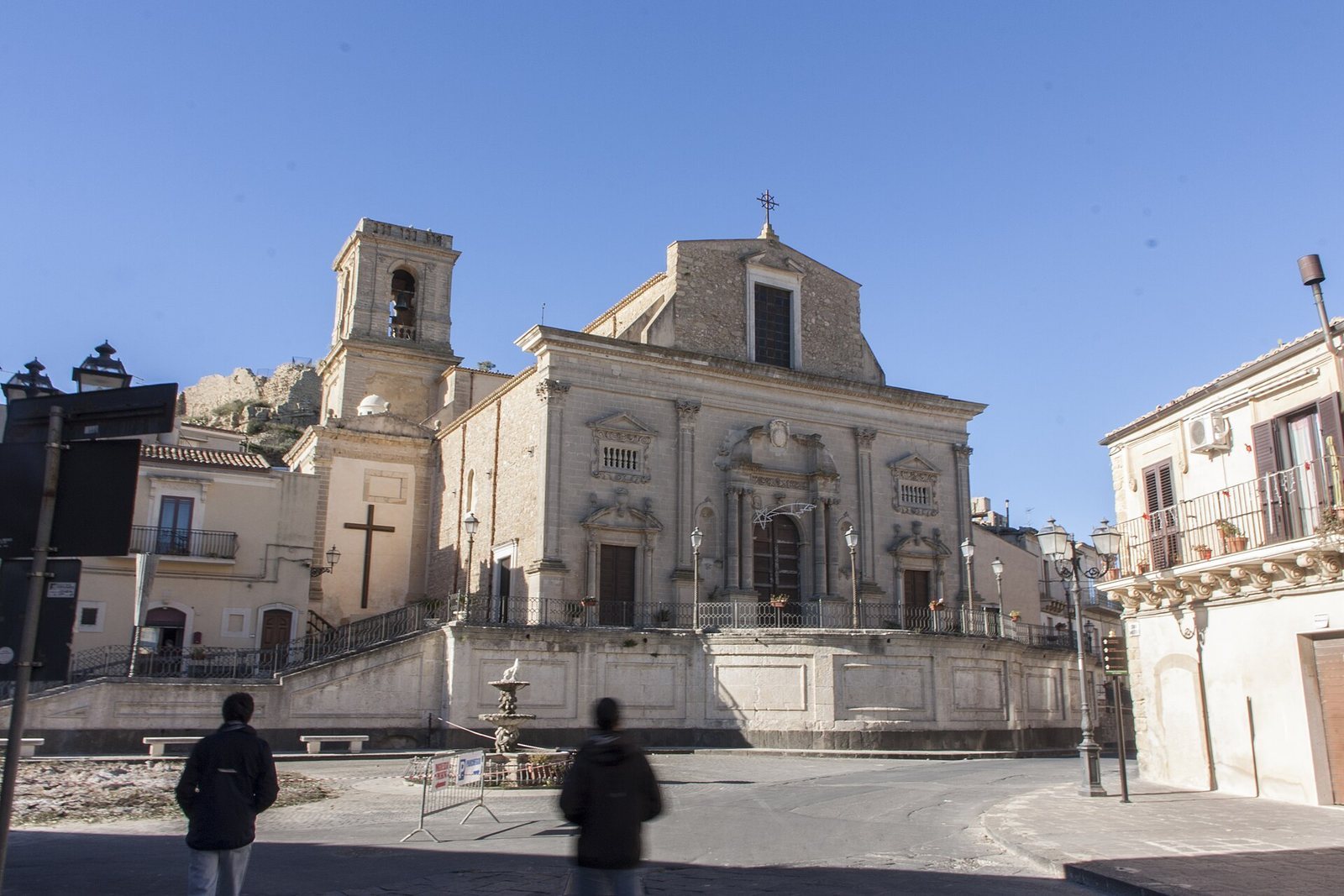
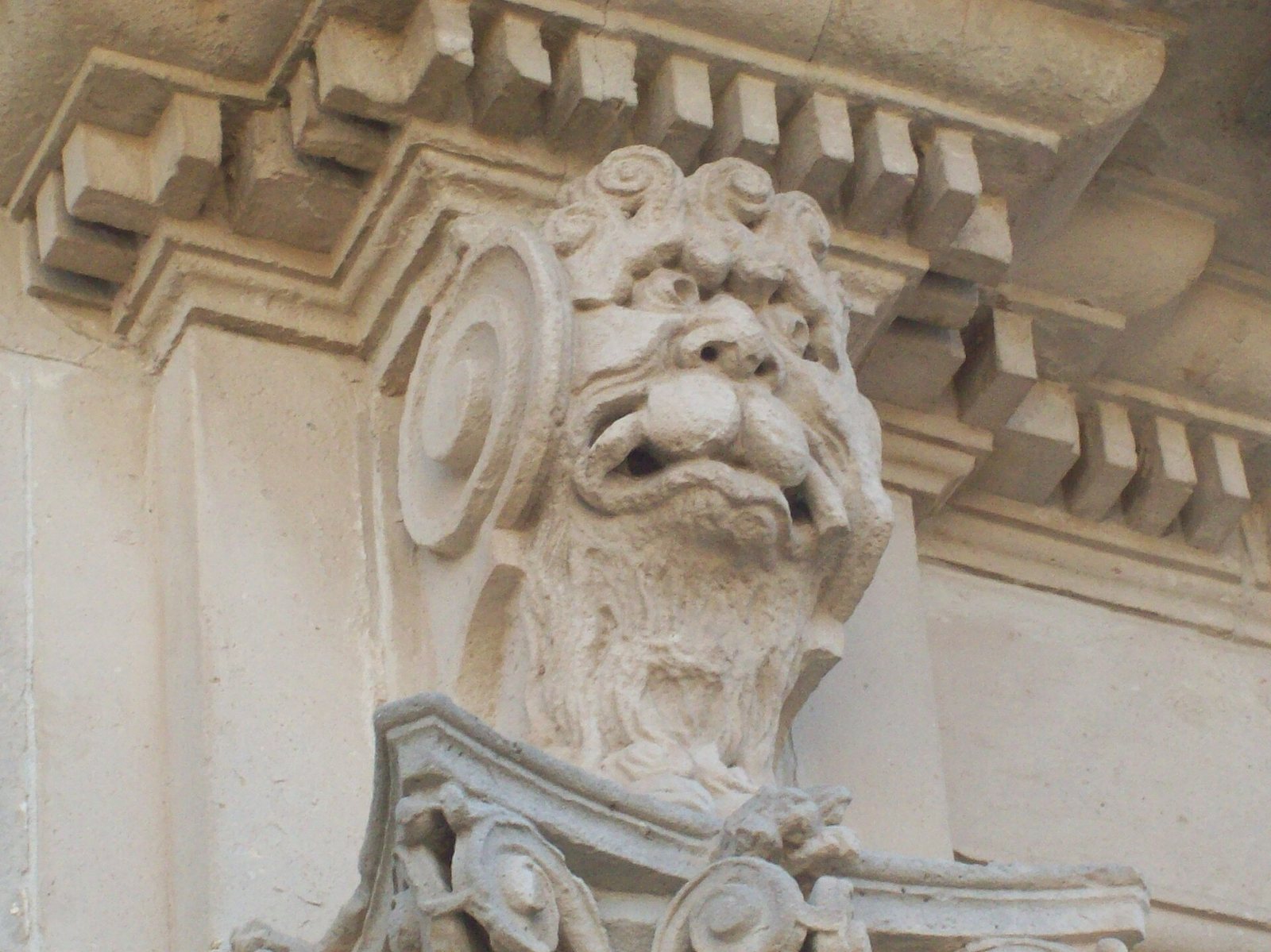
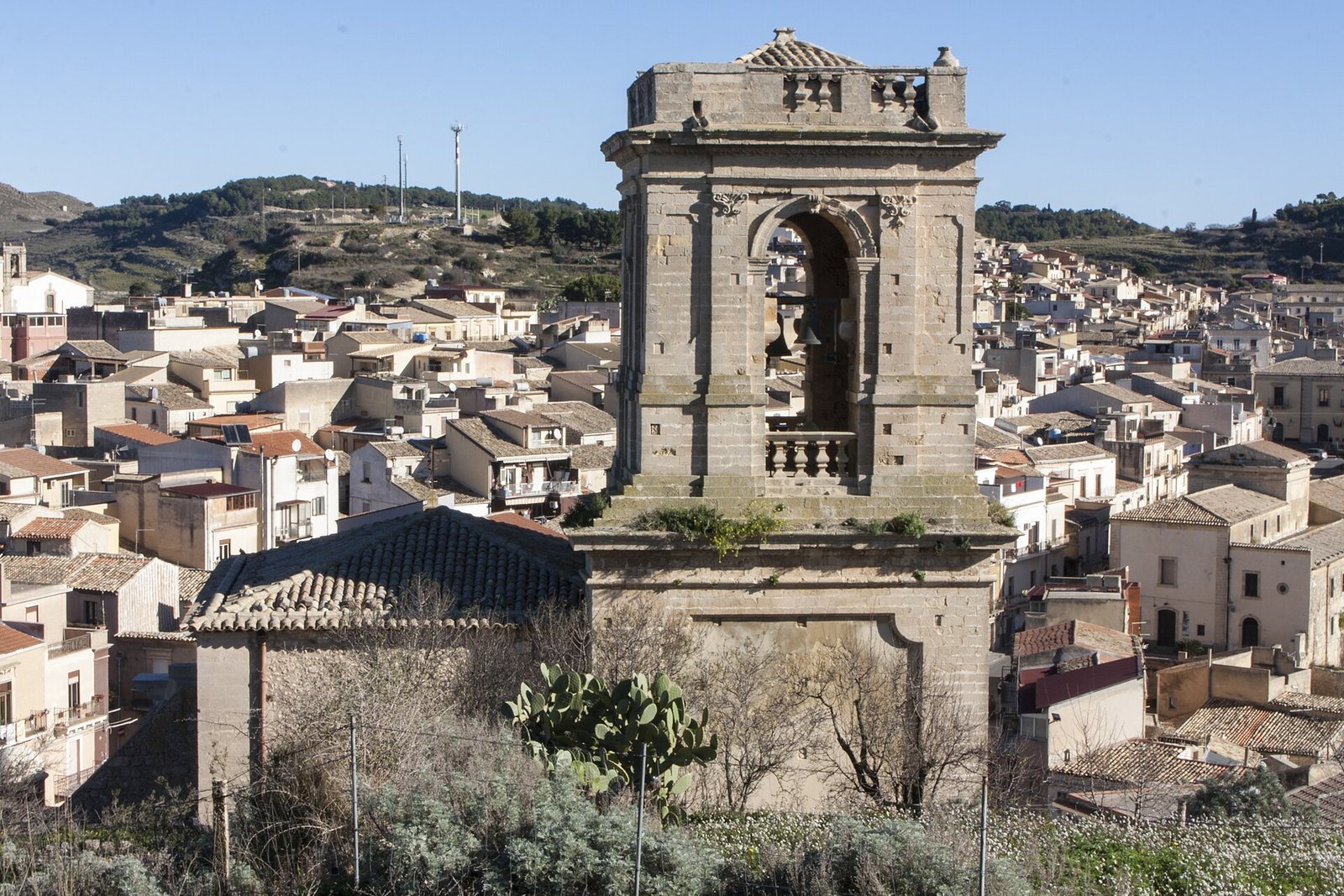
The church stands in Vittorio Emanuele Square at the foot of medieval Santapau Castle. Its basilica plan has three lengthwise spaces, called naves, divided by two rows of six pillars. The white-stone main façade remains unfinished at the top and preserves the clearest evidence of the building’s appearance before the restoration that followed the 1693 earthquake. Capitals, friezes, grotesque masks, and two medallions showing Saints Peter and Paul decorate the façade. Above the central entrance, a shield bearing the Golden Fleece, the badge of a historic chivalric order, displays the heraldic arms of the Ademar marquises of Santapau. The church also has a substantial bell tower. Its forecourt and steps were added in the second half of the nineteenth century to a design by Licodia architect Antonino Astuto.
Side chapels and nave altars
Two side chapels are dedicated to the Blessed Sacrament and Our Lady of Sorrows. The first has twentieth-century stucco decoration and a Baroque wooden tabernacle; the second holds a wooden statue of the Virgin described as Neapolitan work. Altars in the left nave are dedicated to Our Lady of the Souls in Purgatory and the Ecce Homo, a depiction of Christ presented before the Crucifixion. Those in the right nave are dedicated to St Blaise, Bishop, and St John the Baptist.
Chapels of the patron saints
Chapels for St Anthony Abbot and St Margaret of Antioch stand beside the presbytery. The St Anthony chapel holds a wooden sculpture made in 1617 by Neapolitan sculptor Giovan Battista Gallonea. In the St Margaret chapel, a wooden statue by an unknown Sicilian artist is carried in procession on 20 July for the patronal feast.
Images and devotional objects
St John the Baptist altar
Above the St John the Baptist altar is an oil painting of Jesus being baptized in the River Jordan, made by Mario Albertella in 1933. Behind it are the saint’s processional float, a platform used to carry a religious image in a procession, and a statue made in 1910 by Sebastiano Busacca, the church sacristan responsible for liturgical objects. Busacca also produced folk-style works using wax and glue-treated canvas.
Christ taken down from the cross
A sculpture of Christ taken down from the cross has movable arms and is displayed in an urn. The image is the focus of particular devotion on Good Friday during Holy Week.