Exaltation of the Holy Cross Church in Kaczyce: A Relocated Wooden Parish Church
Site at a Glance
- Popularity
- Very Low
- Country
- Poland
- Primary era
- Early Modern
- Eras represented
- Early Modern, Modern
- Civilizations
- Holy Roman Empire, Kingdom of Bohemia
- Site type
- Religious
- Remains
- Church
On this page10 sections
History
The church at Ruptawa
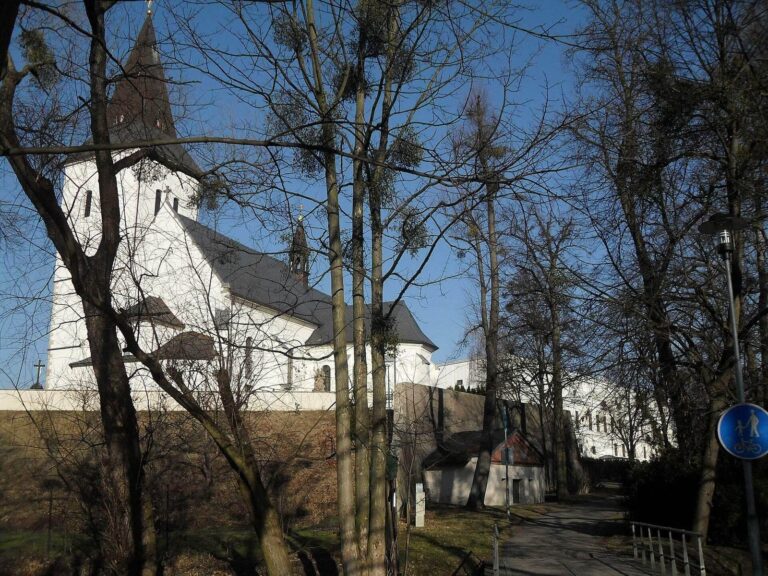
The Exaltation of the Holy Cross church in Kaczyce is a timber Roman Catholic church in Poland, transferred from Ruptawa in 1971–1972. Its wooden building was erected before 1620, on the site of an earlier church first mentioned in 1447, and was dedicated to Saint Bartholomew, one of the twelve apostles. The Ruptawa parish belonged to the Wodzisław deanery, a regional grouping of parishes, and people from Moszczenica and Szotkowice also worshipped there.
During the eighteenth-century Silesian Wars, conflicts chiefly between Prussia and the Habsburg monarchy over control of Silesia, Ruptawa and the surrounding Wodzisław land passed to the Kingdom of Prussia. Kaczyce, by contrast, remained part of Cieszyn land.
Transfer and new dedication
The church sustained damage during the Second World War. After Ruptawa gained a new masonry parish church in 1949, the older wooden building fell into disrepair, and the parish lacked funds for repairs. Kaczyce parishioners, whose parish had been established in 1963 and held services in a chapel, sought permission to move it. With approval from provincial and regional heritage authorities, the building was dismantled and reassembled in Kaczyce in 1971–1972, with some alterations. It was consecrated there on June 25, 1972, and rededicated from Saint Bartholomew to the Exaltation of the Holy Cross, a Christian feast commemorating the cross associated with Jesus’s crucifixion.
Parish church in Kaczyce
The church became the Kaczyce parish church in 1976. It belongs to the Roman Catholic parish of the Exaltation of the Holy Cross, within the Diocese of Bielsko-Żywiec, a church district overseen by a bishop, and the Holešov deanery, a regional group of parishes. Its liturgical feast falls on September 14. The church is protected as a Polish cultural monument, with registrations made in 1956, 1966, and 2019.
Remains
Plan and exterior
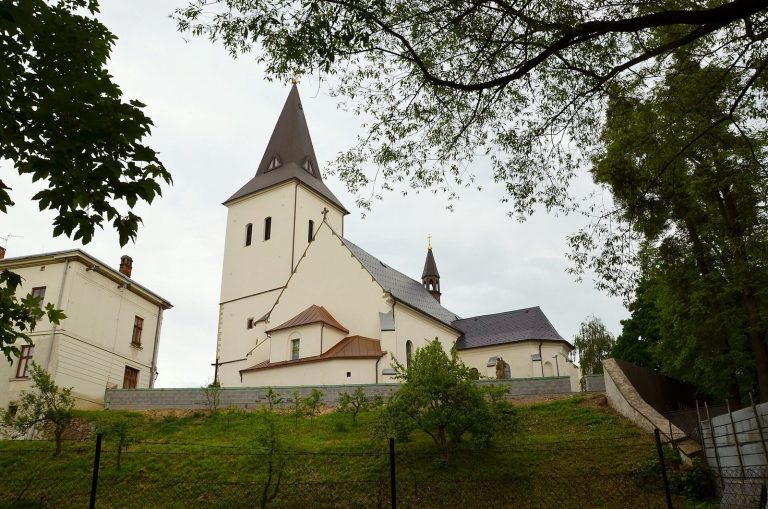
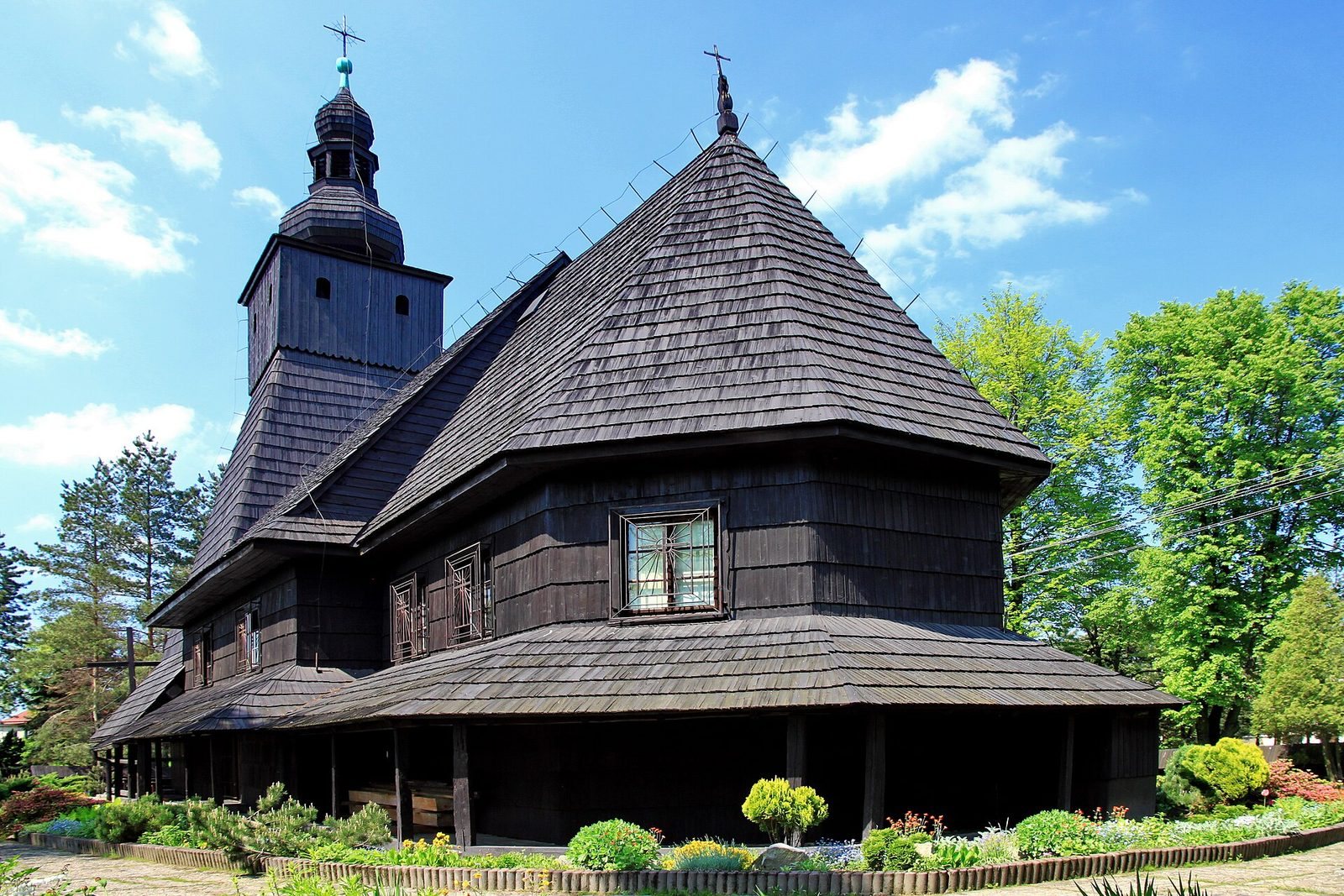
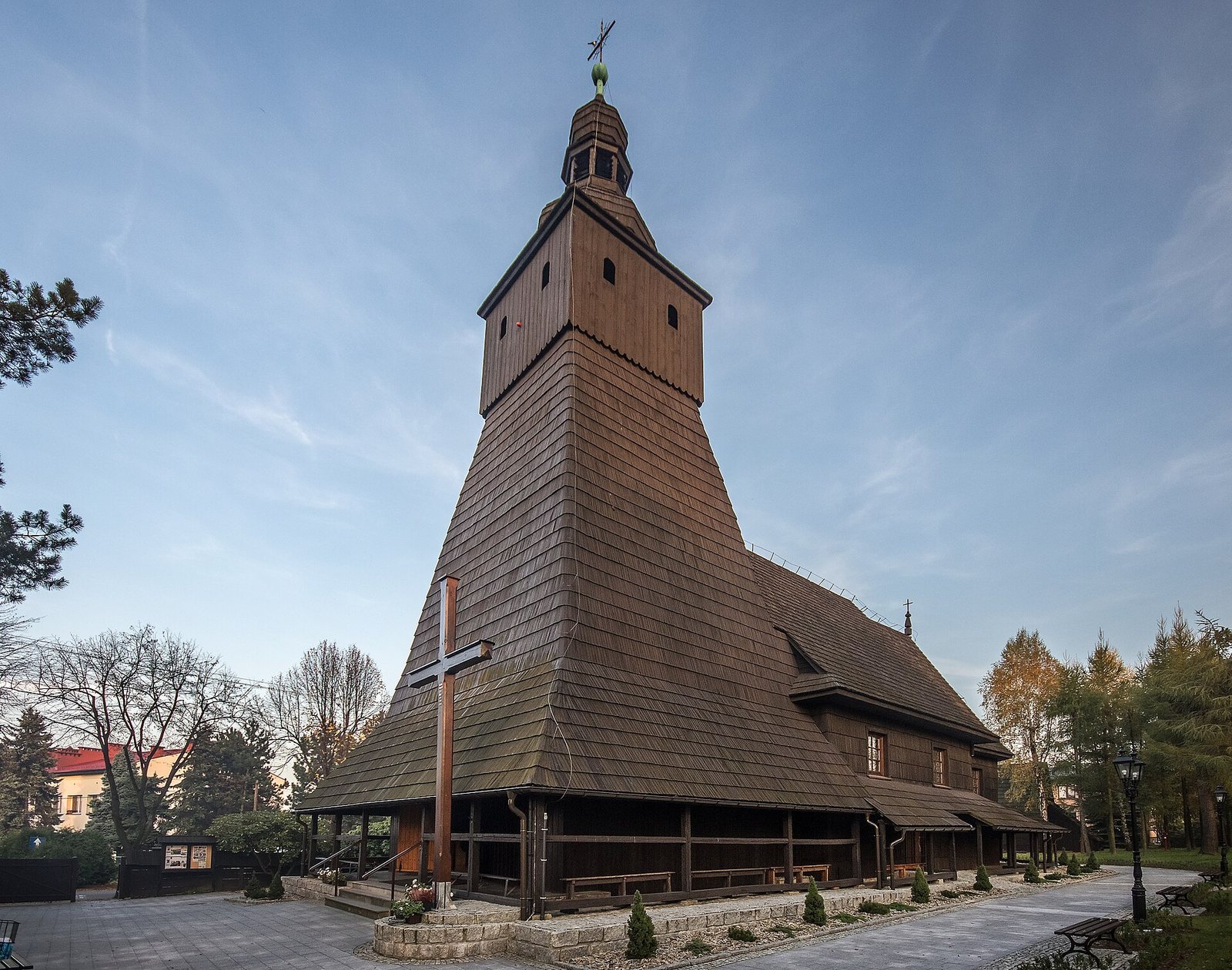
The church has a rectangular plan, with a single nave on a stone base and a chancel, the area around the altar, ending in three angled sides. A gabled roof with two ridges and wooden shingles covers the nave and chancel. Open-sided covered galleries extend along the outer walls, and a sacristy, where clergy prepare for services and keep liturgical objects, adjoins the north side of the chancel.
Bell tower
A square timber tower stands at the western front, built with a frame of upright supporting posts. Its sloping sides are covered with boards and shingles, apart from the level where the bells hang. Above, a rounded, eight-sided dome carries an open lantern, an elevated structure, and a small cupola. This twentieth-century arrangement replaced an earlier pyramidal roof topped by a lantern and cupola. During the transfer, the tower’s height and width were altered, and its bell chamber was made smaller. A 350-kilogram bell named Saint Anthony, cast in Ostrava, was installed in 1973. Parishioners from Skrzyszów reportedly gave it to the Kaczyce parish after it had belonged to the Pogwizdów parish for several years.
Ceiling and painted decoration
The interior has a flat ceiling that curves gently where it meets the walls. Floral polychromy, or multicolored painted decoration, was added in 1974. The design was created by Jadwiga Smykowska of Cieszyn, Adam Romaniuk of Katowice, and Grzegorz Zgraja of Gliwice.
Altars and chancel sculpture
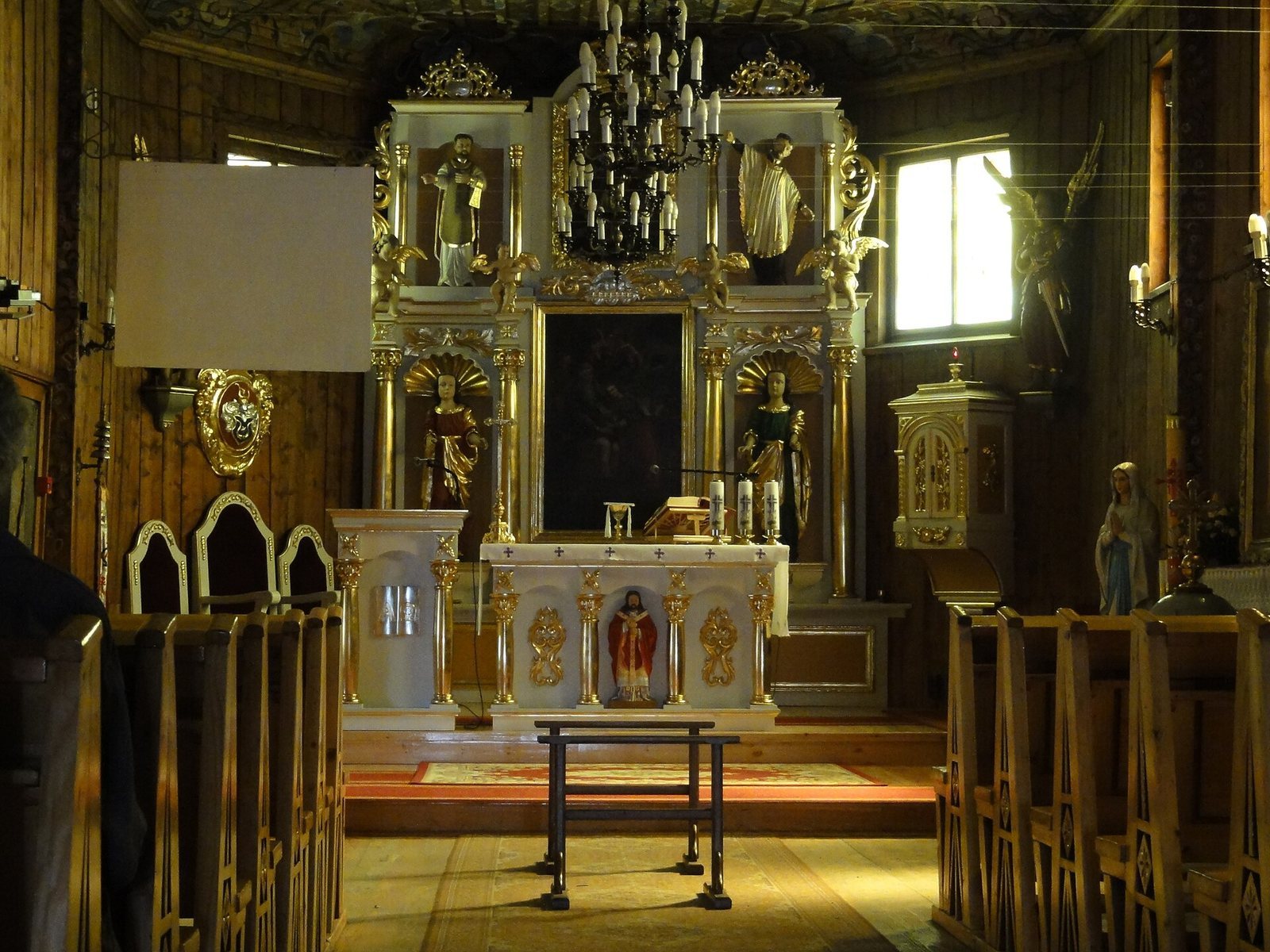
The church contains three altars. The main altar is Baroque, a European artistic style prominent from the late sixteenth to the eighteenth century. It holds an image of Saint Anne, traditionally regarded as Mary’s mother, with the Virgin and Child, alongside figures of Saint John of Nepomuk, a Bohemian priest and martyr, and Saint Ignatius of Loyola, founder of the Jesuits. Its central image, the Education of the Virgin, came from a side altar and was inspired by a composition by the Flemish painter Peter Paul Rubens. The original late-Baroque tabernacle stands beside the altar on the epistle side, traditionally associated with the reading of the Epistle. The other altars are dedicated to Saints Barbara and Catherine, Christian martyrs venerated as saints. A sculpted group on the beam across the chancel, made in the first half of the eighteenth century, shows worshippers adoring the crucified Christ.
Devotional and liturgical objects
Images of the Stations of the Cross, depicting episodes on Jesus’s journey to crucifixion, were made by Jan Krężelok of Koniaków. The church also has twelve statues of the apostles dating to the late fourteenth century, each bearing a prayer in Czech, and a stone baptismal font shaped like a chalice, made in the first half of the seventeenth century. A copy of a fifteenth-century Pietà, a depiction of Mary holding the dead Jesus, was made by Eugeniusz Janota in 1938. The original, dated 1430, is held by the Archdiocesan Museum in Katowice.