Dion: A Macedonian Sacred Center and Roman Colony in Greece
Site at a Glance
- Popularity
- Medium
- Country
- Greece
- Primary era
- Classical
- Eras represented
- Iron Age, Classical
- Civilizations
- Ancient Greek, Kingdom of Macedon, Roman
- Site type
- City
On this page27 sections
History
Dion was a Macedonian sacred center and city-state in Pieria, Greece, at the northeastern foot of Mount Olympus. Cult activity there dates to around 500 BCE, during the Archaic period, an early phase of ancient Greek history. The city’s name derives from Dios, a possessive form of Zeus’s name, although its earliest worship may have centered on a fertility goddess associated with Demeter. Local tradition also held that the legendary poet and musician Orpheus died and was buried at Dion.
From settlement to royal sanctuary
Dion had become a settlement by the Classical period, another early phase of Greek history. Its earliest known mention in historical writing concerns 424 BCE, when the Spartan general Brasidas crossed from Thessaly into Macedonia and reached Dion first. The city-state’s territory is estimated at roughly 200 to 500 square kilometres and included the village of Pimpleia.
In the late fifth century BCE, King Archelaus developed Dion into a major sacred center of the Macedonian kingdom. He established nine days of celebrations for Zeus and the Muses, including sacrifices, athletic contests and dramatic performances. Known as the Olympian Games at Dion, the festival continued until about 100 BCE. Dion also held military importance as a southern stronghold of Macedonian power.
Macedonian kings used Dion for public celebrations and military purposes. Philip II marked his destruction of Olynthus there. Before beginning his campaign in Asia, Alexander the Great assembled his army at Dion, sought Zeus’s aid and held nine days of festivities. After Alexander’s victory over Persian forces at the Battle of the Granicus, a sculptural group by Lysippus commemorating 25 fallen companions was erected in the city.
Destruction and rebuilding
King Cassander built Dion’s fortifications between 306 and 304 BCE, though it is uncertain whether the city had earlier walls. In 219 BCE, the Aetolian commander Skopas led an attack that destroyed Dion. King Philip V retaliated against the Aetolians and rebuilt the city. By 169 BCE, Dion had recovered enough for King Perseus to use it as a base in his struggle against Rome. Roman forces took the city and damaged its walls; Perseus later returned and repaired them.
Roman colony
After Octavian’s victory over Mark Antony and Cleopatra at the Battle of Actium in 31 BCE, he settled people from Italy at Dion and established it as a Roman colony and military settlement. Later known as Augustus, Octavian gave the colony the formal name Colonia Iulia Augusta Diensis. Latin became its official language, but the population soon adopted Greek culture, and most known inscriptions from the Roman period are in Greek. The colony held ius italicum, a legal privilege that brought exemptions from certain contributions and the right to govern itself.
Dion prospered especially during the second and early third centuries CE, while nearby Pydna declined. In the third century, the colony issued coins bearing images of Roman emperors or empresses and its Latin name.
Christianity and abandonment
Christianity and older religious practices coexisted for a time. In the fourth century, three Christian basilicas, or large church buildings, were constructed: two within the city walls and one outside them. Dion had its own bishop in the fourth and fifth centuries. Bishop Palladius attended the Council of Serdica, an early Christian church council, in 343.
Dion suffered destruction in the later Roman period and recovered temporarily in the fifth century. Ostrogothic incursions, earthquakes, torrential rain and flooding contributed to its decline, with the Bafyras River also inundating the site. Residents moved to a safer location nearer the mountains, although a small number remained among the ruins around a basilica. Dion was abandoned by the fifth century.
Rediscovery and archaeological work
The city’s name appears in a tenth-century Byzantine provincial register and persisted in an altered form until the seventeenth century, after which references concerned its ruins. William Martin Leake identified the remains in 1806 and published his discovery in 1835; the city’s theatre was located in 1808. Later nineteenth-century work included investigations by Léon Heuzey and an early collection of inscriptions published by Geórgios Ikonómos.
Exploratory archaeological investigations began in the late 1920s. G. Sotiriadis continued work through 1931, uncovering a fourth-century-BCE Macedonian tomb and an early Christian basilica. Investigations resumed in the 1960s around the theatre and fortifications. From 1973, Dimítrios Pandermalís led research for the Aristotle University of Thessaloniki; systematic excavation began in 1982 and continued into the twenty-first century.
Remains
The ancient city was arranged around a regular street grid, with civic, commercial and residential buildings inside its defenses and most sanctuaries and performance spaces beyond them. Its remains include stone fortifications, public buildings and houses constructed with mud and brick walls, timber roof frames and tiled roofs.
Street grid and fortifications
Plan and streets
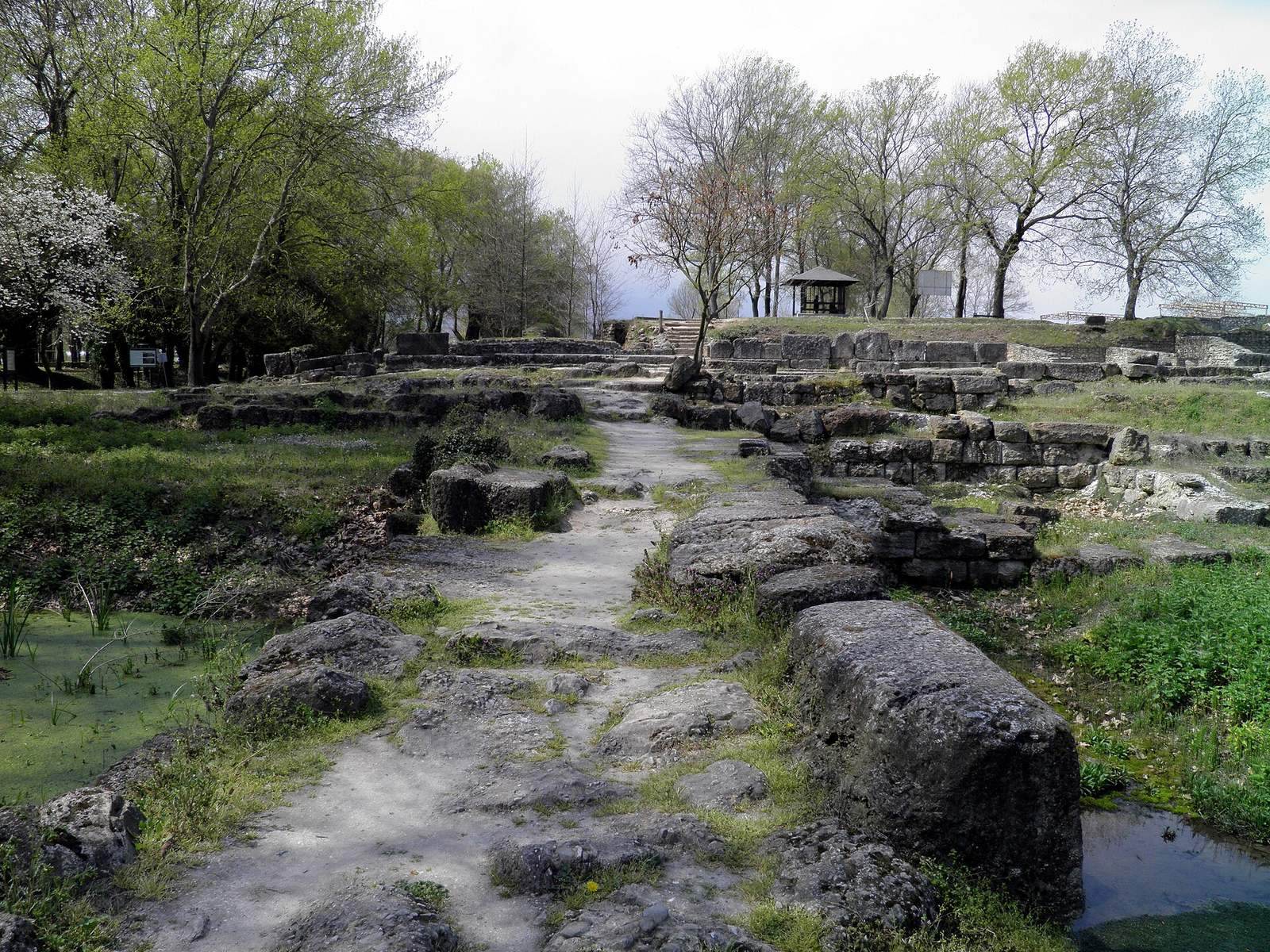
The walled area covered about 43 hectares and had a generally rectangular plan. Its principal north–south street ran northwest to southeast and led to the southern gate; the main east–west street led to the western gate. Both were about 5 to 5.6 metres wide. Archaeologists have identified 22 paved streets, and cart ruts remain visible on one Roman-period road. A roadway between the wall and the first houses provided space for troops to manoeuvre.
Dion stood beside the modern village of the same name, on Mount Olympus’s northeastern foothills near the edge of the plain leading to the Aegean. In antiquity the coast lay about 1.3 kilometres away; today it is about five kilometres distant. The Bafyras River runs east of the city, and its flow has left parts of the archaeological area wetland. Dion also controlled a narrow route between Macedonia and Thessaly.
City wall
The wall enclosed an approximately square area and extended about 2,625 metres. It was roughly three metres thick and seven to ten metres high, built from large blocks of conglomerate stone from Mount Olympus, with upper sections of mud brick. Rectangular towers, each about seven metres square, stood at intervals of roughly 33 metres. A walkway ran along the circuit, which had six or seven gates. A nearby ditch may have helped guard against both flooding and attack. During the Roman period, sections of the wall were dismantled or left unrepaired.
Public center and civic buildings
Forum and basilica
The Roman forum, the city’s principal public square, occupied the middle of its southern area, replacing an earlier Greek agora, or civic marketplace. A large public hall on the forum’s eastern side served commercial and other civic purposes. Two rows of columns divided its interior into three aisles. Three doors opened onto its southern side, while the north probably had an open colonnade. At the eastern end stood the Shield Monument, probably dating to the late fourth century BCE. Carved with shields and body armor, it may previously have decorated the earlier marketplace. On the western side, an imperial shrine had a semicircular platform for statues of Roman emperors.
Baths and latrine
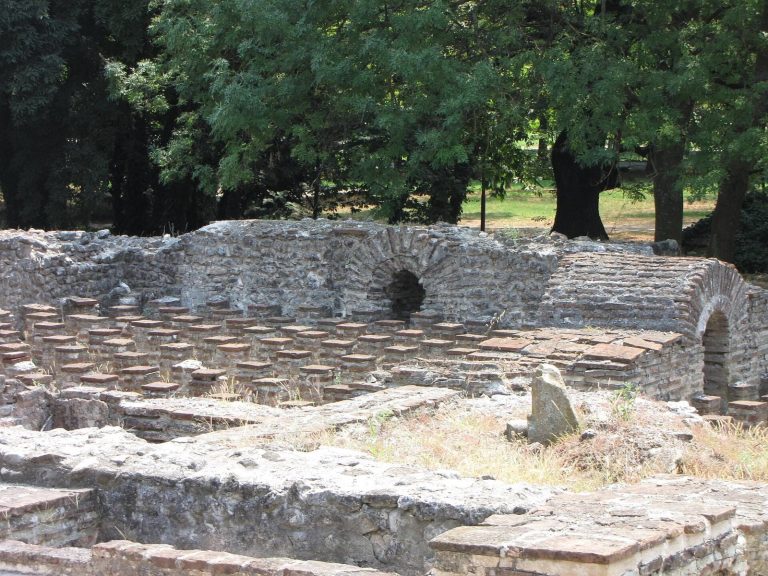
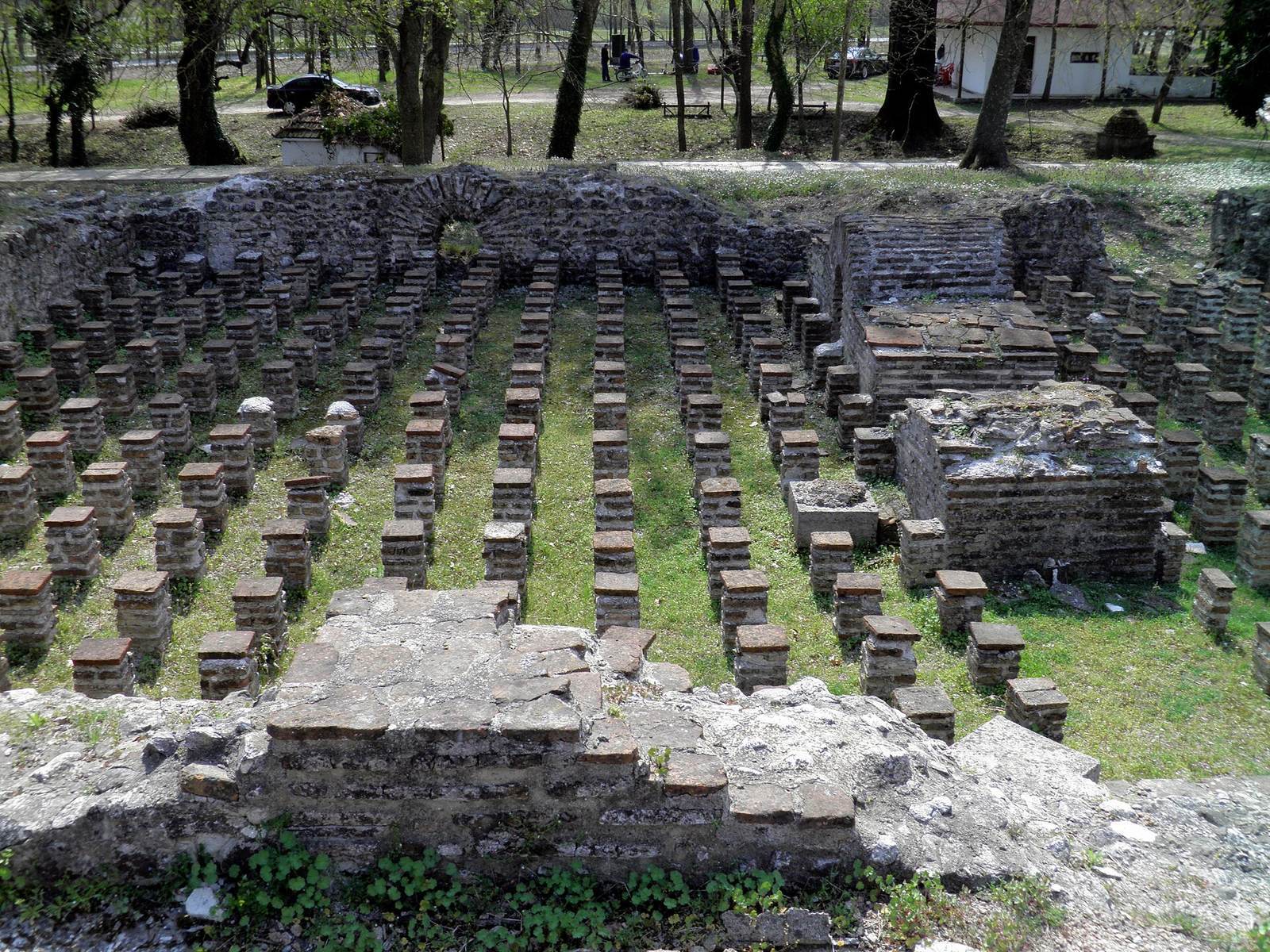
The Great Roman Baths stood south of the forum near the city’s southern edge and covered about 4,000 square metres. The complex included an atrium, hot and warm rooms, a cold-water pool, changing rooms, shops, a small hall for musical performances and a public latrine. Beneath the baths, an underfloor heating system survives clearly: small pillars and channels in the walls carried heat to the rooms and pools above. Mythological mosaics decorated the floors. Other bath complexes stood north of the forum and beside the main street to its east.
The public latrine had marble seats, some of which survive. It is among the oldest surviving examples of its kind in Europe.
Inn and marketplace
The Praetorium, on the main street, served as an inn for public guests and other travellers. It contained two taverns, shops, dining rooms and bedrooms. Across the street stood a polygonal building that was probably used as a marketplace.
Residential buildings
House of Dionysus
In the city’s eastern part, the House of Dionysus was a large, richly decorated private residence of the Roman imperial period, the era of rule by Roman emperors. Its domestic and reception rooms were accompanied by baths, a library, workshops and shops opening onto the street. An Ionic colonnade, a Greek column style, surrounded the courtyard, and several of its columns remain.
The house’s 100-square-metre banquet hall had a polychrome floor mosaic showing Dionysus in a sea procession. Crowned with ivy and holding a drinking vessel and a staff, the god rode a chariot drawn by sea panthers. Sea-centaurs carried banquet vessels, while Silenus looked toward Dionysus and sea monsters’ curling tails rose from the waves. The scene refers to Dionysus’s victory over Lycurgus, a mythical king of Thrace. Smaller tiles created finer details in the mosaic. A small room with a curved end held a statue of Dionysus, and another room contained a shrine and cult statue of the god. Statues of deities and seated philosophers were found in fire-damaged debris within the house.
Other houses
The House of Leda and the House of Zosaks stood in the city’s southeastern corner and date to around the third century CE. The former takes its name from a sculpture of Leda with the swan; the latter is probably named for an owner whose name appears in a mosaic. Both belonged to a wider group of residences decorated with statues and floor mosaics.
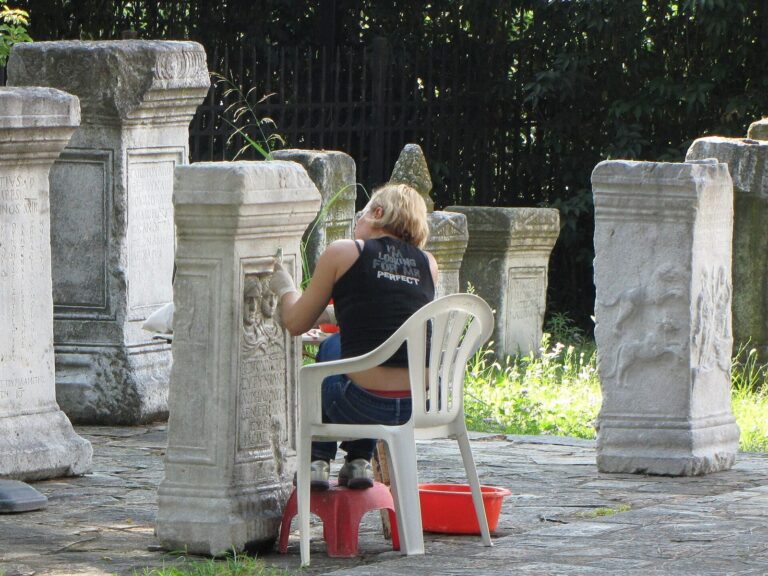
The House of Hydraulis, on the main street, is named for a water-powered pipe organ found there. Dating to the first century BCE, it is the oldest known example of its kind in the world. The nearby House of Epigene and House of Euboulos take their names from names stamped on their lead water pipes. Excavated finds from Dion, including cult statues, funerary monuments, architectural sculpture and mosaics removed from buildings, are displayed in the Archaeological Museum in the nearby village.
Sanctuaries
Sanctuary of Demeter
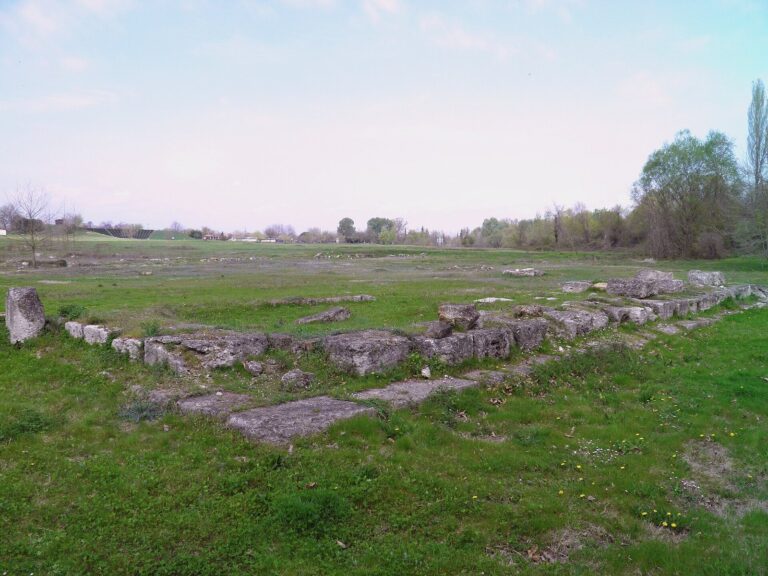
Outside the walls near the end of the main street, the sanctuary of Demeter existed by the sixth century BCE and is described as the earliest known Macedonian sanctuary. Rebuilt in the fourth century BCE, it included two similar small temples dedicated to Demeter and Kore, another name for Persephone. Their Doric columns belonged to a Greek architectural style with simple column capitals. Each temple had an enclosed inner chamber and a deep entrance space, with altars to the east. The sanctuary also hosted other fertility worship. Finds included cult objects, jewellery, coins, vessels, lamps and terracotta figurines, as well as a ring bezel from the fifteenth century BCE. Fire damaged the sanctuary in the fourth century CE.
Sanctuary of Zeus Olympios
At the southern edge of the site, beside the later Roman theatre, the sanctuary of Zeus Olympios was built in the fourth century BCE. Its large square precinct contained a long colonnade and a great altar on the eastern side, where bulls were sacrificed to Zeus. Inscribed stone slabs found at the sanctuary preserve decrees and agreements, including alliances and settlements of border disputes.
Sanctuary of Zeus Hypsistos
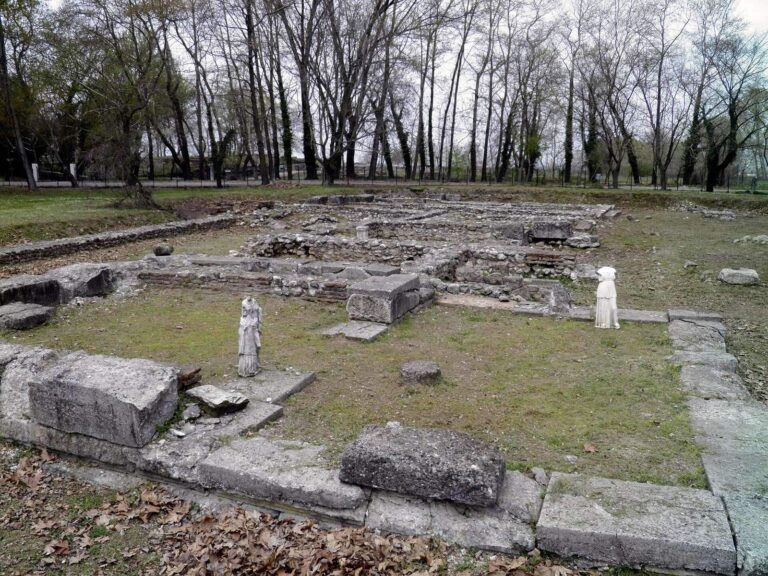
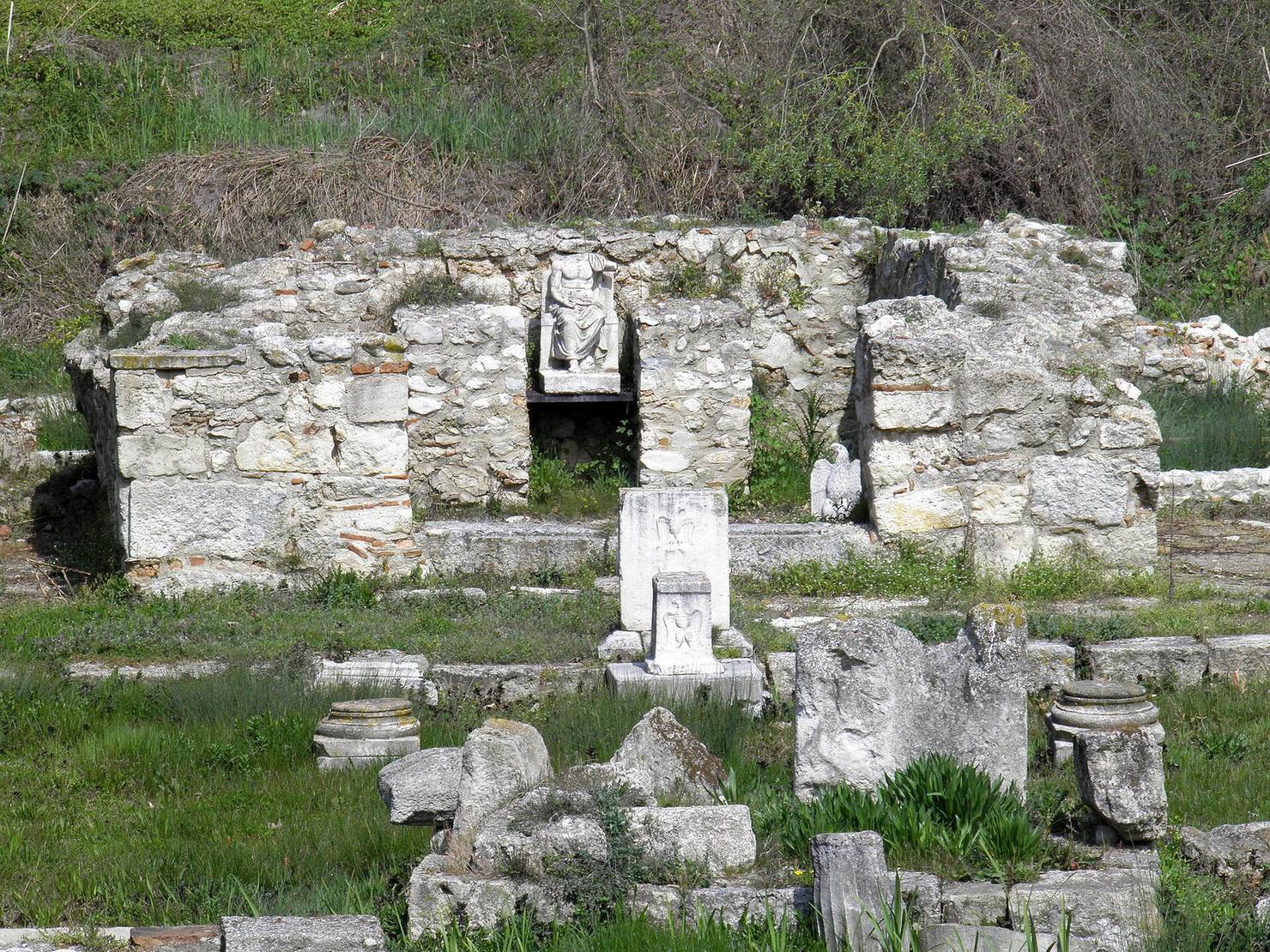
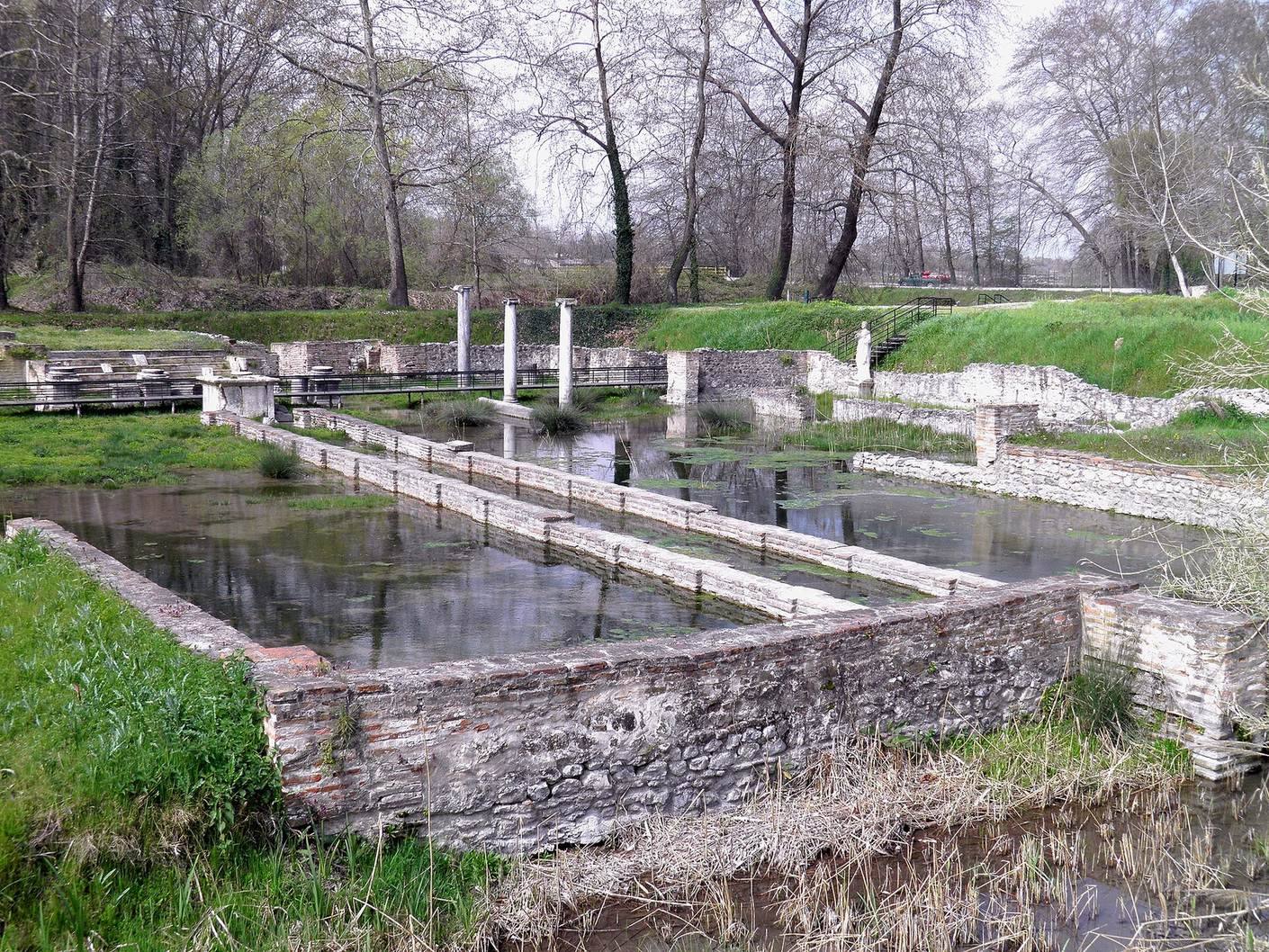
Between the sanctuaries of Demeter and Isis, a small temple to Zeus Hypsistos, meaning Zeus the Highest, stood in a courtyard surrounded by colonnades. A sacred spring is associated with this area. The ruins yielded a statue of Zeus and marble eagles dedicated to him.
Sanctuary of Isis
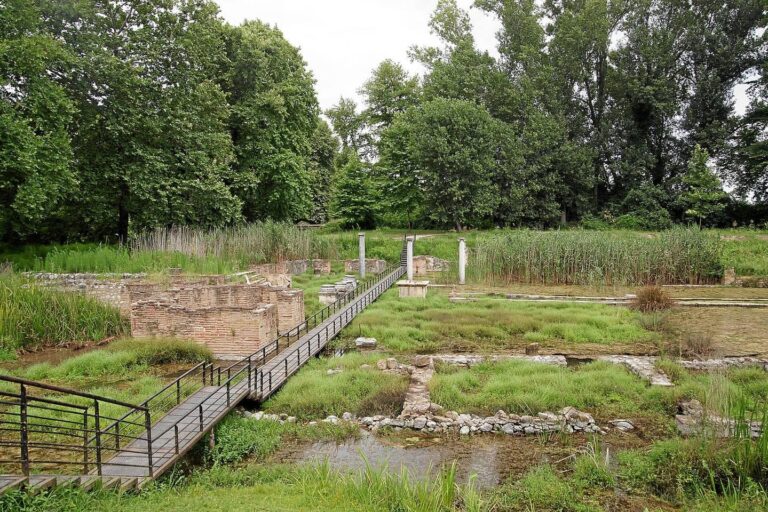
Across the Bafyras River, beyond the city wall’s southeastern corner, the sanctuary of Isis had earlier been dedicated to Aphrodite and to Artemis in her role as a protector of childbirth. It was rededicated to Isis in the second century BCE, and its layout and architecture evoked the Nile. The complex included temples to Isis Lochia, whose title relates to childbirth, Aphrodite Hypolympidia, meaning Aphrodite at the foot of Olympus, and Isis Tyche, associated with fortune. A roofed colonnade on the north side served as a place where pilgrims could sleep overnight. A temple with four columns was dedicated to Isis Lochia.
Theatres and cemeteries
Greek theatre
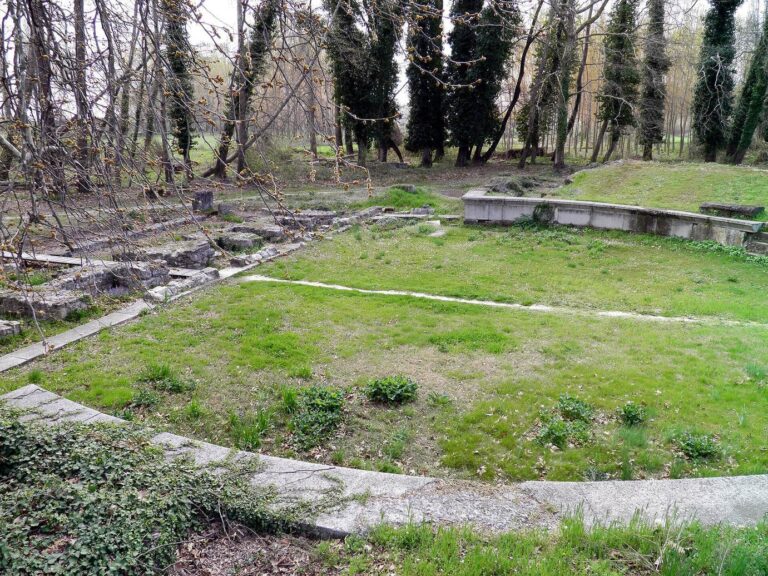
The Greek theatre stood outside the southern walls. First built in the Classical period under Archelaus and rebuilt under Philip V in the Hellenistic period, which followed Alexander the Great’s conquests, it had a semicircular form and a circular central performance area. It remained in use until the Roman theatre was built and has since been reconstructed.
Roman theatre
Built in the second century CE, the Roman theatre lies southeast of the Greek theatre. It was smaller than its predecessor but richly decorated, and took over its role as a venue for performances. The earlier sanctuary of Zeus Olympios lay immediately to its north.
Cemeteries and tombs
Cemeteries lay mainly north and west of the city, including a large Macedonian burial ground to the northwest. The tombs date from about the mid-fifth century BCE to the early fifth century CE. Four Macedonian chamber tombs are known. Tomb I had a Doric façade, an antechamber with Ionic-style columns and a vaulted burial chamber containing a marble funerary couch. Tomb IV lay beneath a burial mound and was approached by a passage. Other grave forms included small tomb houses, altar tombs and stelae carved with reliefs.
Christian church remains
In the city center, a church stood over the remains of a palace. Its surviving remains, along with those of other basilicas, include foundation outlines, fragments of floor mosaics, columns and capitals.