Church of Saint Michael the Archangel in Rogowo: A Roman Catholic Filial Church
Site at a Glance
- Popularity
- Very Low
- Country
- Poland
- Primary era
- Early Modern
- Eras represented
- Early Modern, Modern
- Civilizations
- Brandenburg-Prussia, Holy Roman Empire, Kingdom of Prussia
- Site type
- Religious
- Remains
- Church
On this page8 sections
History
The Church of Saint Michael the Archangel in Rogowo, Poland, is a Roman Catholic filial church, meaning a subsidiary church belonging to a parish. It was built in the second half of the seventeenth century, probably on the site of an earlier church. Its principal founder was Joachim Balthasar von Dewitz, a member of a Pomeranian noble family.
Reconstruction and Catholic worship
A major reconstruction in 1870 gave the church its Neo-Gothic style, a nineteenth-century revival of medieval Gothic design. The church is dedicated to Saint Michael the Archangel, whom Christian tradition associates with opposing evil. Its liturgical commemoration falls on September 29, the same date on which the church was consecrated for Catholic worship in 1945. It belongs to the parish of Our Lady of the Scapular in Radowo Małe.
Remains
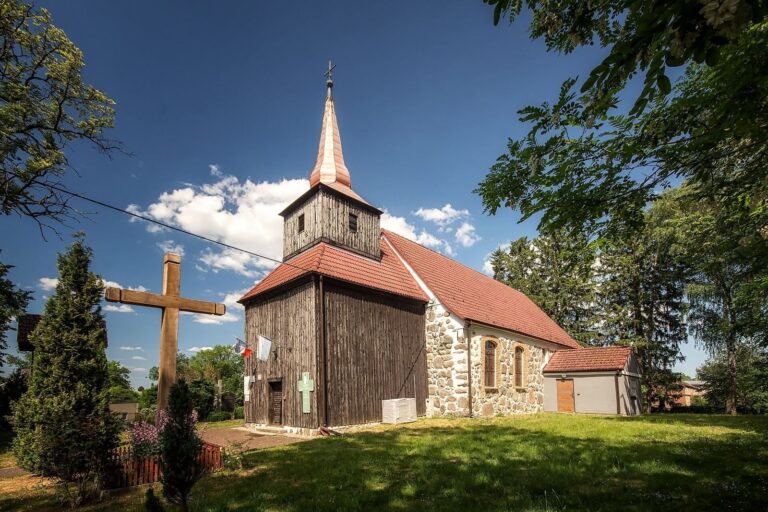
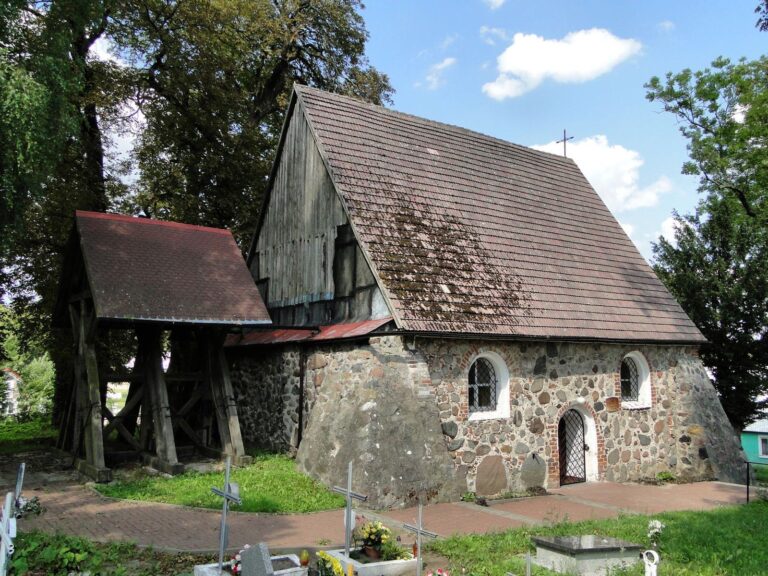
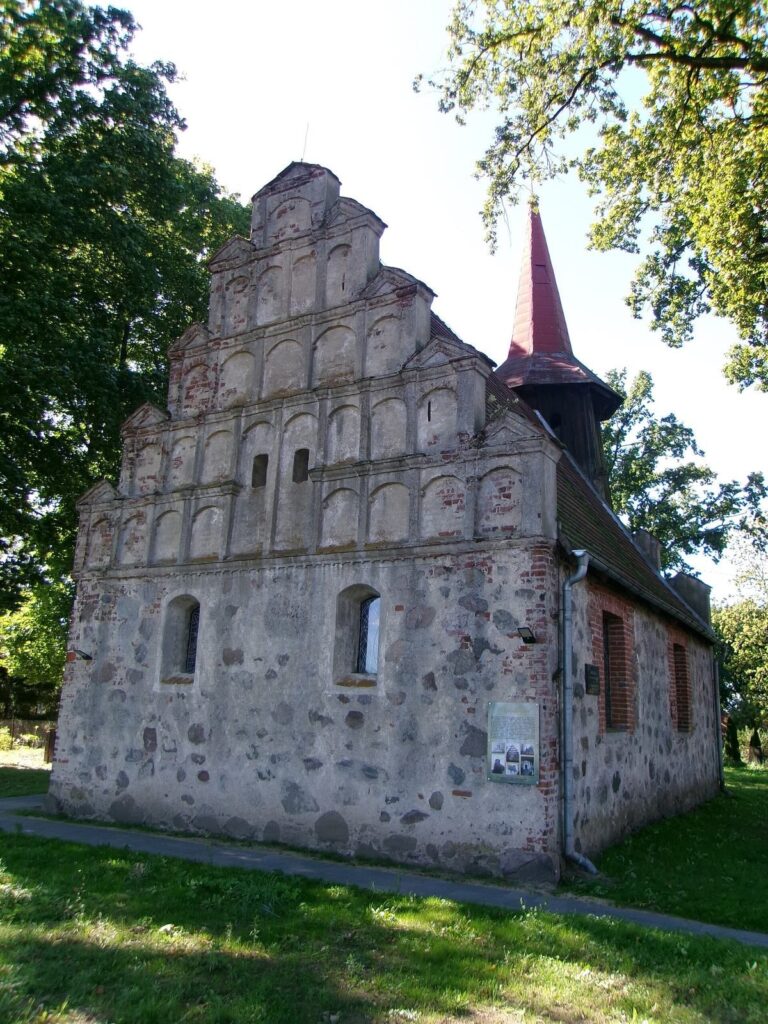
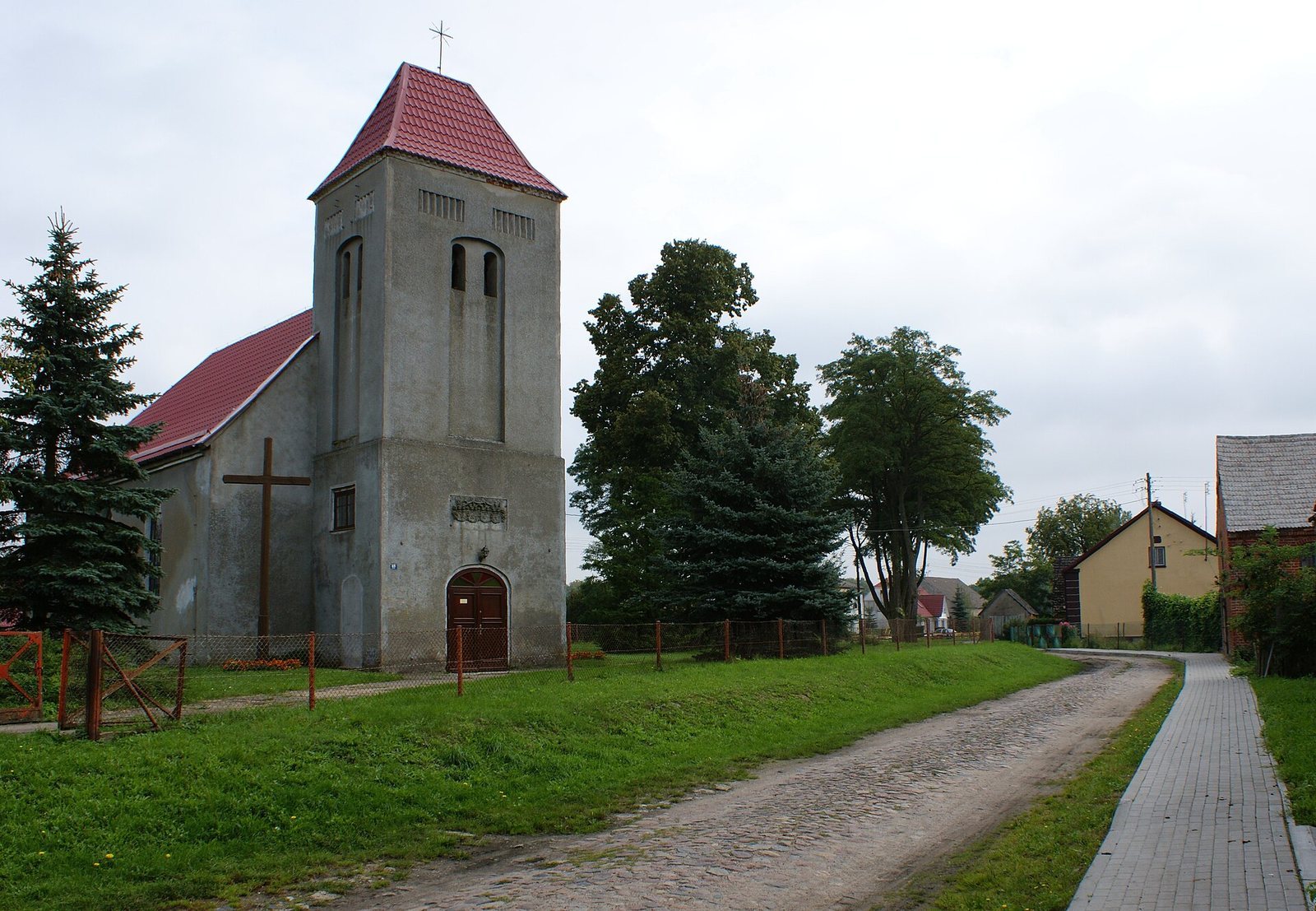
Built of fieldstone, the church has a rectangular plan and a single-room interior. Its east end, which serves as the chancel, terminates in three sides; a two-storey tower stands at the west end.
Exterior
The nave has a gable-ended roof, while the tower is covered by a roof sloping on all sides. On the south wall, the entrance has a pointed arch framed by three stepped layers and a tympanum, the panel above the doorway.
Interior and furnishings
Inside, a painted wooden ceiling rests on exposed beams. The walls are whitewashed, and the floor is cement.
Baroque altar
A two-tier altar dated 1694 stands in the chancel. Baroque is an elaborate European artistic style that flourished from the seventeenth century. The altar’s predella, the section at the base, depicts the Last Supper; above it, the first tier shows the Crucifixion and the second the Resurrection.
Pulpit and patron’s gallery
The church retains a Baroque pulpit decorated with images of the four Evangelists and topped by a six-sided canopy. Remains of a patron’s gallery, a gallery associated with the church’s founder or patron, also survive.
Baptismal font and stained glass
The nineteenth-century baptismal font is made of artificial sandstone. The windows contain stained glass created in 1980 by Bernard and Michał Ratajski of Szczecin.