Macedonian Tombs at Korinos: Ancient Burial Chambers in Greece
Site at a Glance
- Popularity
- Low
- Country
- Greece
- Primary era
- Classical
- Eras represented
- Classical
- Civilizations
- Kingdom of Macedon
- Site type
- Burial
- Remains
- Tomb
On this page11 sections
History
The Macedonian Tombs at Korinos are monumental underground chamber tombs near Korinos, Greece, built by ancient Macedonians in the late 4th century BC. They were used until the beginning of the 3rd century BC. In keeping with Macedonian practice, each tomb was prepared during the lifetime of the person later buried there.
Discovery and archaeological study
Léon Heuzey discovered Tomb A, also known as the Heuzey Tomb, while travelling in Greece in 1855. The tomb was described in 1860, and excavation began the following year. Heuzey published the excavation findings in 1876 with Honoré Daumet.
In 1991, archaeologist Matheos Besios reopened Tomb A and discovered and excavated Tomb B. Archaeologists Hans von Mangoldt and Konstantinos Noulas later made precise measurements of both tombs.
Looting and later use
Grave robbers plundered both tombs and removed some wedge-shaped keystones, stones that lock a vault in place, to gain entry. The identities of the people buried there are unknown, though the elaborate construction suggests they were people of importance.
Heuzey transported nearly all usable, portable finds to France. Inscriptions dating from 1948 onward indicate that shepherds later used Tomb A temporarily to shelter their flocks.
Remains
The two tombs lie about 600 metres northwest of Korinos, near ancient Pydna. Tomb A is east of the A1 highway at the Korinos motorway service area; Tomb B is west of the highway and south of the service area. Each is covered by a grassy mound with pine trees. Within both mounds, the tomb is offset to the left of the main axis when viewed from the entrance, apparently to confuse grave robbers.
Tomb A
Mound, entrance and facade
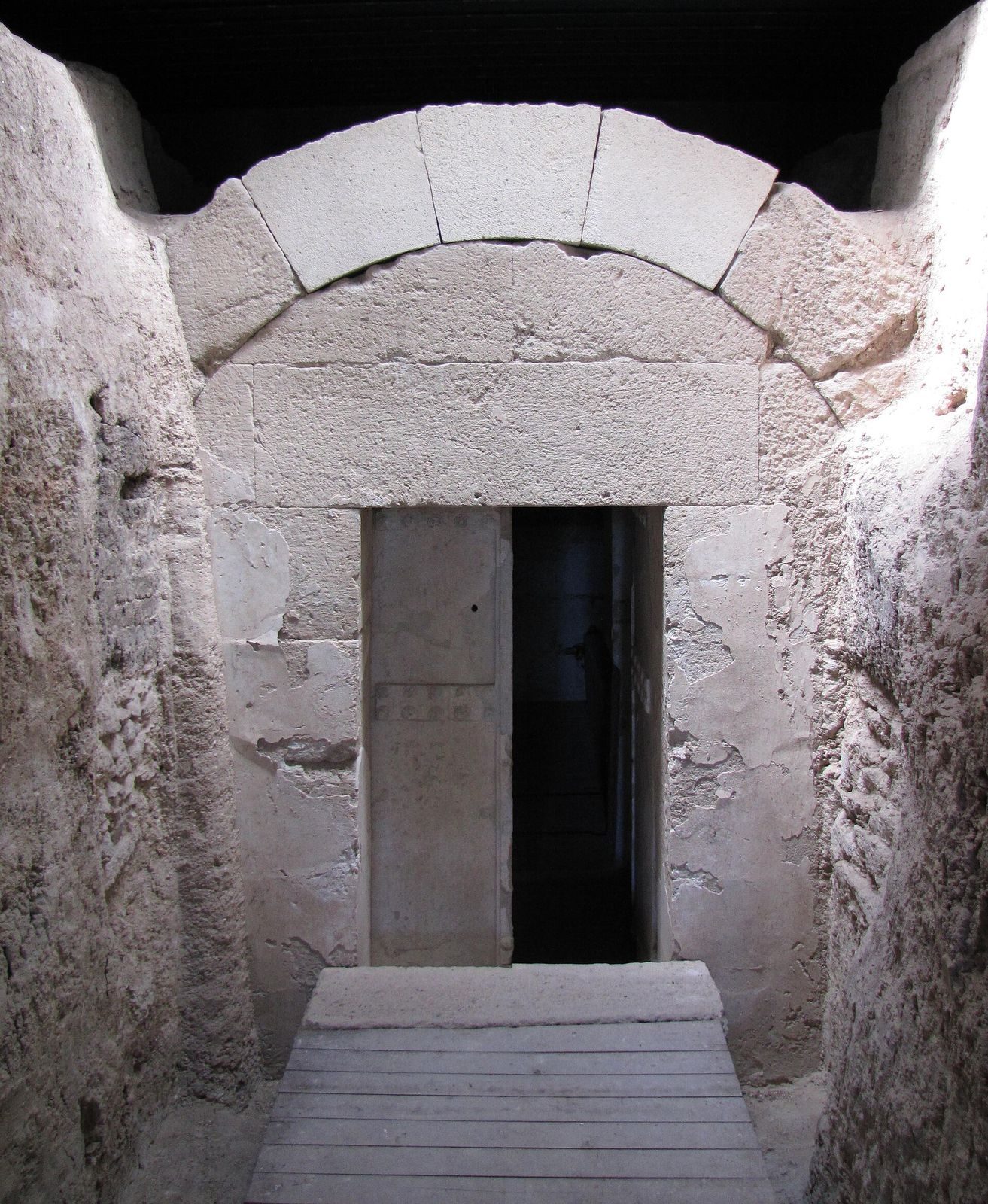
Tomb A’s mound is 60 metres in diameter and 15 metres high. The tomb itself is 22 metres long, making it the largest Macedonian tomb discovered in Pieria as of 2018. Its external entrance extends for more than four metres. The sides were filled with distinct layers of clay, brick, or stone, and the passage slopes downward while becoming lower toward the burial area. The facade was intact when Heuzey found it; today, parts survive and sections have been reconstructed.
Doors and interior passage
A wall and a pair of marble doors once closed the entrance. Modelled on wooden doors, the marble leaves bear imitation fittings and nails; hollows suggest that bronze rings may once have been attached. Both leaves are preserved in the Louvre. Heavy doors protecting the burial chamber had a mechanical device to make them easier to open.
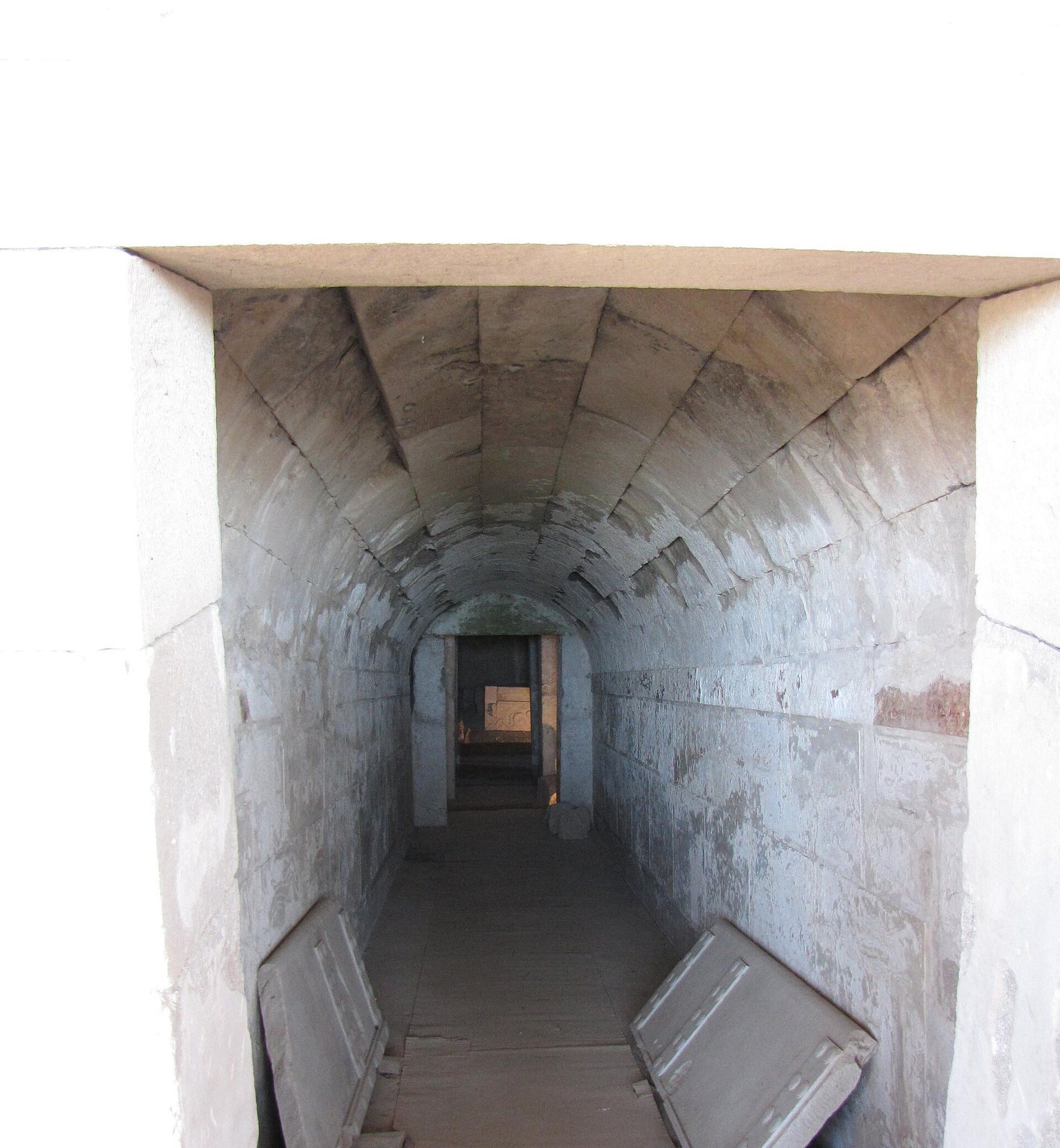
A vaulted corridor made from stone blocks descends toward the first antechamber. The blocks were once plastered, and the rounded ceiling was closed at the top with keystones. A section leading to the forecourt measures about 11 metres long and two metres wide. Traces of plaster painted to resemble marble remain, and the floor has a mosaic-like surface made with embedded pebbles.
Forecourt and burial chamber
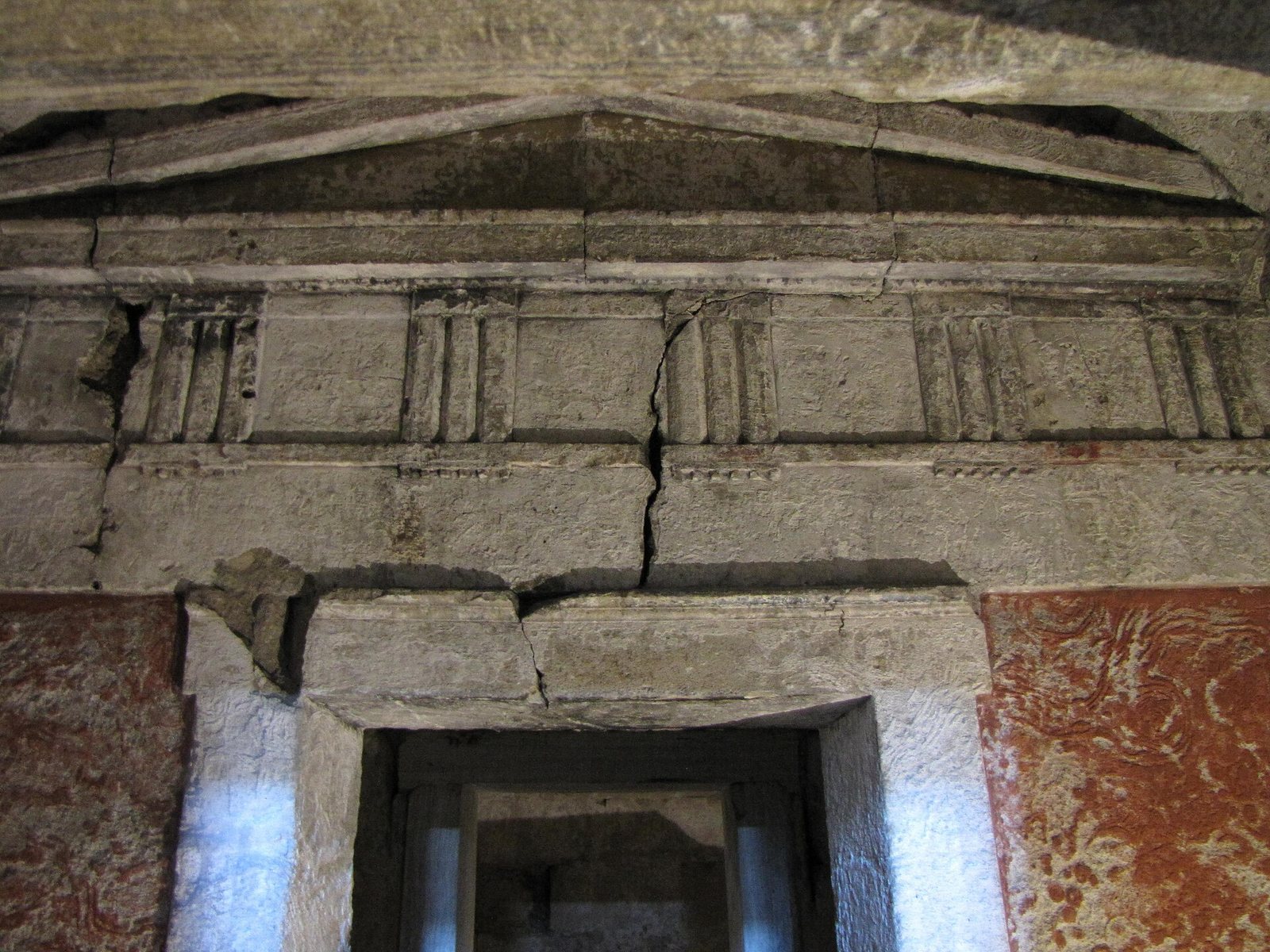
The forecourt has a gable and horizontal upper band in the Doric style, an ancient Greek architectural style. Six vertically grooved blocks decorate the band, and traces of red paint survive. A passage connects the forecourt to an antechamber measuring 1.5 by 3 metres. The forecourt, antechamber, and burial chamber share a vault; the burial chamber measures 3 by 4 metres.
Stone burial couches and a block carved with a snake relief survive in the chamber. One couch, probably associated with a man, was linked to a dog, while the other was associated with a snake. The chamber walls were plastered and painted, and fittings for grave goods remain. Finds included human remains, pottery sherds, and an oil lamp that may have been left by grave robbers.
Tomb B
Mound and chambers
Tomb B’s mound is 40 metres in diameter and 13 metres high. The tomb consists of a vaulted corridor, an antechamber measuring 1.5 by 3 metres, and a burial chamber measuring 3 by 3 metres. A wall and double door secured the antechamber. The heavy limestone door was once plastered, and the door now reattached to the tomb had been found broken.
Burial chamber and finds
Stone slabs pave the floors of the antechamber and burial chamber. A continuous geometric pattern runs along the walls. In the burial chamber, remains from both cremation and burial of unburned bodies were found. Stone bases may have supported wooden burial couches. The painted decoration includes a row of small, tooth-like projections and a band of curling stems and leaves. Fittings for grave goods are attached to the walls and ceiling. Finds included two bronze coins, two greaves, protective coverings for the lower legs, pottery, and fragments of other objects.