Church of Saint Peter Martyr in Baruchella: A Historic Catholic Church
Site at a Glance
- Popularity
- Very Low
- Country
- Italy
- Primary era
- Early Modern
- Eras represented
- Early Modern, Modern
- Civilizations
- Unclassified
- Site type
- Religious
- Remains
- Church
On this page10 sections
History
The Church of Saint Peter Martyr is a Catholic church in Baruchella, Italy, dedicated to Peter of Verona, the thirteenth-century saint also known as Peter Martyr. Construction began in 1524. The church has a Neoclassical facade and late Baroque altars, and is the oldest historic building in its municipality.
The chapel at La Verega and the new church
The church’s earlier history is linked to Domenico Cisamini, a member of a noble Ferrarese family. In 1471, the abbot of Vangadizza granted him an investiture, a formal grant of rights. At his residence at La Verega, Cisamini established a small private chapel dedicated to Saint Peter Martyr. It had one altar, modest sacred furnishings and vestments, a lantern for the Viaticum, the Eucharist given to a person near death, and a baptismal register. The chapel is noted as existing in 1500 and in a 1507 document. Flood damage led to its demolition in 1528.
The present church was begun in 1524 at the initiative of Don Ippolito da Baruchella, the territory’s third rector, a cleric responsible for a church or district. After securing permission from the abbot of Vangadizza, he sold 40 fields to pay for construction, with part of the proceeds due to the abbey. Completion is dated to 1564, while the building’s construction chronology extends to 1671.
Sixteenth-century hardship and later enlargement
During Bishop Canano’s visitation in 1564, Fra Paolo, a Conventual Franciscan, served as curate. The bishop ordered the cemetery around the church to be enclosed and church registers to be kept in line with the Council of Trent, a major Catholic council whose reforms included rules for record-keeping. Repeated floods and resulting famine brought severe hardship to the village.
Standing on a boundary, the church was repeatedly profaned by brigands and bandits amid territorial disputes between the Duchy of Ferrara and the Republic of Venice. Those disputes ended in 1569. A fourth altar, dedicated to Our Lady of the Girdle, was added in 1627. Substantial enlargement and other major works affecting both the church and bell tower followed in 1642.
Flood, jurisdiction, and consecration
A catastrophic flood in 1789 destroyed the settlement, while the church, rectory, and inn survived. The Territorial Abbey of Vangadizza, an abbey with jurisdiction over a territory, was suppressed in 1792, and its parishes passed to the Diocese of Adria. During Bishop Speroni degli Alvarotti’s visitation in 1793, the church was still described as unconsecrated.
During Bishop Guido Maria Mazzocco’s visitation in 1944, the church was declared consecrated. It later attained parish-church status and belongs to the Diocese of Adria-Rovigo.
Remains
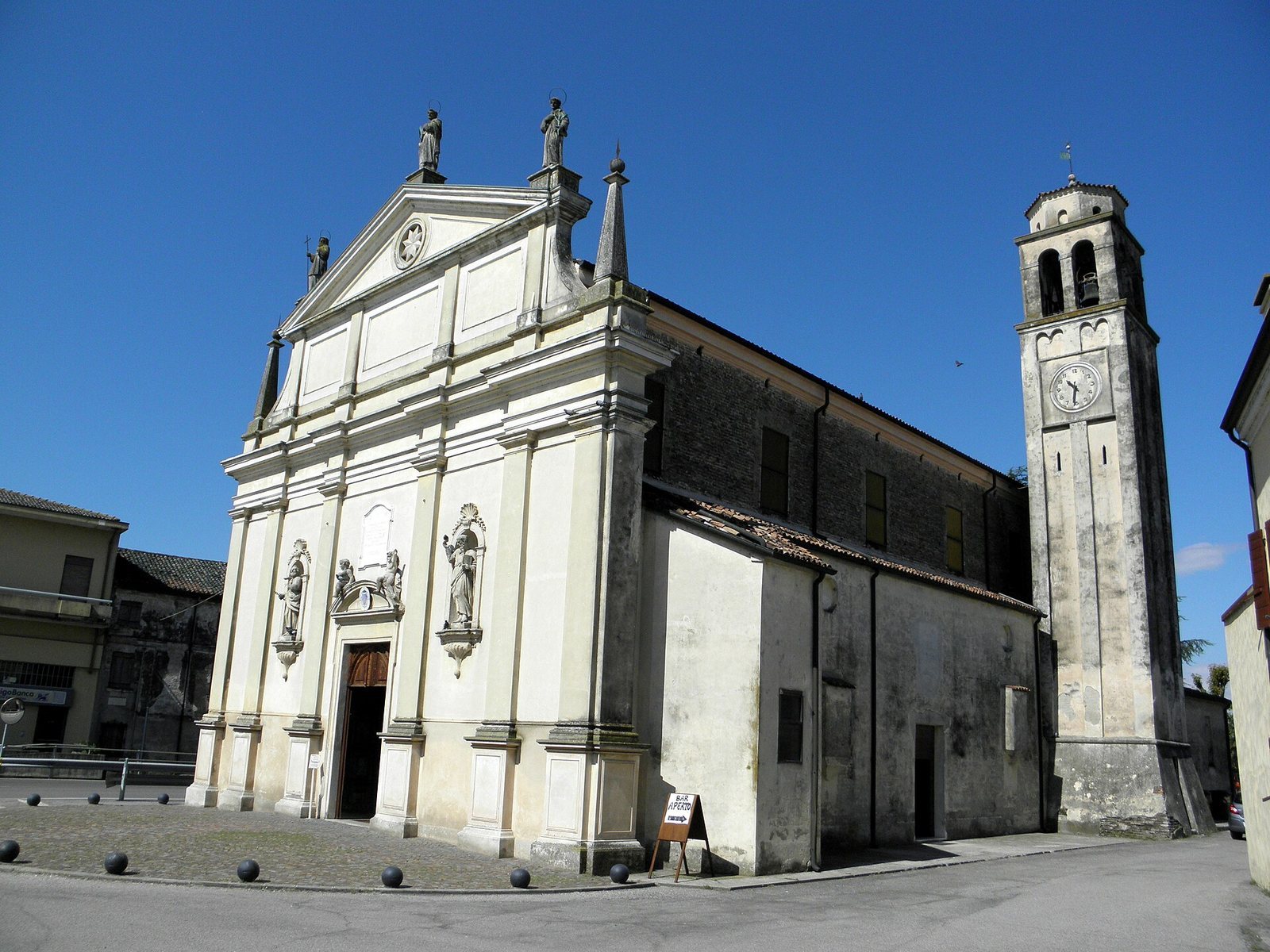
The church has a single-nave plan, with a broad, unified interior known as a Venetian hall. Its principal exterior and interior features include a Neoclassical facade, richly ornamented late Baroque altars, and a seventeenth-century bell tower.
Facade
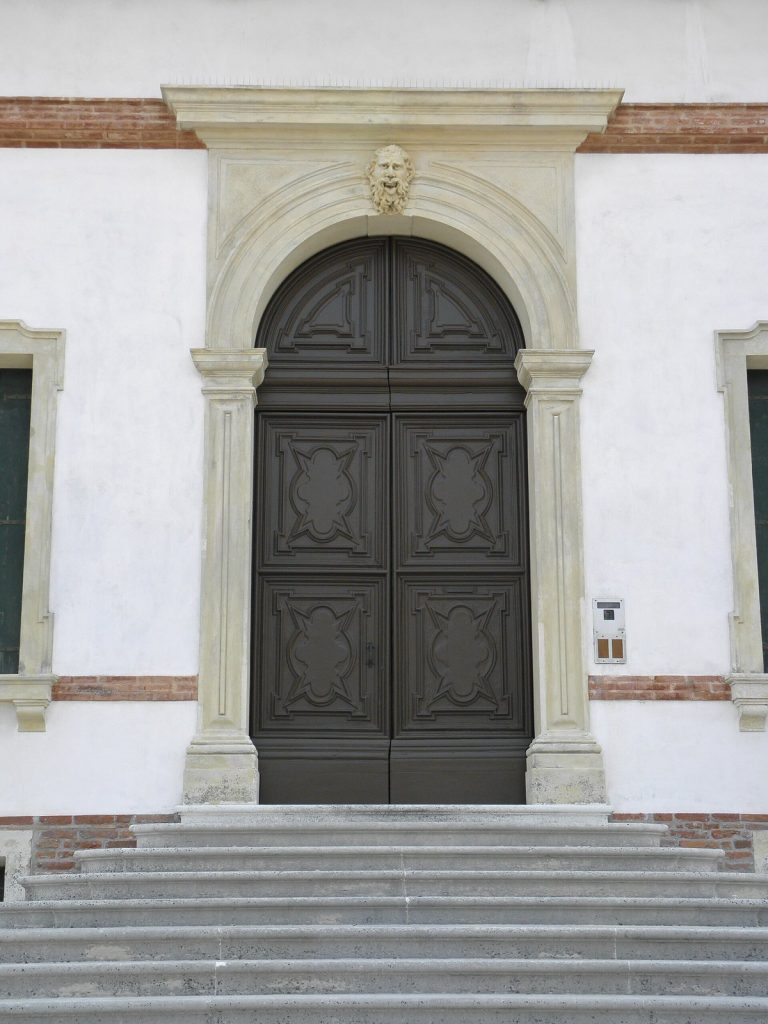
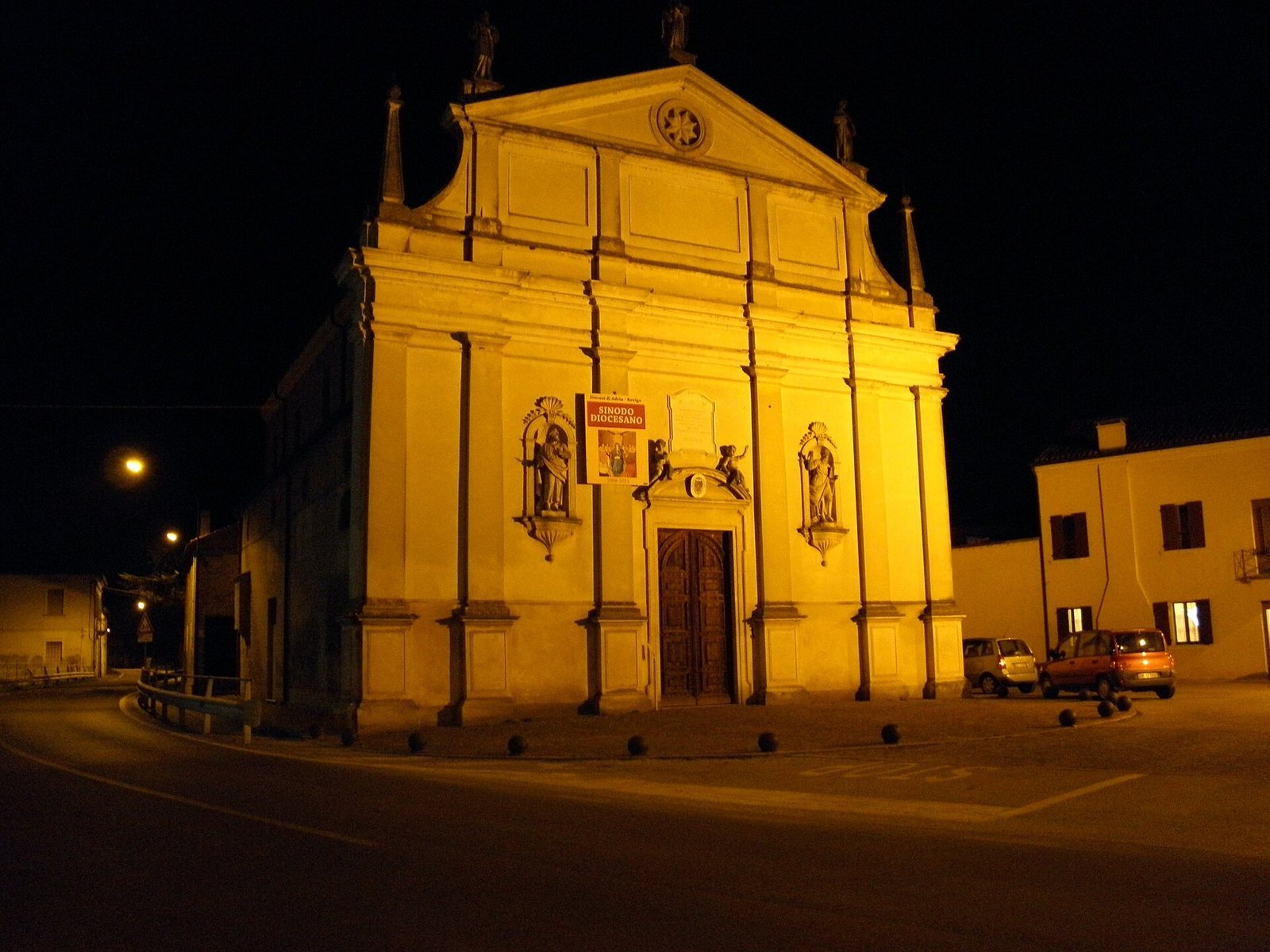
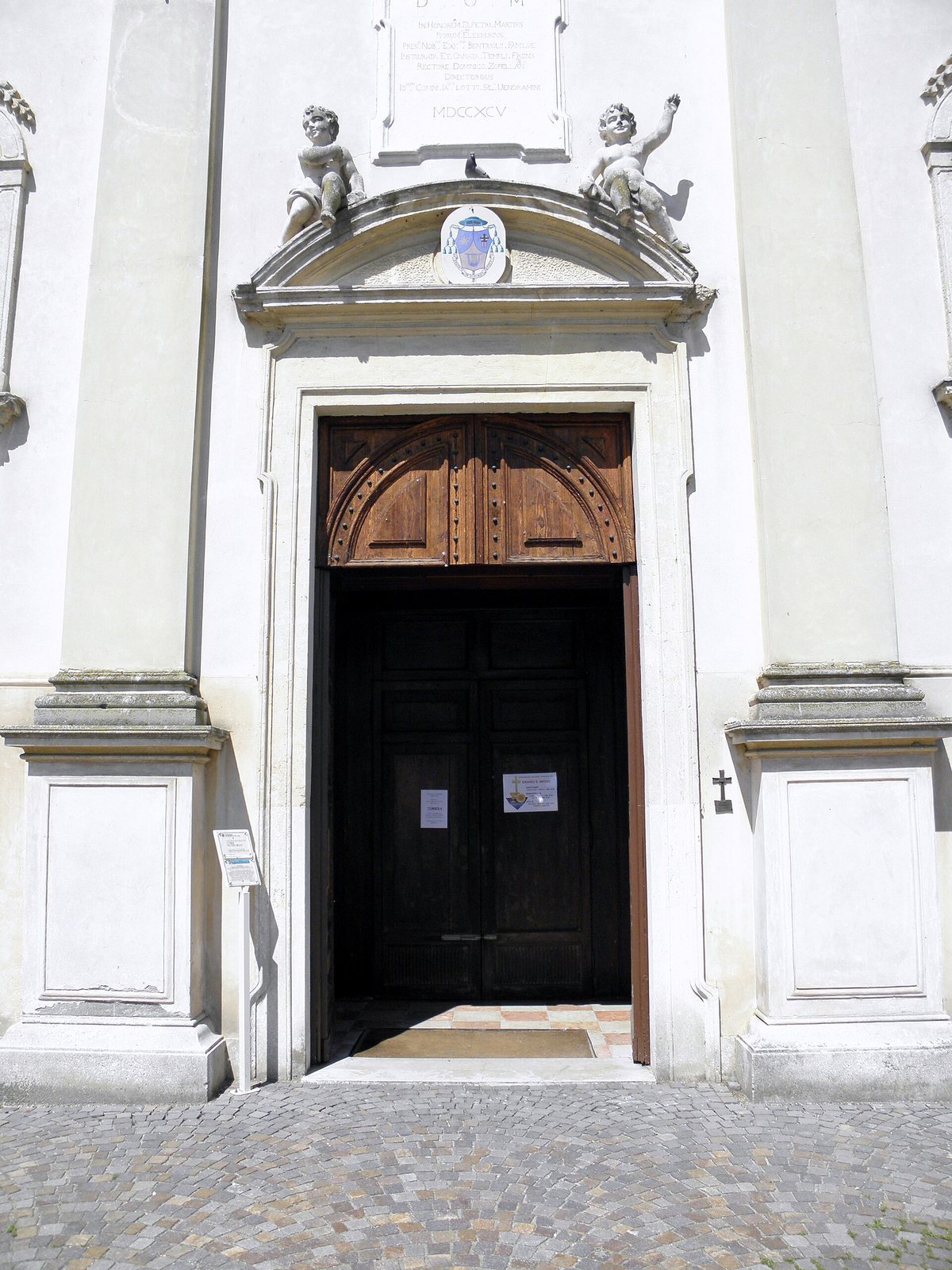
The Neoclassical facade draws on ancient Greek and Roman design. It is arranged in two levels of flat pilasters, shallow projections resembling columns, and crowned by a pediment, the shaped element at the top of the facade. An eight-pointed star occupies the pediment’s centre. Three stone statues stand above it: Peter Martyr in the middle, with Francis of Paola and Anthony of Padua beside him. They replaced earlier statues that had been destroyed. Niches at the lower level hold Saint Peter the Apostle to the left of the entrance and Saint Paul of Tarsus to the right.
Interior
The church’s altars have a pronounced late Baroque character, a style associated with dramatic and richly ornamented forms. The principal altar is dedicated to the Madonna, Saint Sebastian, and Saint Roch. The fourth altar, added in 1627, is dedicated to Our Lady of the Girdle, a devotional title for the Virgin Mary. A fresco decorates the central part of the ceiling. On the interior wall opposite the facade, a choir loft holds a two-manual pipe organ, meaning an organ with two keyboards. Built by the Farinati workshop in 1912, it remains a feature of the church interior.
Bell tower and bells
Tower
The seventeenth-century bell tower rises 50 metres. Lightning destroyed its terminal spire in 1845. The tower sways when all three bells are rung together for festive peals. In 2021, workers replaced its worn iron bell frame with a reconstructed steel frame and installed anti-pigeon nets.
Bells
The tower’s three bells sound G-flat 3, A-flat 3, and B-flat 3. The second was cast by Cavadini of Verona in 1844. Colbachini of Padua returned the largest and third bells in 1947; together, those two bells weigh 711 kilograms. The largest sounds the hours and strikes once at each half-hour. A smaller bell, sounding D 5, is kept in the rectory. It has been recast several times and is no longer used. Before the bell-frame work, it stood in the tower’s bell chamber with the others, but remained unused because it was not electrified.