Madonna di Tirano: A Renaissance Marian Sanctuary in Italy
Site at a Glance
- Popularity
- High
- Country
- Italy
- Primary era
- Early Modern
- Eras represented
- Early Modern, Modern
- Civilizations
- Austrian Empire, Duchy of Milan, French, Habsburg
- Site type
- Religious
- Remains
- Basilica
On this page14 sections
History
Madonna di Tirano is a Roman Catholic church and Marian sanctuary in Tirano, Italy, whose Renaissance construction began in 1505. Dedicated to the Virgin Mary, it is regarded as Valtellina’s principal religious monument and the Diocese of Como’s leading Marian sanctuary.
Apparition and foundation
Local tradition places an apparition of the Virgin Mary to the farmer Mario Omodei on 29 September 1504, in a vegetable garden where the church now stands. She was said to warn that a plague affecting people and animals would grow worse, urge the construction of a church at the site, and promise to heal Omodei’s seriously ill brother.
Omodei shared the story with the knight Luigi Quadrio and other local notables. After his brother recovered, Omodei and Tirano’s parish priest, Gregorio degli Omodei, went to the garden and resolved to build a church. According to the tradition, the plague stopped when construction began. A temporary chapel was built before work on the larger church, authorized by the bishop of Como, commenced on 25 March 1505, the Feast of the Annunciation. The site then lay beyond Tirano’s city walls.
Construction and devotional role
The exterior was completed in 1513, while work on the interior continued until before the church was blessed and consecrated by Bishop Cesare Trivulzio on 14 May 1528. The design is attributed, though not with certainty, to the Renaissance architect Tommaso Rodari; his brothers Giacomo, Donato, and Bernardino probably also took part in the building work. Saint Charles Borromeo, a sixteenth-century cardinal and archbishop of Milan, is said to have visited in 1580.
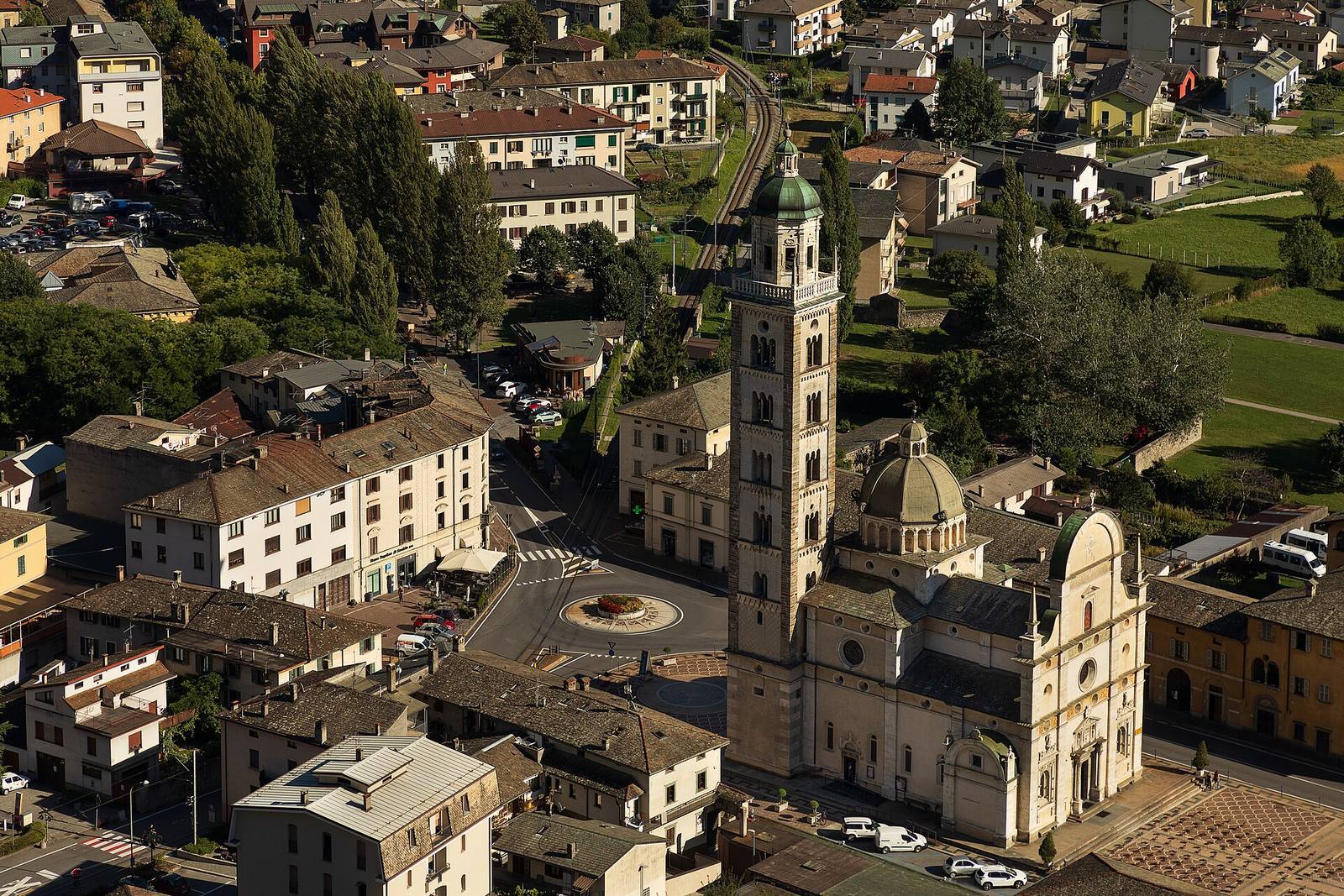
Construction continued after the church’s consecration. The bell tower, begun in 1578, was completed in 1641, and the dome and its surrounding exterior structure were built between 1580 and 1587. In 1927 Pope Pius XI granted the church the honorary rank of minor basilica. Pope Pius XII named the Virgin of Tirano Valtellina’s special heavenly patron in 1946. Omodei is popularly called Blessed, a title used by bishops and by Popes Pius XI and Pius XII, although the Catholic Church has not formally recognized him as blessed. In 2003 Bishop Alessandro Maggiolini designated the church a diocesan shrine, a church recognized by its diocese as a place of particular devotion. The sanctuary continues to receive pilgrims and others seeking help.
Remains
Plan and exterior
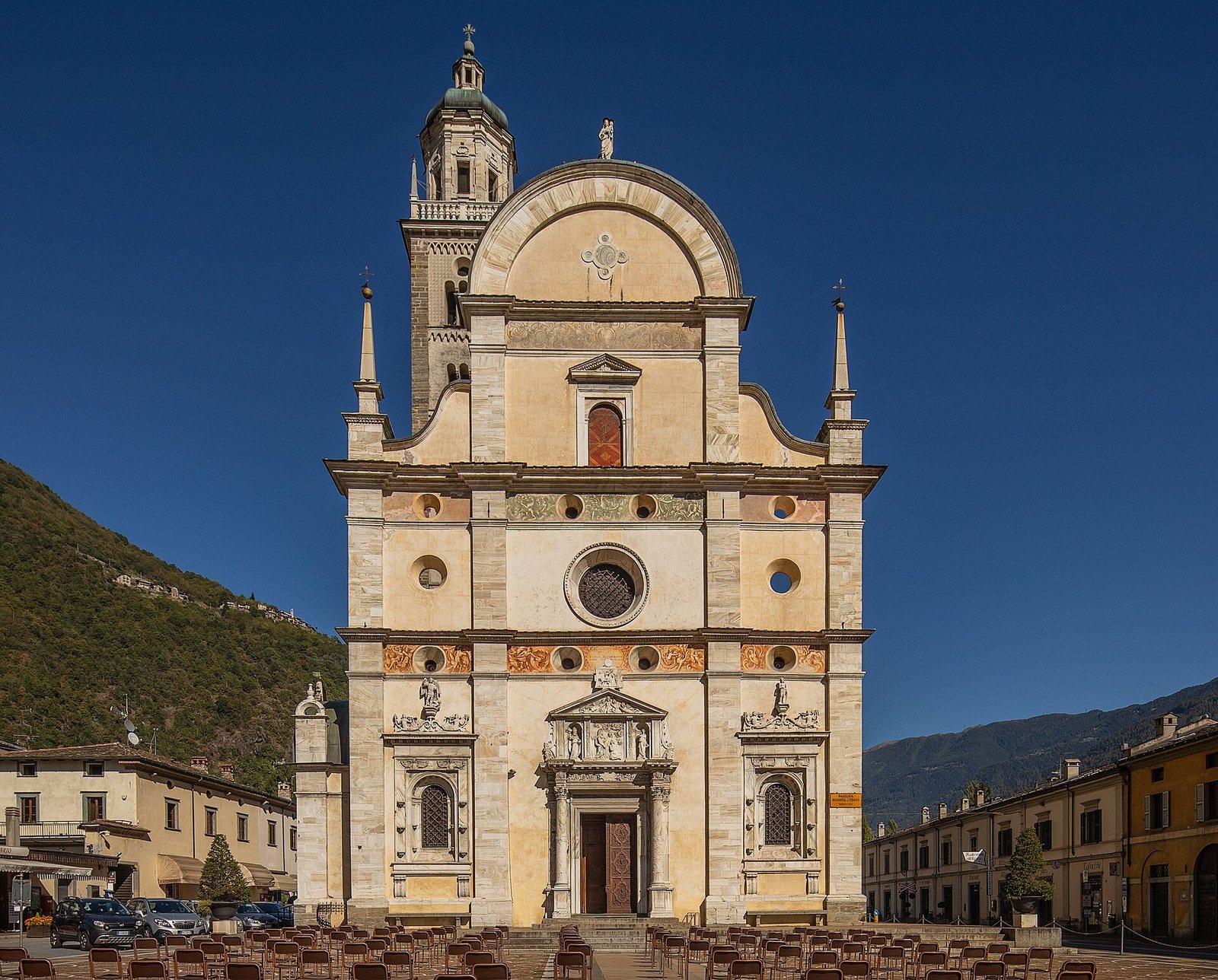
The sanctuary stands in western Tirano, at the foot of the church of Santa Perpetua. Its Renaissance exterior combines Tuscan, Lombard, and Venetian influences, and the façade has a light, open appearance. Several round windows punctuate the front, while the main portal faces away from the town. The church has three aisles and a Latin-cross plan, with a long central nave crossed by a transverse arm. The nave measures 20 metres long and 14 metres wide. The principal portal, sculpted by Alessandro della Scala of Carona, dates to about 1530–1534; Giacomo Rodari is credited with the sculptural ornament on the large windows and side doors.
Dome and bell tower
Dome
A statue of Saint Michael the Archangel, a prominent figure in Christian tradition, stands above the dome. The sculptor Francesco Guicciardi made the statue.
Bell tower
The eastern side of the tower was decorated with Cipriano Valorsa’s painted coats of arms of the Three Leagues, an alliance of three territories in what is now the Swiss canton of Graubünden. The tower’s bells, initially three, were later recast as five. A clock installed in 1577 was funded by Lorenzo Peverelli; the present clock, made by Luigi Maccaferri of Gallarate, dates to 1828. Its Roman-numeral face is on the side toward the town and is now barely visible.
Interior furnishings and decoration
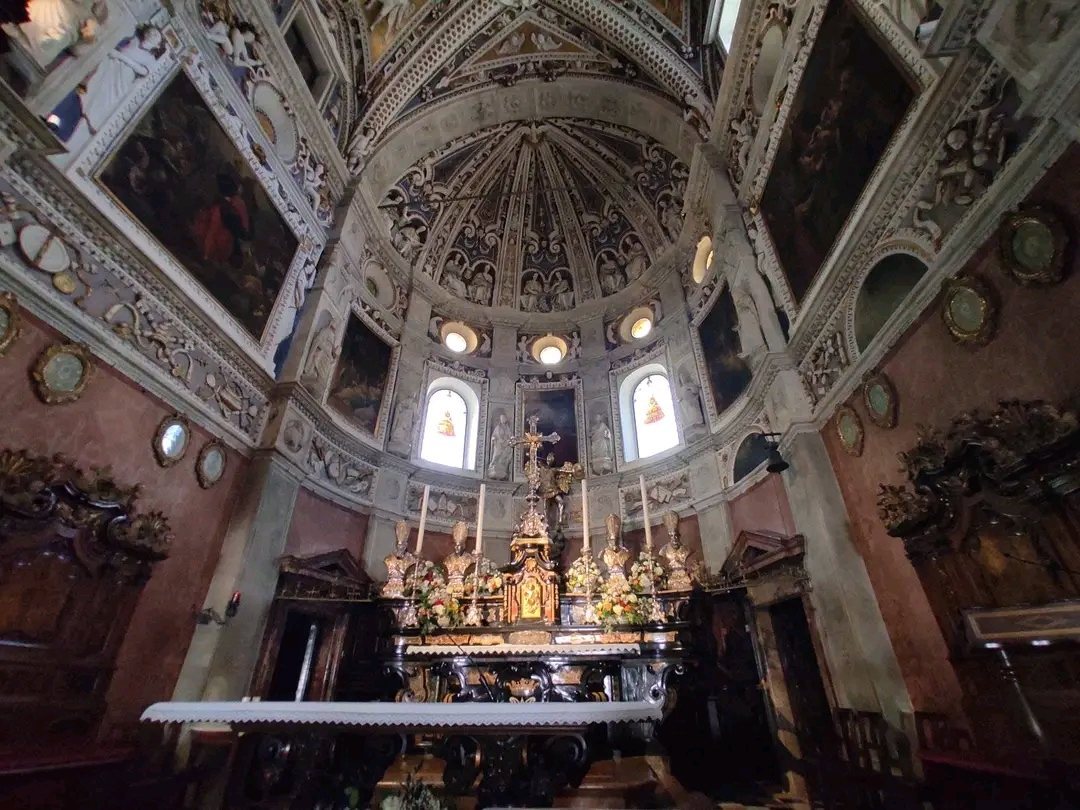
Decorative scheme and altarpiece
Stucco, paintings, sculptures, and other ornament cover the walls and vaulted ceilings. The stuccoes are attributed to Giuseppe Bianchi and date to 1595. Candelabra motifs decorate the column-like wall projections, while panels ornament the arches and beams. An altarpiece made by Giovanni Angelo and Tiburzio Del Maino between 1519 and 1524 incorporates a seventeenth-century painting of the miracle associated with the sanctuary’s foundation. A carved inscription inside the church records Pope Pius XII’s 1946 proclamation of the Virgin of Tirano as Valtellina’s special heavenly patron.
Main altar and choir
The main altar is a Baroque work of 1748, decorated with inlaid marble. A wooden choir in the apse dates to 1749.
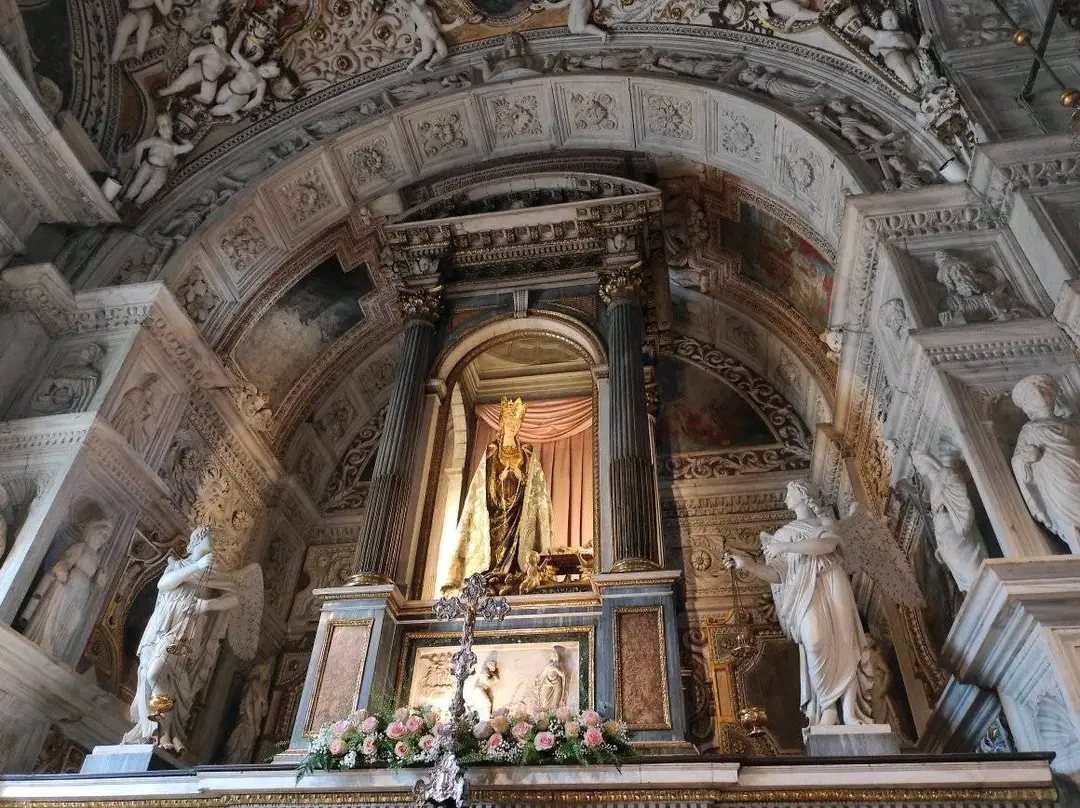
Madonna chapel
The chapel opens from the first bay on the left. A statue of the Virgin Mary carved by the Del Maino brothers stands on a marble altar from the early nineteenth century. Behind the altar, a shrine chamber contains statues depicting the reported apparition. The marble altar replaced an earlier wooden altar made by the Del Maino workshop. In 1798, authorities of the Cisalpine Republic, a short-lived northern Italian republic established under French influence, seized the wooden altar to take its silver sections, which had been attached in the late seventeenth century.
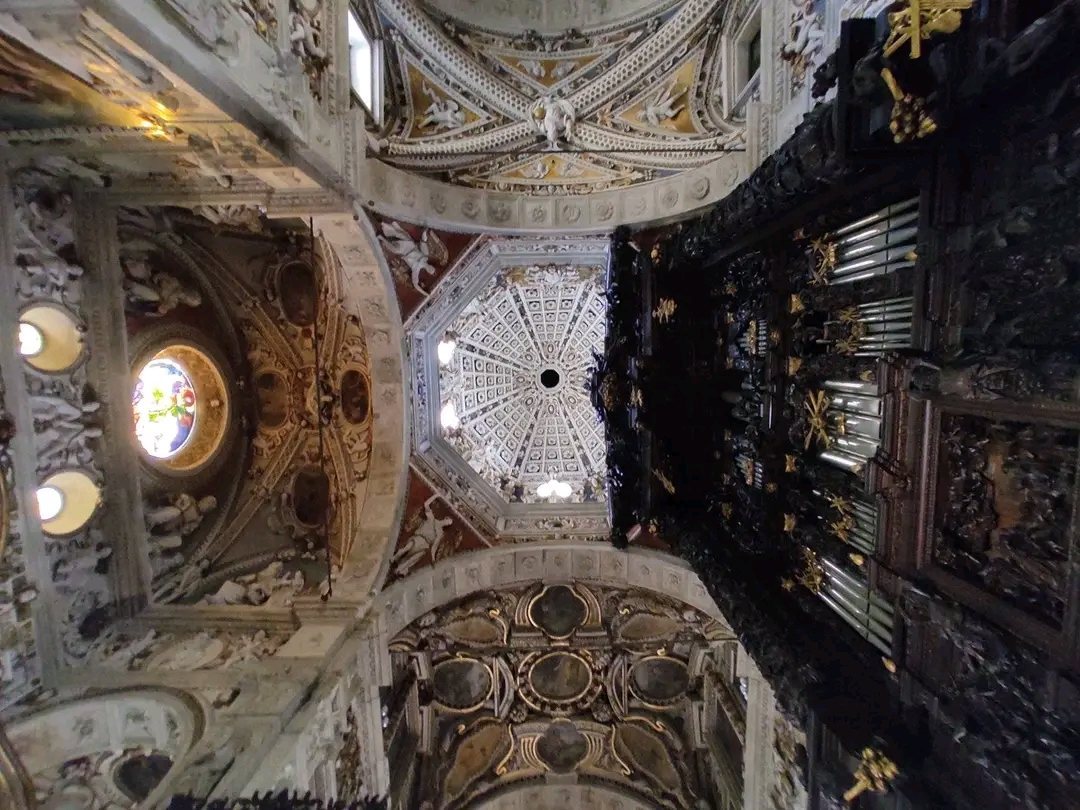
Organs and pulpit
The monumental organ was built by Giuseppe Bulgarini of Brescia between 1608 and 1617, then completed by G. Battista Salmoiraghi in 1638. It rests on eight large red-marble columns and has a richly carved wooden case. During Holy Week, a cloth painted by Carlo Marni in 1650 and depicting the Coronation of the Virgin was used to cover the organ when it was not played. A second organ stands on a gallery above the main portal. Its cream-coloured case has pilasters and ornamentation; the pulpit opposite the principal organ has a similar style and colour scheme.
Baptismal font
A statue of Saint John attributed to Alessandro della Scala adorns the baptismal font.