Chiesa dei Santi Pietro e Paolo: Galatina’s Mother Church
Site at a Glance
- Popularity
- Medium
- Country
- Italy
- Primary era
- Early Modern
- Eras represented
- Early Modern, Modern
- Civilizations
- Italian, Kingdom of Naples, Spanish
- Site type
- Religious
- Remains
- Church
On this page15 sections
History
The Chiesa dei Santi Pietro e Paolo is a Catholic mother church in Galatina, Italy, dedicated to the early Christian apostles Peter and Paul. Construction began in 1633, and the church’s completion is dated to the nineteenth century. Its façade is Baroque, and the church belongs to the Catholic Archdiocese of Otranto, an ecclesiastical jurisdiction led by an archbishop.
The earlier church and Galatina’s Greek tradition
The present church replaced an earlier religious building near the city’s principal entrance, the Main Gate. The predecessor was probably dedicated to the Immaculate Virgin, reflecting the Catholic teaching that Mary was preserved from original sin from the moment of conception. Greek-rite services, a form of Eastern Christian liturgy, were held there in 1355. Galatina was regarded as a Greek city, and Greek remained its official language until the mid-sixteenth century.
Construction and collegiate status
The present church was extensively reshaped during the 1630s and 1640s at the request of the Universitas, a civic body that could act on behalf of the local community. This gave the mother church a leading role among Galatina’s other churches. The building’s completion is dated to the nineteenth century.
Under Archbishop Adarzo de Santander, substantial work on the interior took place between 1657 and 1674. The church became a collegiate church in 1663, meaning that a chapter or college of clergy served it. A chapel for the Blessed Sacrament, the consecrated Eucharist, was built during this period and later destroyed.
Earthquake damage and later changes
The earthquake of 1743 severely damaged the church. Several restoration campaigns followed in the second half of the eighteenth century. In 1875, the interiors were almost entirely refashioned.
Remains
The Baroque façade
Lower level and central doorway
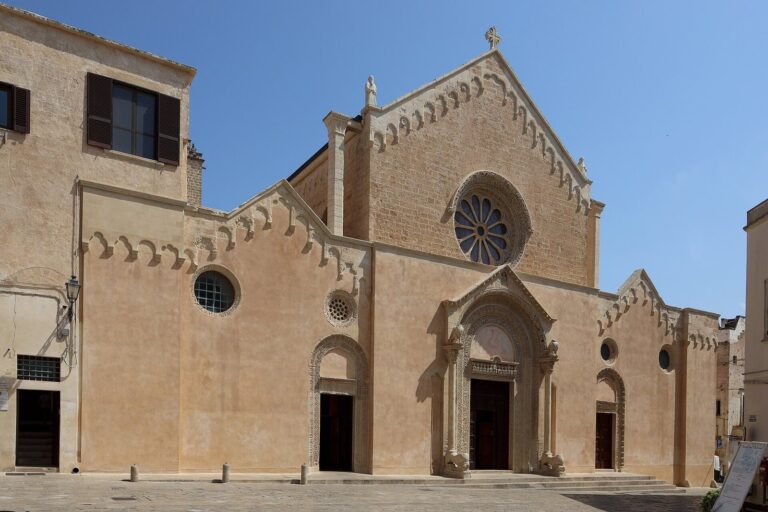
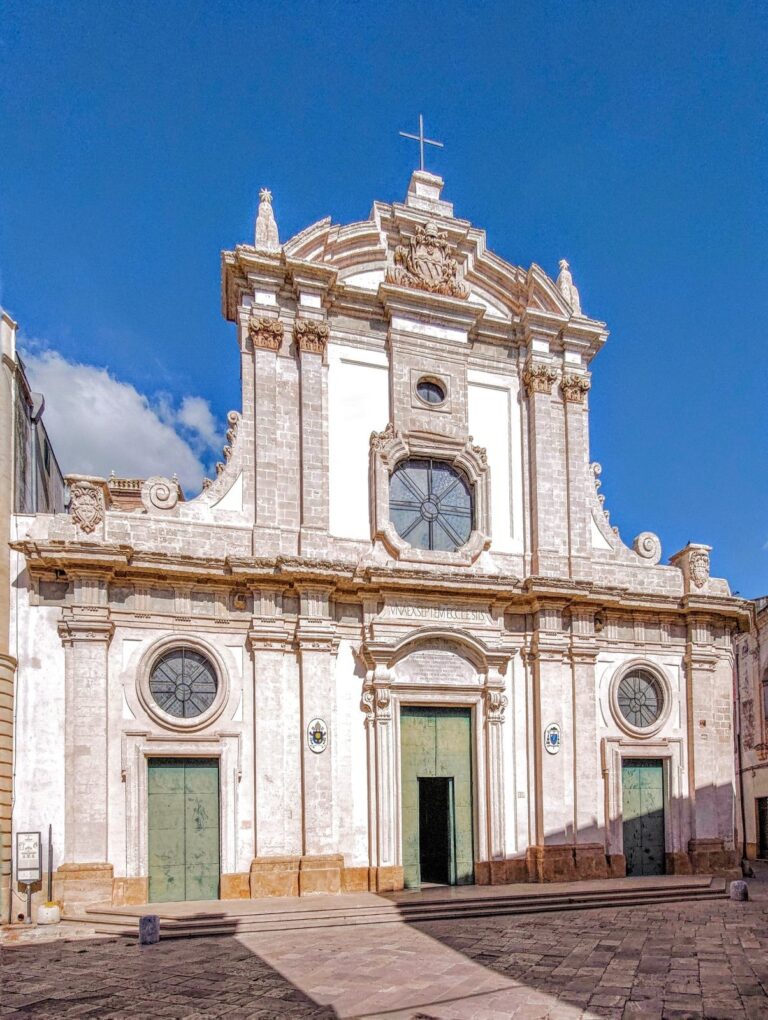
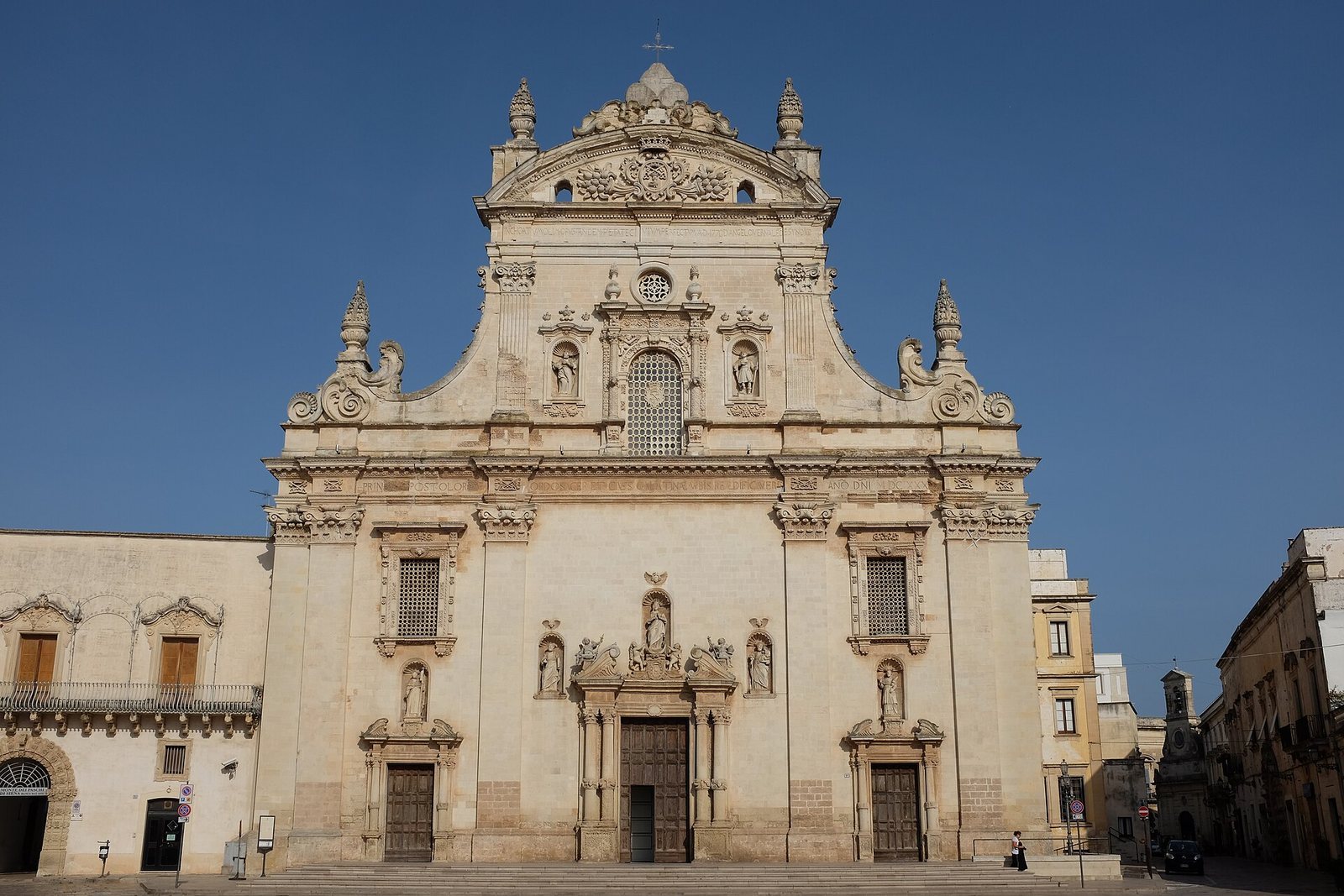
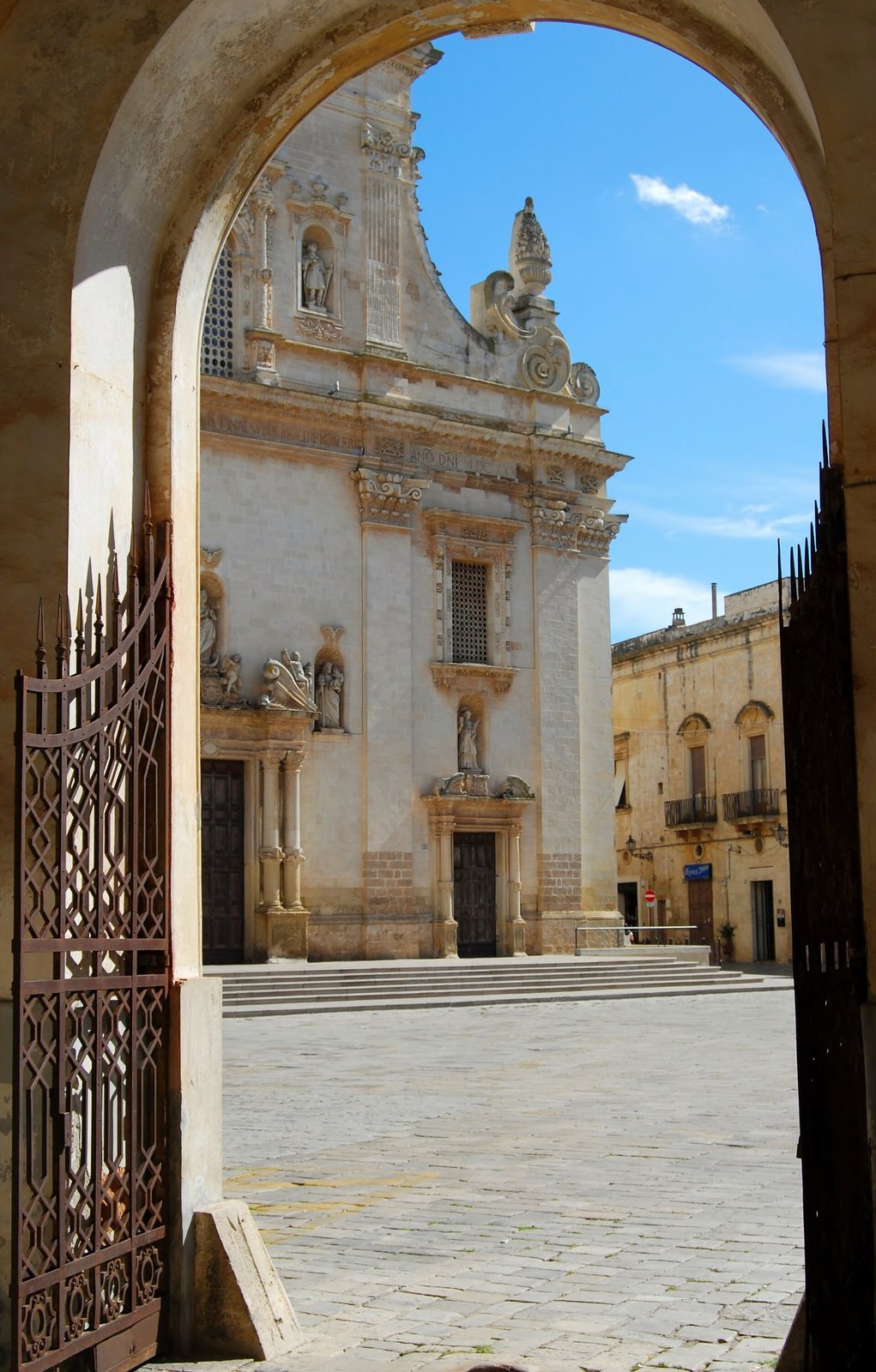
Facing Saint Peter’s Square, the façade was built in at least two phases between the seventeenth and eighteenth centuries. Its style is shared by much of Galatina’s religious and private architecture. Shallow vertical supports divide the lower level, which has three doorways and two richly decorated windows worked on by Giuseppe Zimbalo, a leading architect and sculptor of the Lecce Baroque. The central doorway is framed by two tiers of columns supporting a lintel dated 1633. Two cornices rise above it to a niche containing a statue of the Immaculate Virgin. Adarzo’s coat of arms appears at the niche’s base, while statues of Saint Peter and Saint Joseph occupy two niches below.
Side entrances
The smaller side doorways have simpler columns. Niches above their lintels hold statues of Saint Raymond Nonnatus, associated with the redemption of captives, and Saint Peter Nolasco, founder of a religious order devoted to ransoming Christian captives. The two large windows and Adarzo’s coats of arms complete the lower façade’s decoration.
Upper level
Two shallow vertical supports frame the upper level’s central area, with an ornate window and niches containing statues of Saint Tryphon, an early Christian martyr, and Saint Paul. Flower-filled vases stand at the sides. Curled forms connect the façade to a pediment, its crowning section, which bears Galatina’s coat of arms.
The church interior
Aisles and altar end
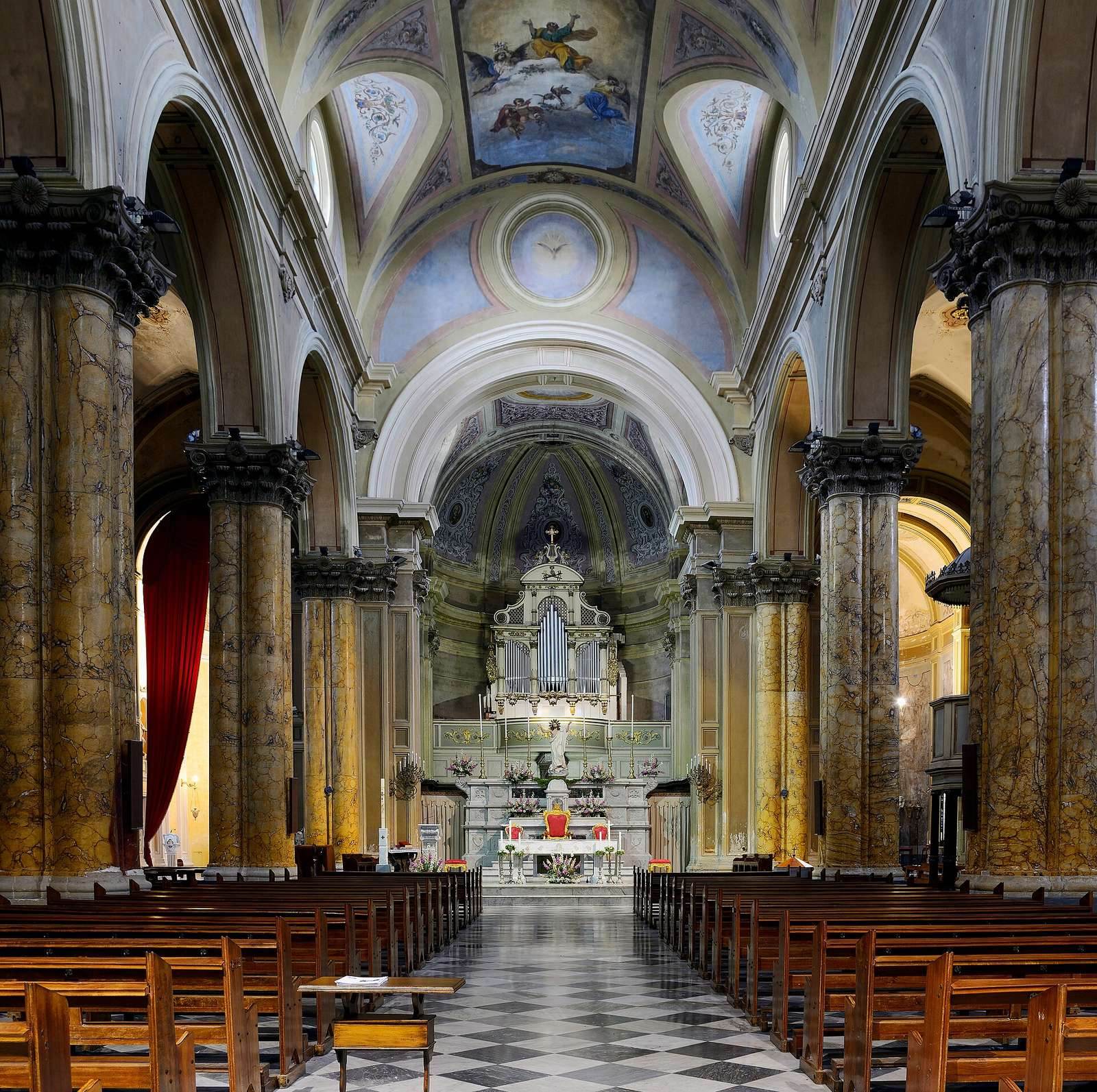
Three aisles are divided by arches resting on pillars set at a 45-degree angle, with four half-columns attached to each pillar. The side aisles have cross-shaped vaults formed by intersecting curved sections and end in two spacious chapels. In the central aisle, the roof trusses are concealed by a barrel-shaped vault with curved, half-moon sections. The aisle ends at a broad presbytery, the area around the altar, and a deep choir.
Central vault and choir paintings
Frescoes by the Neapolitan painter Vincenzo Paliotti cover the central aisle’s vault. They show Saint Peter’s release from prison, the Miracle of Saint Peter, the Giving of the Keys, and his glory. Two paintings in the choir, associated with Santander’s patronage, depict Isaiah’s prophecy of the Messiah’s birth from the Virgin and the Giving of the Keys.
Paintings in the side aisles
The right aisle contains a seventeenth-century Assumption and a late-sixteenth-century Saint Francis Receiving the Stigmata. Works in the left aisle include a seventeenth-century Madonna of the Rosary with Saints, Pietro Picca’s Crucifixion of Saint Peter from the second half of the seventeenth century, an Immaculate Conception attributed to Oronzo Tiso and dated to the late sixteenth century, and a seventeenth-century Our Lady of Mount Carmel with the Souls in Purgatory.
Counterfaçade paintings
The counterfaçade, the interior wall opposite the main façade, holds Serafino Elmo’s 1756 Washing of the Feet, along with Jesus Walking on the Water and The Apparition of Christ to Saint Peter.
End chapels
The chapels at the ends of the side aisles contain an eighteenth-century statue of the Immaculate Virgin attributed to the Neapolitan sculptor Giuseppe Sammartino and a seventeenth-century statue of Saint Peter by the Lecce artist Giuseppe Cino. The Chapel of Saint Peter also contains an old silver bust of the saint and a stone that tradition identifies as the place where Peter sat during a stop in Galatina on his journey to Rome.