San Martino: The Parish Church of Sambughè, Italy
Site at a Glance
- Popularity
- Very Low
- Country
- Italy
- Primary era
- Early Modern
- Eras represented
- Medieval, Early Modern, Modern
- Civilizations
- Holy Roman Empire, Italian, Venetian
- Site type
- Religious
- Remains
- Church
On this page19 sections
History
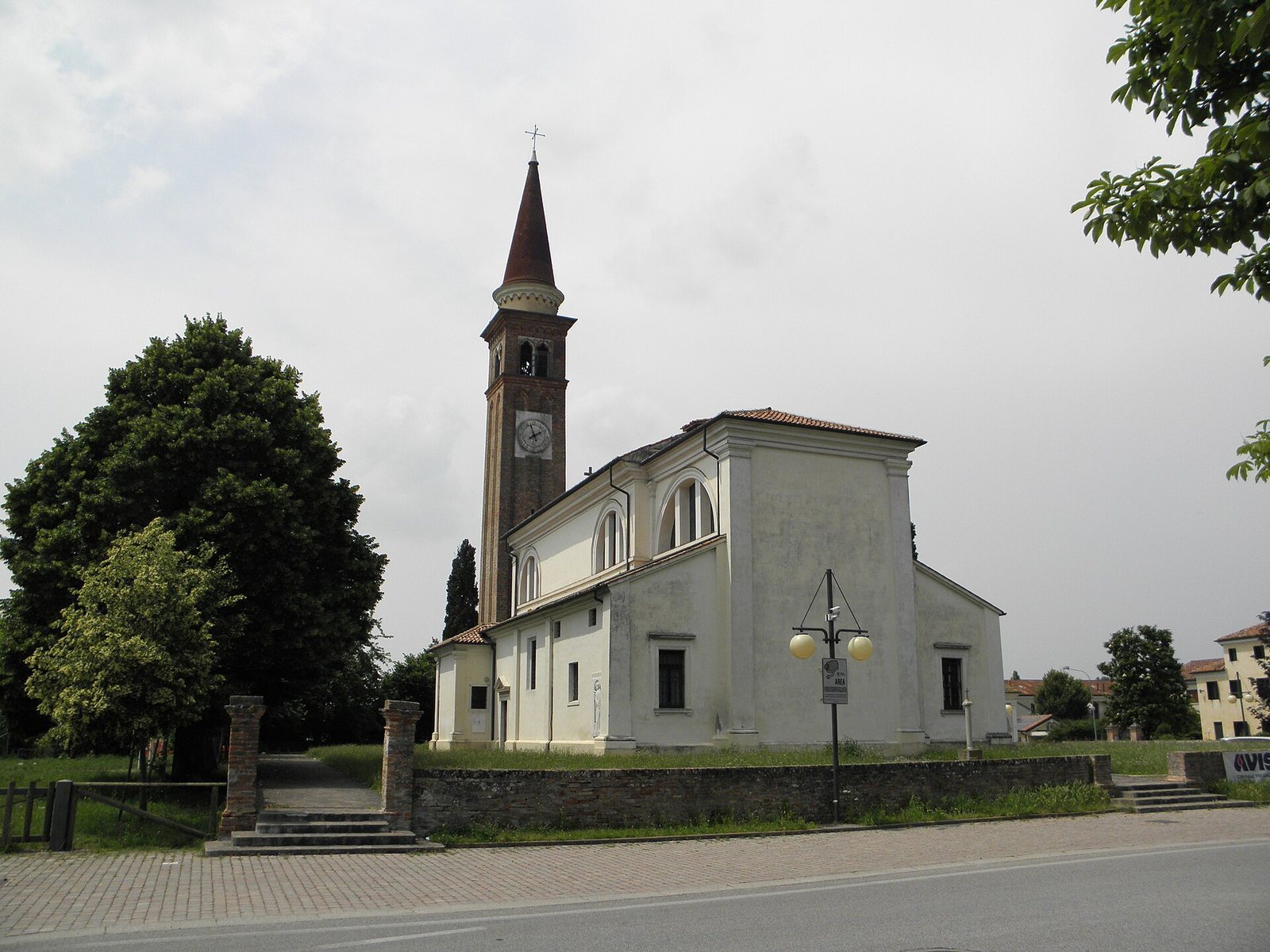
San Martino is the Roman Catholic parish church of Sambughè, Italy, dedicated to Saint Martin of Tours, a fourth-century Christian bishop. It belongs to the Diocese of Treviso. The present late Renaissance church was rebuilt in the first half of the seventeenth century over the perimeter walls of an earlier Romanesque church. Bishop Marco Morosini consecrated it on 26 August 1642, when Don Lazzaro Perusini was parish priest.
Earlier worship and the seventeenth-century church
A small rural chapel dedicated to Saint Bovo stood in Sambughè by the beginning of the fourteenth century. The later church’s history also includes gifts intended for its community. In 1667, Giovanni Andrea Lumaga, who owned a summer villa in Sambughè, arranged for two paintings for the church. His sons, Ottavio and Giovanni Battista, formally gave them to the parish by notarial deed on 3 August 1707. The brothers came from Piuro and lived in Venice.
In 1683, a bequest by the Venetian canon Giambattista Usodimar established the Pious Institute for the Poor of Sambughè. His gift comprised a palace, eleven small houses, and fields. The institute continued as a legal institution under Lucrezia Gennari, the last heir of the Usodimar family.
Devotion and later changes
Local tradition tells that a statue of the Madonna and Child was found in a ditch on what is now Via Sagramora and carried to the church in a solemn procession. Residents set the feast day for 8 September in remembrance, and the date became the start of the annual village festival.
On 23 August 1863, lightning struck the church and burned the former choir loft. The fire destroyed, among other things, an organ made by Gaetano Callido. A replacement loft was built in 1863–64. The church underwent restorations in 1834, 1959, and 1973.
Remains
San Martino is a three-aisled church, with a central nave flanked by two side aisles, and contains five altars. Its interior combines marble and stone altar structures with paintings, carved woodwork, and sculpture. The area around the main altar is the presbytery.
Altars
High altar
The high altar has a broad altar table, a small temple-shaped tabernacle for the consecrated Eucharist, and a flat decorative front in multicolored marble. Four large marble columns, topped by Composite-style capitals, support a pediment, the architectural top above the columns. A Latin inscription on the altar’s right side names parish priest Lazzaro Perugino and churchwardens Giovanni Bergamo and Battista Murario in connection with its erection.
The altarpiece shows Saint Martin giving part of his cloak to a poor man, an episode from the saint’s traditional story. The painting by Michele Desubleo dates to the third quarter of the seventeenth century and was probably brought from Venice around 1652.
Madonna altar
The Madonna altar in the right aisle dates to 1763. Its shrine-like structure includes an altar table with a flat front and multicolored marble panels, a tabernacle with an architectural front, and two marble columns with Corinthian capitals, or ornate column tops. A low broken pediment, split at the centre, is topped by three stone angels.
The carved wooden Madonna and Child is gilded and tooled, and probably comes from a Venetian workshop of the late seventeenth century. It is a fully rounded sculpture using the imagery of the Madonna of Loreto, a devotional image of Mary and the Christ Child associated with the shrine at Loreto.
Crucifix altar
The Crucifix altar in the left aisle dates to the first half of the eighteenth century. Its altar table supports a tabernacle with an architectural front and stands between two marble columns with Corinthian capitals. Three child figures top its low, broken pediment. The altar’s flat front has a stone support and multicolored marble panels, with a cross at its centre; geometric patterns decorate the step.
The associated painting, from the same half-century and attributed to Francesco Migliori, depicts Christ on the cross with Saints Lawrence and Lucia, remembered as early Christian martyrs, and Saint Roch, traditionally associated with protection from plague.
Saint Anthony altar
The Saint Anthony altar dates to the second half of the eighteenth century. Its altar table has a flat front of multicolored marble and an architectural-fronted tabernacle. Two marble columns with stone Corinthian capitals support a low pediment topped by three stone angels. The painting, by an unknown artist, shows Saint Anthony of Padua embracing the Christ Child. Anthony was a thirteenth-century Franciscan friar and preacher.
Saint Vincent altar
The Saint Vincent altar dates to the first half of the eighteenth century. Its altar table has a flat front and is flanked by two marble columns with Corinthian capitals. A low broken pediment has a projecting cornice with small tooth-like blocks and two stone angels. The painting, apparently from the same period and by an unknown artist, shows Saint Vincent Ferrer, a Dominican preacher of the fourteenth and fifteenth centuries, with Saint Bovo, Saint Eurosia, and poor people. Bovo was a medieval saint venerated in northern Italy; Eurosia was a Christian martyr especially venerated in Spain and parts of Italy.
Presbytery and choir
Altar enclosure and paintings
Eighteenth-century marble balustrades enclose the presbytery in two matching sections. Small columns alternate with rectangular molded piers. A walnut Madonna and Child stands on one side, opposite a statue of the Sacred Heart of Jesus, a Christian devotion focused on Christ’s heart as a sign of divine love. Vinzenz and Ludwig Moroder of Val Gardena carved both statues in 1948.
Two canvases in gilded frames show Jesus before Herod and the raising of Christ on the cross. Mattia Preti painted them between 1653 and 1660.
Choir stalls
The walnut choir stalls date to 1665 and are of Venetian workmanship. They may have been given by the Lumaga family. Carved plant designs decorate their consoles; the vertical supports have Ionic capitals, or scroll-shaped column tops. The crowning element includes vases holding palm branches and winged child figures.
Other furnishings and decoration
Doorway, confessionals, and baptismal font
A two-leaved door on the right has molded frames, a two-part wrought-iron bolt, and bronze handles shaped as children holding grape clusters. Three small wooden sculptures sit above it: a standing curly-haired child in the middle, with a seated female figure on each side. Higher up hangs a carved, gilded wooden crown, probably made by an unknown Venetian workshop between 1740 and 1760.
Two walnut confessionals, booths used for the Catholic sacrament of confession, stand in the side aisles. Made in Venice around the middle of the seventeenth century, they have twisted columns, drapery, Composite-style capitals, broken pediments with projecting cornices, and crosses at their tops. One also has two child figures playing musical instruments.
The stone baptismal font probably dates to the first half of the eighteenth century and is associated with the church’s rebuilding. It has a square base, a pear-shaped shaft, and a circular basin carved with plant designs in low relief. Its carved wooden cover is partly gilded and topped by a painted wooden Saint John the Baptist, the biblical prophet who baptized Jesus. A seventeenth-century stone basin with a circular bowl and molded rim stands beside the font.
Choir loft and painted ceilings
The wooden choir loft, supported by four Ionic columns, was made in 1863–64. Three oil paintings on its front rail, made around the middle of the twentieth century, depict Saint Cecilia, an early Christian martyr; Pope Gregory the Great, a sixth-century pope and theologian; and Pope Pius X, who held office from 1903 to 1914. The church’s current organ was made by the Aletti firm of Monza in 1940. It is unusable and has limited historical importance.
The central nave’s vaulted ceiling carries a brush-painted Glory of Saint Martin and symbols of the four Evangelists, the traditional authors associated with the Gospels of Matthew, Mark, Luke, and John. Gian Maria Lepscky painted them in 1928. Four nineteenth-century frescoes on the presbytery vault represent Faith, Hope, Charity, and Justice. A crucifix of gilded wood inlaid with mother-of-pearl hangs to the left of the main entrance. Made in the first half of the eighteenth century, it is the work of a skilled Venetian-school artist.
Exterior memorials and former cemetery
Memorial slabs
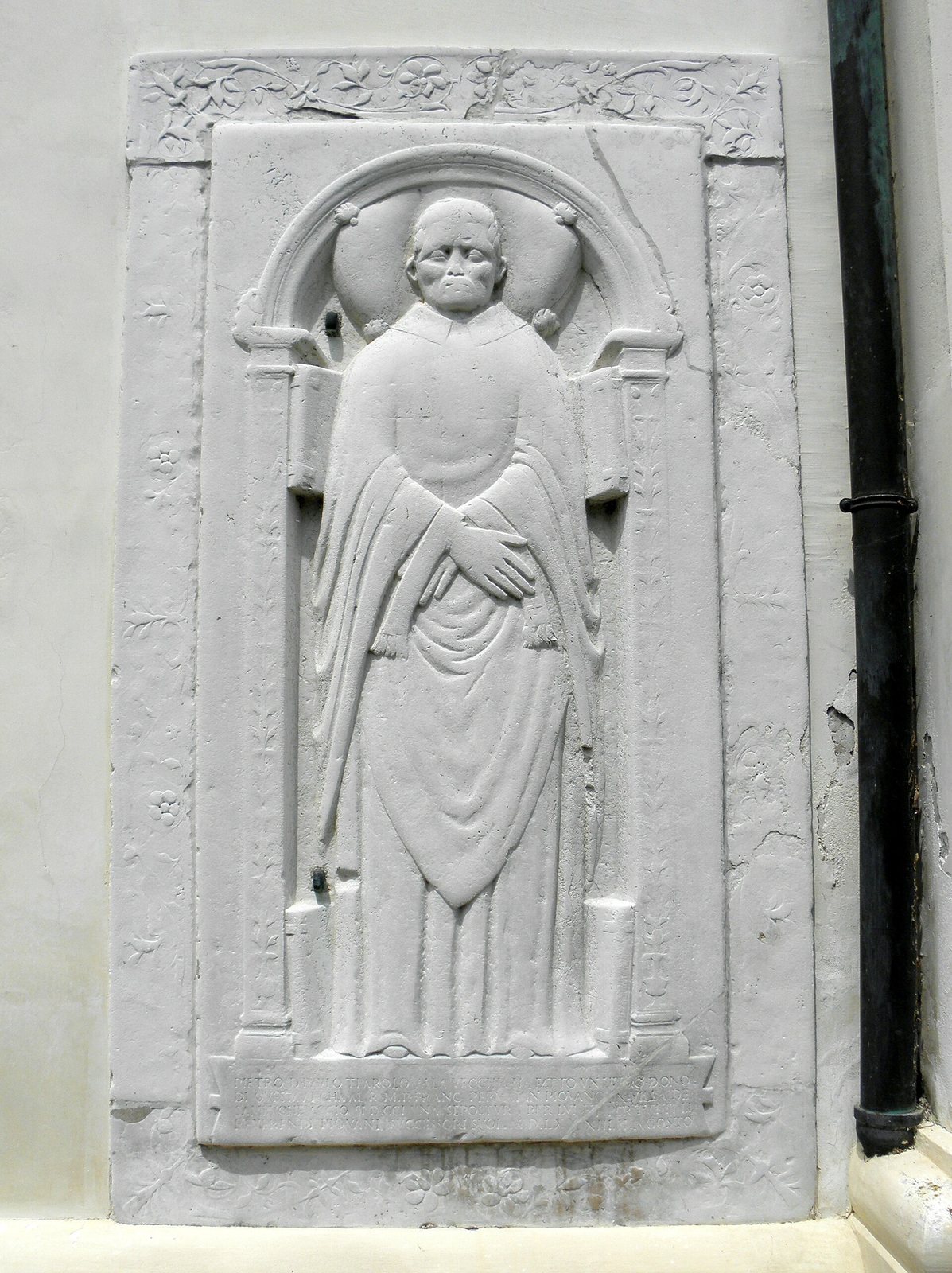
Two marble slabs are set into the church’s exterior walls. One is a funerary floor slab showing a richly dressed prelate lying within a shrine-like frame. Its inscription, dated 11 August 1583, says that Pietro d. Paulo Tlarolo Alla Vecchia gave the tomb to parish priest Franc. Permarin for his burial and that of his successors.
The second slab is a Venetian-made marble relief, a carving in which figures project from the background, dating to the second half of the sixteenth century. Framed by molded, painted plaster, it depicts the Man of Sorrows, an image of Christ displaying the wounds of the Passion, supported and surrounded by angels.
Former cemetery entrance and column
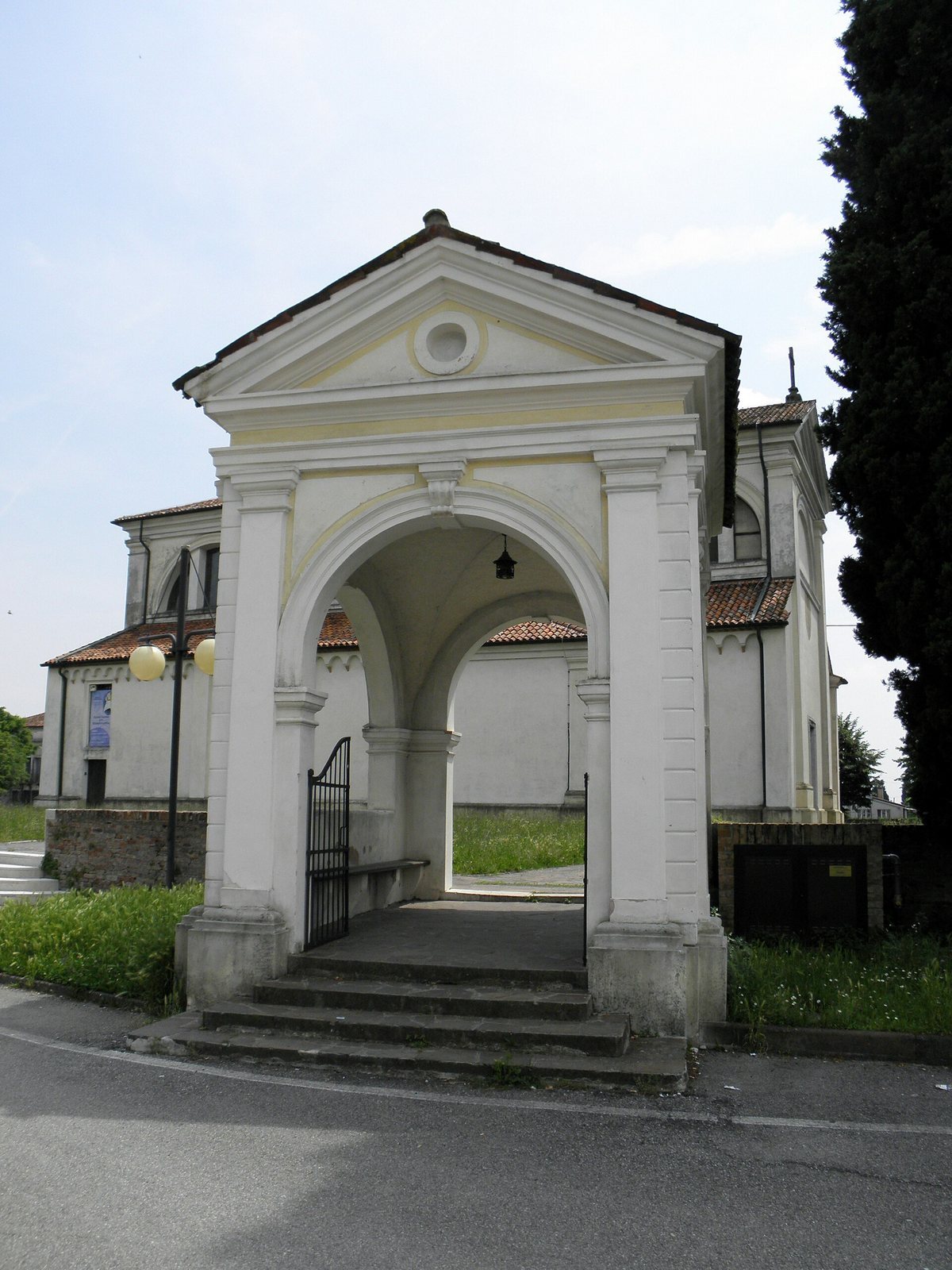
On the lawn, which formerly served as the cemetery, stands a marble column topped by an iron cross. The column probably dates to the second half of the seventeenth century. Between the church and rectory is an ornamental entrance once used to reach the cemetery. An inscription on the right side of its upper structure names parish priest Lazzaro Pervigino and is dated 29 May 1530. The cemetery had ceased to exist by 1955.