San Clemente, Padua: A Mannerist Church and Former Parish
Site at a Glance
- Popularity
- Medium
- Country
- Italy
- Primary era
- Early Modern
- Eras represented
- Medieval, Early Modern, Modern
- Civilizations
- Holy Roman Empire, Venetian
- Site type
- Religious
- Remains
- Church
On this page9 sections
History
San Clemente is a Mannerist church in Padua, Italy, dedicated to Clement I, an early bishop of Rome traditionally counted as the fourth. Tradition places its foundation in the fifth century.
Foundation and medieval parish
One account says that Paduans who had settled on Rivoalto and Dorsoduro gave the church to Padua after 421. The gift was made in gratitude for the construction of San Giacomo, consecrated on 25 March 421 by Bishop Severiano dei Dauli. Chronicler Guglielmo Ongarello connected the tradition with the settlers’ building of San Giacomo di Rialto and San Raffaele. He also related that Doge Andrea Dandolo, Venice’s chief magistrate, allowed them to sponsor the Padua church.
The earliest known written mention of San Clemente dates to 1190. It became a parish church in the fourteenth century. From 1386, it commemorated Francesco da Carrara, ruler of Padua, and his victory over Antonio della Scala, ruler of Verona.
Rebuilding and later use
Guilds based around nearby market squares helped develop the church by commissioning private altars and restoration work. The medieval building underwent major changes in the sixteenth century as the square was reorganized. Further renovation followed in the seventeenth and eighteenth centuries, and the works were completed in the eighteenth century.
A bell tower on the church site was demolished in the second half of the nineteenth century. San Clemente was formerly a parish church and is now a rectory dependent on the Cathedral Basilica of Santa Maria Assunta. It is recognized as Italian national heritage.
Remains
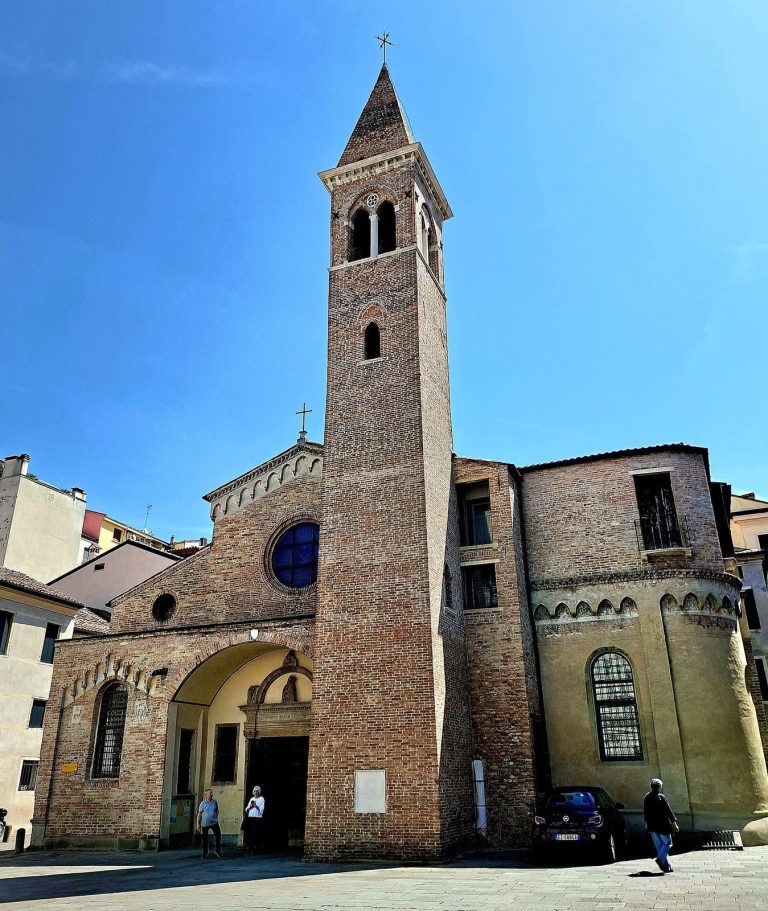
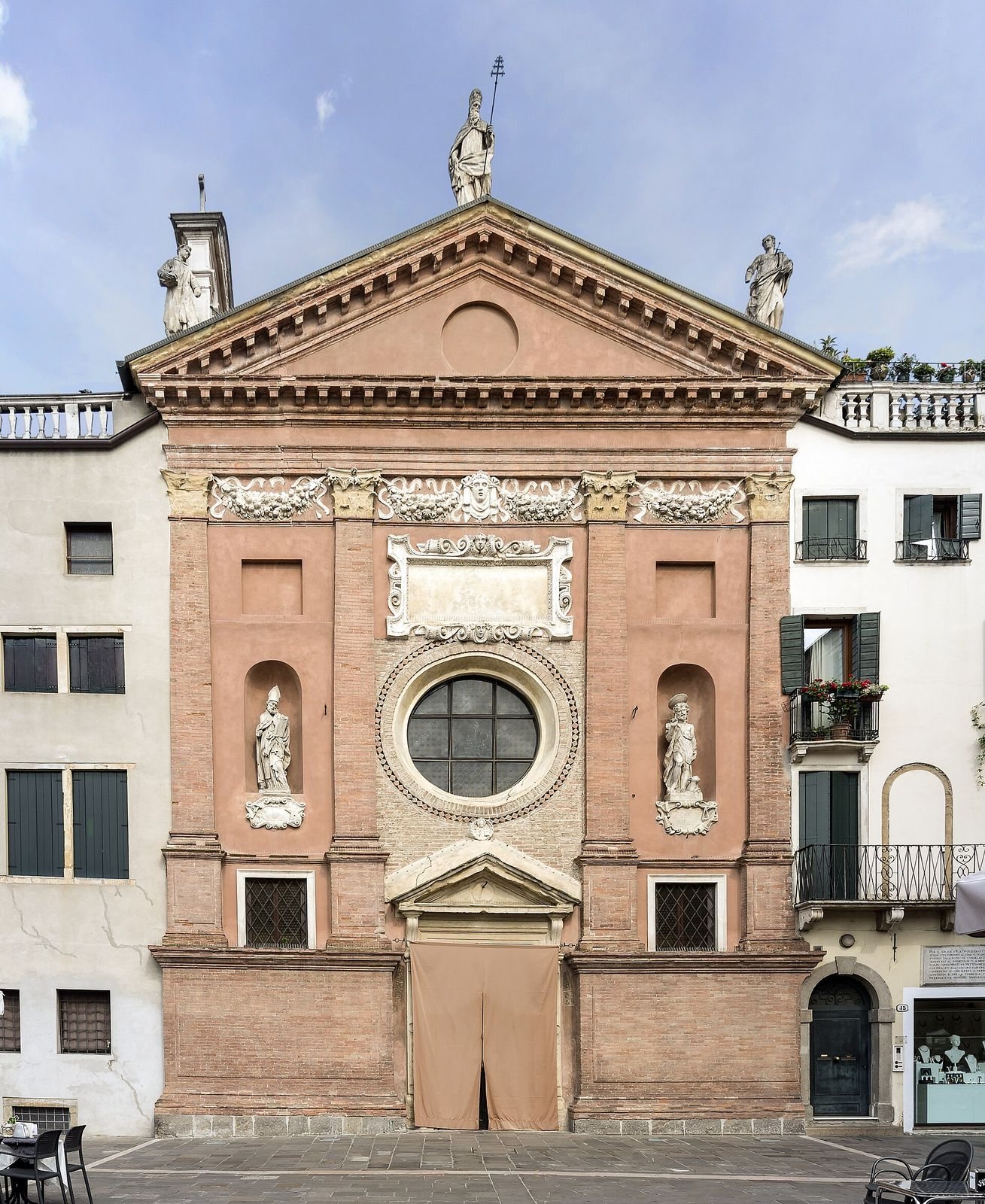
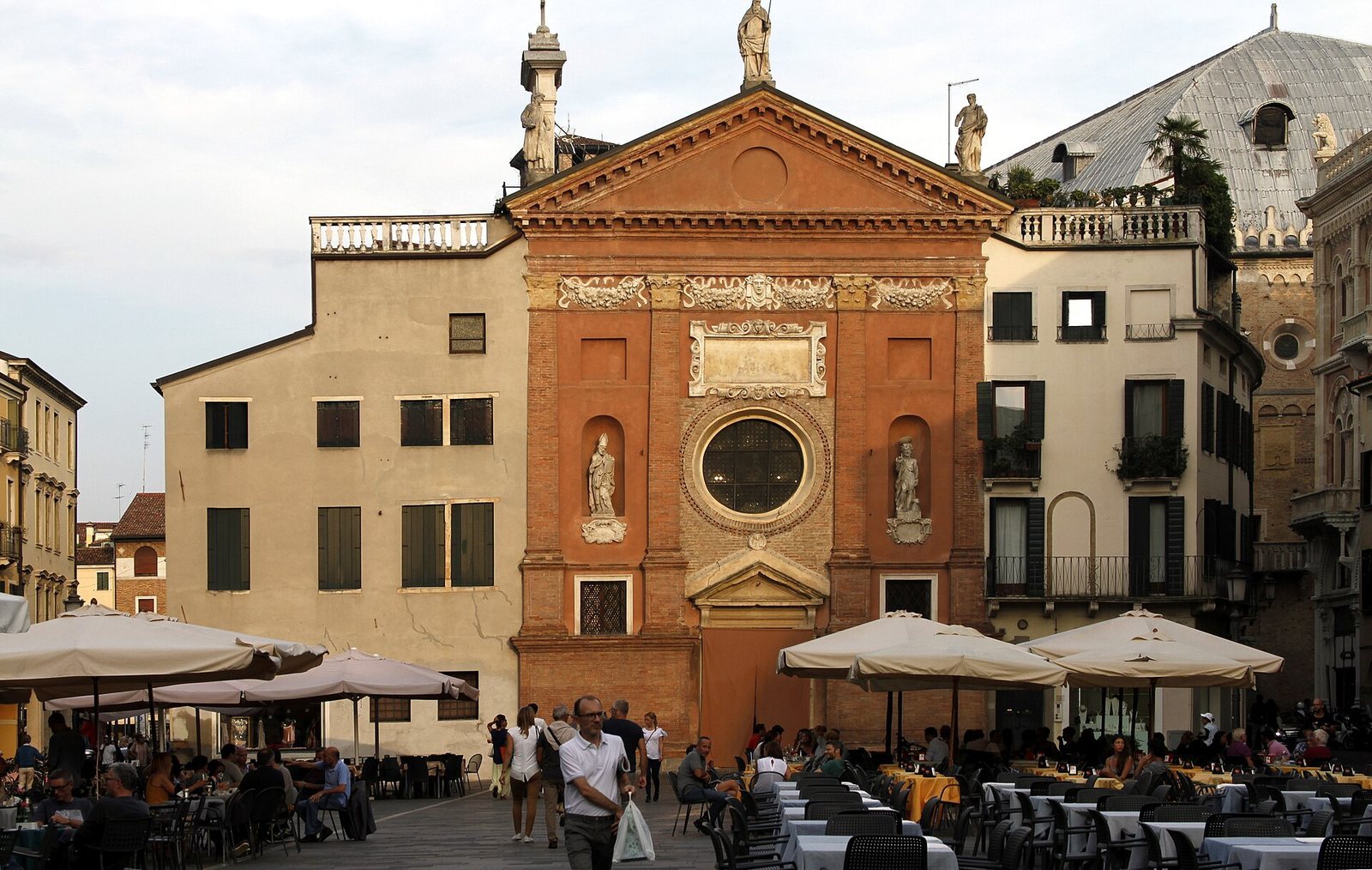
Residential and commercial buildings surround the church, leaving its façade visible on Piazza dei Signori, facing the Clock Tower. Inside, the nave ends in a small square-plan sanctuary. The surviving exterior and furnishings bring together features from different periods.
Exterior
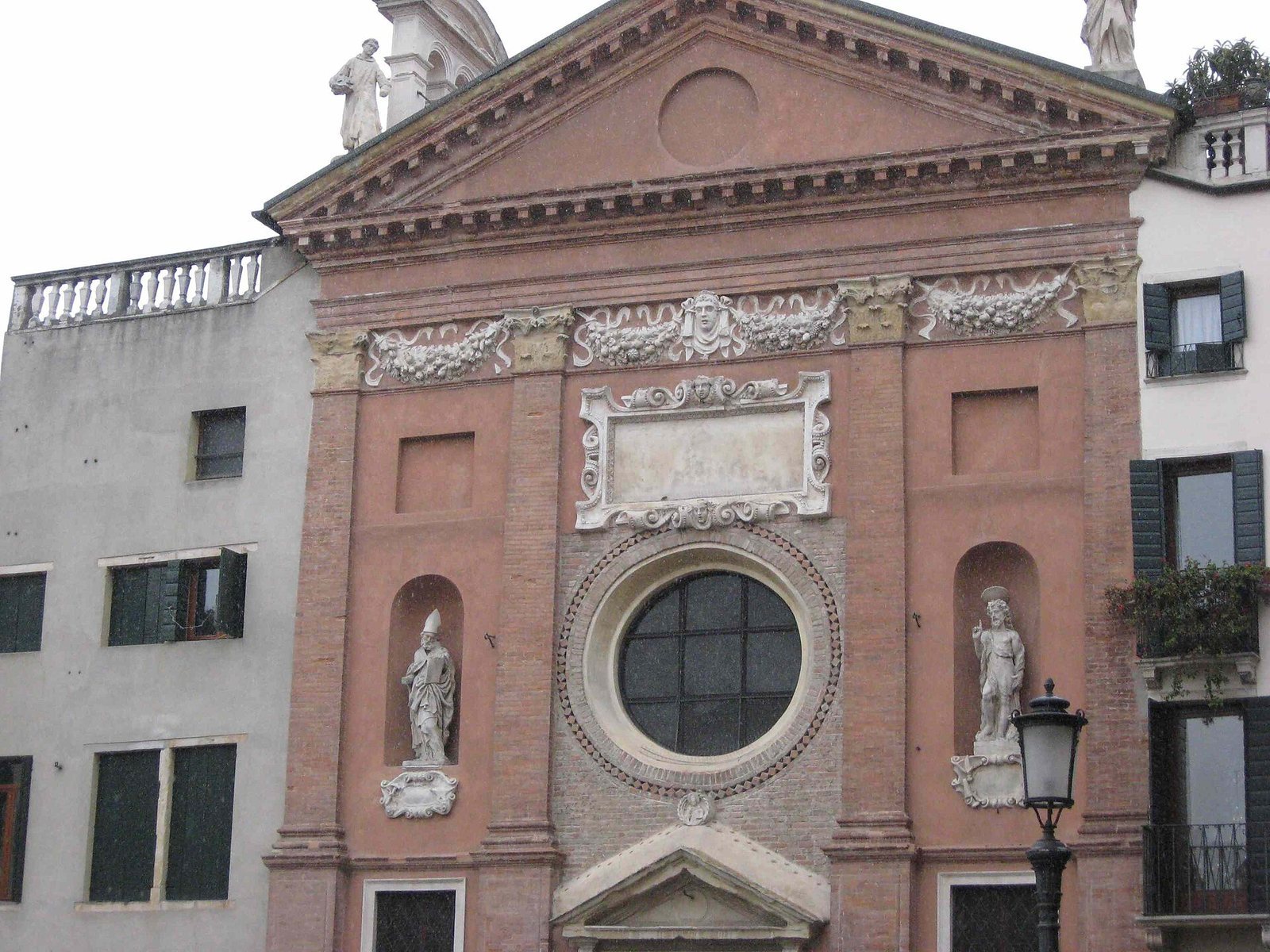
The façade is divided into three vertical sections by pilasters, flat columns attached to the wall, topped with Corinthian capitals, or column tops. Garlands extend between them, and statues of St Clement, St Justina, and St Daniel stand above the pediment. The portal has its own pediment and is topped by a large round window with terracotta decoration dating to the twelfth or thirteenth century. Below it is a small round raised relief of St Clement from the fourteenth century. Niches hold statues of Sant’Alò and St John the Baptist, dated 1696 and bearing guild insignia. A Neo-Baroque bell gable stands at the side of the church.
Interior
Nave and paintings
The nave has a keel-shaped vault, whose profile resembles the underside of a ship’s hull. Paintings by Giovanni Battista Bissoni, Giovanni Battista Rossi, and Giulio Cirello are among the interior works. At the first altar on the right, Pietro Damini’s painting shows Jesus giving the keys to St Peter. A large canvas depicting the Sermon of St John the Baptist is by Francesco Zanella. Near the entrance, a fresco is attributed to Jacopo Bellini.
Altars and sculpture
The main altar, dated 1782, carries an altarpiece by Luca Ferrari of Reggio showing Pope Clement I surrounded by angels. The grocers’ guild paid for the altar of St Anthony of Padua, whose carved relief depicts John the Baptist with tools associated with the grocers’ trade. A statue of St Anthony took the place of Pietro Malombra’s painting of St Charles Borromeo and a nun; Malombra’s painting has since been restored. The Paduan sculptor Tiziano Minio is buried in the church.
Choir loft and organ
The eighteenth-century choir loft occupies the counter-façade and contains an organ in a Rococo case. Domenico Malvestio built the organ in the early twentieth century, probably reusing sound-producing components from an earlier instrument that may date to the seventeenth century. It has one 54-note keyboard and a straight 27-note pedalboard. The keyboard and pedals operate mechanically, while pneumatic controls operate the stops, which select groups of pipes. Most pipes are enclosed in an expression case, an enclosure that can control their sound; some pipes of the Principal 8-foot stop are outside it.