Basilica di San Giovanni Battista al Rosario: A Minor Basilica in Lecce
Site at a Glance
- Popularity
- Medium
- Country
- Italy
- Primary era
- Early Modern
- Eras represented
- Medieval, Early Modern
- Civilizations
- Habsburg, Kingdom of Naples, Spanish
- Site type
- Religious
- Remains
- Basilica
On this page12 sections
History
Dominican origins and construction
The Basilica di San Giovanni Battista al Rosario is a Roman Catholic church in Lecce, Italy, built for the Dominican Order in the Baroque period, an ornate style of art and architecture. An earlier structure on the site dates to 1388, the year Dominican friars arrived in Lecce. Construction of the present church began on 6 March 1691, and its architect contributed personally to the costs.
The architect died in 1710 and, at his own request, was buried in the church. Other artists completed the building in 1728, the year it was consecrated.
Parish and basilica
The Confraternity of Our Lady of the Holy Rosary is based at the church, giving rise to the “al Rosario” in its formal name. The church is also the burial place of Ugo De Blasi, a Lecce priest recognized as Venerable, a Catholic title given in advance of possible beatification and canonization.
Since 1914, the church has served as a parish. In 1948, Pope Pius XII granted it the honorary Catholic title of minor basilica.
Remains
Façade
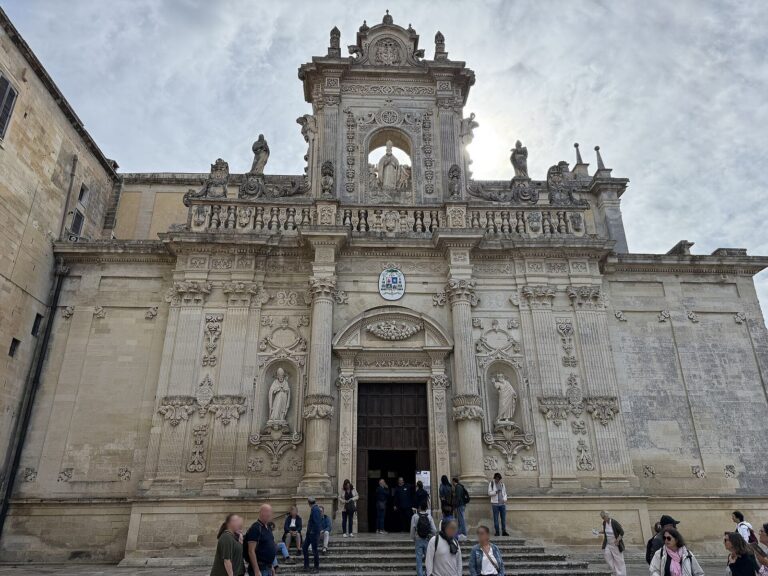
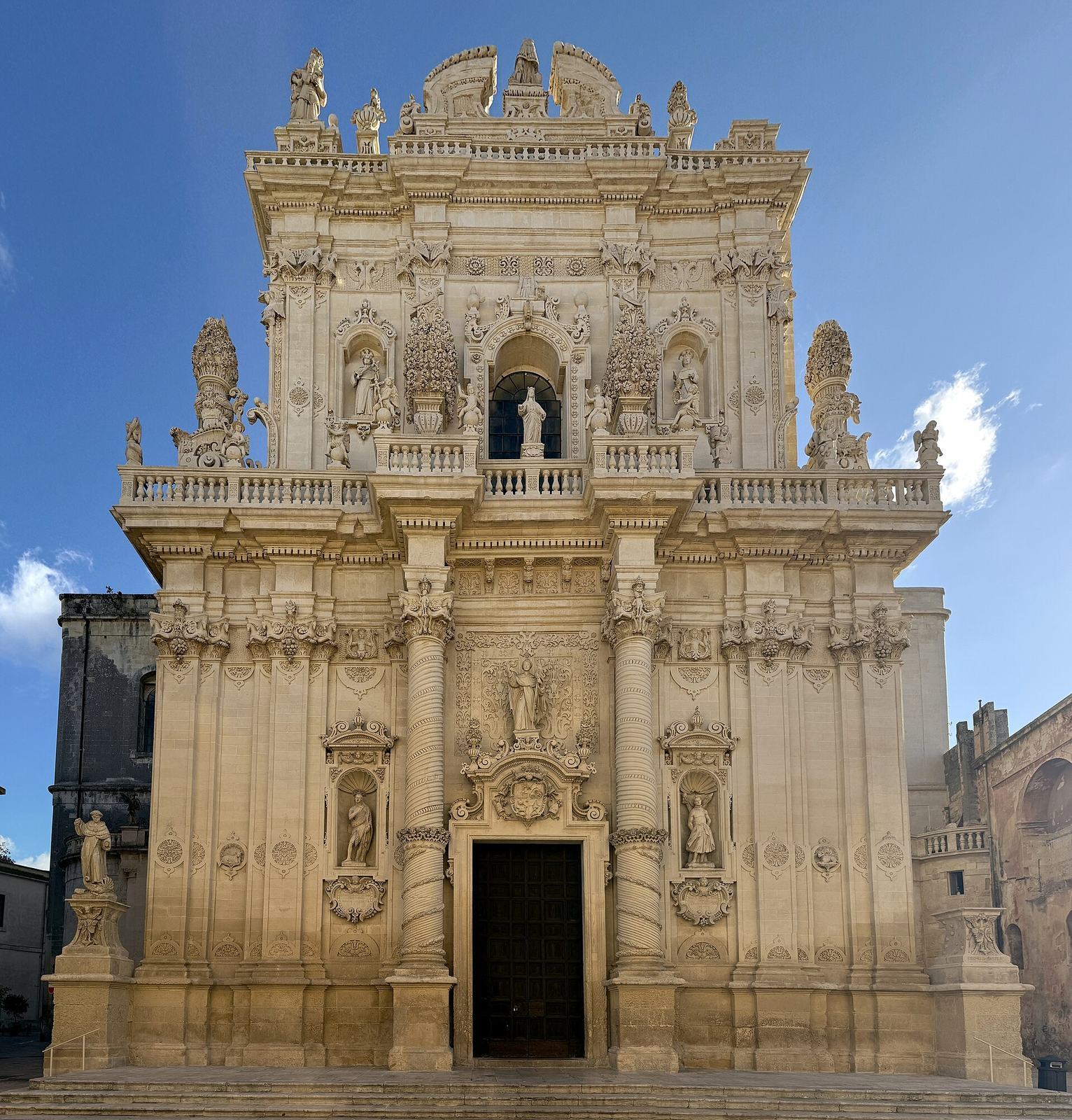
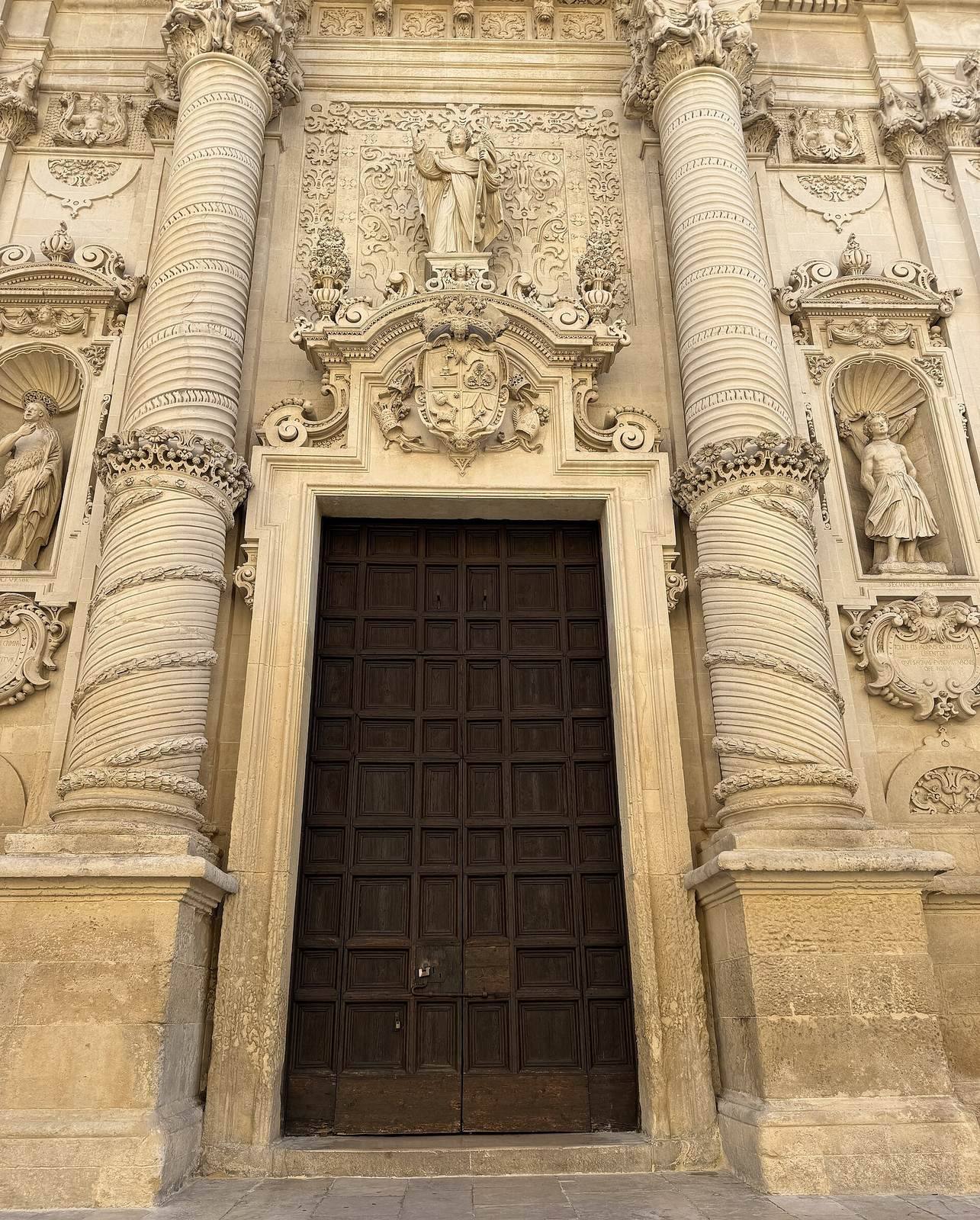
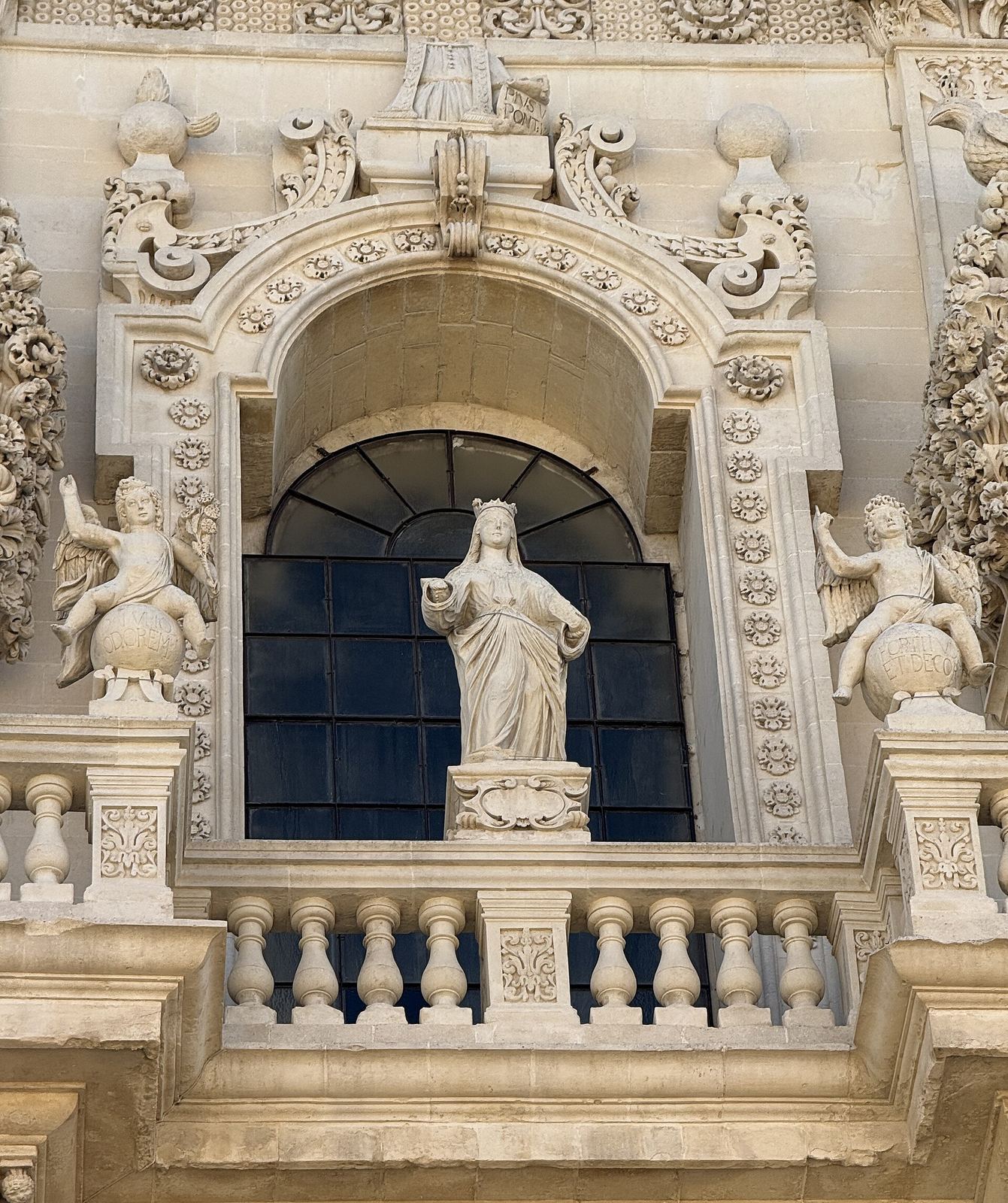
The ornate Baroque façade is arranged in two levels, separated by a balustrade, a railing supported by short posts. Floral trophies decorate the railing, alongside statues on spherical bases that represent visions of the biblical prophet Ezekiel. Below, two large fluted columns frame the main portal, which is topped by a Dominican emblem and a statue of Saint Dominic de Guzmán, founder of the Dominican Order. Niches on either side hold stone figures of Saint John the Baptist and Blessed Francis of the Order of Preachers. Above the balustrade, a statue of the Virgin Mary aligns with the large central window; other statues occupy niches set above those on the lower level. A second balustrade and a broken pediment, whose upper outline is interrupted, crown the façade. Tall plinths stand at its lower outer edges, one supporting a statue of Saint Thomas Aquinas.
Interior
Central octagon
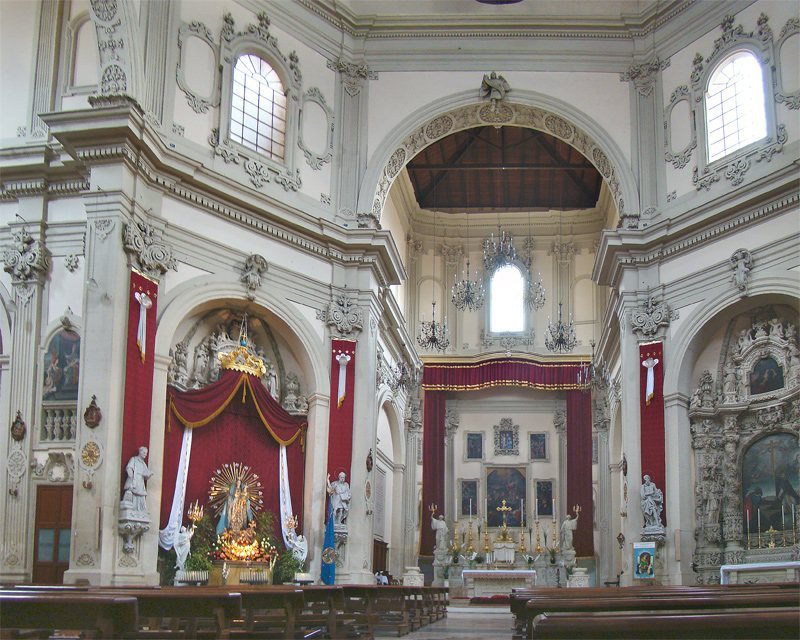
The church’s Greek-cross plan has four arms of roughly equal length arranged around a large octagonal space. Timber trusses roof the interior. The original design called for a dome, but the span and the architect’s death made that plan impracticable. Around the octagon, supports have family coats of arms carved into their bases, commemorating families who helped finance construction. Stone statues of Saint Thomas Aquinas, a Dominican theologian, stand alongside figures of Saints Augustine, Paul, Peter, Gregory the Great, Ambrose, and Jerome.
Entrance and left-arm altars
Twelve short chapels mark the interior perimeter, each with a Baroque altar; further altars stand in chapels around the octagonal crossing. Near the entrance are altars dedicated to Saint Catherine of Siena and the Baptism of Jesus. Both date to the first half of the eighteenth century. The altars along the left arm of the cross are dedicated to the Nativity of Jesus, Our Lady of the Rosary, and the Nativity of Mary.
Main altar and paintings
The presbytery, the part of the church around the main altar, contains an altar made of Lecce stone, a local limestone. Paintings cover the rear wall, including a central seventeenth-century image of the Preaching of Saint John the Baptist by Oronzo Letizia of Alessano. Four smaller works show episodes from Abraham’s life. They are the earliest works by the Neapolitan painter Paolo Finoglio whose dates and authorship are securely established.
Right-arm and crossing altars
Altars along the right arm of the cross are dedicated to the Assumption, the Crucifix, and Saint Rose of Lima. The Saint Rose altar includes a canvas dated 1735 by the Lecce painter Serafino Elmo. Four altars in the octagonal chapels honor Saint Thomas Aquinas, Saint Vincent Ferrer, Saint Dominic, and Saint Peter Martyr, also known as Peter of Verona.
Pulpit
The stone pulpit bears a carved scene from the Apocalypse, the biblical Book of Revelation. Its construction in stone is described as unique among Lecce’s churches.
Cenotaph
On the inner face of the entrance wall is a cenotaph, a memorial for someone whose remains are not necessarily buried there, to Antonio De Ferrariis, known as Galateo. The monument includes marble portraits and inscriptions dated 1561 and 1788.