Annunciation Church: A 17th-Century Orthodox Church in Tula, Russia
Site at a Glance
- Popularity
- Medium
- Country
- Russia
- Primary era
- Early Modern
- Eras represented
- Early Modern, Modern
- Civilizations
- Russian
- Site type
- Religious
- Remains
- Church
On this page8 sections
History
Annunciation Church is an Orthodox church in Tula, Russia, built in stone in 1692 in the Russian ornamental style, a 17th-century Russian style characterized by elaborate decorative forms. It is Tula’s oldest Orthodox church and the city’s only architectural monument dating to the 17th century. The church belongs to the Tula and Efremov diocese, a church district overseen by a bishop.
The wooden church and its parish
A wooden church stood on the site before the stone building. A 1625 record describes it with a chapel dedicated to Basil the Blessed, an Orthodox saint. By 1687, the church had an altar dedicated to the Annunciation, the Christian feast commemorating the announcement to Mary that she would bear Jesus. The parish drew mainly from townspeople, blacksmiths employed by the state, and people supported by charitable almshouses.
Construction and later changes
The stone church was erected in 1692 through the efforts of Feofilakt Fedorov, a priest at the earlier wooden church. A chapel honoring Leontius of Rostov, a saint revered in the Orthodox tradition, was first located inside the church. In 1760 it was moved to the refectory, a hall attached to the main church, which was enlarged to accommodate it. The wooden-plank roof was replaced with iron in 1790, when the altar windows were also enlarged. Other windows were widened in 1804, altering the building’s earlier facade.
The Iveron icon of the Mother of God, an Orthodox image associated with the Iveron Monastery on Mount Athos, became especially venerated from 1850. It had been carried to a nearby fire that threatened widespread damage; afterward, the wind died down and the fire was extinguished. In 1858 the refectory was enlarged with an asymmetrical addition on its south side. Its right chapel was dedicated to the Iveron icon instead of Leontius, whose chapel moved to the left. Merchant I. S. Lomov gave the Iveron icon a silver covering in memory of the fire.
Parish institutions and modern history
An almshouse associated with the church was recorded in 1785, and a parish school began operating there in 1891. The street took its name from the church, became Soviet Lane in 1922, and regained its historic name in 1995. The church closed in 1932, after which its building served for many years as a grocery warehouse. It received state protection as a historic and cultural monument in 1945 and is now a cultural heritage site of federal significance.
The first restoration took place in the first half of the 1970s. Tula and Moscow craftspeople repaired architectural details and surveyed the extensive basement, which had previously served utilitarian purposes. City authorities returned the church to worshippers in 1990, and Archpriest Lev Makhno became its rector in June and led its restoration. The roof was replaced, the domes and bell tower were covered in red copper, and cracks in the walls were sealed. On October 26, 1990, Archbishop Alexy of Alma-Ata and Kazakhstan consecrated the right chapel to the Iveron icon, with the blessing of Metropolitan Serapion of Tula and Belev, a senior bishop. The bell tower received bells in March 1991. The main altar was consecrated on April 7, 1992, the church’s 300th anniversary. The altar of the lower baptismal church, a church or chapel used for baptism, was dedicated to the Mother of God icon titled “Assuage My Sorrows.” Specialists from a branch of the Academy of Sciences in Chernogolovka later installed a clock in the bell tower. An elementary school of the Tula Orthodox classical gymnasium operates at the church. Work carried out from 2022 to 2024 strengthened the foundations, restored brickwork, replaced the roof, and repaired the facades and bell tower.
Remains
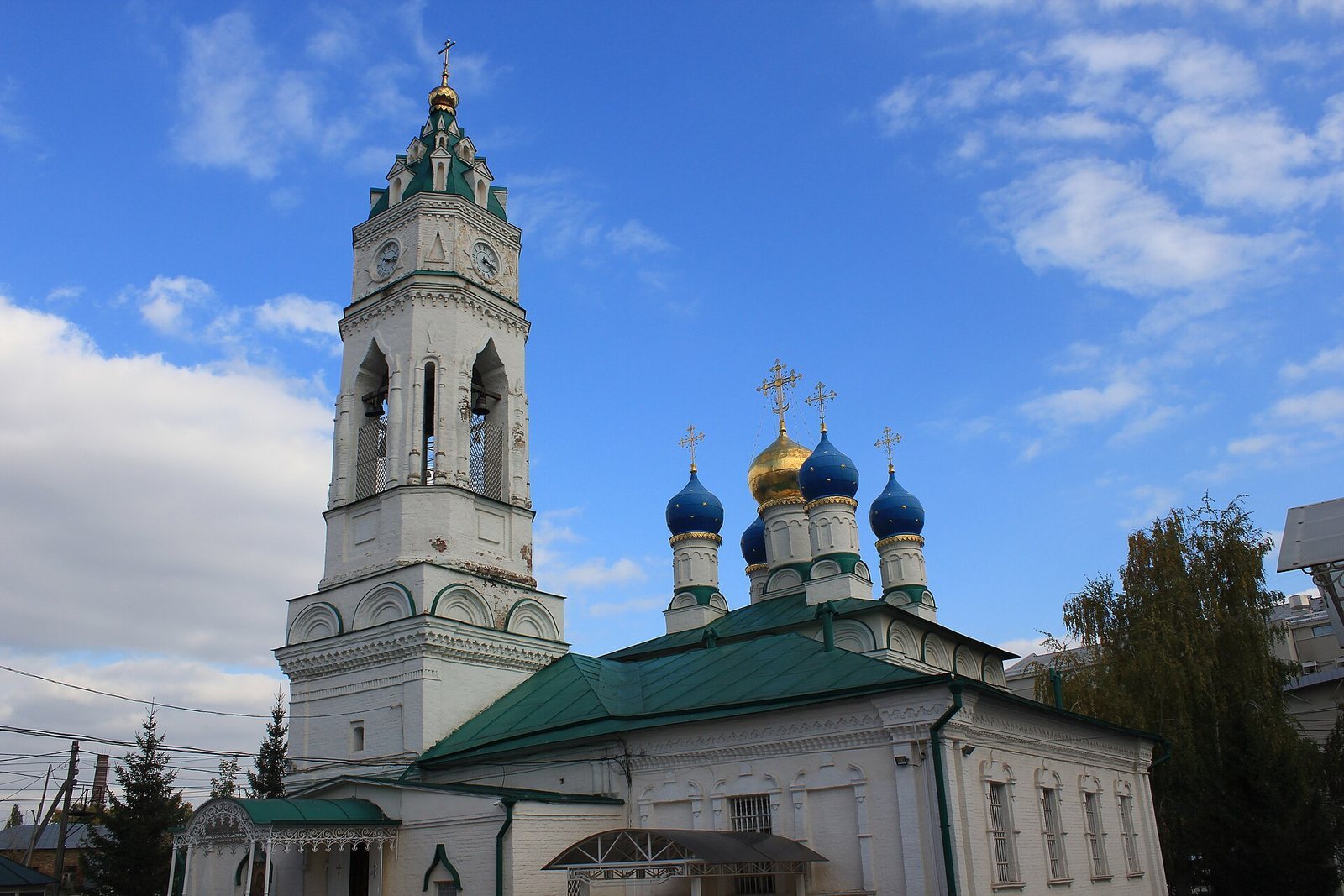
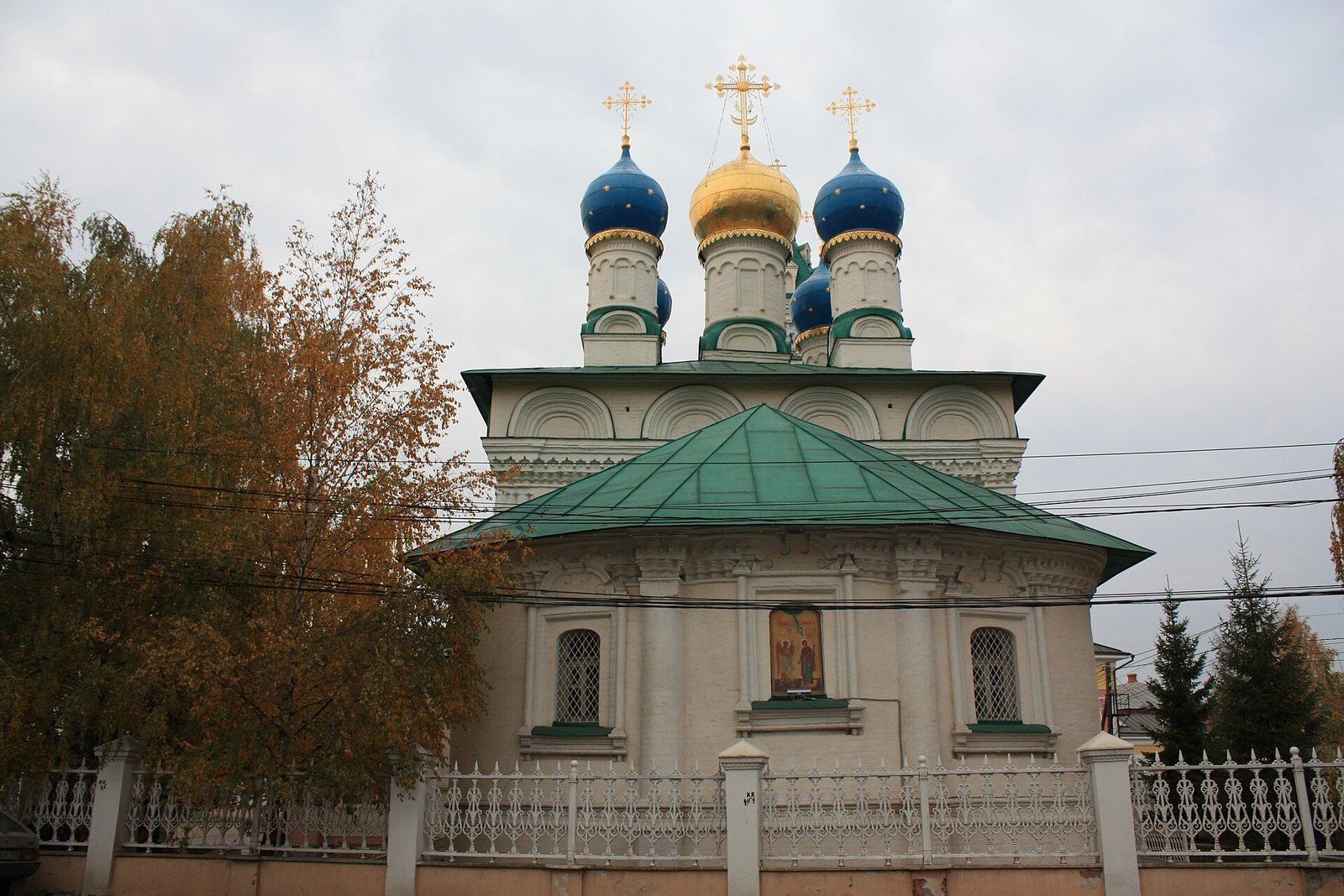
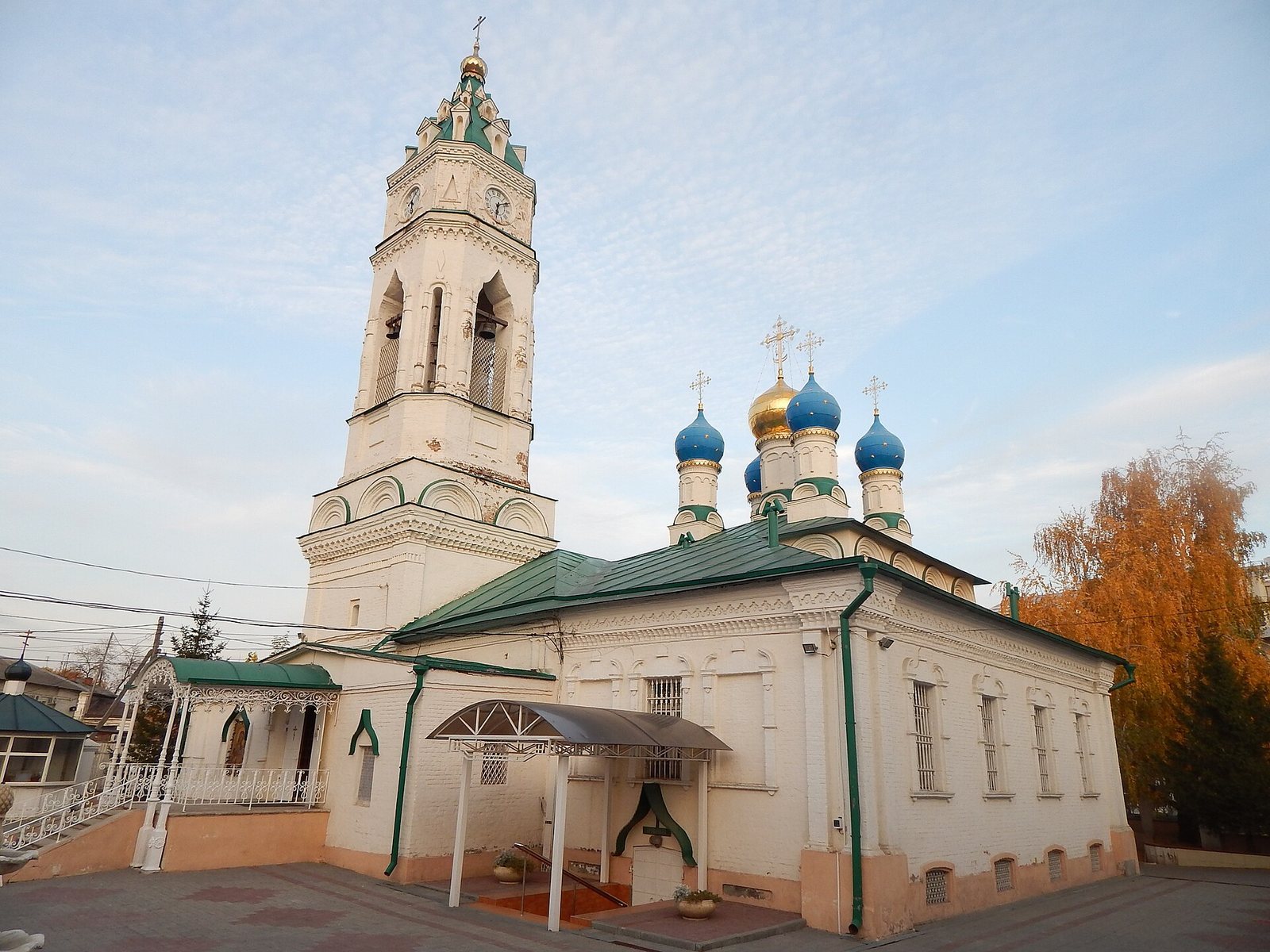
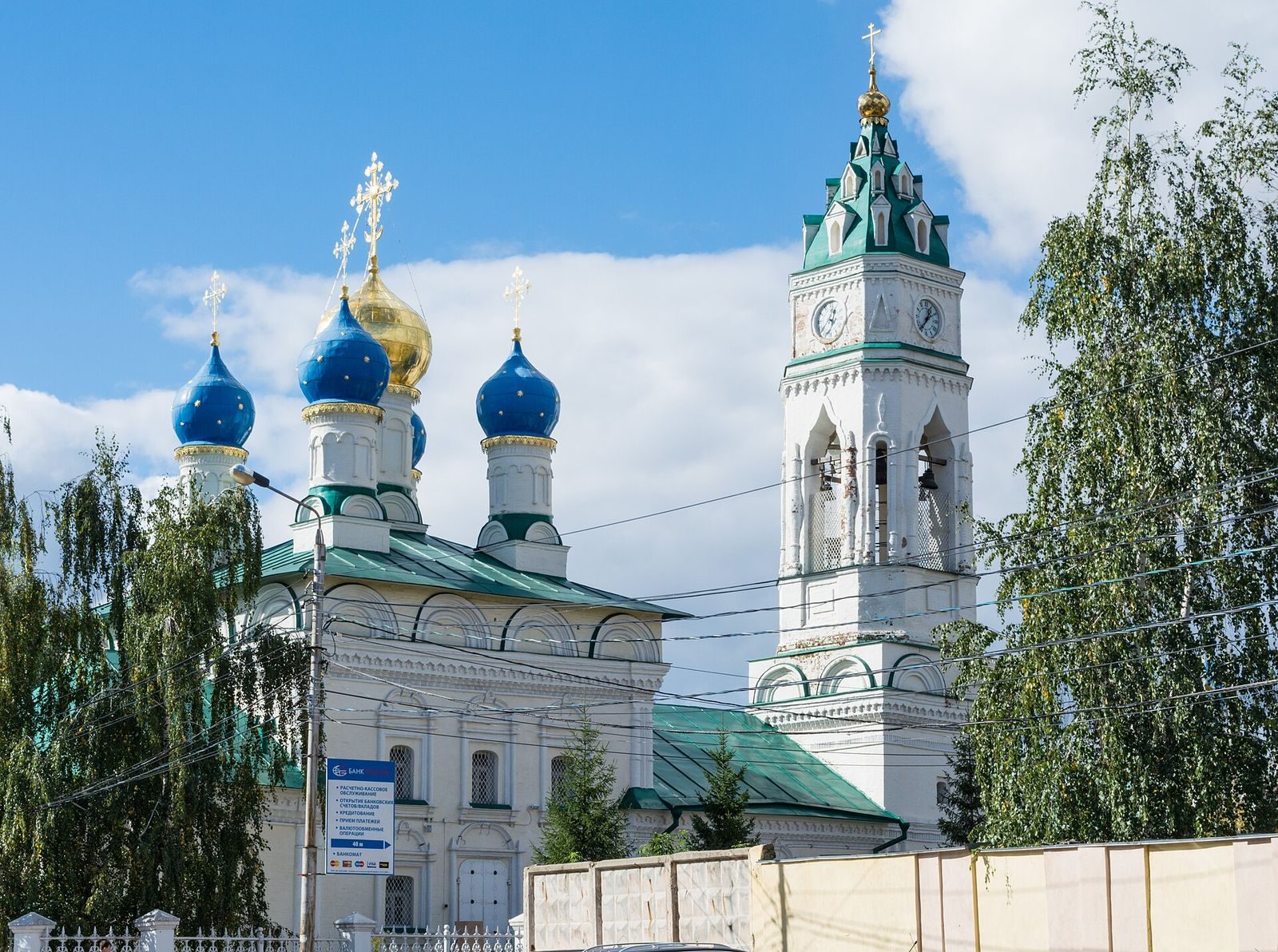
The church is a small, five-domed building with a nearly cubic main body and a four-sided roof. Groups of three slender columns mark its corners, while a broad cornice carries intricate brick patterns. Above it runs a row of kokoshniks, decorative curved or gable-like forms, arranged out of alignment with the windows. Another projecting cornice sits above the corner columns. The five domes stand on drums set on square bases whose faces are decorated with kokoshniks. The drums have no windows, and the upper five-domed arrangement is decorative. Two rows of windows give the exterior the appearance of two storeys, but light a single, undivided interior space.
Bell tower
A high, tent-roofed bell tower joins the northwest corner of the refectory and was probably built with the church in the late 17th century. Its tall, square lower stage is decorated with kokoshniks. Above it rises another high square stage with slightly bevelled corners, rather than the octagonal shape common in bell towers of the 16th and 17th centuries. Narrow, tall windows pierce the middle stage, while the upper stage has triangular windows. The tent forms only about one-sixth of the tower’s total height. Seven bells hang in the tower, ranging in weight from one to 22 poods, a traditional Russian unit of about 16.4 kilograms. The oldest was cast in 1771 and the newest in 1870.
Refectory and chapels
The refectory has a chapel on each side, with the Iveron chapel on the right and the chapel of Leontius of Rostov on the left. Its south side includes the asymmetrical extension associated with the 1858 enlargement. Spacious cellars lie beneath the church, and merchants from the surrounding area rented them for storage.
Inscription and furnishings
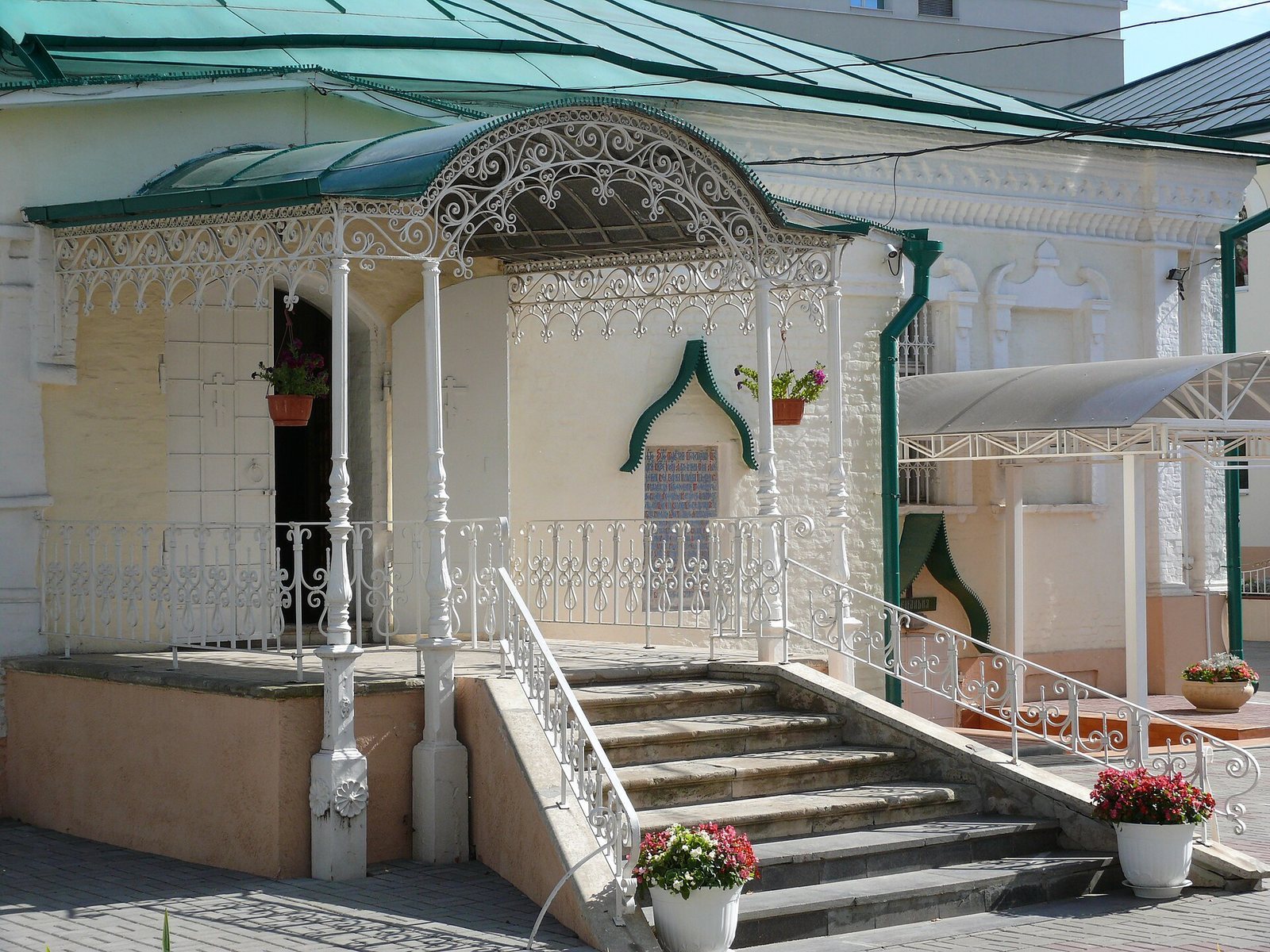
A white-limestone slab measuring 119 by 69 centimetres is set into a vestibule wall. Its inscription gives the church’s construction history, names hieromonk Feodosy, a monk ordained as a priest, as builder, and preserves his testament. In 1862 the church’s icons and liturgical objects, apart from the Gospels, bore more than four poods of silver. The silver was of the 84-zolotnik standard, equivalent to 875 parts per thousand. Alexei Pyatin carved the iconostasis in the right chapel, and Tula resident Igor Borisovich Shchelokov painted its icons.