Hohle Fels: A Paleolithic Cave and Archaeological Site in Germany
Site at a Glance
- Popularity
- High
- Country
- Germany
- Primary era
- Modern
- Eras represented
- Modern
- Civilizations
- German
- Site type
- Domestic
- Remains
- House
On this page17 sections
History
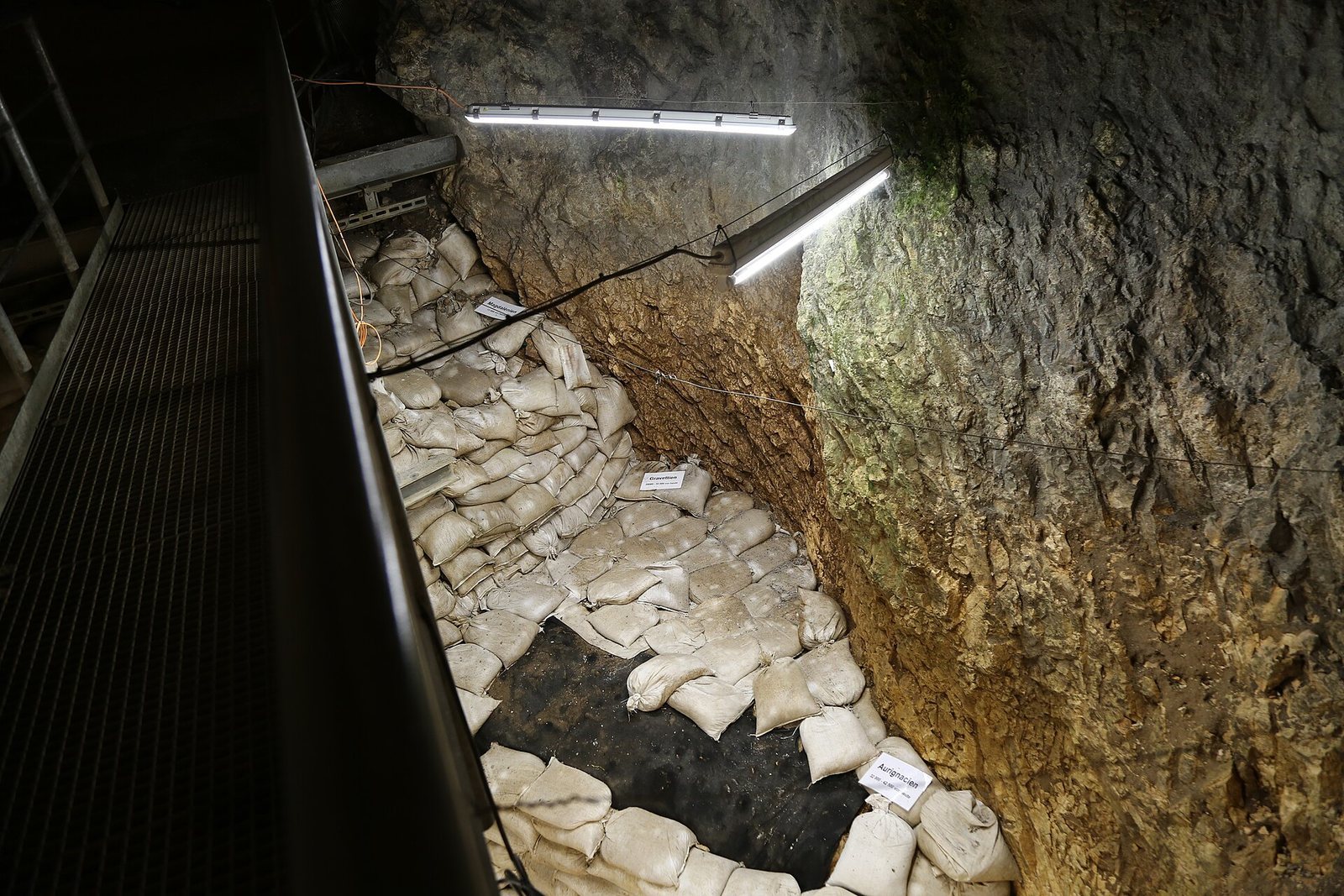
Hohle Fels is a karst cave near Schelklingen, Germany, with evidence of human activity extending from the Middle Paleolithic through the Upper Paleolithic. It is a major Central European archaeological site, preserving traces of successive cultural phases, including the Aurignacian, Gravettian, and Magdalenian. These are archaeological phases within the Upper Paleolithic, ordered here from earlier to later. During the Würm, the last glacial period named in the Alpine region, cave bears also used the cave as a winter den.
Nineteenth-century discovery and excavation
The cave entered modern records in 1830, when potter Karl Friedrich Rixinger found cave-bear bones while digging for clay. He sold them to collector Friedrich von Mandelsloh but did not note their precise findspot. From 1844, cotton manufacturer Georg Reichenbach removed large quantities of bat guano and other deposits to use as fertilizer. In 1870, naturalist Oscar Fraas arranged for the cave earth to be examined and measured its phosphate content at about 19 percent, attributing this to weathered organic material, including guano and bone.
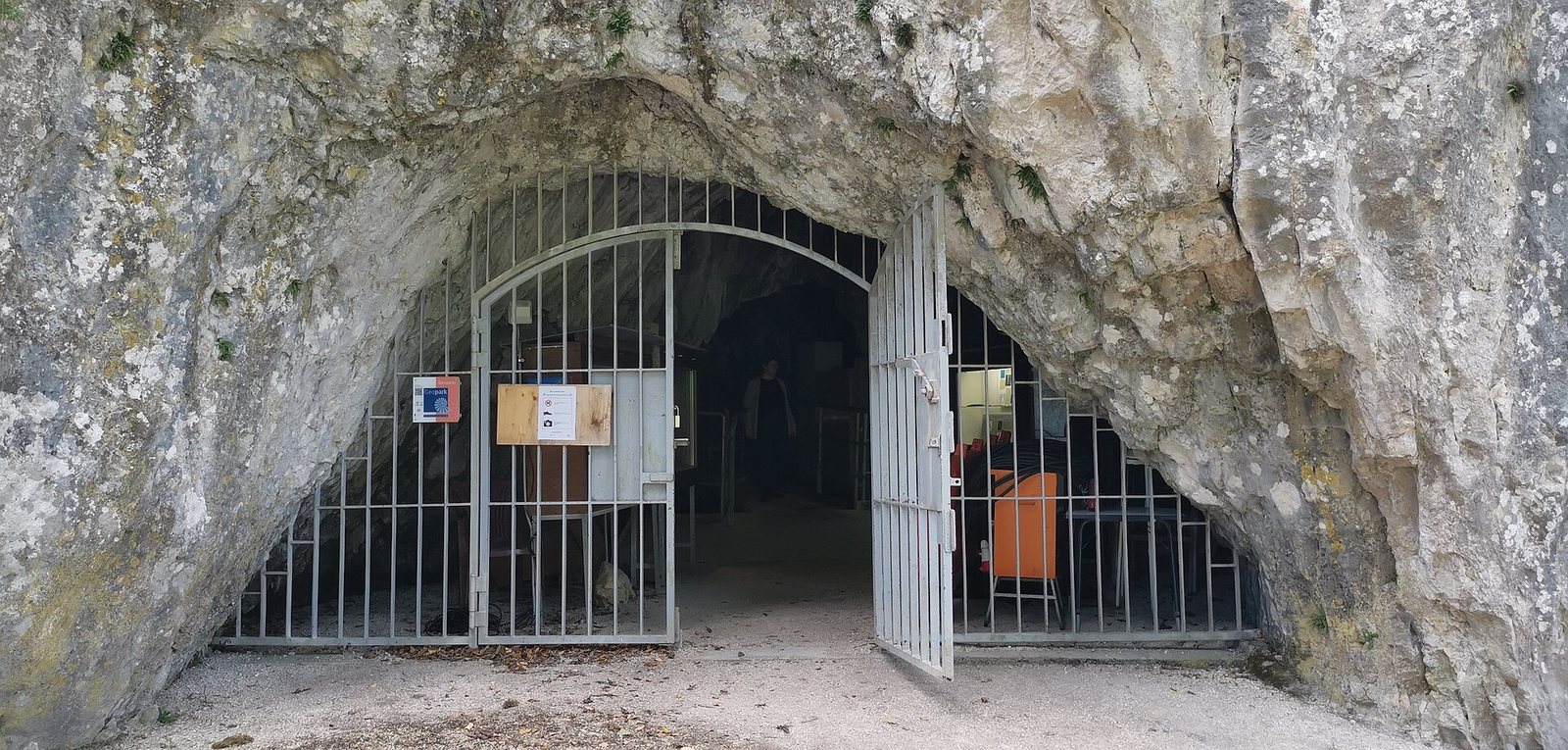
Fraas and pastor Josef Hartmann excavated Hohle Fels in 1870 and 1871, recovering bones of cave bear, reindeer, mammoth, and wild horse. In 1872, the Anthropological Association and Rudolf Virchow, founder of the Berlin Society for Anthropology, Ethnology and Prehistory, visited the cave during a meeting. A barred gate, wooden stairs, and walkways were installed for the occasion. Visitors were allowed to take some excavated objects, while the remaining material, roughly a railway wagon’s load, went to the Royal Natural History Cabinet in Stuttgart.
Twentieth-century research and later recognition
Prehistorian Robert Rudolf Schmidt assigned tools recovered by Fraas to the Aurignacian and Magdalenian, although his 1906 investigation did not find archaeological layers. Gertraud Matschak and Gustav Riek excavated from 1958 to 1960, followed by a survey in 1966 by Bernhard Mangold, Andreas Pöhler, and Helmut Frank. During the Second World War, German armed forces used the cave as a bunker and stored fire pumps belonging to Klöckner-Humboldt-Deutz there.
The University of Tübingen’s Institute for Prehistory began excavations in 1977 under prehistorian Joachim Hahn. Nicholas Conard has led annual excavations since 1997. In the 1990s, the institute adopted Hohle Fels as the standard form of the name, which became usual in its publications under Conard. By 2016, excavations had recovered more than 80,000 stone artifacts and almost 300 ornaments.
In 2017, Hohle Fels became part of the UNESCO World Heritage property Caves and Ice Age Art in the Swabian Jura, which includes three caves in the Ach Valley and three in the Lone Valley. The inscription recognized the caves’ early figurative art and musical instruments under cultural criterion iii, which concerns exceptional testimony to a cultural tradition or civilization. That year, Hohle Fels was also named a Geopoint, a designated geological point of interest within the UNESCO Global Geopark Swabian Alb.
Remains
Cave form and archaeological layers
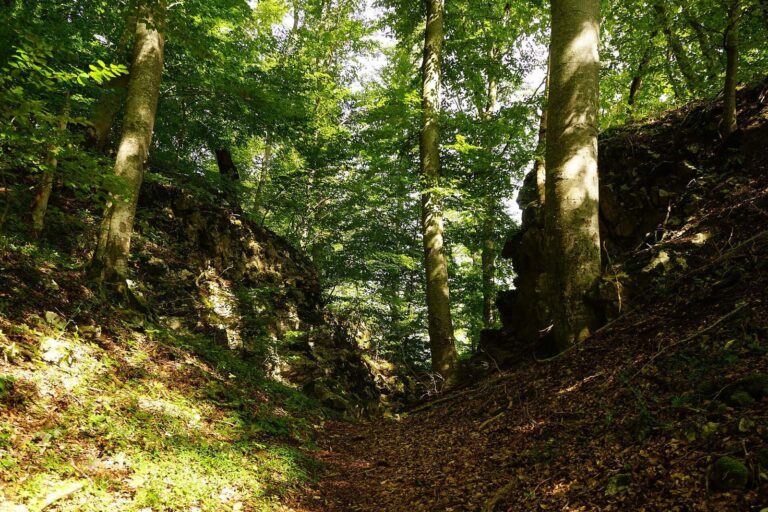
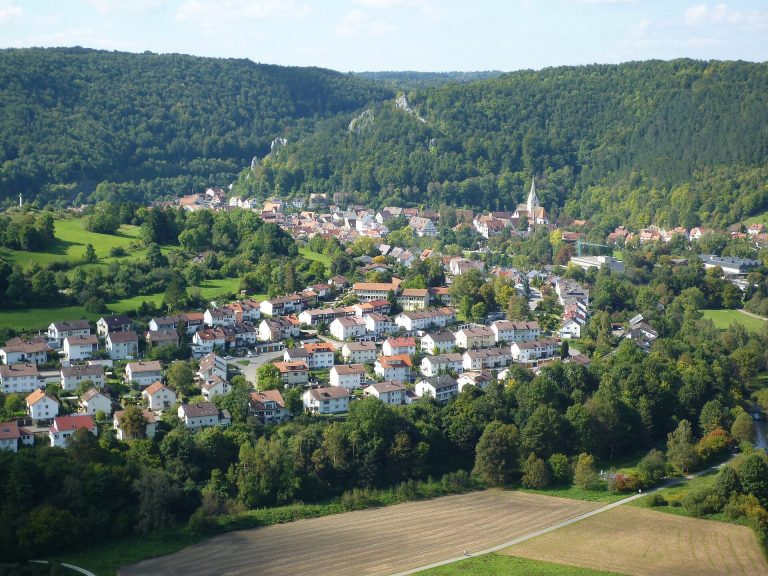
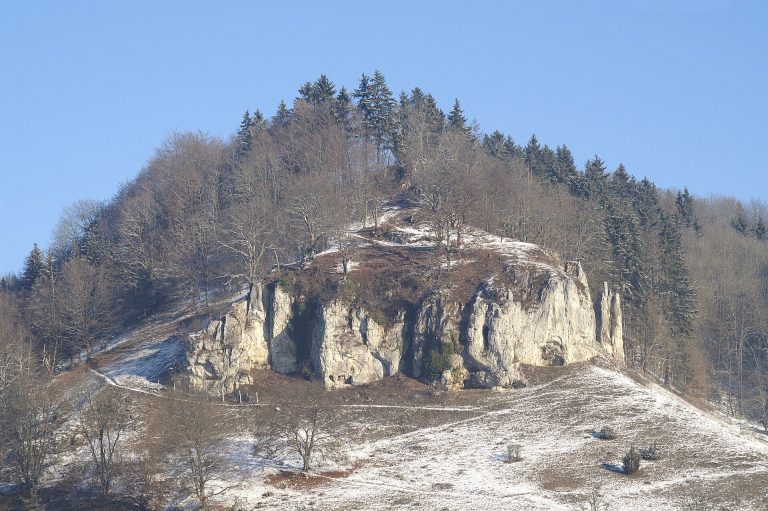
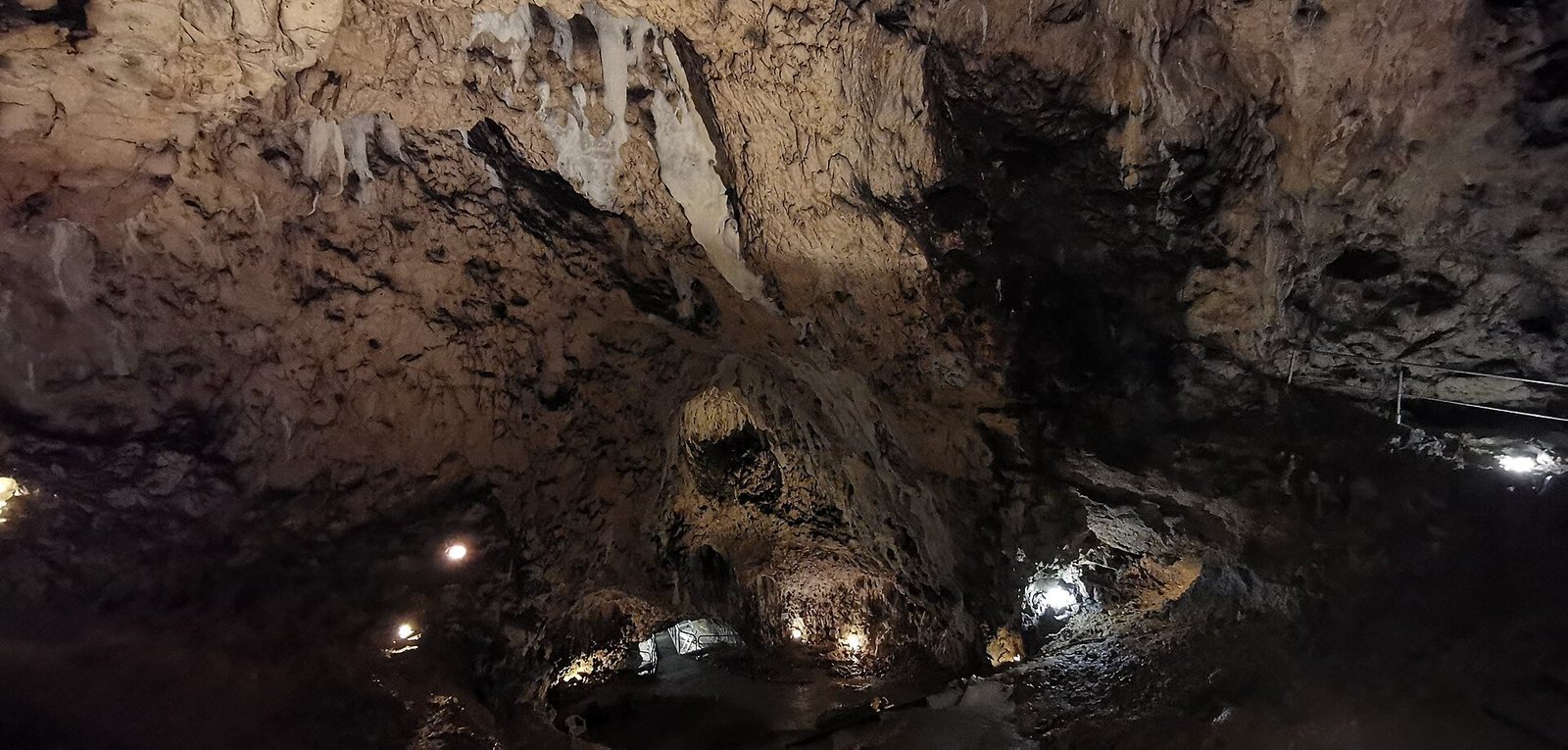
The cave formed in soluble rock through water-driven dissolution. Its entrance lies about one kilometre east of central Schelklingen, at 534 metres above sea level, in a sponge-reef formation of the White Jurassic at the foot of the right-hand slope of the present-day Ach Valley. Its geological classification is Malm epsilon, a subdivision of the Upper Jurassic in a traditional regional scheme. A passage about 30 metres long leads to a chamber roughly 30 metres high, covering about 500 square metres and holding approximately 6,000 cubic metres. Two passages, each a little over 20 metres long, branch from the chamber. Its shape has prompted the description oven cave, and the chamber is among the largest in the Swabian Jura.
The cave deposits are divided into 18 layers, preserving finds from different periods of human activity. The objects and remains described below come from particular horizons or layers, which are identified where their positions are known.
Middle Paleolithic evidence
Horizon X
A bifacial leaf point made from local Jurassic chert was recovered in 2020 from Middle Paleolithic horizon X, about 1.2 metres below the base of the Aurignacian layers. The horizon is more than 60,000 years old and has also been dated to roughly 65,000 years by electron paramagnetic resonance, a method for estimating the age of archaeological deposits. Wear on the point indicates that it was attached to a handle at its less pointed end and used as a hunting weapon. Its damage most closely fits use as a thrusting-spear point, though the precise way it was wielded remains uncertain. Six bird bones from the same horizon have cut marks made with stone tools.
Early Upper Paleolithic art and tools
Ivory figurines
A mammoth-ivory animal figurine is represented by a head found in 1999 and a matching body fragment recovered in 2022. The head was first identified as a horse, but the completed figure may depict a cave bear or cave lion; its identity is uncertain. Two fragments of a separate, 4.7-centimetre bird figurine, found in 2001 and 2002, fit together. Its elongated form and posture have been interpreted as those of a waterbird.
A 2.5-centimetre human figurine found in 2002 may have a cat-like head. It has been described as a small lion-human by comparison with the Lion Man from Hohlenstein-Stadel. The 6-centimetre Venus of Hohle Fels was recovered in 2008 from layer V, assigned to the early Aurignacian. Its minimum age is given as 32,000 years BP, meaning before 1950, or at least 35,000 calibrated BC, a calendar-date equivalent adjusted from a radiocarbon age. It is among the oldest known Venus figurines. Two matching ivory fragments found in 2014 were assembled into a decorated figurative piece. Its resemblance to the Venus led excavators to suggest that it could be part of a second female figurine.
A 5.9-centimetre mammoth-ivory figurine body recovered from lower Aurignacian layers in 2023 has been interpreted as an otter; its head is missing. Two more mammoth-ivory bird figurines, about 40,000 years old, came from lower Aurignacian layers in 2025. One depicts a resting bird, possibly incubating eggs. The other is about 2 centimetres long, with outspread wings, a broken left wing, and parallel incisions representing feathers. It has been described as the smallest known Ice Age artwork from the UNESCO World Heritage region.
Flutes and worked ivory
A nearly complete flute made from a griffon-vulture forearm bone was found in layer Va in 2008. It survives to a length of 21.8 centimetres and is about 0.8 centimetres in diameter; the layer dates to at least 35,000 calibrated BC. Two other flute fragments from the cave are made of mammoth ivory and were probably produced by the same technique as a flute fragment from nearby Geißenklösterle.
Forty bead-shaped mammoth-ivory ornaments presented in 2017 represent several stages of production and use, from blanks and unfinished pieces to worn beads. Some have multiple perforations, a form known from Hohle Fels alone. Fifteen matching pieces of a four-hole perforated ivory baton, found in August 2015 and described in 2024, were reconstructed as a tool 20.4 centimetres long, 3.6 centimetres wide, and 1.5 centimetres thick. Traces of plant fibres, fine grooves, and experiments indicate that it was probably used to twist fibres into cord.
An ivory tool recovered in July 2024 measures 24.7 centimetres and weighs 168 grams. About 39,000 years old, it was first used as a tool of uncertain function and later reshaped into a chisel. It is the largest fully shaped ivory tool known from Hohle Fels.
Gravettian remains
Cave-bear hunting and butchery
A flint projectile point embedded in a cave bear’s chest vertebra provides direct evidence of cave-bear hunting at Hohle Fels. The animal was probably killed while hibernating in the cave. Cut marks on other bear bones show that carcasses were butchered.
Stone tools and pigment
Fourteen matching fragments of an anthracite-coloured siltstone object, a fine-grained sedimentary rock formed from compacted silt, were recovered from a Gravettian layer in 2004. Reconstructed, the phallus-shaped object measures 19.2 centimetres and is known as the Phallus of Schelklingen. Scars and impact and scraping marks have led to its interpretation as both a retoucher, used to shape or resharpen stone tools, and a striking tool.
A pebble found in Gravettian layer IIb in 2018 has a faceted surface with grinding marks and red pigment powder, evidence that it was used to grind ochre into pigment. Notches and impact marks also indicate use as a hammerstone.
Magdalenian remains
Painted stones and pigment
A limestone fragment found in upper Magdalenian layer GH 1k in 1998 measures 7.6 centimetres long. Two double rows of red dots on its convex upper surface were identified as ochre pigment containing limonite. Four other painted stones were found in 2009. One from layer AH Ia has two complete double rows and part of another dotted row; a stone from layer AH I has blurred red marks. Pigment pieces from upper Magdalenian layers include hematite from AH Ic and red ochre from AH Ib. These finds indicate that the red paint was probably made from red ochre or hematite, minerals that occur naturally in karst fissures in the Swabian Jura.
Human remains and genetic findings
Remains from at least five individuals have been identified at Hohle Fels. DNA was extracted in 2016 from two Magdalenian thigh-bone fragments, HohleFels10 and HohleFels49, and a cranial fragment, HohleFels79. The thigh-bone fragments may belong to the same person. HohleFels10 and HohleFels49 were indirectly dated to about 16,000 to 14,260 years BP; HohleFels79 was directly dated to about 15,070 to 14,270 years BP.
All three individuals were assigned mitochondrial haplogroup U8a. Mitochondrial DNA passes through the maternal line, and haplogroups identify broad branches of genetic ancestry. Y-chromosome DNA, passed through the paternal line, identified haplogroup I2 in HohleFels49 and I2a1a in HohleFels10 and HohleFels79.
Finds on display
The reconstructed animal figurine, waterbird figurine, Venus of Hohle Fels, and flute are displayed in the permanent exhibition of the Prehistory Museum in Blaubeuren.