Hallstatt: A Prehistoric Salt-Mining and Archaeological Landscape
Site at a Glance
- Popularity
- High
- Country
- Austria
- Primary era
- Bronze Age
- Eras represented
- Bronze Age, Iron Age, Medieval, Modern
- Civilizations
- Celtic, Duchy of Austria, Habsburg, Hallstatt culture, Holy Roman Empire
- Site type
- Economic
- Remains
- Mine
On this page25 sections
History
Hallstatt is an archaeological landscape beside Hallstätter See in Austria, shaped by human activity over more than 7,000 years and by salt extraction from at least 1500 BC. Its remains span the salt mountain above the lakeside settlement as well as the settlement area itself.
Bronze Age salt production
Salt mining is securely established at Hallstatt by about 1500 BC. A debris flow buried the known Bronze Age mines in the 13th century BC. It is uncertain whether miners then shifted to another part of the mountain or whether extraction paused until the Hallstatt period. Late Bronze Age pottery and the need for workers suggest that people lived on the mountain, although the presence of a lakeside settlement at this time remains uncertain.
Bronze Age Hallstatt also processed meat on a substantial scale. Timber structures once interpreted as dwellings are now understood as installations for salting meat. Radiocarbon dating places their wood in the 13th and 12th centuries BC. Animal remains indicate that pork was processed along with sheep, goats, and cattle. Selected cuts were probably brought to the mountain, salted, and taken into the mines to mature. Hallstatt may have been a major production centre, and its salt was probably carried over long distances, though its wider trading role and the uses of the salt remain uncertain.
Hallstatt-period mining and burial
The Hallstatt period is an archaeological term for phases of the Early Iron Age, named after Hallstatt and its cemetery. Mining resumed in a different part of the mountain, using a different method, roughly three centuries after the end of Bronze Age mining. Salt production helped sustain the community’s prosperity. The cemetery’s rich grave goods point to far-reaching contacts, but individual objects may have arrived through trade, gifts, migration, theft, or warfare.
Evidence from human remains suggests that people buried in the cemetery had undertaken strenuous work, probably in mining or salt processing. Wear on the bones of adults and children indicates that women carried heavy loads and that some children may have worked from about eight years of age. Children’s shoes and a cap sized for an infant also suggest that children, and possibly nursing infants, were present in the mines.
A major debris flow around the middle of the fourth century BC brought Hallstatt-period mining to a sudden end and may have left the valley uninhabitable for years. A miner now known as the Man in Salt was discovered in 1734 during extraction at the Kilbwerk and buried in Hallstatt’s cemetery. Investigations at the findspot in the 1960s linked his death with the disaster and the end of mining in this period.
La Tène and Roman Hallstatt
The La Tène period, the archaeological era following the Hallstatt period and named after a Swiss site, saw renewed mining and settlement. Whether mining continued immediately after the fourth-century BC disaster is uncertain. The oldest known La Tène mining and settlement remains date to the second century BC and lie at the more sheltered Dammwiese. The cemetery also continued in use during this period.
A settlement beside the lake at present-day Lahn was probably founded late in the first century AD and flourished during the second and third centuries. It was probably reduced in size in the fourth century, but habitation continued. Noricum, an ancient kingdom that included Hallstatt and later became a Roman province, entered a treaty relationship with Rome in 15 BC under Augustus. Local elites retained administrative control and their privileges. Under Claudius, whose reign lasted from AD 41 to 54, Noricum became a province with a Roman military presence, and many highland settlements in the region gave way to lower settlements and towns.
Salt production arrangements under Roman rule remain uncertain. The La Tène mine or settlement may have continued in use, or Roman authorities may have controlled the salt trade. In 488, Odoacer ordered the Romanized population to leave the area. Pottery fragments and place-names with late Latin roots suggest that people nevertheless remained at Hallstatt. Salt use between the fifth and thirteenth centuries is uncertain.
Medieval salt trade and state control
Around 904, King Louis IV the Child ordered Count Aribo to regulate trade routes, delivery permissions, tolls, and payments, at the urging of the archbishops of Salzburg and the bishops of Passau. The resulting Raffelstetten Customs Regulation strengthened the two church authorities’ control over their salt markets. Hallstatt salt remained important in the Traungau and areas to its southeast.
A conflict over salt trade between Salzburg and the Habsburgs brought fighting to the region in 1291–1297. Salzburg Archbishop Konrad IV of Fohnsdorf invaded Habsburg territory, and his forces destroyed two newly established boiling pans at Gosau and Hallstatt’s core mine, the Draunau. Salzburg lost the conflict, paid the Habsburgs a large sum under an agreement against establishing further boiling pans, and ceded territory. A charter issued in 1311 by Elisabeth of Carinthia, Gorizia and Tyrol reorganized mining and salt-boiling under state authority, granted Hallstatt’s citizens market rights and certain holdings, and indicates that mining was already operating.
In the late fifteenth century, repeated leases of the salt mountain were intended to raise state revenue, but the private operations damaged the workings. Maximilian I ended the leases. From the sixteenth century, experts inspected the salt works; their proposals appeared in the 1524 Hallstatt Ordinance, and the mountain was fully surveyed in 1527. Under Maximilian and later Habsburg rulers, Habsburg control of salt production expanded while Salzburg’s archbishops were progressively excluded from the trade. The shift from dry mining to brine production also changed the industry: salt was dissolved in water underground, then the brine was carried to valley boiling houses. Their demand for firewood helped shape the wider region.
Modern mining and archaeological research
A fire in 1750 destroyed many houses in Hallstatt’s centre, all state buildings, and nine houses belonging to salt merchants. Around 1900, about 250 people worked in the salt works, mostly from Hallstatt and nearby communities. They worked eight-hour underground or twelve-hour surface shifts and stayed on the mountain during the working week. Economic crisis in the 1920s led to partial closures. A new mine entrance opened four metres above lake level, and its connection to higher levels in 1952 ended the workers’ long-standing residence on the mountain. The mine manager, who had lived in the Rudolfsturm since the thirteenth century, moved to the valley in 1960. Salt extraction continues under Salinen Austria AG.
Finds from Hallstatt had attracted attention by about 1600, and excavations began in 1824. Mining official and archaeologist Johann Georg Ramsauer excavated systematically in the Salzbergtal from 1846 to 1863, uncovering 980 graves and producing detailed plans, descriptions, and watercolours. Isidor Engl excavated the cemetery from 1871 to 1877. Friedrich Morton and Adolf Mahr began work in the Bronze Age mine at Grünerwerk in 1927; Morton later excavated at the Dammwiese and uncovered 61 cemetery burials dating from 600 to 350 BC.
Modern investigations in the prehistoric mines began in 1960 near the findspot of the Man in Salt. Later work expanded research into Bronze Age and Hallstatt-period workings. Excavations in 1992 showed that the cemetery extended beyond the area then thought to have been explored, and annual cemetery excavations began in 1993. Work in building cellars and other small areas from 1987 to 1994 also revealed settlement traces from several periods. Since 1995, the Natural History Museum in Vienna and Salinen Austria have maintained a research base at Hallstatt, now located in the old mountain forge in the high valley. Their work includes experimental archaeology and collaboration across scientific fields.
Hallstatt has belonged to a UNESCO World Heritage property since 1996. Protection of town buildings and limited open space restrict excavation, while slope failures and debris flows complicate fieldwork. Since 2016, core samples taken from a pontoon over lakebed sediments have been used to study plant and mineral layers and investigate the area’s history back to the Stone Age; further exploratory drilling followed in 2019.
Remains
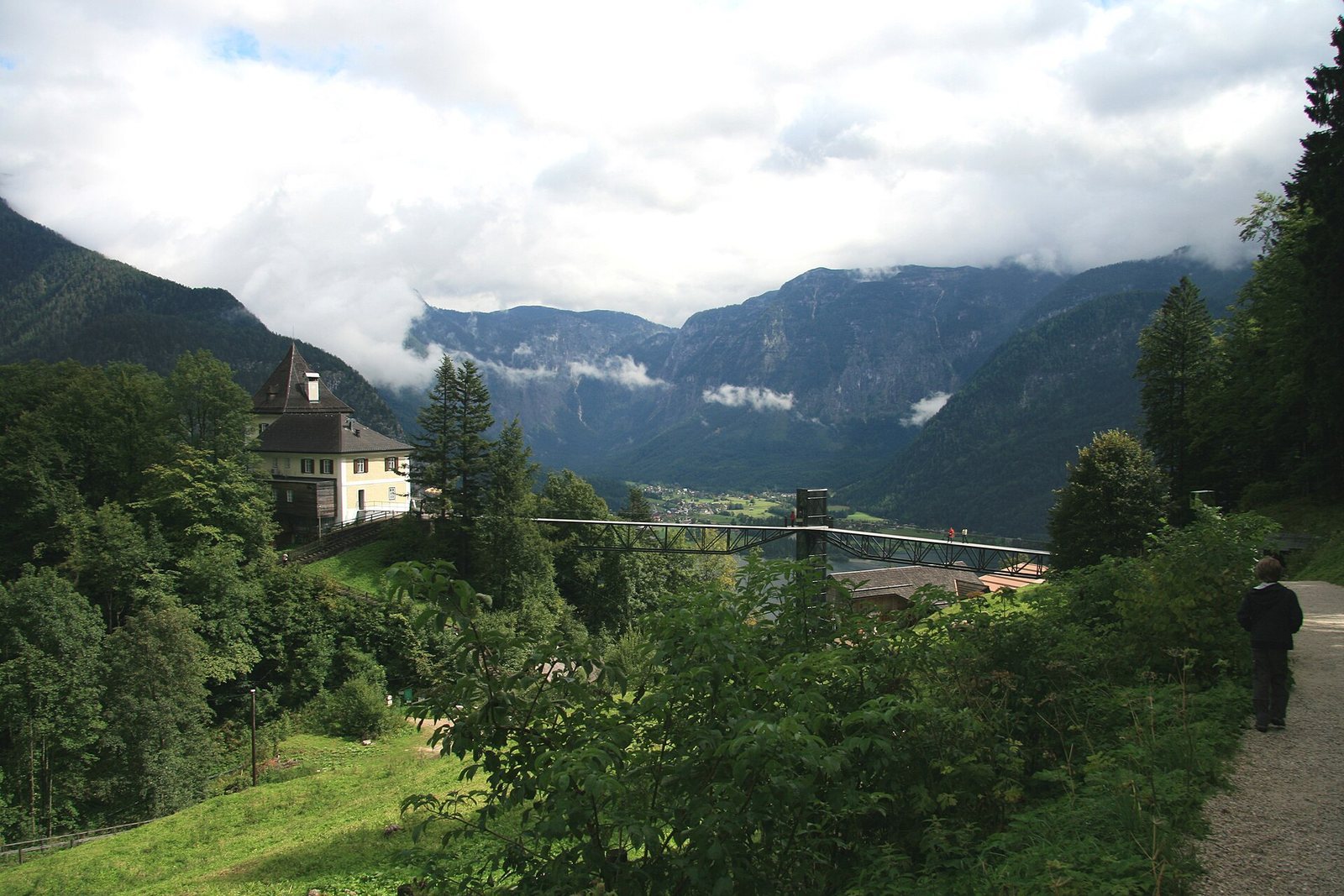
The archaeological landscape extends from the lakeside settlement at Hallstätter See up to the salt mountain and high Salzbergtal. Prehistoric mines and processing areas occupy the mountain, while cemetery and settlement remains are found in the high valley and beside the lake. The surviving evidence includes underground workings, wooden structures, burials, buildings, tools, and unusually well-preserved organic materials.
Early finds and Bronze Age mines
Early objects and mine workings
The oldest known human-made object from Hallstatt is an antler pick, about 7,000 years old, found in 1838 in the Kaiser-Josef mine passage. Stone axes from the salt mountain and settlement area date from 5000 to 2000 BC. Three Bronze Age mines are known: Appoldwerk, Christian von Tuschwerk, and Grünerwerk. Their vertical shafts descended more than 100 metres, with side chambers cut into the salt deposits. One measured chamber at Christian von Tuschwerk was at least 50 metres long and more than 20 metres wide, with a height exceeding 10 metres. Miners extracted salt dry, cutting parallel grooves with bronze picks and carrying the loosened pieces in bags up wooden stairs before hauling them to the surface in woollen sacks. Specialized equipment included carrying bags and leather hand protection.
Wooden staircase at Christian von Tuschwerk
A wooden staircase from Christian von Tuschwerk survives in its entirety. Tree-ring dating places its timbers in 1344 and 1343 BC, making it the oldest preserved wooden staircase known in Europe. More than a metre wide, it allowed people to pass or carry heavy loads alongside one another. Two log stringers, each 20 to 35 centimetres in diameter, have deep grooves holding the tread boards by square tenons; spacer boards sit above and below each tread. Its construction in separate parts made the staircase easier to transport and repair.
Mountain pressure threatened the staircase, so it was recorded at its findspot, dismantled into more than 60 pieces, and moved to the Natural History Museum in Vienna for technical study, including computed tomography. Since 2015 it has been reassembled in a purpose-built chamber in the Hallstatt mine. A sealed display case and climate monitoring help maintain conditions suitable for the wood.
Meat-curing installations
Large wooden block structures on the salt mountain are interpreted as installations for curing meat. Their basins could hold enough meat to salt 150 to 200 pigs at one time. Excavated animal bones are mainly from pigs, with sheep, goats, and cattle also represented. Many come from animals of a narrow age range and regularly lack particular body parts, evidence consistent with selected cuts being processed at the site.
Hallstatt-period mine and cemetery
Mining galleries and salt
Hallstatt-period workings followed the salt veins through horizontal galleries. The best-investigated gallery extends for more than 170 metres, measures 5 to 27 metres across, and reaches up to 20 metres in height. Bronze picks left heart-shaped grooves in the salt; their impressions remain visible in the Heart Chamber at Stügerwerk. Two salt slabs from this period survive, weighing 12 and 42 kilograms, while impressions in the rock suggest that some extracted slabs exceeded 100 kilograms. Small salt fragments are abundant in the mining deposits. In some places, debris that entered abandoned workings preserved their original dimensions against pressure from the mountain.
Cemetery and burial practices
The cemetery contains burials dating from about 800 to 400 BC and is estimated to have held roughly 5,000 to 6,000 graves. Cremations and inhumations occur throughout its use, with their relative frequency changing over time. Twelve urn burials are known. Some cremation deposits with circular outlines may have been placed in organic containers. Inhumations were usually laid on their backs, most often with heads to the west and feet to the east, though other orientations and body positions also occur. Burials range from infants to elderly adults.
Grave goods and the sword from grave 994
Grave goods include vessels, finely made weapons, and elaborate jewellery. About twenty swords from Hallstatt-period warrior graves survive. Those dating from 800 to 600 BC are bronze or iron, and the most ornate examples have ivory hilts. Antenna-hilted daggers, sometimes with elaborate or figurative decoration, occur in graves dating from 600 to 400 BC.
A rich Early La Tène burial, grave 994, contained a sword in its scabbard, wrapped in cloth and placed beside the deceased’s right arm. The hilt ends form a bird’s head on each side. Four decorated panels on the scabbard show armed riders and foot soldiers, wheels held by pairs of figures, and two men wrestling. The imagery has been interpreted in different ways; Fritz Eckart Barth understood the wheels as substitutes for chariots in a battle scene. The sword’s place of manufacture is unknown.
La Tène settlement and mine
Dammwiese settlement
The La Tène settlement lies on the Dammwiese, a high moor at 1,357 metres above sea level just below the tree line. Its wet ground preserved wooden house remains and numerous wooden tools. Drainage channels and ditches are among the features of the settlement, which occupies a location unaffected by debris flows.
Mine entrance and tools
Excavation in 1937 recorded part of a La Tène mine entrance and its entrance building; sections of the entrance are displayed in the Hallstatt Museum. Finds from the mine include a shoe, two shovels, and two tool handles. The mine covered an estimated 72,000 square metres and reached 330 metres in depth. Later mining reached the same high workings by the sixteenth and seventeenth centuries, and mountain pressure has since closed the passages to the prehistoric mine.
Roman settlement at Lahn
Beside the lake at Lahn, excavations revealed Roman stone buildings with underfloor heating and wall paintings. Seven cremation graves, about 250 metres from the buildings, were constructed as small stone chambers; some held richly furnished cremated remains. Two fourth-century inhumations were placed in rubble from demolished houses.
Medieval and later salt works
Mine passages and brine production
High- and late-medieval mine passages were opened below the lower Dammwiese, and some remain in use. In later salt production, water was introduced into salt-bearing rock to dissolve the salt and form brine. Pumps raised the liquid, and hollow pipes made from spruce trunks carried it to boiling houses in the valley. There, large pans were heated over wood fires until the water evaporated and rock salt remained.
Rudolfsturm
The Rudolfsturm is a tower on the salt mountain, built in 1284 by Albrecht I as a defensive structure and named for his father, Rudolf. It later served as the mine manager’s residence. The manager moved to the valley in 1960.
Organic remains from the mines
Wood, leather, and textiles
High salinity, stable temperature and humidity, and the absence of ultraviolet exposure have preserved large quantities of organic material underground. Finds include thousands of wooden-tool fragments, more than 300 objects made from leather, fur, or hide, and nearly 700 separate textile pieces grouped into more than 300 assemblages. The textiles include work sacks and clothing; some dyed or decorated fragments may have come from fine garments reused as rags. Once excavated, these materials begin to deteriorate. Textile traces preserved as mineral deposits on metal grave goods, including the sword from grave 994, can reveal thread thickness, twist, and sometimes pattern.
Food and underground work
Food remains include a spoon with traces of food, hazelnut shells, fruit stones, containers with casein residue, cooking-pot fragments, charred wood, and human excrement. Together, these finds show that miners prepared food underground. The excrement suggests meals often included a porridge of barley, millet, and field beans cooked with fatty, low-grade meat. Evidence of open fires is also consistent with their use to circulate air through the mine workings.