Church of Saints Peter and Andrew: Parish Church of Trequanda
Site at a Glance
- Popularity
- Low
- Country
- Italy
- Primary era
- Medieval
- Eras represented
- Medieval, Early Modern, Modern
- Civilizations
- Grand Duchy of Tuscany, Italian, Republic of Siena
- Site type
- Religious
- Remains
- Church
On this page13 sections
History
The Church of Saints Peter and Andrew is the principal Catholic place of worship in Trequanda, Italy, and the seat of its parish. Construction began in 1327, and the building brings together the medieval Romanesque and Gothic styles with later Baroque work. Dedicated to the apostles Peter and Andrew, it follows the Roman Rite, the principal liturgical tradition of the Latin Catholic Church, and belongs to the Diocese of Montepulciano-Chiusi-Pienza, a territorial church jurisdiction.
Foundation and later changes
A ceremony marking the laying of the first stone took place in 1327, attended by a representative acting on behalf of Pope John XXII. A church probably stood on the site before then; it was demolished to make way for the new building.
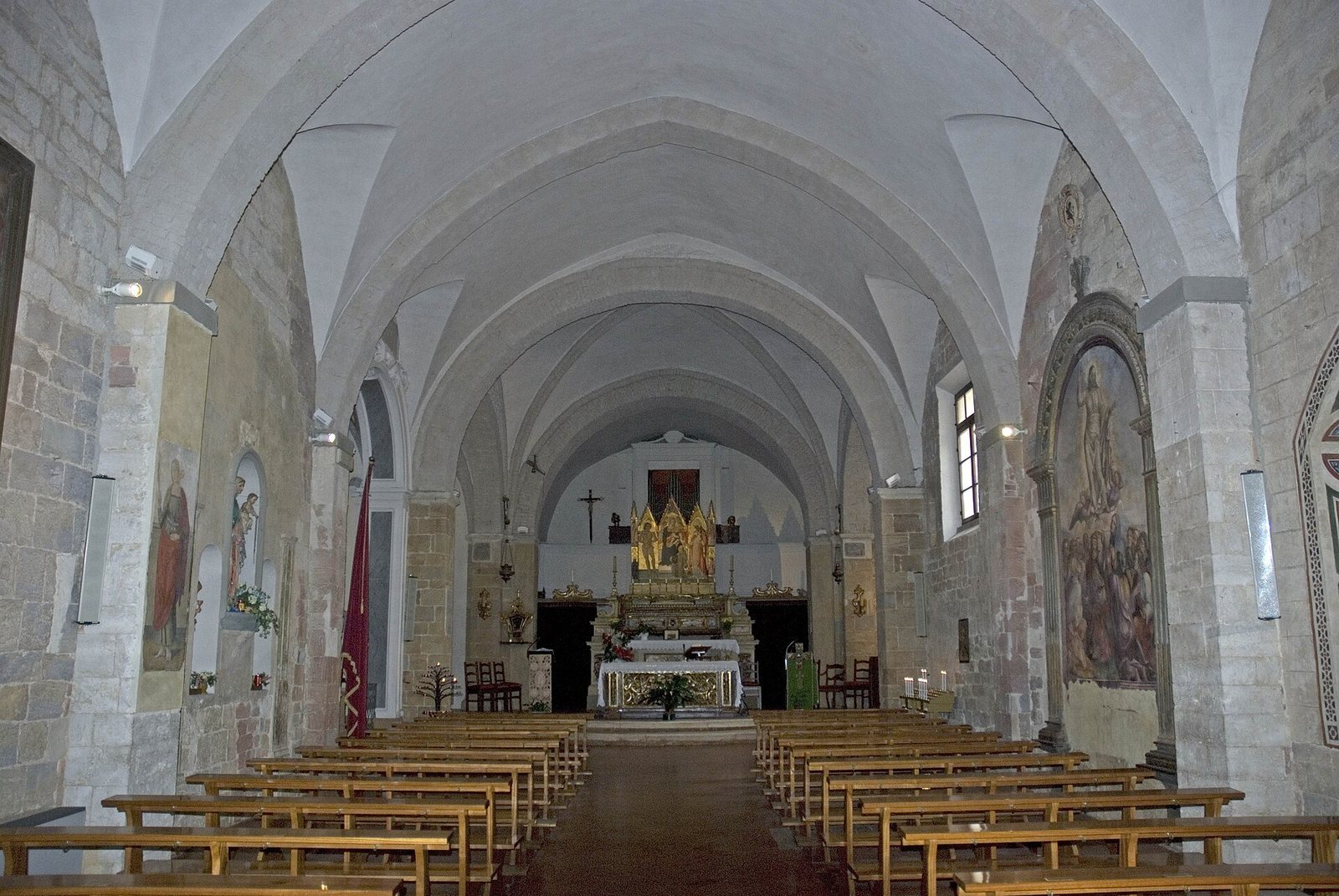
The church underwent partial renewal between 1520 and 1535. Further building work followed in the 17th and 18th centuries, including changes to the church’s tower and altar end. The last restoration took place in 1875, when the original timber-truss ceiling was replaced by the present barrel vault with lunettes.
Remains
The church has a Latin-cross plan, with a single nave (the main body of a church), a transept (the crosswise arm) meeting it at the crossing (their central junction), and a raised presbytery (the area around the high altar) leading to a square apse (the end space behind the altar). Tuff and travertine form much of the exterior, while marble is used in the bell tower.
Exterior
Façade
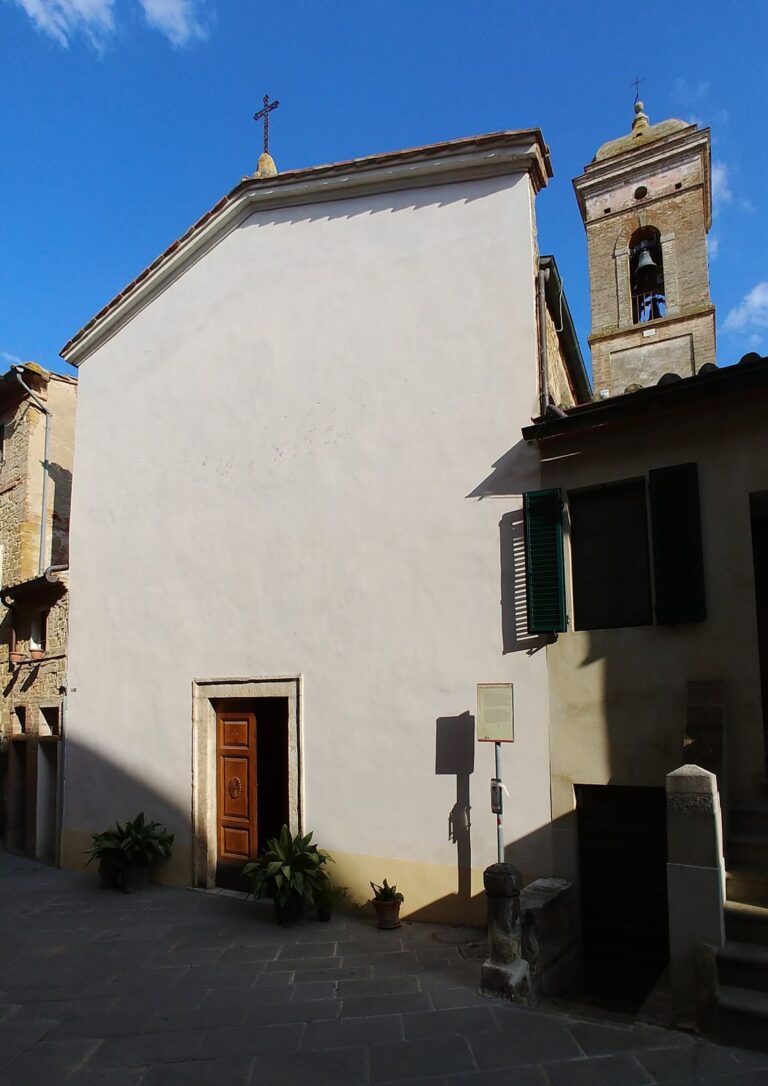
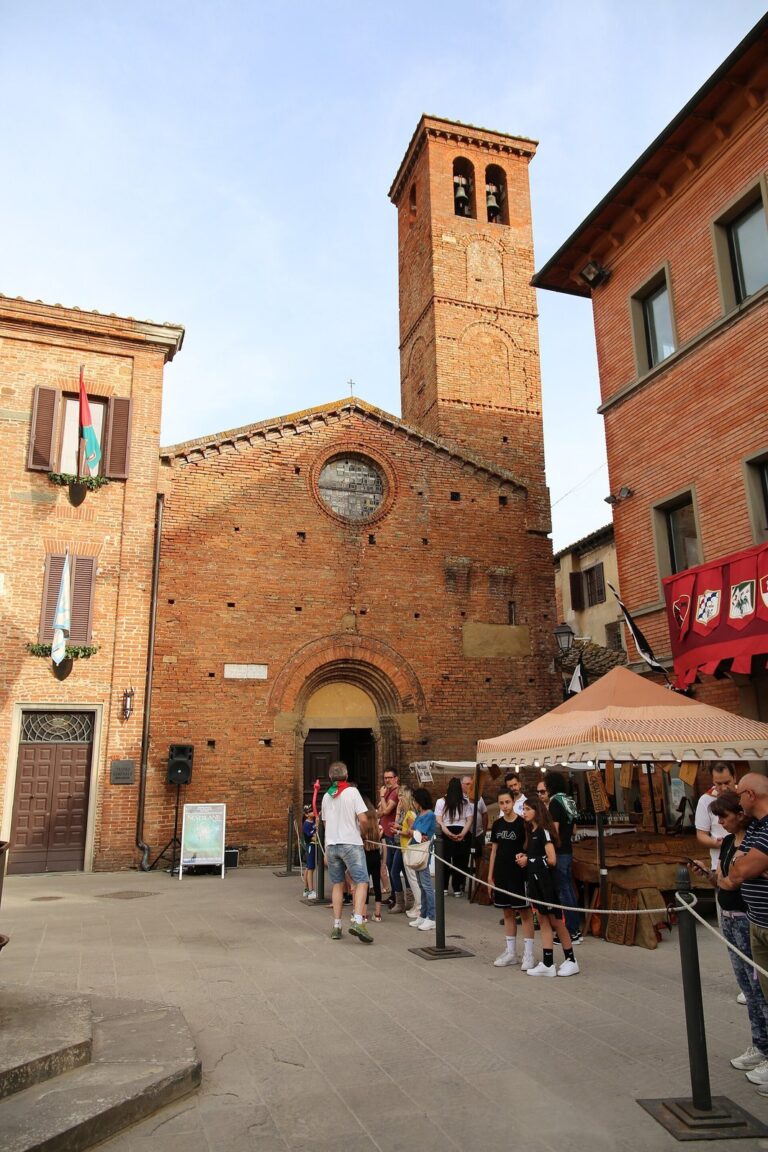
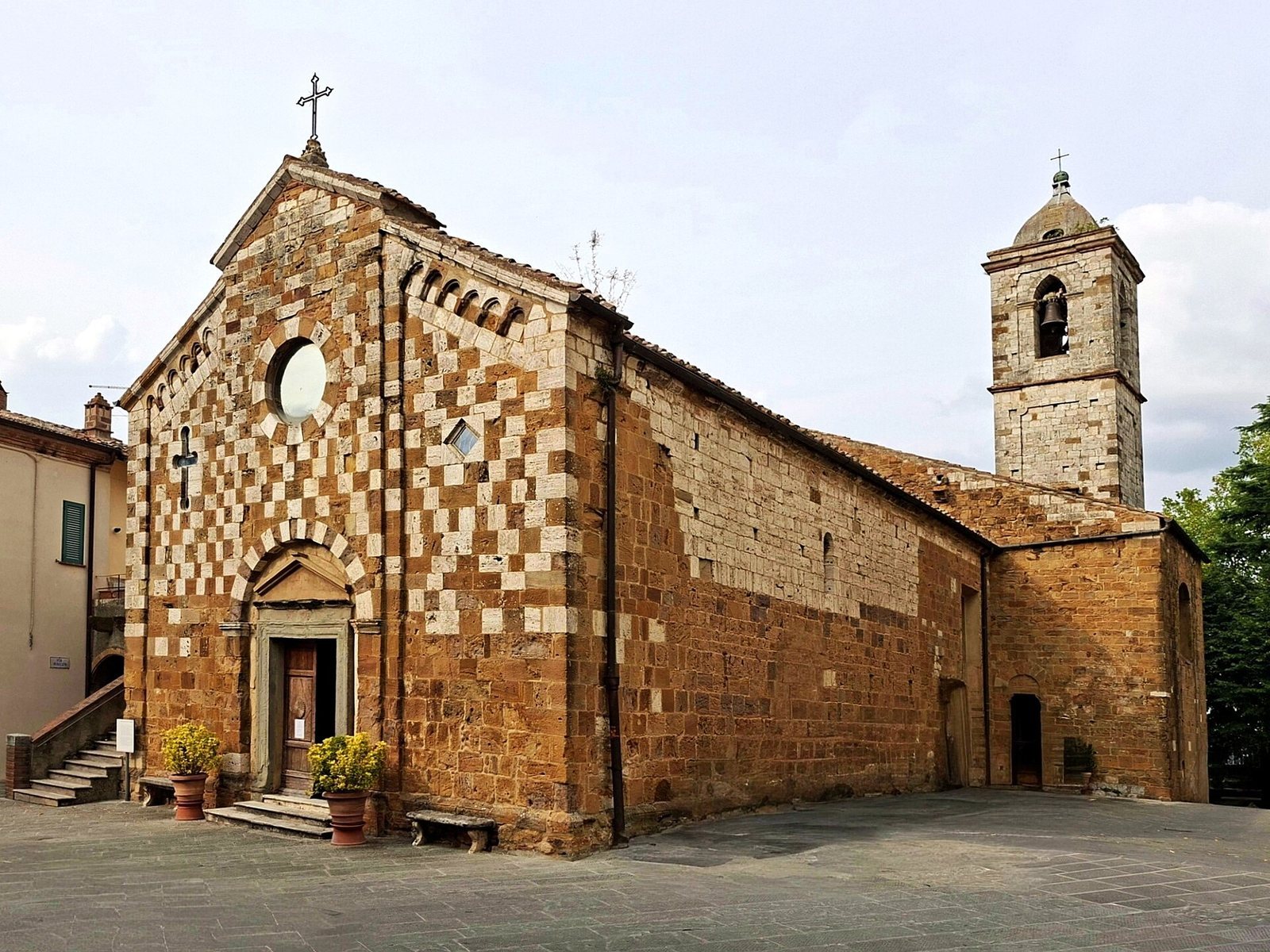
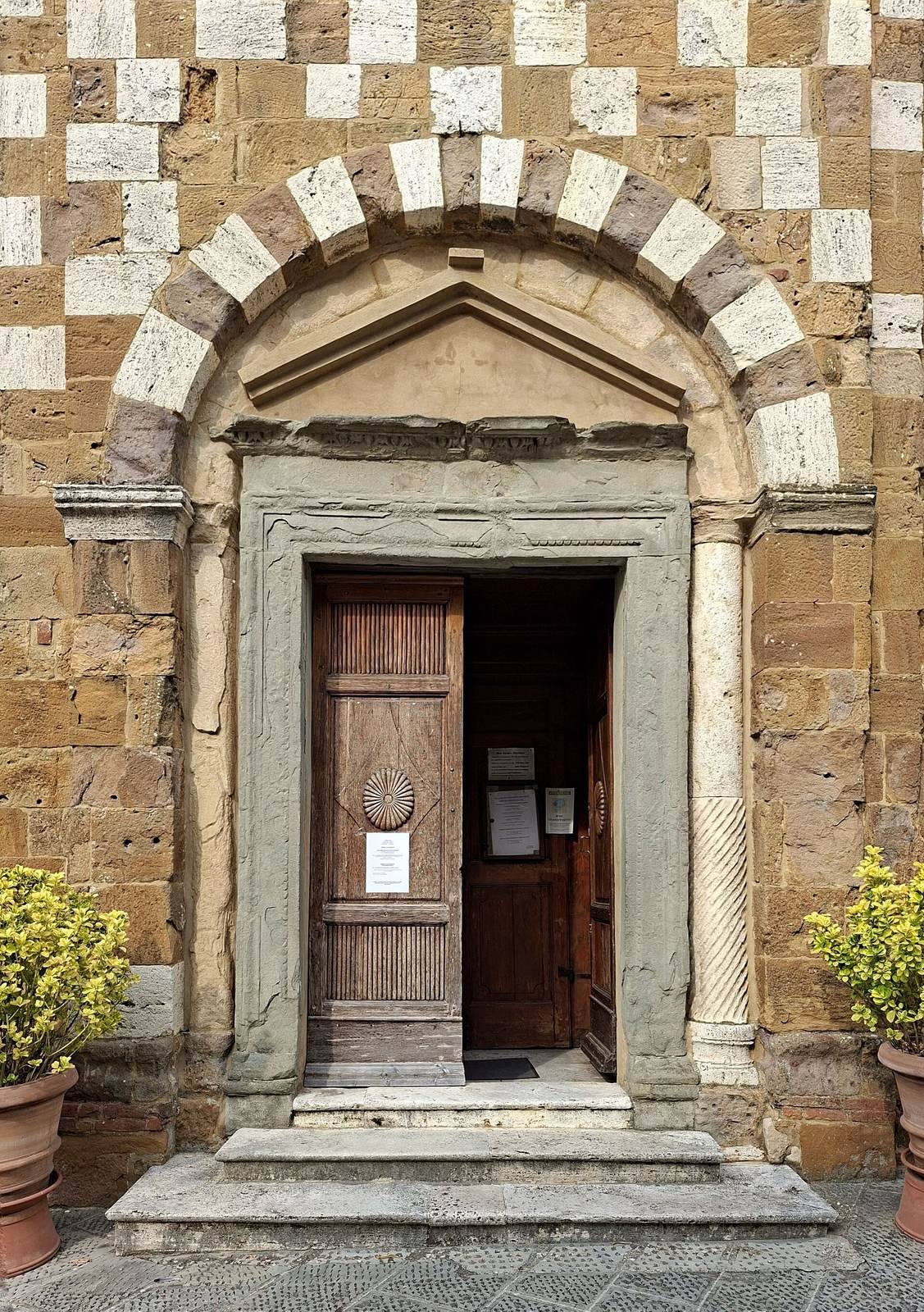
The façade has a stepped outline and a checkerboard pattern made from alternating blocks of tuff, a rock formed from compacted volcanic ash, and travertine, a type of limestone. Its central section is narrower than the two sides. At ground level, a Renaissance stone portal with a triangular pediment sits inside a round-headed arch that served as the original entrance. A circular rose window is set above it. Each side section ends in six pointed corbel arches, small arches supported by projecting masonry. The right side has a small diamond-shaped window, while the left has a cross-shaped window with flared ends.
Transept doorway and exterior masonry
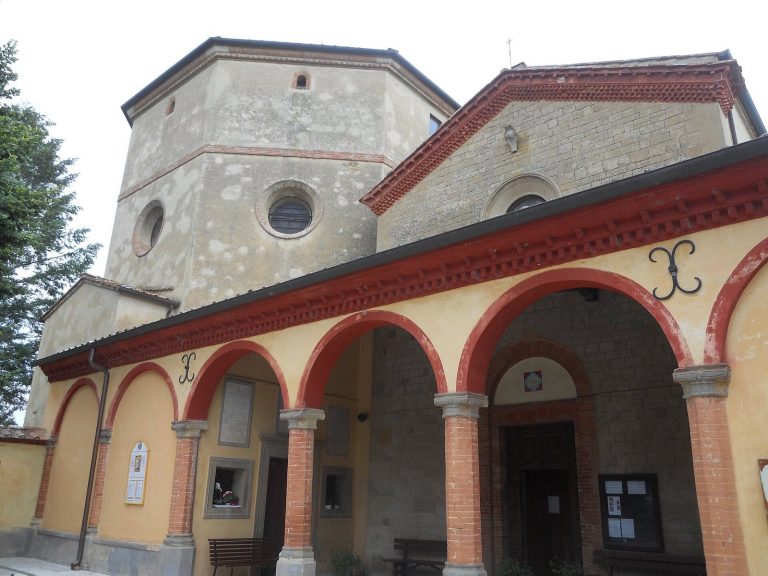
Beyond the façade, large, compact areas of tuff or travertine form the exterior walls. A small Romanesque doorway with a semicircular lunette, or panel, opens in the right arm of the transept.
Bell tower
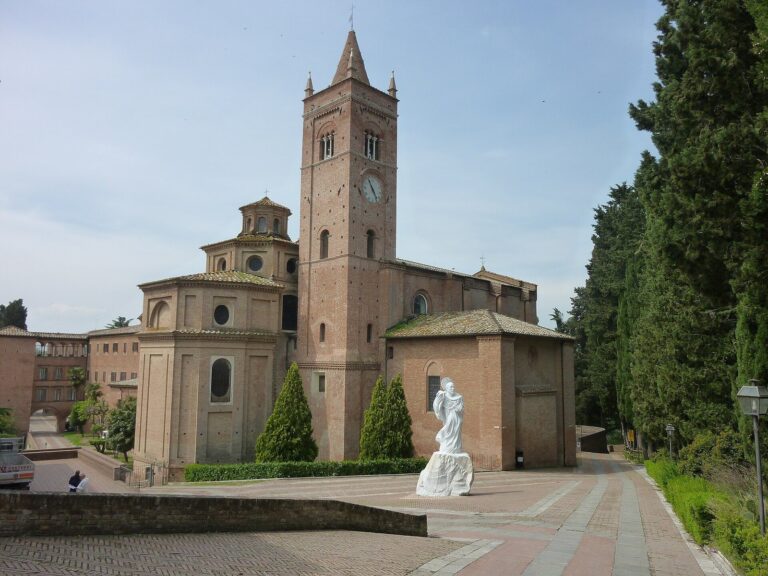
The bell tower stands beside the right side of the apse. Built from marble blocks, it has pointed, single-opening windows in its bell chamber.
Interior
Nave and bay artworks
Round arches resting on piers divide the vaulted nave into four bays. In the first bay, an 18th-century painted wooden crucifix hangs on the left wall. A Gothic window in the second bay is above a painted niche dated 1449 by Bartolomeo da Miranda, a 15th-century painter. The image shows the Madonna and Child with Saints Catherine of Alexandria, Mary Magdalene, John the Baptist, and Bernardino of Siena. In the next bay, a gray sandstone frame marks the remains of a 16th-century altar. It was shortened when the floor was raised. The frame contains The Ascension, a fresco from about 1530–35 by Sodoma, the name used by the painter Giovanni Antonio Bazzi, with work by his workshop. Fragmentary remains of another altar stand in front.
Chapel of the Blessed Sacrament
The Chapel of the Blessed Sacrament opens from the left wall of the final nave bay. Its Baroque altar is decorated to imitate marble and carries a painting of the Sacred Heart of Jesus.
Transept sculpture
A polychrome terracotta sculpture of the Madonna and Child by the Renaissance sculptor Andrea Sansovino stands in the right arm of the transept. It dates to the 1520s.
Presbytery and high altar
The presbytery occupies part of the crossing and rises two steps above the rest of the church. Its Baroque high altar holds a 16th-century wooden urn containing the remains of Bonizzella Cacciaconti, venerated as a blessed in Catholic tradition. The altar also displays a 15th-century triptych, a work composed of three panels, by the Sienese painter Giovanni di Paolo di Grazia. Against a gold background, it depicts the Madonna and Child with Saint Bernardino of Siena between Saints Sebastian and Clement.
Apse and organ
The apse has a square plan and a barrel vault. A choir loft against its rear wall holds a pipe organ built in 1841 by the Paoli brothers. The instrument has mechanical action, one keyboard with a reduced low range, and a pedalboard permanently connected to the keyboard.