Aghia Varvara Church: A Greek Orthodox Monument in Skoutari, Greece
Site at a Glance
- Popularity
- Very Low
- Country
- Greece
- Primary era
- Medieval
- Eras represented
- Medieval, Early Modern, Modern
- Civilizations
- Byzantine, Greek
- Site type
- Religious
- Remains
- Church
On this page9 sections
History
Aghia Varvara Church is a Greek Orthodox church at Skoutari, Greece, generally dated to the 13th century from the style of its Byzantine frescoes, wall paintings made on wet plaster and belonging to the medieval Christian tradition centered on Constantinople. It is regarded as an important example of Palaiologan art, the late Byzantine artistic tradition associated with the Palaiologos imperial dynasty, which ruled from 1261 to 1453. The church is also considered a notable monument of the sun-facing part of Lower Mani.
The church belongs to the Metropolis of Mani, a Greek Orthodox diocese within the Church of Greece. Its interior decoration developed over several centuries. Removal of plaster brought early wall paintings to light, but their deteriorated state makes the original decorative program difficult to date precisely. A later phase, in the late 16th century, added an image of a crowned female saint near the doorway between the sanctuary and the prothesis, the chamber where Eucharistic offerings are prepared. Similar images of female saints appear in sanctuaries elsewhere in Mani.
Later decoration and restoration
The latest fresco decoration was painted in 1882-1883 by an icon painter from Mani. Restoration campaigns, including work in 2007 and 2013, sought to recover the church’s earlier appearance and revealed Byzantine and post-Byzantine decoration.
Remains
Architectural form
Plan and masonry
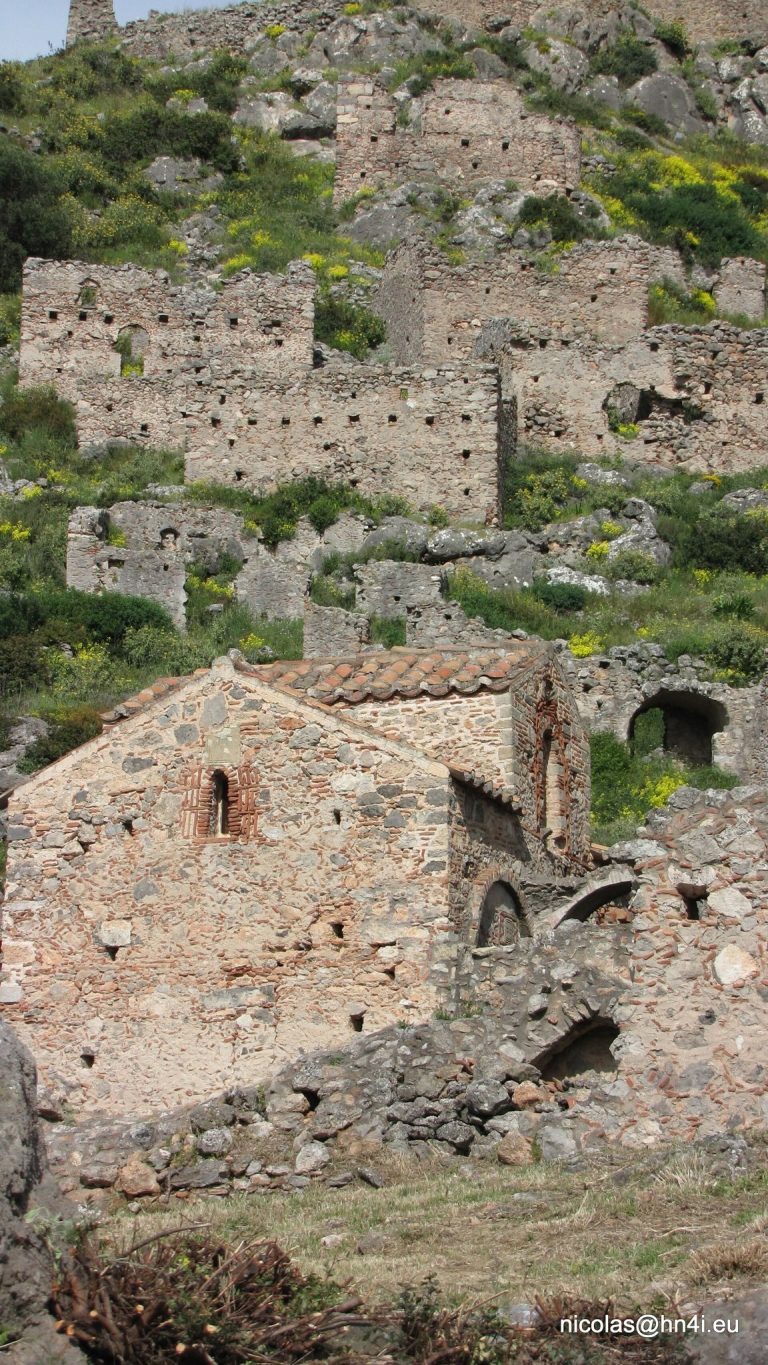
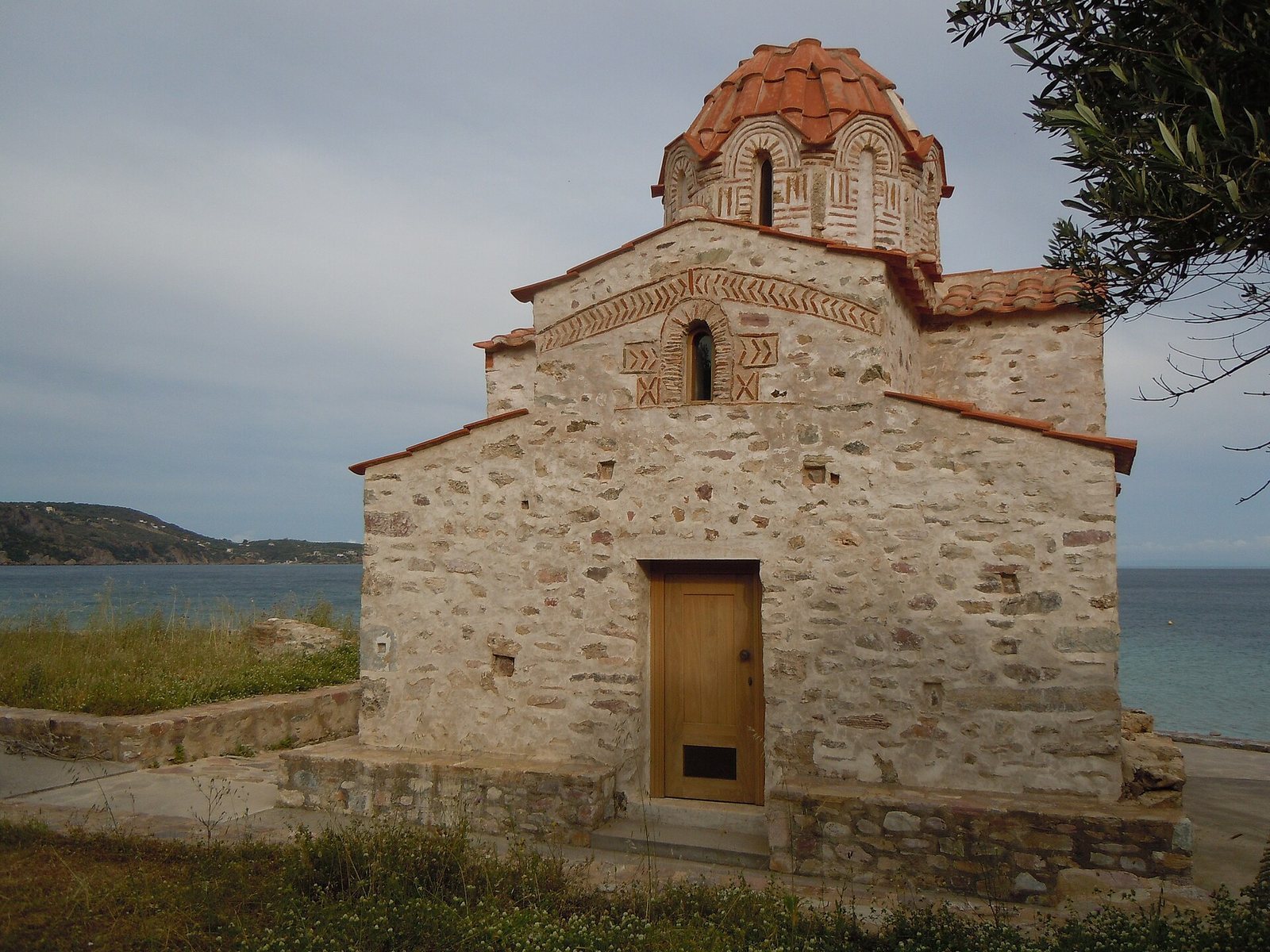
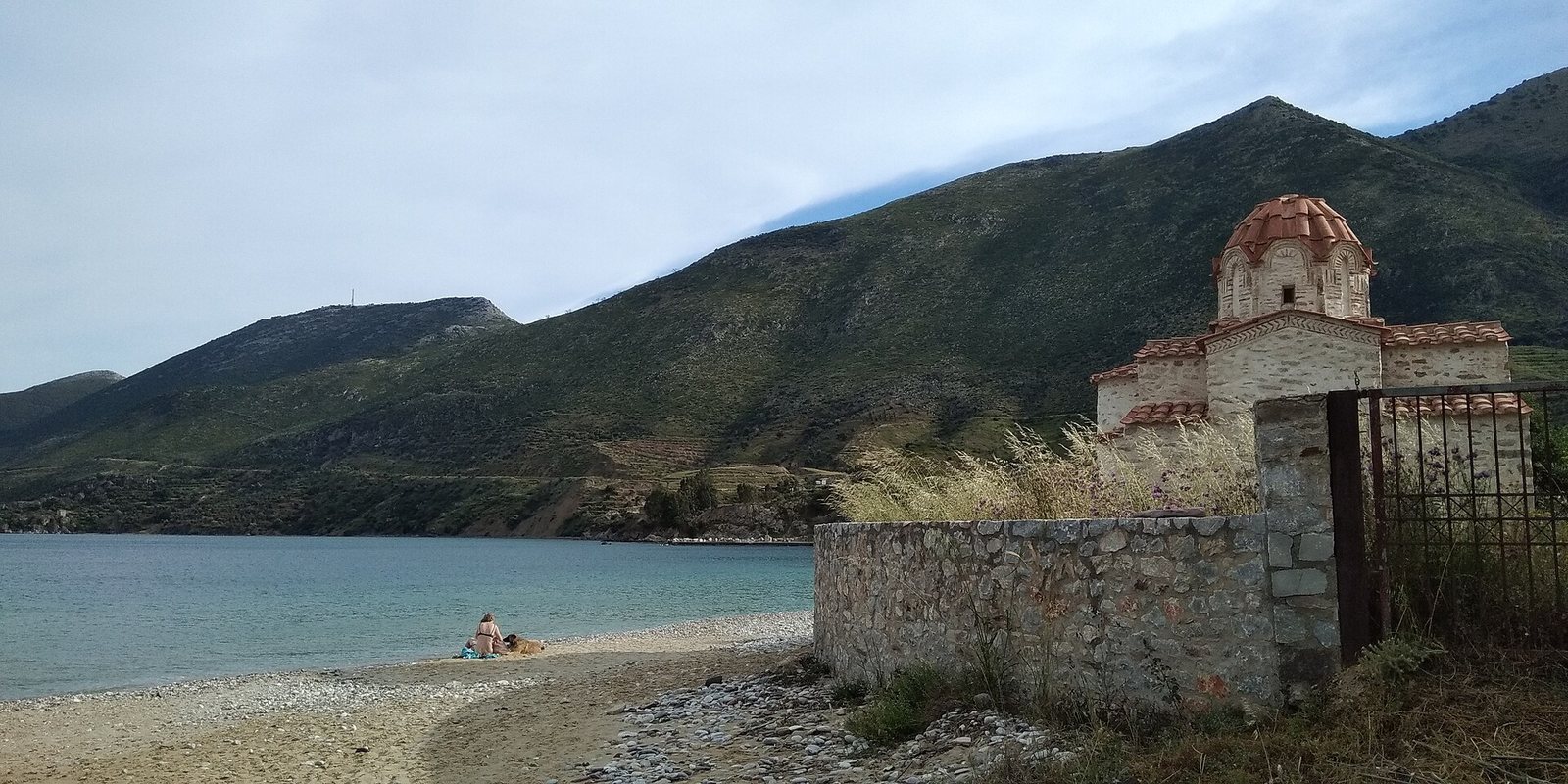
The small church stands beside the beach at Skoutari, at the foot of Mount Arabikias, and measures about 6 by 6.5 metres. Its square plan contains four interior pillars and follows a domed cross-in-square design, in which the arms of a cross fit within a square layout. Three apses, curved sanctuary ends, project from the east. Rough stone forms most of the walls, with a few pieces of marble incorporated into the fabric. The building also uses porous stone and concealed-brick masonry, a method in which brick elements are mostly hidden within the wall construction.
Dome and west front
The dome rises from an octagonal drum, the raised section supporting it. Windows open on the drum’s main faces, while shallow arched recesses occupy the faces between them. Stone columns mark its corners, and brick courses and frames decorate its sides and continue below the arches. Brickwork in a fishbone pattern runs along the cornices of the cross arms and across the west façade. The west window has a single opening framed by two bands of this brickwork and a cross-hatched pattern.
Painted decoration
Byzantine paintings
The early wall paintings survive in fragments. Part of a Pantocrator, an image of Christ as ruler of all, remains in the dome. His head faces from west toward east, an unusual arrangement that may relate to imagery of the Last Judgment, the final judgment of humanity. A circle of prophets between the drum windows refers to the foretelling of the Incarnation, God becoming human in Christ, and the Second Coming, Christ’s expected return. Surviving portions include the upper part of a figure in the southeast, a damaged prophet in the northwest, and two figures in the southwest whose garments remain while their faces are lost.
The pendentives, curved supports between the square room and the dome, carried seated images of the four Gospel writers. The sanctuary vault preserves parts of an Ascension scene divided into three sections. Groups of apostles extend along the vault, with archangels at their eastern ends. Of the central image of Christ ascending, only part of an angel holding his glory survives, above the south half-dome. Images of three hierarchs, or senior bishops, appear in blessing poses on the sanctuary walls. Those on the north wall are nearly intact; on the south wall, the paintings are badly damaged and only one figure can just be made out.
Later paintings
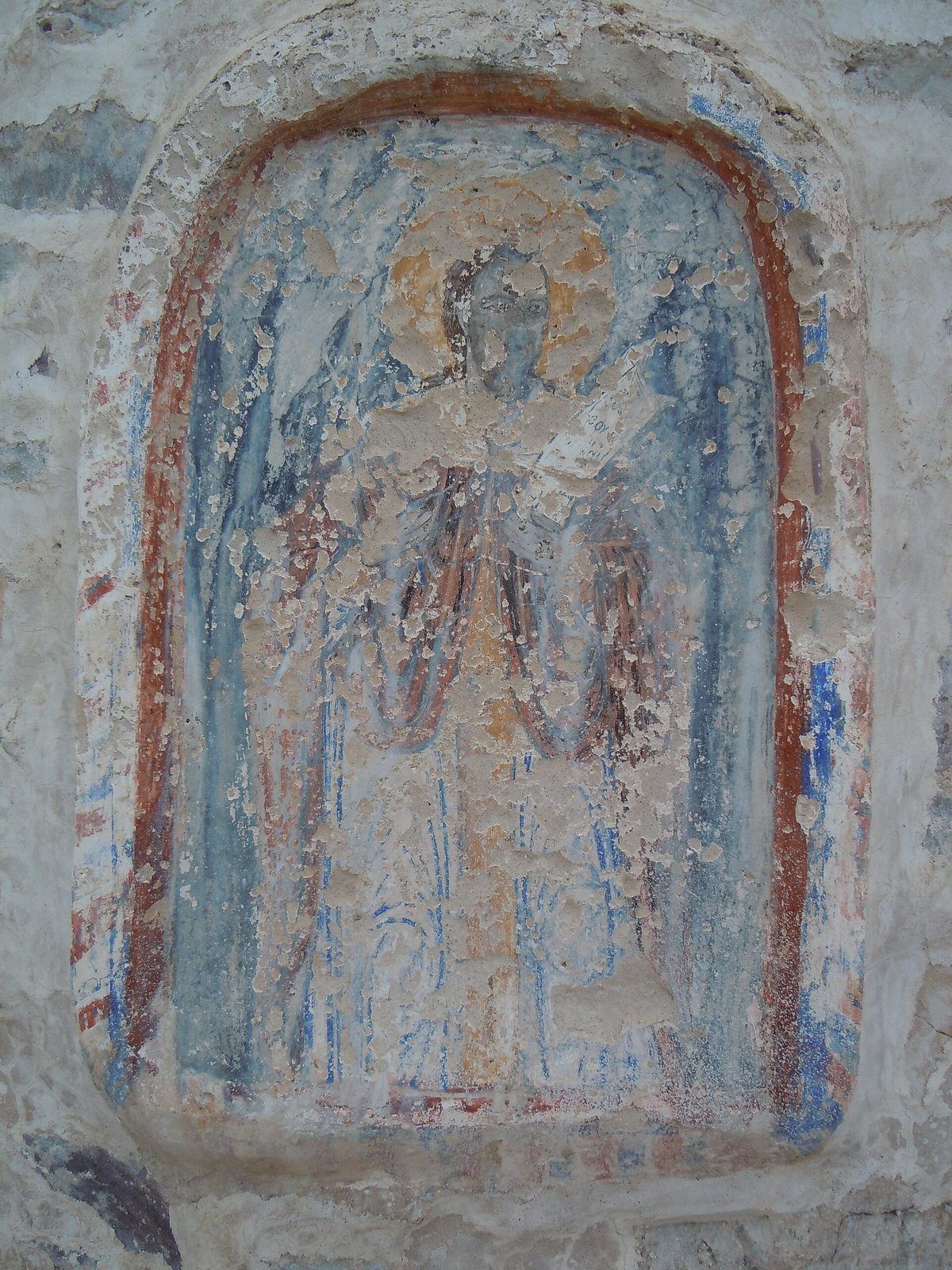
Near the doorway to the prothesis is the late 16th-century image of a crowned female saint dressed in royal clothing. The paintings from the church’s latest decorative phase include a Platytera, an Orthodox image of Mary with the Christ Child before her, accompanied by archangels and saints. Other scenes show the Communion of the Apostles and hierarchs jointly officiating at the liturgy. An image called the Extreme Humility, depicting Christ suffering after the Passion, and figures of saints are partly or entirely destroyed. A fresco is also visible on an exterior wall.