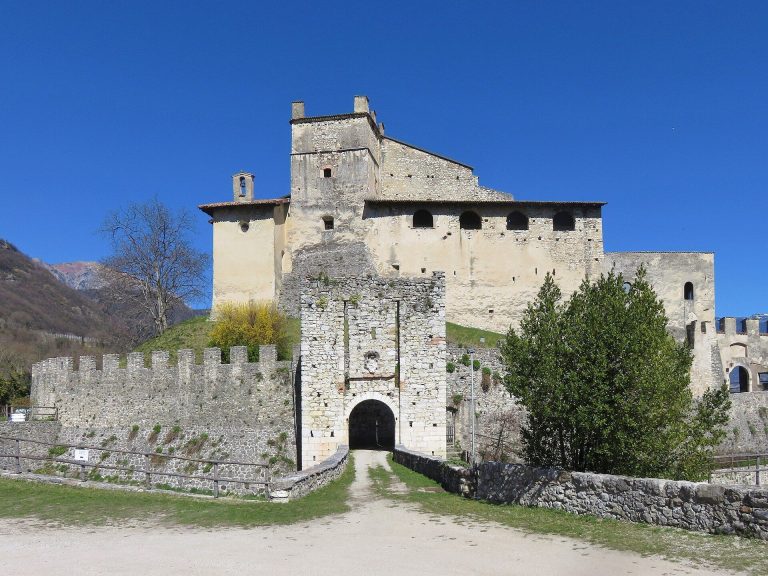
Church of the Holy Martyrs: A Catholic Church in Cavedine, Italy
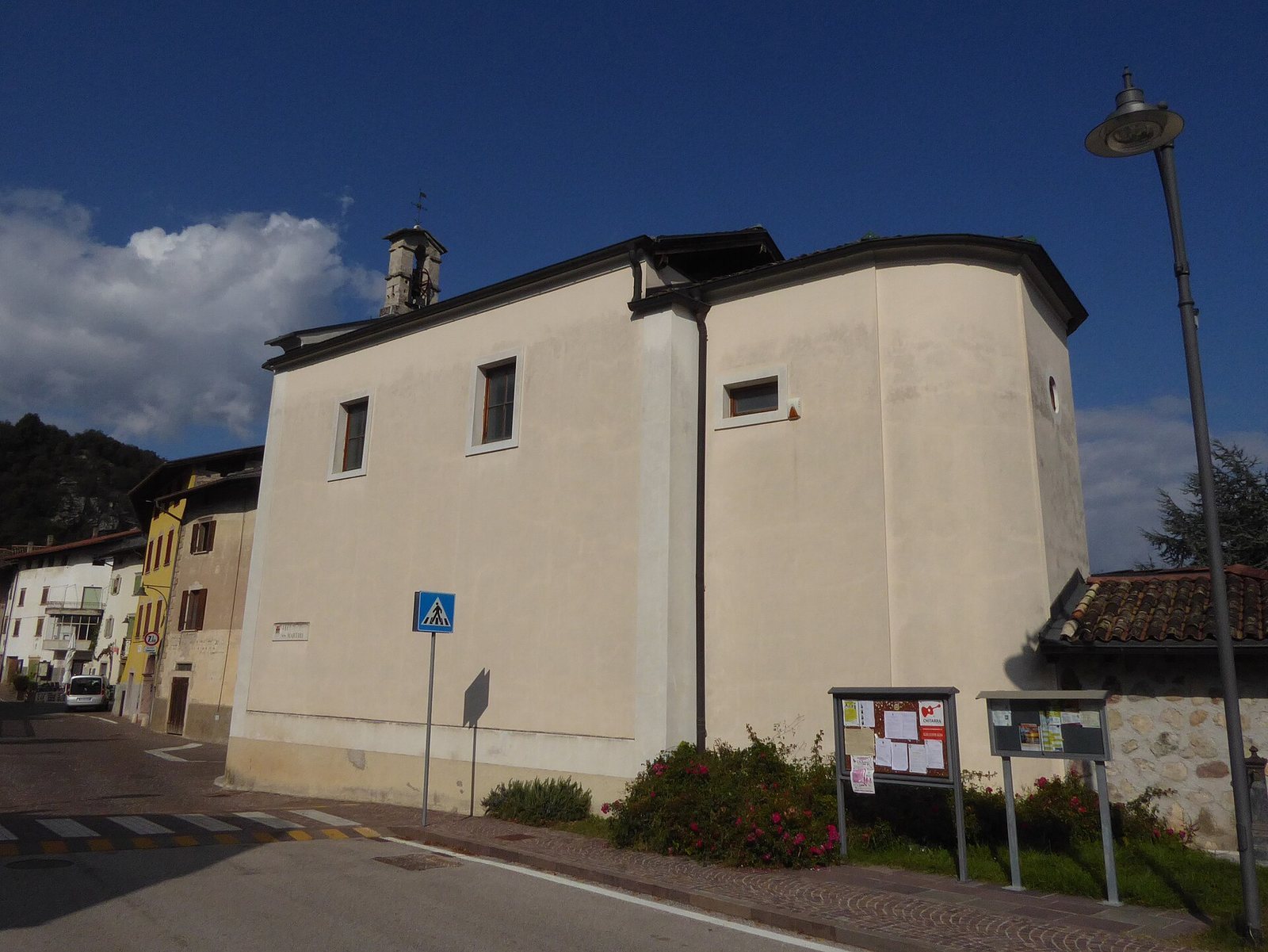
Site at a Glance
- Popularity
- Very Low
- Country
- Italy
- Primary era
- Modern
- Eras represented
- Modern
- Civilizations
- Habsburg, Italian
- Site type
- Religious
- Remains
- Church
On this page13 sections
History
The Church of the Holy Martyrs is a Catholic church in Cavedine, Italy, and a dependent church of the parish church of Saint Mary of the Assumption. It belongs to the Archdiocese of Trento, a major territorial jurisdiction of the Catholic Church. Its first place of worship was built in 1575 at Le Pozze, in the then-village of Laguna, following a vow made during that year’s plague epidemic. The chapel was dedicated to Saint Roch, traditionally invoked for protection against plague. Its later name, the Chapel of Saint Roch and the Ten Thousand Martyrs, referred also to Roman soldiers commemorated as Christian martyrs. The church eventually took its present name.
Rebuilding
By 1810, the original building had fallen into disrepair and was demolished. A Baroque church was built on its site between 1815 and 1820 and blessed in 1823.
Later changes and restoration
A small bell gable was added in 1863. When the First World War began, the church bell was requisitioned. An old ploughshare served in its place until a replacement bell was installed in 1925, the same year the church was restored. Further restoration followed in 1958 and 1996. Changes to worship arrangements between 1965 and 1975 added an altar facing the congregation, a lectern for readings, and a wooden seat. The main altarpiece was restored in 2003, and repairs to the side walls followed in 2005.
Remains
Exterior
Plan and construction
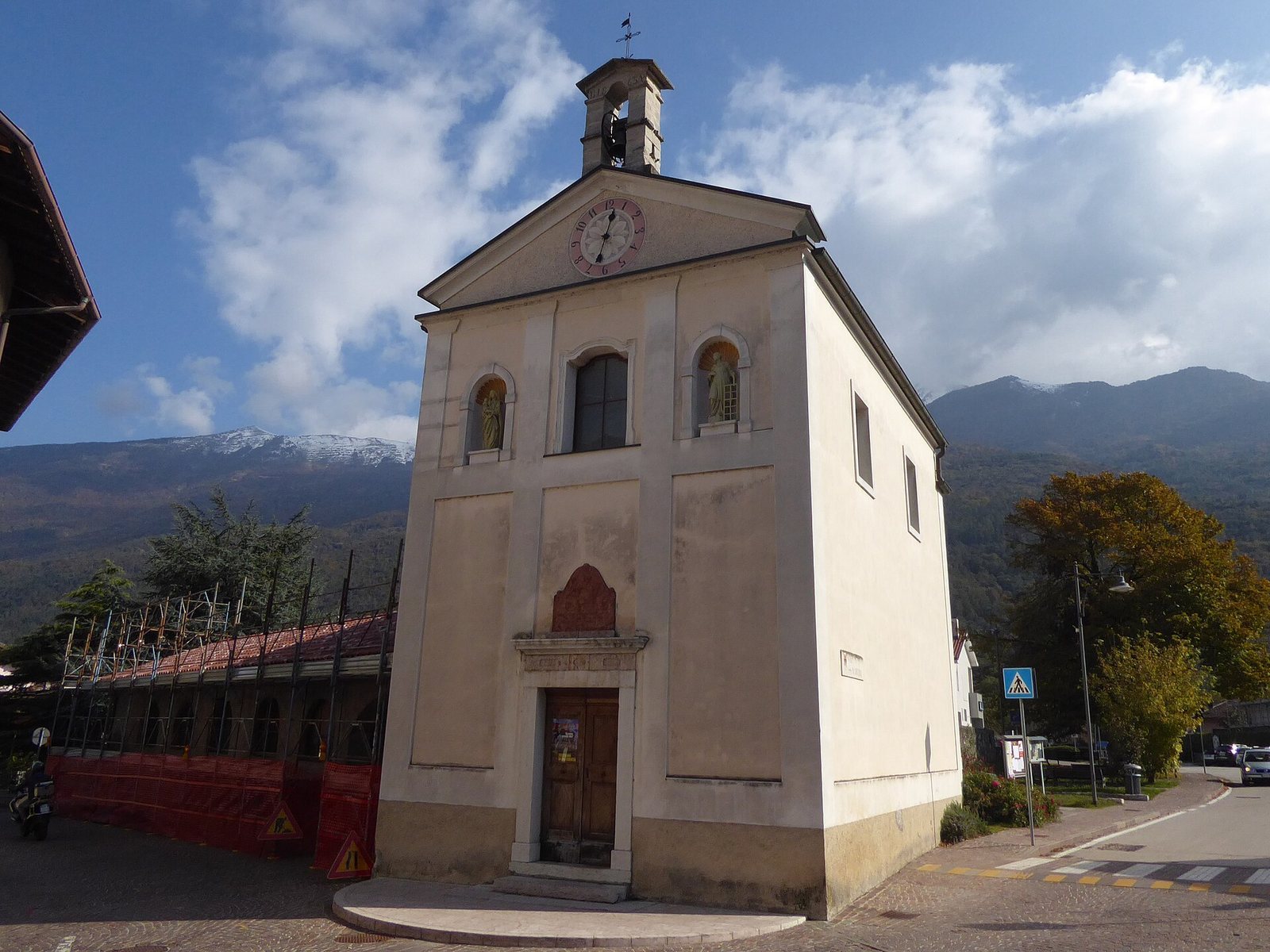
The church stands at the center of old Laguna, now the lower part of Cavedine, and faces east. Its rectangular main body extends along an eastward axis, with a lower presbytery, the area around the altar, adjoining it. The exterior walls are plastered rubble stone resting on a stone base. A gabled roof covered with clay tiles tops the main body; the presbytery has angled rear corners.
Façade and bell gable
Four Tuscan pilasters, flat vertical supports in a simple classical column style, and a horizontal band divide the façade into six panels. The central lower panel contains the entrance, whose lintel is dated 1820; a plaque above it summarizes the church’s history. A low-arched window sits above the entrance. Round-arched niches in the neighboring panels contain copies of two statues from the altar. Higher on the façade, a triangular pediment frames the clock face. A small bell gable with a two-pitched cap rises at the roof ridge.
Interior and furnishings
Nave and presbytery
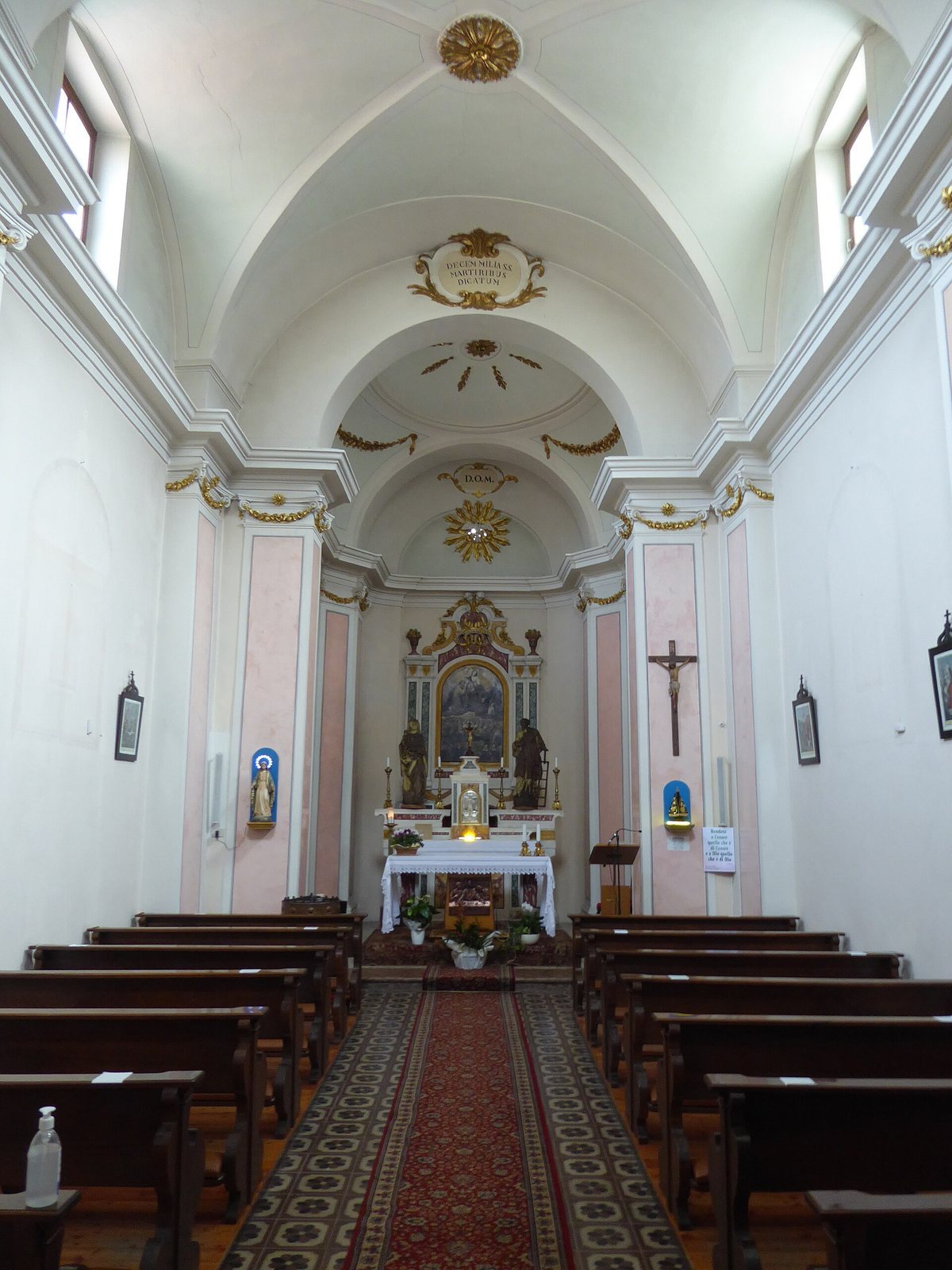
The single rectangular nave has cement-tile flooring decorated with multicolored floral patterns. Ionic pilasters, flat wall supports shaped in the Ionic column style, divide it into two sections and support round arches. Each section has a cross vault, formed by intersecting barrel-shaped ceilings, with rectangular windows set into the curved areas along the sides. A cornice runs around the interior. An arch at the nave’s eastern end opens into the presbytery, which is raised by several steps and has Venetian terrazzo, a composite stone flooring, and a dome supported by curved structures called pendentives. The space narrows into a semicircular apse, or end space, with a barrel-vaulted ceiling; it serves as the sacristy, a room used for church furnishings and preparation for worship.
Main altar and altarpiece
The nineteenth-century main altar is made of painted stucco designed to resemble marble. Its altarpiece, from the first half of the seventeenth century, depicts Mary and the infant Jesus beneath a crown of angels. Below them are Saint Joseph, Mary’s husband and Jesus’ earthly guardian; Saint Roch; and Acacius, associated with the Ten Thousand Martyrs. Acacius appears at the head of the Roman soldiers martyred with him. The scene also includes crowds of devotees and a view of Cavedine, where the churches of Saint Stephen, Saint Lawrence, and Saint Mary of the Assumption can be seen.
Statues and the congregation altar
Two wooden statues on the main altar were formerly displayed on the façade: an eighteenth-century Saint Lawrence, an early Christian martyr, and an earlier statue of Mary and the infant Jesus. Shelves beside the arch to the presbytery hold an Immaculate Madonna and Our Lady of Aparecida, a title of Mary venerated as Brazil’s patroness. The latter statue was donated by a nephew of emigrants. The altar facing the congregation includes a bronze plaque showing a detail of the Last Supper.
Paintings and Stations of the Cross
Engraved Stations of the Cross, a series of images recalling Jesus’ final journey to crucifixion, date to the late eighteenth century. Four paintings were transferred from the churches of Saint Stephen and Saint Mary of the Assumption. Three came from Saint Mary’s church, while the painting of Jesus in the Garden of Gethsemane, comforted by an angel, is the one from Saint Stephen. The other works show the Assumption of Mary, the belief that she was taken bodily into heaven, among angels; Mary crowned by angels with Saints Luke and Mark, the Evangelists associated with the Gospels bearing their names; and the Madonna of Sorrows with Mary Magdalene, a follower of Jesus, and either Joseph of Arimathea, associated with Jesus’ burial, or John the Evangelist, traditionally identified with the apostle John.
Ploughshare
A niche in the wall to the right of the entrance holds the old ploughshare.