Optina Pustyn: A Russian Orthodox Monastery and Spiritual Center
Site at a Glance
- Popularity
- Very High
- Country
- Russia
- Primary era
- Early Modern
- Eras represented
- Early Modern, Modern
- Civilizations
- Russian
- Site type
- Religious
- Remains
- Monastery
On this page16 sections
History
Optina Pustyn is a Russian Orthodox men’s monastery near Kozelsk in Russia. Its origins are traditionally placed in the late fourteenth century, although written evidence confirms its existence in the fifteenth. As a stavropegial monastery, it is placed directly under the authority of the Church’s central leadership rather than a local bishop. Its jurisdiction shifted between dioceses, and it passed to the Kaluga diocese in 1799.
Origins and early records
A foundation tradition credits a repentant robber named Opta with establishing the monastery. According to the story, he became a monk called Macarius. The date and account remain uncertain, but a church register compiled in 1670 from an older record points to a community already present in the fifteenth century. Before a church council in 1503 required monasteries to separate men and women, monks and nuns at Optina lived in different parts of the community. The monastery’s name may preserve an idea of “living together.”
Records from Kozelsk dated 1629–1631, during the rule of Boris Godunov, refer to provisions for memorial services for Tsar Feodor Ioannovich, who had died in 1598. A surviving contribution book from 1670 lists gifts from members of the ruling family. The monastery recovered after Lithuanian forces devastated the area near the end of the Time of Troubles, a period of Russian dynastic crisis and foreign intervention around 1598–1613.
Construction, suppression, and decline
Work on the monastery’s first stone church began in 1689. It was dedicated to the Entry of the Theotokos into the Temple, an Orthodox feast honoring Mary, and included a chapel for Paphnutius of Borovsk. In 1704, Peter I imposed a state levy on the monastery to help pay for the building of St Petersburg and the war with Sweden. The burden contributed to a sharp decline in the community, which had only twelve members by 1724.
That year, the monastery was suppressed under the Spiritual Regulation, an early eighteenth-century reform of Russian church administration, and attached to the Transfiguration Monastery at Belyov. Its wooden buildings deteriorated. Catherine I ordered its restoration late in 1726, and on 11 July 1727 its property was returned to Tikhon, the abbot of the Belyov monastery.
Renewed building began with a wooden bell tower in 1741 and a new Church of the Entry in 1750. The church included chapels dedicated to Paphnutius of Borovsk and Theodore Stratelates. The Paphnutius chapel was consecrated in 1759, when the church was nearly complete; a new cathedral was finished in 1768. In 1764, Optina was classed as a monastery outside the state-authorized staffing establishment. Its numbers continued to fall, from three monks in 1770 to two elderly monks in 1773.
Revival and spiritual life
A revival began after Metropolitan Platon of Moscow and Kaluga took an interest in Optina in 1795 and visited the following year. At his urging, the experienced monk Abraham became abbot. The community had grown to twelve by 1797, with additional support from Theophylact, bishop of Kaluga.
In the early nineteenth century, the monastery undertook a broad building campaign. The Kazan church and a hospital church were consecrated in 1811, and the authorized community was raised to thirty monks, including the abbot. A secluded skete, a small monastic community associated with a larger monastery, was established in 1821 for monks who had spent years in solitude. An elder guided its spiritual life while the abbot retained administrative authority. Visitors and donations increased, and the monastery acquired land and a mill as its buildings developed.
Optina became known for eldership, the practice of seeking spiritual guidance from an experienced monk, or elder. Leo was regarded as the first founder and inspiration of this tradition. Macarius followed him as spiritual leader and encouraged the publication of writings by early Christian teachers; his influence reached other monasteries. Moses, abbot from 1826 to 1862, oversaw the community’s renewal and construction, while his brother Anthony led the skete for fourteen years and helped establish eldership there. Later elders included Hilarion, Anatoly Zertsalov, Joseph, Barsanuphius, Anatoly Potapov, and Nectarius, the last elder chosen by the community. Nikon continued giving spiritual guidance after the monastery closed and later died in exile.
The monastery combined religious scholarship with hospitality to travelers and charitable work. With help from the Kireyevsky brothers and other writers, it published religious books and built a substantial library. Both brothers were buried within the monastery walls. Optina also influenced other monastic communities, including the nearby Shamordino convent, founded in 1884.
Writers and thinkers associated with Optina included Nikolai Gogol, Fyodor Dostoevsky, Konstantin Leontiev, and Sergei Nilus, whose visits are linked to houses in the skete. In 1878, the philosopher Vladimir Solovyov accompanied Dostoevsky to Optina after the death of Dostoevsky’s son. Dostoevsky stayed for three days, and the visit informed details in The Brothers Karamazov. Elder Ambrose, who lived at the skete, is often regarded as a model for the novel’s Elder Zosima. Other visitors included Vasily Zhukovsky, Ivan Turgenev, and Vasily Rozanov. Leo Tolstoy also visited, though he disapproved of eldership.
Closure and Soviet-era use
A decree closed Optina on 23 January 1918, but an agricultural cooperative continued there for a time. When it ended in spring 1923, the site passed to Glavnauka, the Soviet agency responsible for scientific, museum, and monument affairs, and became a historical monument and museum. Isaac Bobrakov, the monastery’s last abbot, was executed in 1938.
A rest home named for Maxim Gorky opened on the grounds in 1931. In November 1939, on the orders of Soviet security chief Lavrentiy Beria, the NKVD converted it into the Kozelsk-1 camp for about 5,000 Polish officers. About 4,400 were later sent to Katyń and killed in the 1940 mass execution by Soviet authorities. During the Second World War, the complex housed a hospital. In 1944–1945 it served as a screening and detention camp for Soviet officers returning from captivity. A military unit occupied the site after the war, and security and military uses continued until the complex was abandoned by 1980.
Return and remembrance
The Russian Soviet Federative Socialist Republic returned Optina to the Russian Orthodox Church on 17 November 1987, and the Church’s Holy Synod approved its reopening on 30 December. The first liturgy since the closure was held in a gate tower on 3 June 1988. The skete returned to the monastery in 1990, and by the early 2000s the complex had been almost entirely restored.
Ambrose was canonized in 1988. The Russian Orthodox Church Outside Russia canonized a group of Optina monastics in 1990; the Russian Orthodox Church recognized them for local veneration in 1996 and approved their wider veneration in 2000. The group was collectively called the Optina elders, although not all its members had served as elders. It included Leo, Macarius, Hilarion, Anatoly Zertsalov, Joseph, Barsanuphius, Anatoly Potapov, Nectarius, Nikon, Moses, Anthony, Isaac Antimonov, and Isaac Bobrakov. About twenty people connected with Optina who suffered during twentieth-century persecutions were canonized as martyrs or confessors; those named include Euthymius, Panteleimon, Lawrence, Seraphim, Paphnutius, Raphael, Ignatius, Vincent, Gury, Joannicius, Isaac, Agapit, Nikon, Sebastian, and Boris.
On Easter, 18 April 1993, three monks were murdered at the monastery: priest-monk Basil (Roslyakov) and monks Ferapont (Pushkaryov) and Trophim (Tatarinov). On Good Friday in 1994, a young pilgrim named Yuri was killed on the woodland path between the skete and the monastery. Optina Pustyn is now designated a cultural heritage site of federal significance in Russia.
Remains
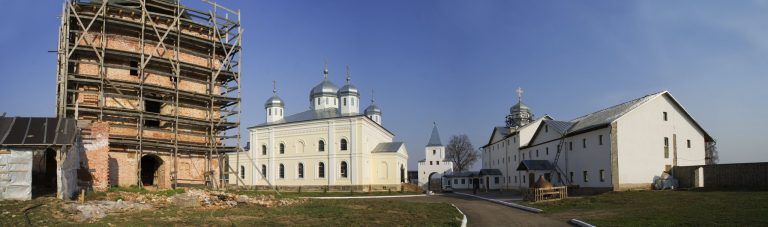
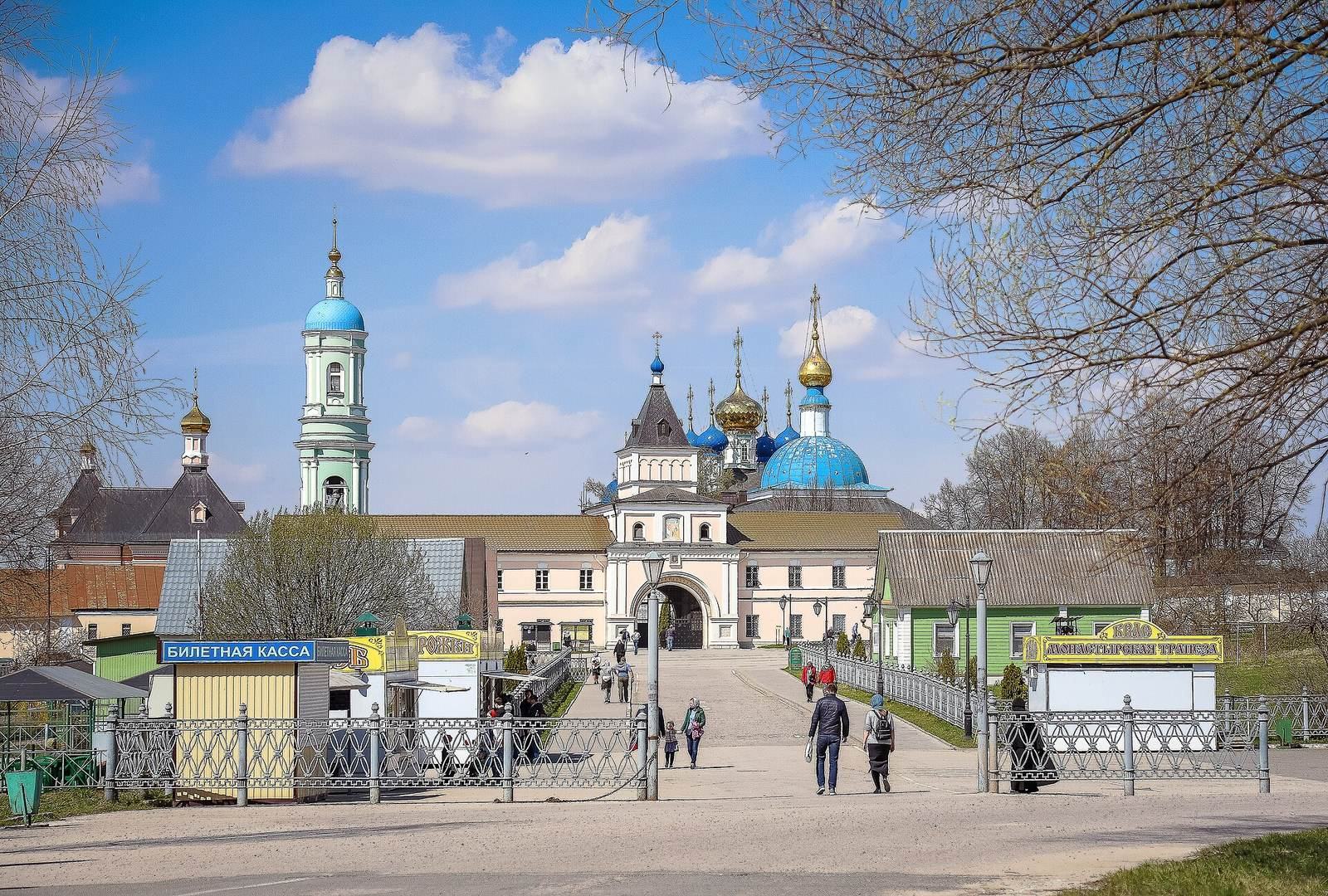
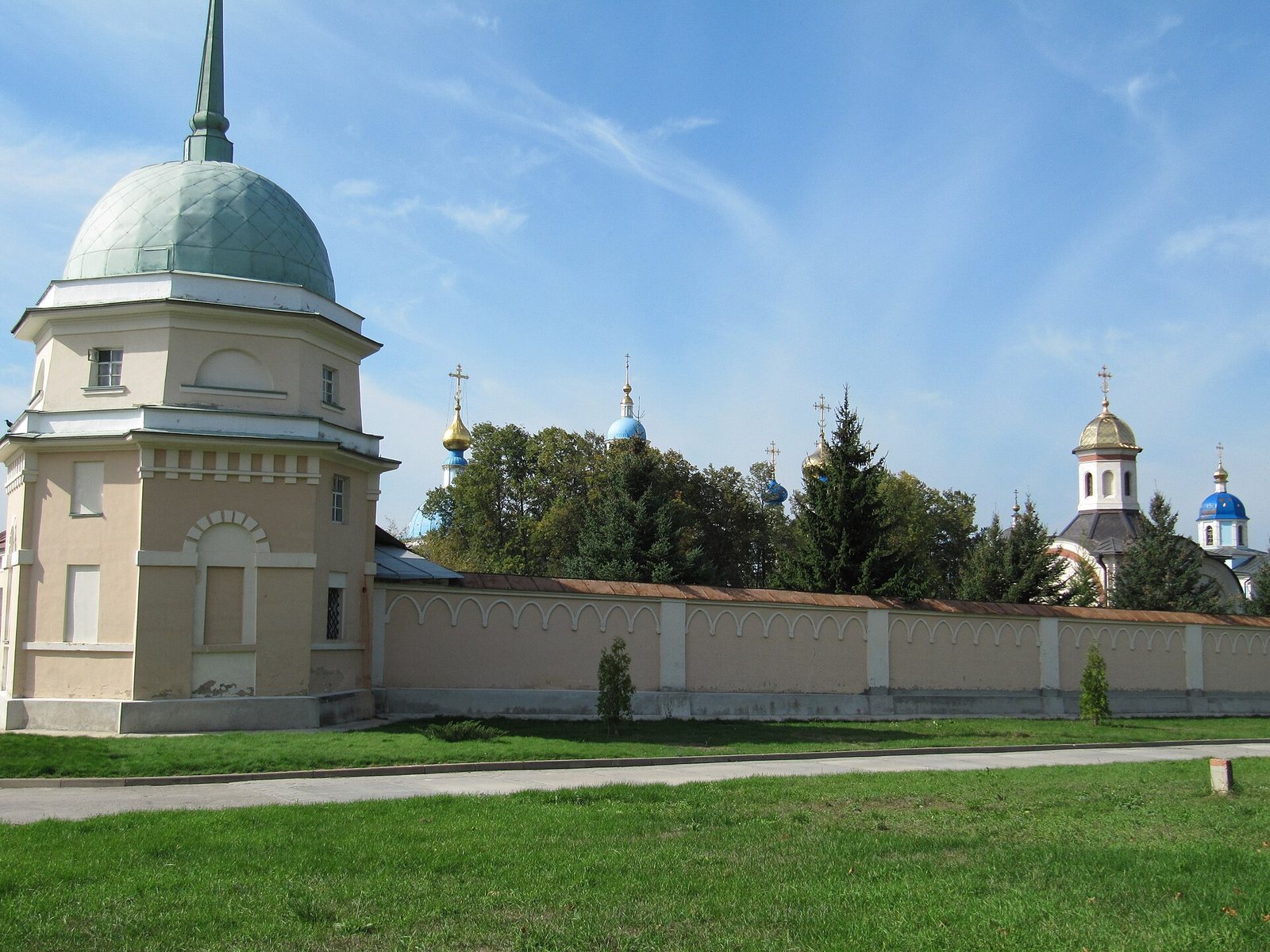
The monastery’s plan is almost square. Its central cathedral is surrounded by churches arranged in a cross-shaped layout, within a low enclosure marked by four corner towers. The surviving buildings reflect the monastery’s development across several centuries.
Monastery precinct
Central church and surrounding churches
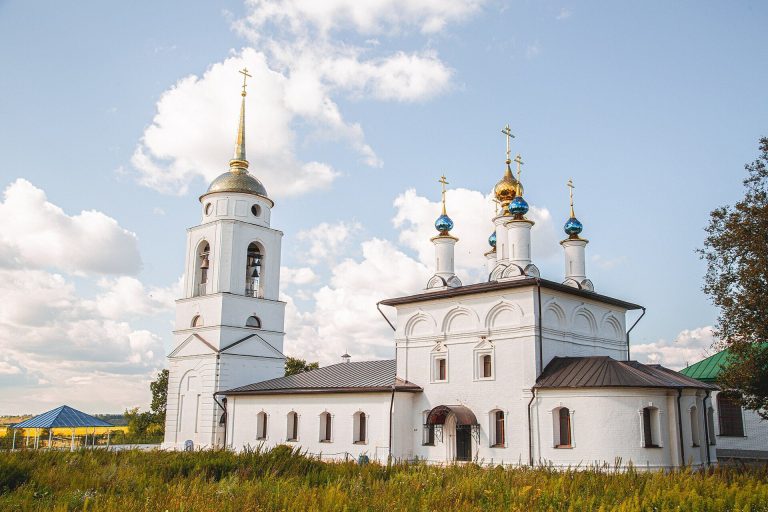
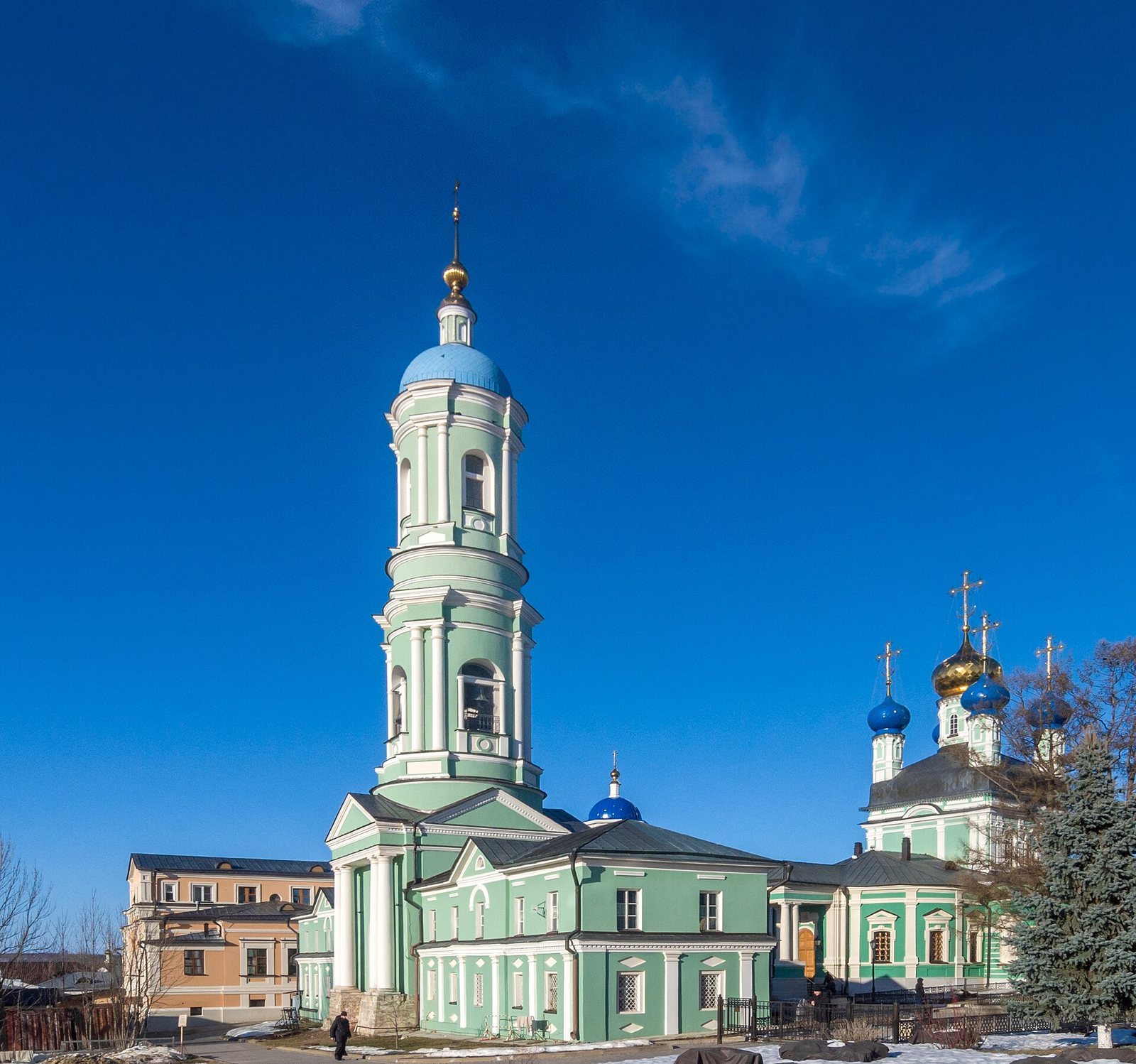
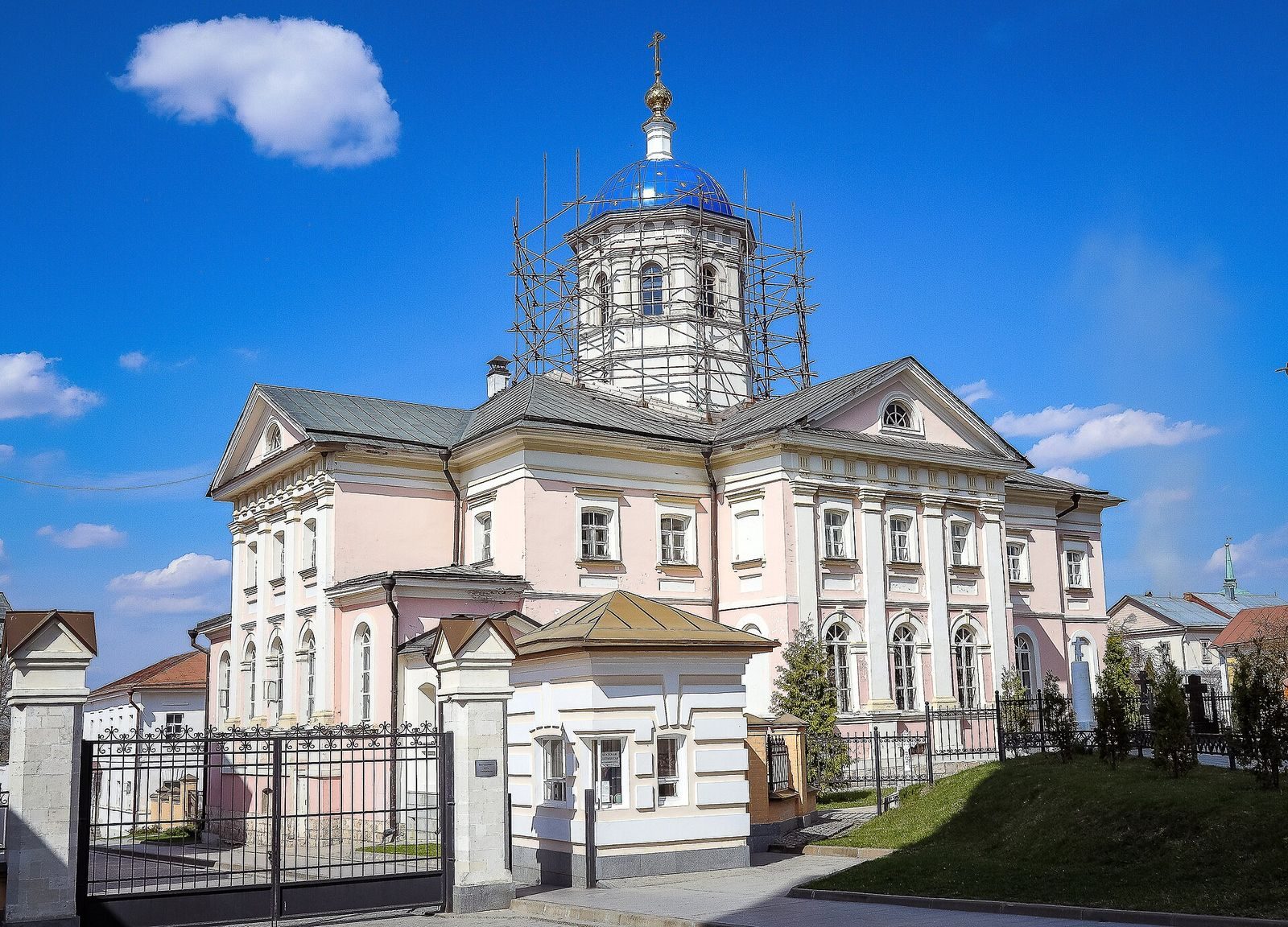
The Cathedral of the Entry of the Theotokos into the Temple occupies the center of the complex. Around it, the church to the north is dedicated to Mary of Egypt and was formed by converting the old refectory in 1858. To the south stands the Church of the Kazan Icon of the Mother of God, built in 1811; the church to the east is dedicated to the Vladimir Icon of the Mother of God.
Enclosure and corner towers
A low wall and four towers at the corners were built around the monastery between 1832 and 1839, enclosing its nearly square precinct.
Bell tower and monks’ cells
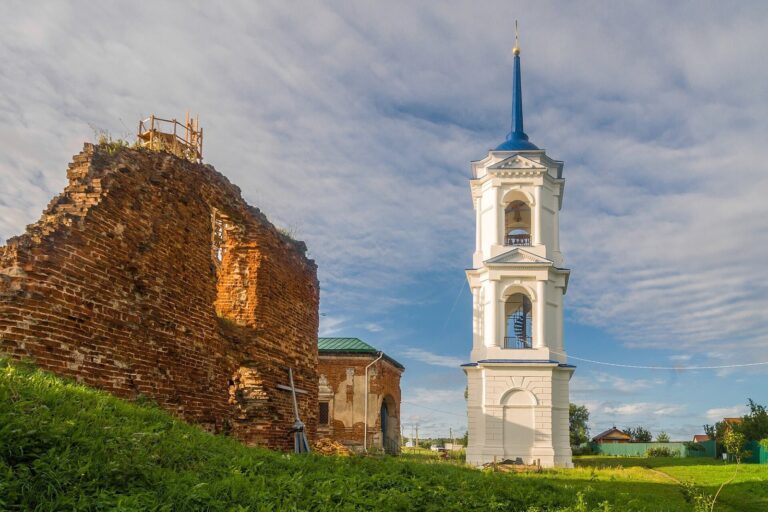
The early nineteenth-century bell tower has three tiers and stands 30 sazhen high, using an old Russian unit of length. Wings of monks’ cells were attached to either side. The tower and one wing were completed in 1804; the other wing followed in 1806.
Hospital church
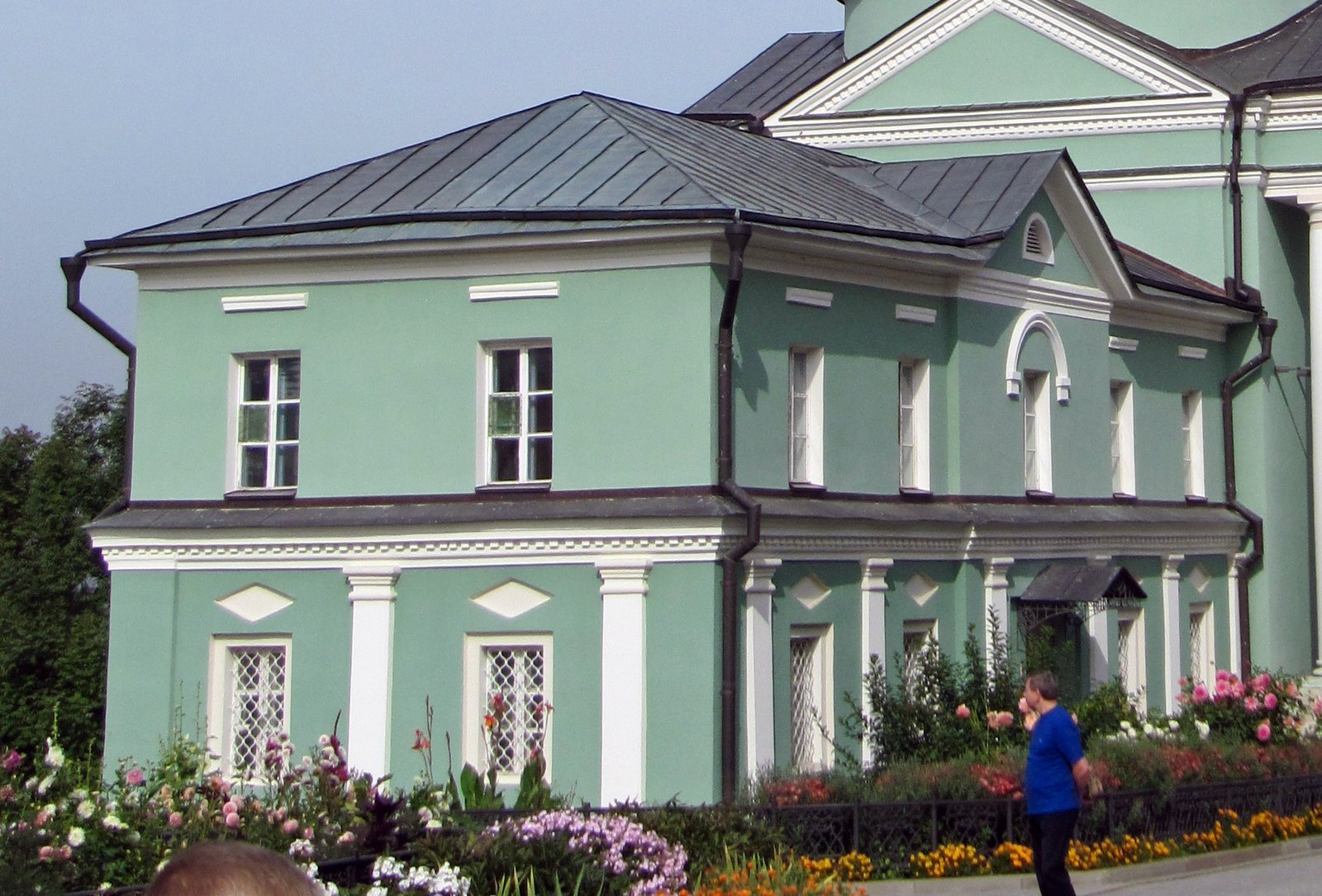
The hospital church, completed and consecrated in 1811, had six attached cells. Court councillor Kamynin supplied building material for its construction.
Skete and its buildings
The skete lies beyond the monastery grove, about 400 metres from the main complex. When it was established, cutting trees around it was prohibited so that the secluded community would remain enclosed by forest. Services were held there throughout the day and night.
Church and visitors’ houses
The wooden Church of John the Baptist was built in 1822 from timber taken from the forest that had grown on the skete’s site. Houses associated with visits by Gogol, Dostoevsky, Leontiev, and Nilus also survive.
Cells and reception room
Nilus described the furnishings of Optina cells in the early twentieth century as including a wooden bed, an icon with a lamp, a chair, a small table, and a washstand with a basin. Ambrose’s cell has been restored and contains several of his belongings. Portraits of visitors, including members of the Romanov family, Dostoevsky, and Tolstoy, hang in the room used to receive distinguished guests.
Memorial to the monks killed in 1993
A chapel dedicated to the Resurrection of Christ was built in 2008 above the burial place of the three monks killed in 1993. Bloodstained floorboards were removed and preserved as relics, objects venerated for their association with a holy person or event. The bell tower was retained as a memorial to the killings.