Bishop’s Palace in Treviso: Residence of the Diocesan Bishop
Site at a Glance
- Popularity
- Low
- Country
- Italy
- Primary era
- Medieval
- Eras represented
- Medieval, Early Modern
- Civilizations
- Holy Roman Empire, Venetian
- Site type
- Religious
- Remains
- Palace
On this page14 sections
History
Medieval residence
The Bishop’s Palace in Treviso, Italy, was built in the 12th century as the residence of the bishop of the Catholic Diocese of Treviso, beside the cathedral. Frescoes found at the site indicate that a building stood here by the 12th or 13th century. Medieval documents often called it a domus lapidea, meaning “stone house.”
In the early 14th century, a hall used to settle legal disputes received a painting of Justice between Mercy and Conscience. The Italian writer Francesco da Barberino proposed the subject and may have designed the work. On 22 July 1329, Cangrande I della Scala, a prominent lord of Verona and member of its ruling Scaliger family, died in a palace room, four days after entering Treviso in victory.
Rebuilding and renewed decoration
Bishop Ermolao Barbaro, whose term lasted from 1443 to 1453, ordered a major renovation and rebuilt the palace in brick. He commissioned the artist Donatello to decorate the audience hall with scenes of Roman festivals, but those paintings have since been lost. The art historian Domenico Maria Federici later proposed that they were reproduced in the Renaissance work Hypnerotomachia Poliphili. A stone plaque on the palace’s first floor commemorates Barbaro’s building work.
In 1574, Bishop Giorgio Corner commissioned a new decorative scheme by Benedetto Caliari. Later bishops, including Giovanni Battista Sanudo, Paolo Francesco Giustiniani and Bernardino Marin, also ordered alterations. During rebuilding of the adjoining cathedral in the late 18th century, its builders demolished the audience hall’s southeast wall, and the hall’s frescoes were renewed.
Abandonment, return and modern restoration
After the palace fell into disrepair, Bishop Sebastiano Soldati, who succeeded Marin and served from 1829 to 1849, abandoned it. Bishop Federico Maria Zinelli, in office from 1861 to 1879, arranged a restoration and brought the bishop’s seat back to the building. Alterations followed the First World War and, more extensively, the Second World War. Anglo-American bombing destroyed the northwest wing, which was rebuilt in 1959.
A 2007 restoration returned the audience hall’s 1574 frescoes to their original appearance. Benedetto Caliari is credited with executing them, assisted by Francesco Montemezzano, then 19, and possibly Antonio Vassilacchi, also known as Aliense, then 18. The painter and biographer Ridolfi names the artists. Work in 2022–2023 restored the palace’s exterior fresco decoration.
Remains
Exterior and passageways
Main facade
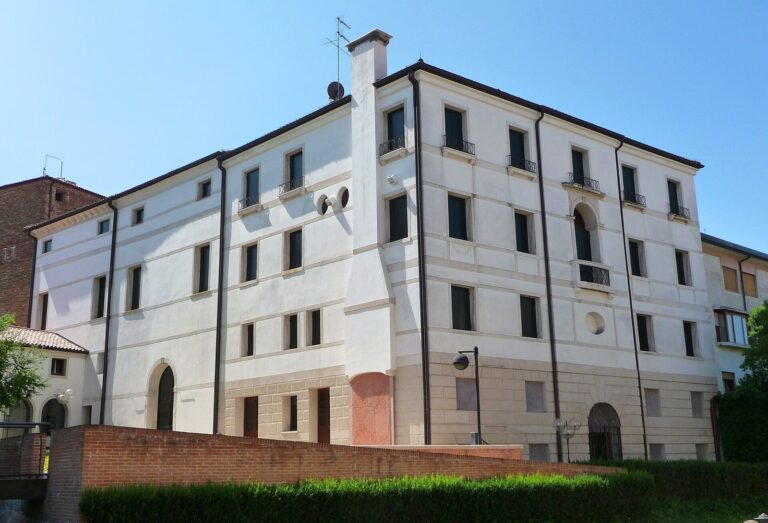
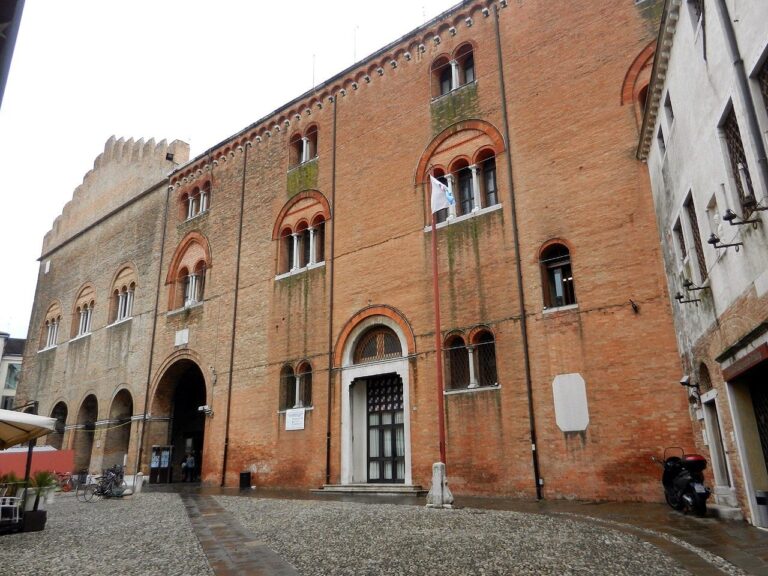
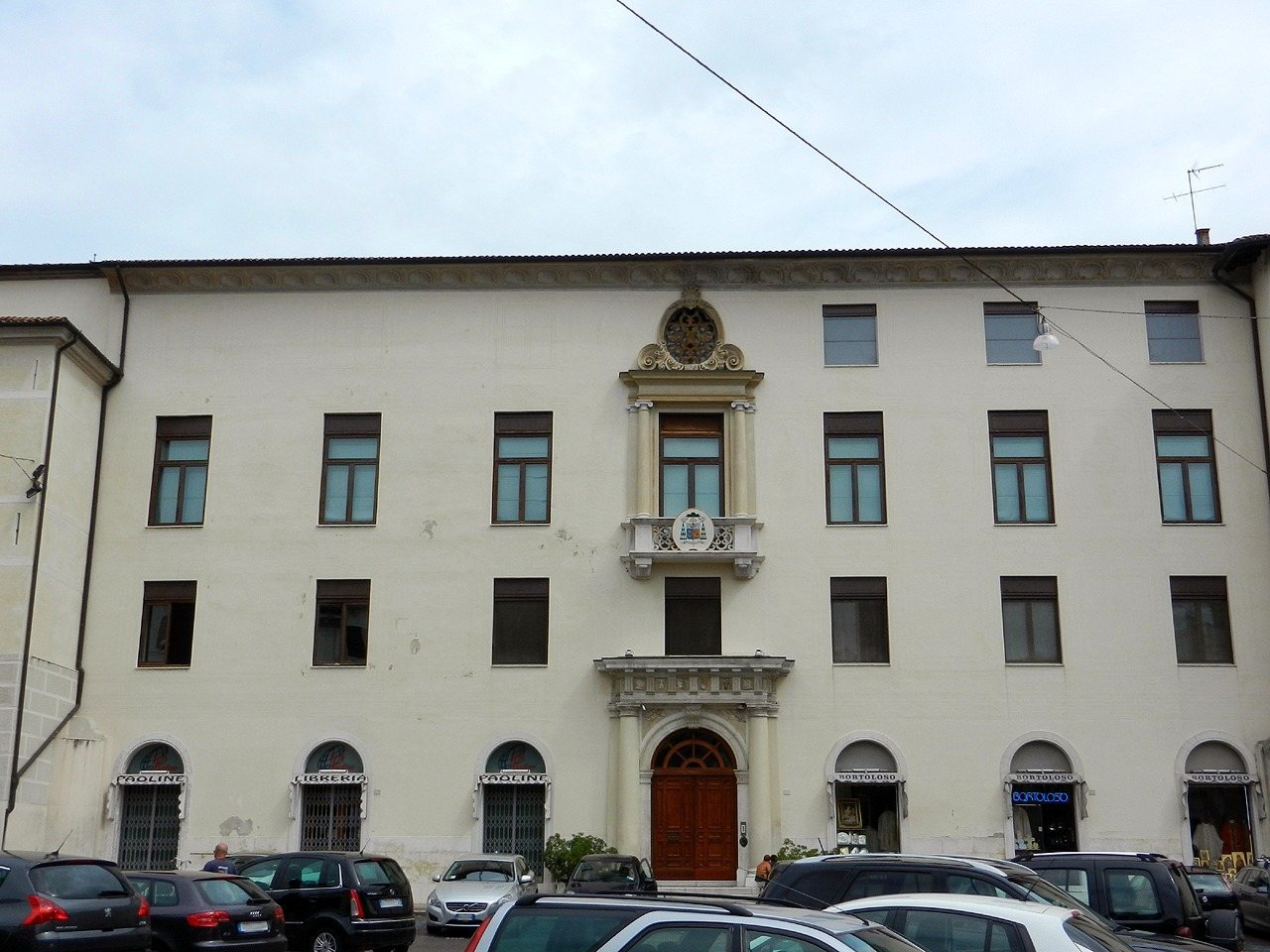
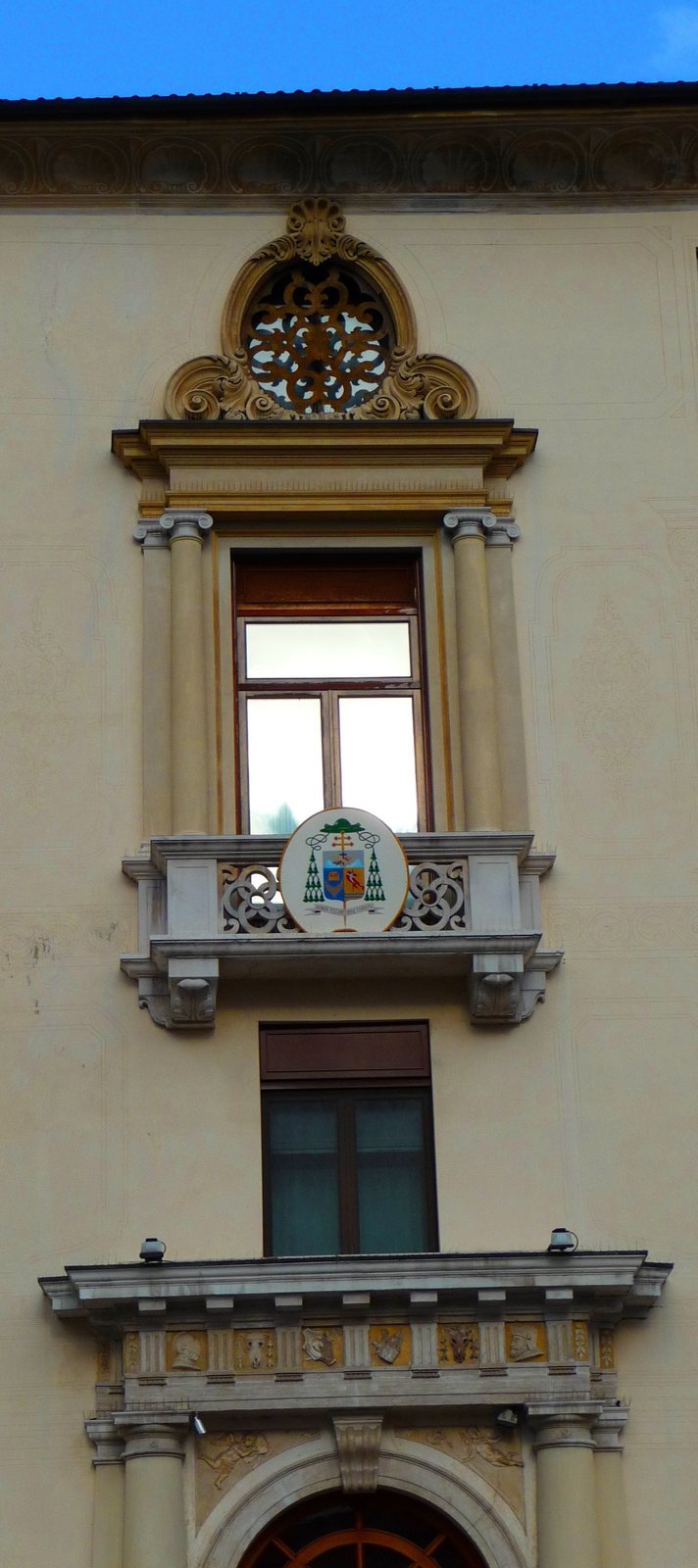
The palace occupies a corner of Piazza Duomo and adjoins the cathedral. Its main facade is arranged around a central doorway with a round stone arch. Two Doric columns, a classical column form, frame the entrance and support an entablature, the horizontal structure above them. Its decorative band alternates triglyphs, or grooved blocks, with metopes, or panels. A broad Baroque balcony projects from the second floor, with an oval opening above it crowned by volutes, scroll-shaped ornaments. Other windows and openings are plain. Caliari’s frescoes once framed them, though repeated repainting long made the decoration difficult to see.
Covered passage and former tower
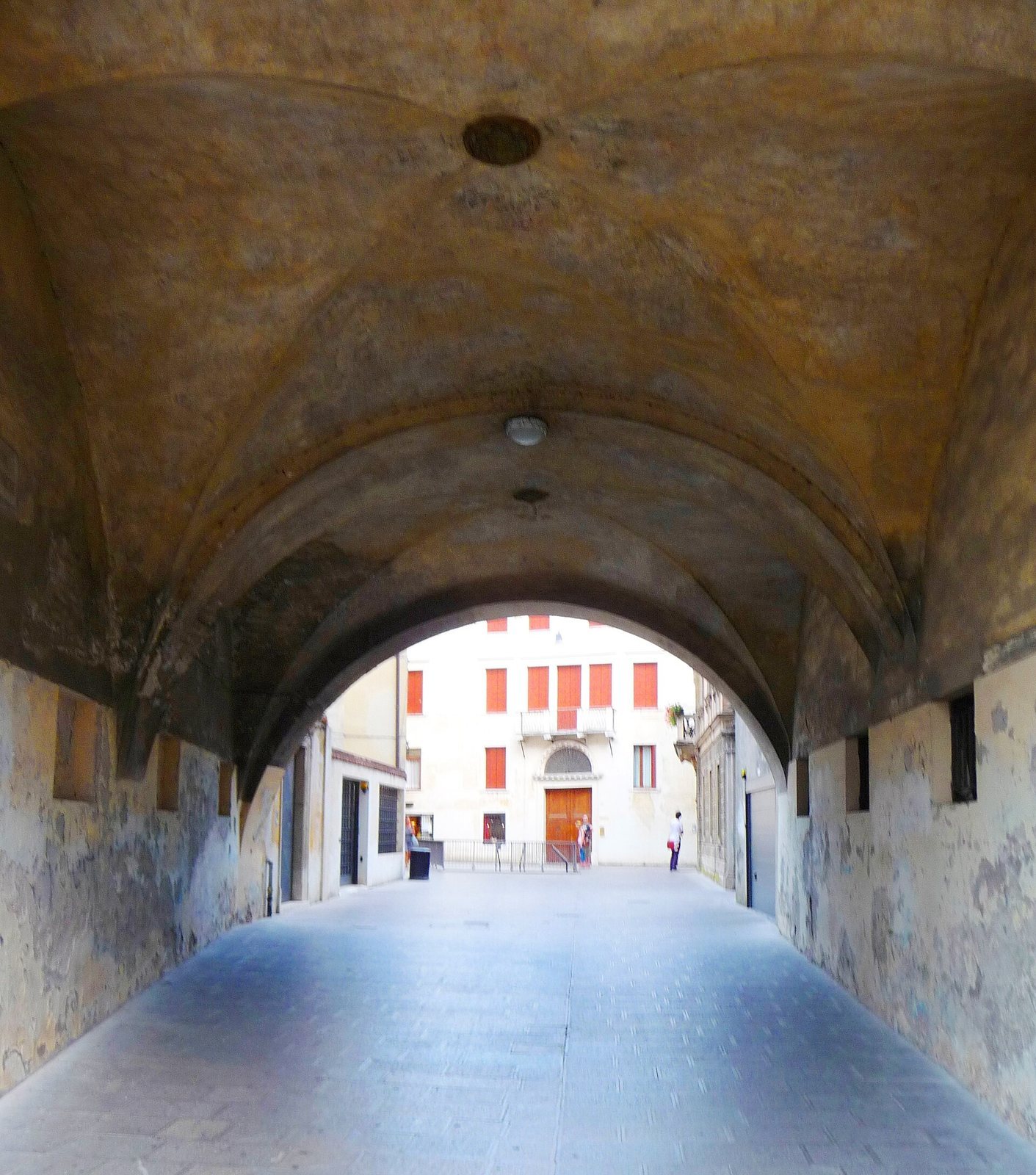
A vaulted passage joins the palace and cathedral at their junction, crosses above part of the street and leads to Via delle Canoniche. Its ceiling is formed by intersecting barrel-shaped vaults. The passage is known from 14th-century evidence, may be older and took its present form through work in the 15th century. Two coats of arms belonging to Barbaro appear on the vault. Between the cathedral facade and the palace’s main facade, a small projecting section preserves what is identified as the base of the former Bishop’s Tower. The tower also appears in engravings by Vincenzo Maria Coronelli and Salomon, and in a painting by Medoro Coghetto.
Northwest wing
The rebuilt northwest wing has a portal topped by a large low-relief carving. It brings together two crossed keys, Treviso’s coat of arms and the arms of Bishop Niccolò Franco, who held office from 1485 to 1499.
Central staircase and audience hall
Staircase and hall entrances
In the palace’s central section, a grand staircase commissioned by Bishop Paolo Francesco Giustiniani leads to the large audience hall on the first floor. Three hall doorways have imposing entablatures, horizontal structures above the openings. Their decorative bands bear the names of Bishops Giorgio Corner and Bartolomeo Gradenigo, whose term ran from 1668 to 1682. The first floor also holds the stone plaque commemorating Barbaro’s renovation.
Allegories and Gospel scenes
The hall’s wall paintings, traditionally attributed to Benedetto Caliari, show the influence of his brother Paolo Veronese. Gospel parables appear within painted architectural frames, where fluted columns separate niches and openings with painted balconies. On the northeast wall, Hope holds an anchor and Faith carries a chalice and cross. The southeast wall presents the parables of the unjust steward, the prodigal son, and Lazarus and the rich man, alongside Charity with three children and two other figures representing Virtue. On the southwest wall, the parable of the unforgiving servant is flanked by a meditating Virtue with a closed book and Temperance, who holds fruit and raises her other hand. The northwest wall’s niches show Justice with scales, Fortitude holding a column and Prudence looking at herself in a mirror.
Painted details and ceiling
Violet-toned contrasts of light and dark give the painted figures depth. Low-relief scenes appear beneath the niches and in plaques above the doors, where sculpted supporting figures frame them. Some subjects are difficult to identify; they include Cain and Abel below Fortitude, Job tempted by demons beneath the Virtue holding a book, and Elijah beneath Temperance. Painted objects seemingly resting against the walls and garlands hanging from column capitals extend the illusion of depth. Above, the ceiling has recessed panels and a large central coat of arms belonging to Bishop Federico Maria Zinelli.
Frescoes now in the Diocesan Museum
Two frescoes discovered in the palace are now held by the Diocesan Museum of Treviso. One depicts the murder of Thomas Becket, the archbishop of Canterbury, in his cathedral by agents of King Henry II of England. The scene was regarded as expressing the Church’s resistance to civil authority. The other shows Christ in Limbo, an intermediate abode for souls not yet admitted to heaven in traditional Christian belief.