Church of Saint Martin in Peschiera del Garda: A Roman Catholic Parish Church
Site at a Glance
- Popularity
- Low
- Country
- Italy
- Primary era
- Modern
- Eras represented
- Classical, Modern
- Civilizations
- Austrian Empire, Habsburg, Italian, Roman
- Site type
- Religious
- Remains
- Church
On this page14 sections
History
Roman site and early parish
The Church of Saint Martin is a Roman Catholic parish church in Peschiera del Garda, Italy, dedicated to Martin of Tours. The present Neoclassical building, drawing on ancient Greek and Roman forms, was built from 1820 to 1822. The parish belongs to the Diocese of Verona, a church district overseen by a bishop, and is regarded as one of the diocese’s oldest.
A temple to Jupiter, a principal god of ancient Roman religion, may once have occupied the site. Roman foundations excavated north of the church support this possibility. The parish is first mentioned on 12 November 877, when Charles the Bald, a ruler of West Francia, confirmed earlier documents for Theotricus, abbot of Nonantola. A reference from 1008 explicitly identifies a church dedicated to Saint Martin. In 1145, Pope Eugene III issued a formal decree referring to the parish of Piscaria, its chapels, customary church dues, fisheries, and a share of an estate.
Parish and Napoleonic era
An archpriest, a senior priest with authority over other clergy or churches in a district, was appointed in 1454. In 1510, Peschiera’s archpriest took part in confirming a reported apparition of Mary at Lake Frassino.
Napoleon Bonaparte captured Peschiera in mid-1796 during the First Coalition War, a European conflict against Revolutionary France. He captured it again during the Second Coalition War after the town had passed to the Habsburg monarchy. Under French occupation, the earlier church served as a hospital and military store. In 1810, the French closed the civil and military cemeteries on either side of it and opened a replacement outside the town, near the Sanctuary of Our Lady of Frassino. The church returned to religious use and was reconsecrated in 1812.
Rebuilding and redesign
After the Congress of Vienna, Austrian authorities ordered the war-damaged church demolished. It was pulled down in 1814 because it was considered unsafe, and a priest received 17,500 lire toward a replacement. The new church was built from 1820 to 1822. During the siege by Piedmontese-Sardinian troops in April 1848, its tower was damaged and soon rebuilt; the entrance and apse were also rearranged.
At the direction of priest Giuseppe Lenotti, a remodeling from 1930 to 1933 established the church’s present arrangement. Painter Severino Saoncella received a commission in 1937 to decorate the interior walls with frescoes, paintings made on wet plaster. Further renovation followed in 1966, and the frescoes and decorative features were restored in 2008 and 2009.
Remains
Roman foundations
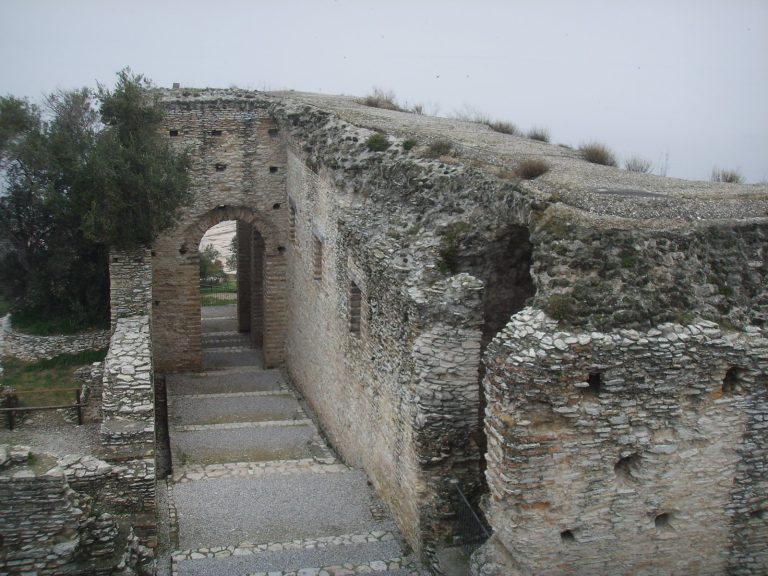
North of the church are Roman foundation walls belonging to several building phases dated from the second century BC to the fifth century AD.
Setting, plan, and exterior
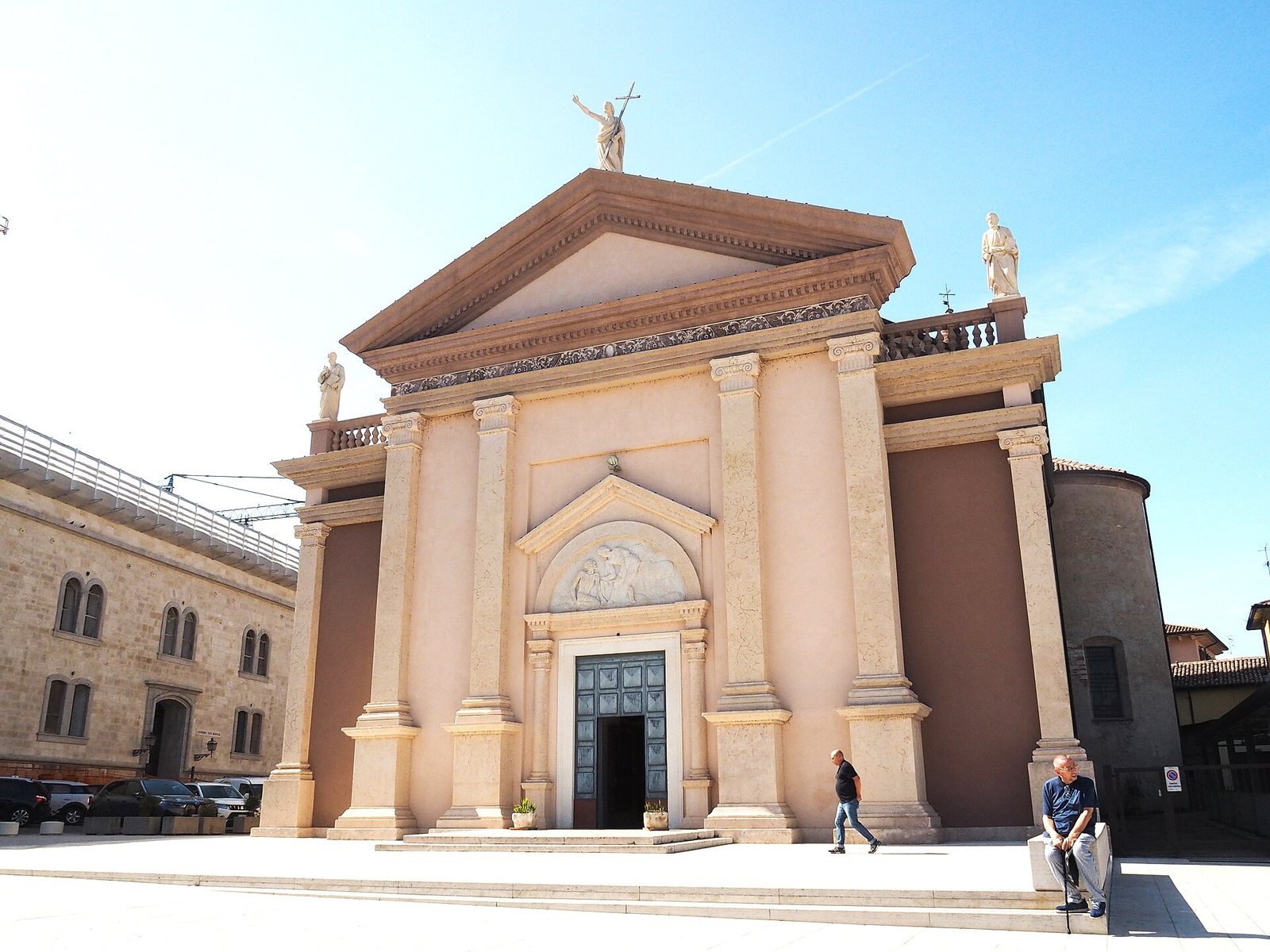
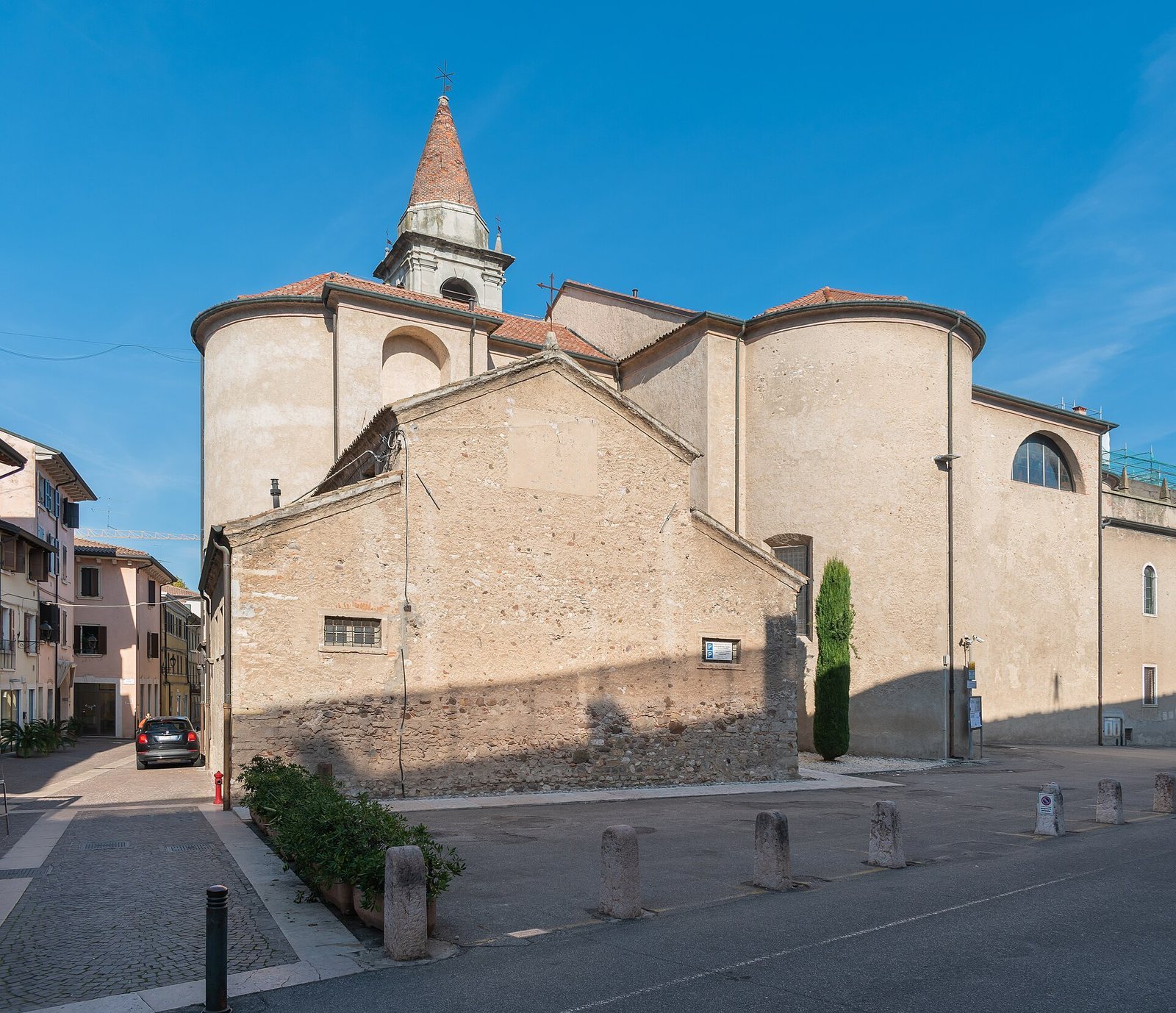
The church stands in the historic center of Peschiera del Garda, in the southern part of the largest island in the Mincio River, at Piazza Ferdinando di Savoia, also called Piazza d’Armi. Its plan has one main hall and a cross-shaped arrangement; its architecture and furnishings are Neoclassical. The entrance now faces east, the apse is at the west end, and the façade faces the square. Above the main doorway, a relief shows Martin dismounting from his horse to share his cloak with a beggar. A statue of Jesus holding a cross-shaped staff stands on the roof ridge, with Peter, holding a key, and Paul, holding a book and sword, at the two corners.
Interior
Entrance and baptistery
Above the main entrance is an organ, while a window opposite depicts Cecilia of Rome playing one. Just inside, on the right, a small baptistery contains a baptismal font. Its two windows show Jesus being baptized by John the Baptist, with Jesus on the left and John on the right. Between them, a Latin inscription means Living spring, regenerating water, purifying wave. A painted window above the baptistery entrance shows Saint Barbara with cannons at her feet, presenting her as patroness of artillery.
Side altars
The first niche on the right holds an altar dedicated to Anthony of Padua. A confessional is beside it, with a statue of Rita of Cascia on the other side; the window above depicts the Last Supper. Opposite, another niche contains an altar dedicated to the Sacred Heart, with a second confessional to its left and a statue of Saint Joseph to its right. Joseph holds a flowering staff and a carpenter’s square, and the window above shows the Adoration of the Magi. In the left aisle, an altar to Our Lady of the Rosary commemorates the Christian coalition’s 1571 victory over the Ottoman fleet at the Battle of Lepanto. Its windows depict Isaiah on the left and Jeremiah on the right.
Side entrance painting
Above the right-hand side entrance is a painting dated 1631 by Giacomo Piacentini. It depicts Saint Sebastian pierced by arrows, Saint Roch, and the Virgin Mary above them.
Right transept altar
The right transept, the crosswise part of the church, contains an altar dedicated to Blessed Andrea Grego of Peschiera, a fifteenth-century Dominican friar and preacher. A glass reliquary, a container for a religious relic, displays his right arm. The stained-glass windows show the prophets Daniel on the left and Ezekiel on the right.
Main altar and apse
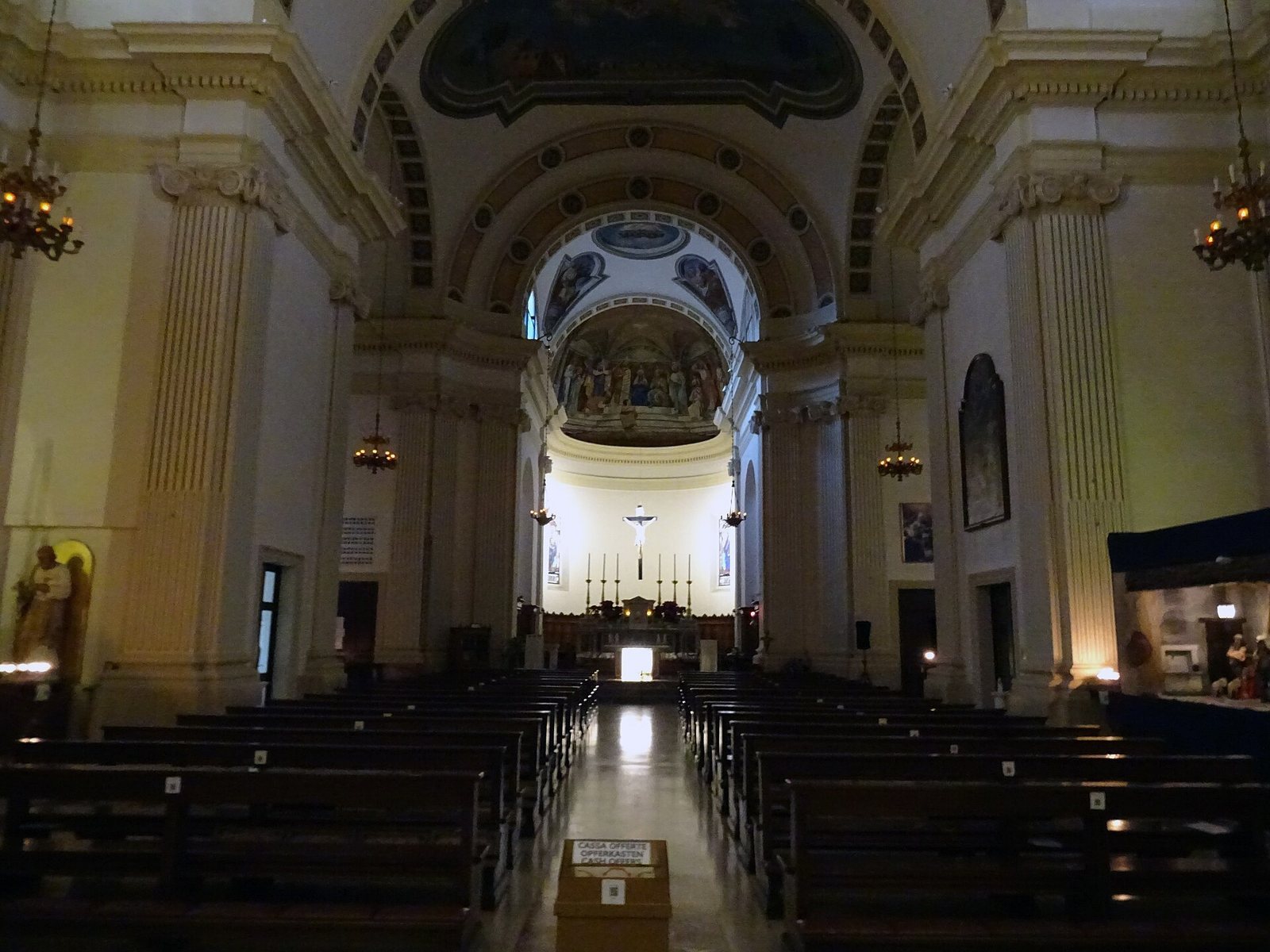
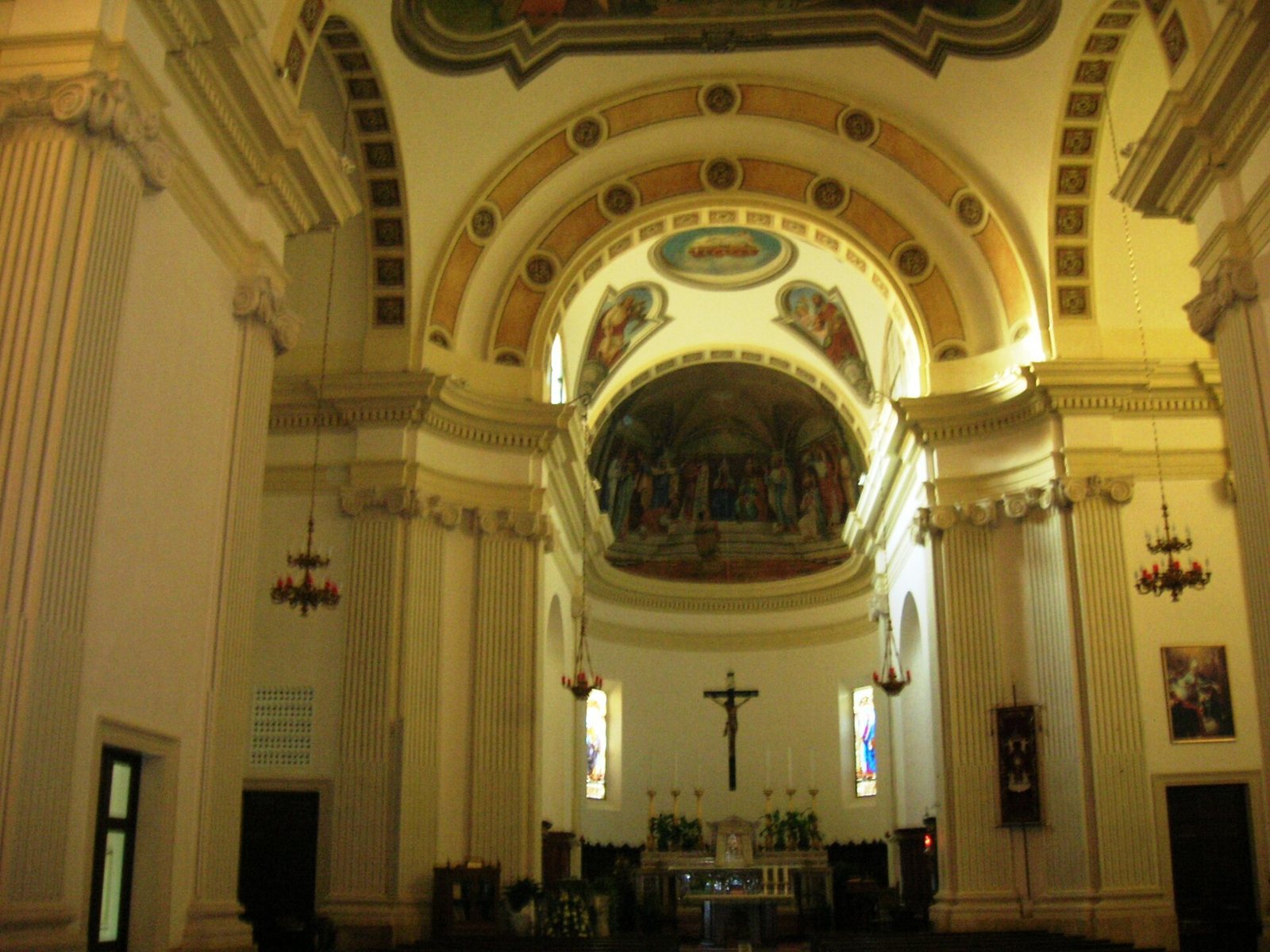
The main altar, made of inlaid marble in the first half of the nineteenth century, has a tabernacle, a receptacle for the Eucharist, with marble columns and a hand-hammered copper door. A sculpture shows Martin on horseback drawing his sword to divide his cloak and share it with someone in need. The windows depict Peter on the left and Paul on the right. At the west end, the apse, or end section of the church, has a fresco of Pentecost. The dome above the altar shows the four Evangelists in its corners and the Lamb of God at its center.
Ceiling paintings
Other ceiling paintings depict episodes from Andrea Grego’s life. Above the organ, he bids farewell to his relatives; the next painting shows him preaching to listeners in Valtellina. A painting in the transept depicts the rescue of Peschiera’s fortified stronghold from a fire.