Santa Maria del Tindari: A Parish Church in Condrò
Site at a Glance
- Popularity
- Very Low
- Country
- Italy
- Primary era
- Early Modern
- Eras represented
- Early Modern
- Civilizations
- Kingdom of Sicily, Spanish
- Site type
- Religious
- Remains
- Church
On this page21 sections
History
Santa Maria del Tindari is a Roman Catholic church in Condrò, Italy. The church was founded in 1571, when construction of the present building began, during the second half of the sixteenth century. It is dedicated to Most Holy Mary of Tindari and Saint Vitus, an early Christian martyr, and is the largest church in Condrò.
Also called the duomo, a term for a major church that does not itself mean a bishop’s seat, and the Matrice, or principal church, it serves as the parish church of Most Holy Mary of Tindari and Saint Vitus. It belongs to the Archdiocese of Messina-Lipari-Santa Lucia del Mela, a major Catholic territorial jurisdiction, and is linked to the Vicariate and archpriesthood of Milazzo. A vicariate is a subdivision of a diocese or archdiocese, while an archpriesthood is a district or office led by an archpriest. The vicariate is under the patronage of Saint Francis of Paola, an Italian friar who founded the Order of Minims. The church has undergone restoration and structural alterations in recent times, though their dates are unspecified.
Remains
Exterior and interior layout
Facade and plan
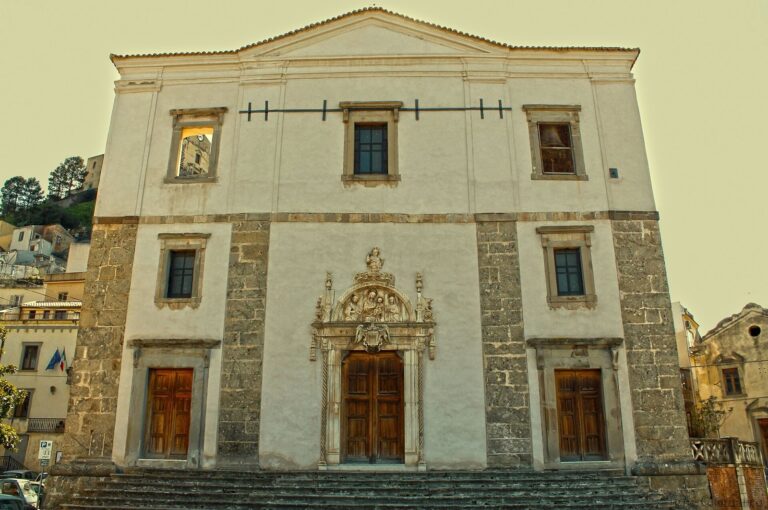
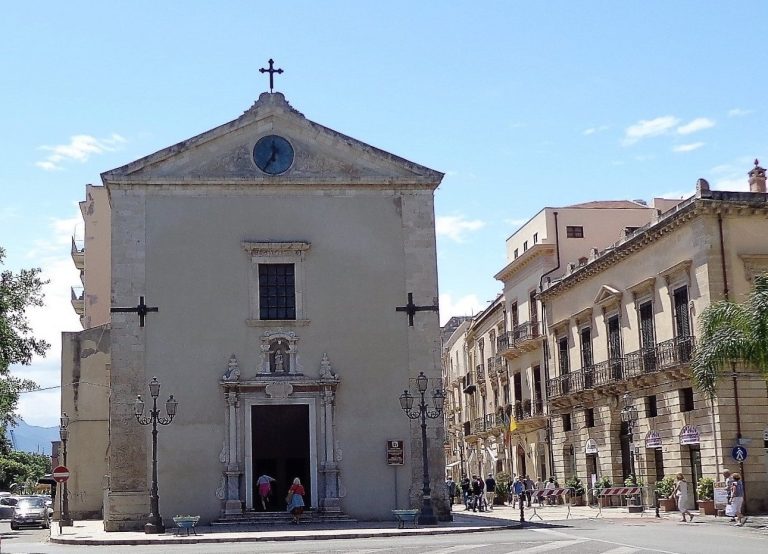
The principal façade faces Piazza Duomo. The exterior shows evidence of restoration and structural change. Inside, the church follows a Latin-cross basilica plan: a central nave, or main body, is flanked by two side aisles, and a crosswise section forms the arms of the plan. Large rounded arches rest on substantial piers and divide the interior into bays, or sections between structural divisions. Each aisle has five bays. The east-side aisle has a side entrance in its third bay.
Interior structure and decoration
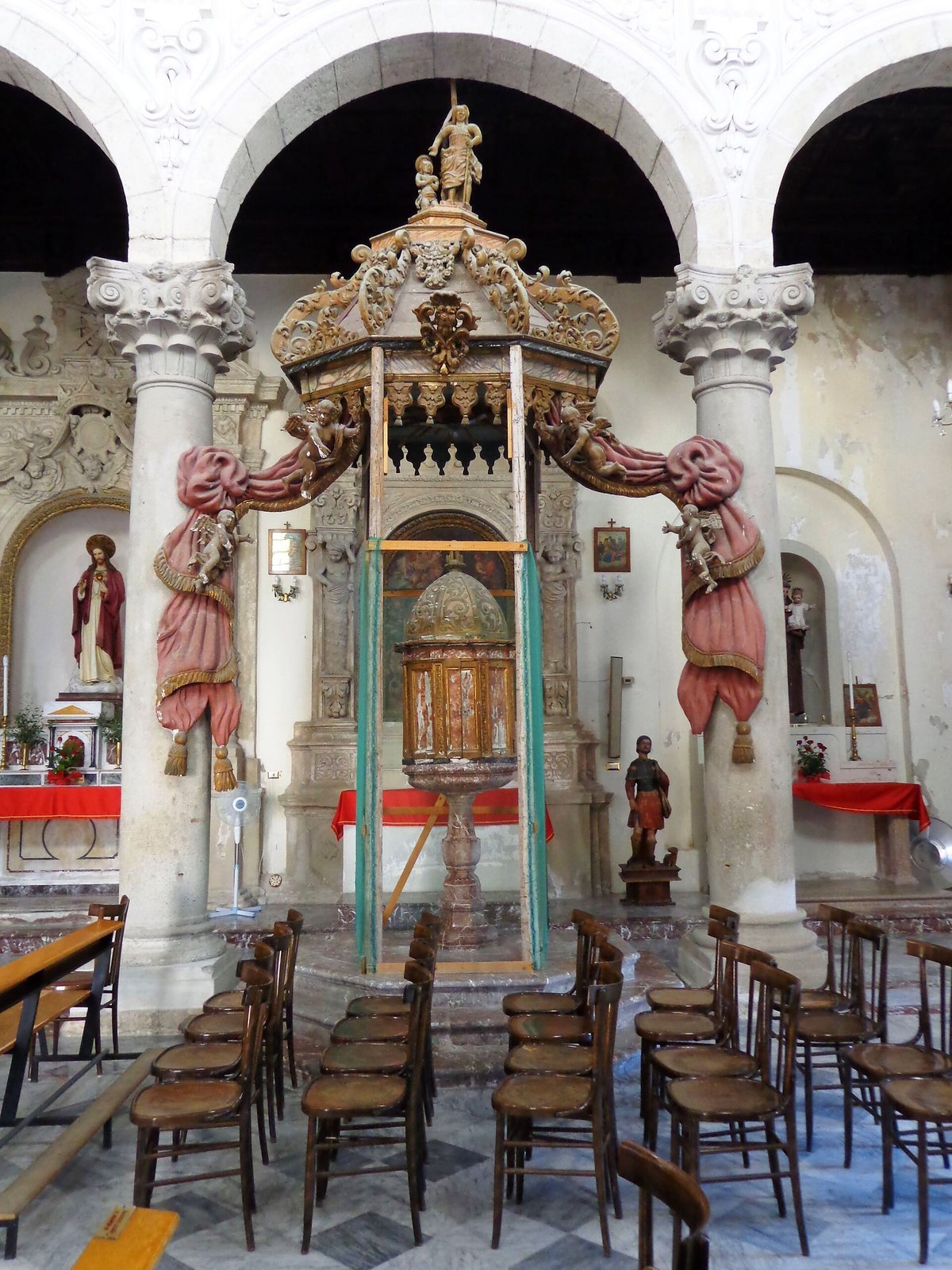
All three naves have wooden ceilings divided into recessed panels. A carved and gilded panel in the central ceiling depicts the Coronation of the Virgin. Friezes, rosettes, and stucco ornament cover the walls, with stucco figures of biblical characters in the central nave. Local-stone altars and carved wooden figures add further detail to the bays and apses, or recesses at the ends of the church. The interior also contains a baptismal font with a canopy and a wooden pulpit. Many altars feature an entablature, the horizontal structure above columns, and a pediment, the shaped element crowning it.
Altars in the side aisles
Right aisle, first bay
The altar of Saint Anthony of Padua, a Franciscan preacher, has a restrained design. A statue of the saint occupies a niche set into a recessed arch. Beside the altar, on its left, an old wooden statue depicts Saint Vitus the Martyr.
Right aisle, second bay
This altar is dedicated to the Virgin and Child and the Souls in Purgatory, understood in Catholic teaching as a state of purification after death. Sculpted herms, human-form supports, stand on brackets; their patterned garments and partly banded torsos rise to ornate capitals. Above them, a richly moulded entablature carries a curled pediment with a central upright panel, or stela, and a coat of arms. Winged child figures flank the arch. The niche holds a painting of souls in purgatory and saints before the Virgin. Its upper section is badly damaged and requires conservation.
Right aisle, third bay
The Sacred Heart altar honours a Catholic devotion focused on Jesus’ heart as a sign of his love. Plant forms carved at the column bases meet vertically grooved shafts, described as Doric, which appear to merge with the folds of a canopy. The columns support a moulded entablature and a broken triangular pediment. Its central panel bears a radiant halo and a dove representing the Holy Spirit. Beneath a crown, a coat of arms, and a winged child’s head, the canopy spreads fringed drapery between further winged heads. A gold-framed niche contains a statue of the Sacred Heart.
Right aisle, fourth bay
The altar of Saint Nicholas, venerated as a Christian bishop and saint, has sculpted human-form supports with floral garments and partly banded torsos. Their capitals carry a richly moulded entablature, topped by a curled pediment with a central panel and coat of arms. Winged child figures are arranged symmetrically beside the arch. An elaborate frame surrounds a painting of a bishop saint in the niche.
Right aisle, fifth bay
This altar is dedicated to the Virgin and Child and to Dominican saints, meaning saints associated with the Dominican religious order. Floral and plant-like carving decorates the column bases, while the grooved shafts have Corinthian capitals, column tops decorated with foliage. The entablature supports a broken triangular pediment, whose small central shrine contains a statuette of the Immaculate Conception, the Catholic belief that Mary was conceived without original sin. Floral ornament fills the spaces beside the arch, and the niche holds a painting of the Immaculate Conception among Dominican saints.
Left aisle, first bay
The altar of Saint Michael the Archangel has columns with plant-carved bases, grooved shafts, and Corinthian capitals. Above them, a moulded entablature supports a broken arched pediment and a small shrine beneath a triangular gable. Two angels with trumpets stand beside the arch. In the niche, a wooden statue shows Michael with a sword and the scales of justice in his left hand.
Left aisle, second bay
The small altar of Saint Francis of Paola is elaborately decorated. Its columns have plant-patterned bases, grooved shafts, and Corinthian capitals. A moulded entablature and broken triangular pediment crown the structure, with an acanthus-leaf band between the sections of the pediment. The niche contains a bust of the saint leaning on a staff, displayed behind glass.
Left aisle, fourth bay
This altar honours the Virgin, Saint Anne, and the Child Jesus. Its columns have plant-carved bases, grooved shafts, and Corinthian capitals, supporting a moulded entablature and a broken arched pediment. A round panel at the centre bears a dove representing the Holy Spirit. A high relief of Mary, Jesus, and Anne is enclosed by stucco acanthus leaves and a garland. Anne holds a basket of medlars; the figures sit on nimbus-like forms within a domestic scene. Winged child figures occupy the oval above and the frame’s corners, while a crowned coat of arms surmounts the composition.
Left aisle, fifth bay
The altar of Saint Joseph and the Child Jesus has columns with plant-patterned bases, grooved shafts, and Corinthian capitals. A richly moulded entablature supports a broken arched pediment with an intervening arch segment. Wooden statues show Joseph, traditionally regarded as Jesus’ earthly father, and the Child holding hands. Their tunics are silvered; blue shading appears on Joseph’s, and both figures wear gilded cloaks.
Transept and side chapels
Altar of Saint Vitus
In the right transept, paired columns frame the altar of Saint Vitus. They combine Ionic-style bases, grooved shafts, garlands of plant forms, and Corinthian capitals. The inner pair projects farther forward than the outer pair, creating a layered arrangement. A moulded entablature supports a curled pediment with inward-turning spirals, shells, and acanthus leaves. Its depth recedes toward a semicircular central panel bearing a radiating halo and a dove representing the Holy Spirit, with winged child figures at the base.
Altar of Saint Francis of Assisi
Another right-transept altar is dedicated to Francis of Assisi, founder of the Franciscan order. Its pilasters are decorated with acanthus garlands, curls, and spiral forms. The moulded entablature rests on supports ornamented with winged child heads, and a curled pediment above has further child figures on its slopes. Angels draw back a drape to reveal a coat of arms bearing the motto “Pax et Bonum,” meaning “Peace and Good.” A statue of Francis stands in the arch, with Saint Lucy on the right bracket and Padre Pio of Pietrelcina on the left. Padre Pio was a twentieth-century Italian Capuchin friar.
Chapel of the Most Holy Crucifix
The right-side apse contains the chapel of the Most Holy Crucifix. Beneath the altar table, a wooden-and-glass urn holds a figure of the Dead Christ. An arch ornamented with stylized acanthus leaves frames a radiating composition centred on the crucifix. Winged child figures carry objects associated with the suffering and death of Jesus. At the cross’s foot, beside a small wooden tabernacle, stucco figures show the Sorrowful Virgin, Mary Magdalene embracing the cross, and Saint John the Apostle, in that order. A doorway to the sacristy, where clergy prepare for services and keep liturgical objects, stands at the far right.
Chapel of the Most Holy Sacrament
The left-side apse contains the chapel of the Most Holy Sacrament, the Eucharist. Spiral-shaped wooden supports connect the altar table to an upper structure of successively smaller marble steps. On the fourth level, angels surround a tabernacle beneath a wooden ciborium, a canopy-like altar structure. Small, finely carved columns enclose a niche containing a wooden statuette of the Immaculate Conception. The niche has golden halo forms and a shell associated with the pilgrimage of earthly life. Above it, a second, six-sided tier rises beneath a decorated ribbed dome. Projecting shelves hold wooden figures of biblical characters. The structure is damaged on its right side and requires conservation.
Central apse and Madonna of Tindari
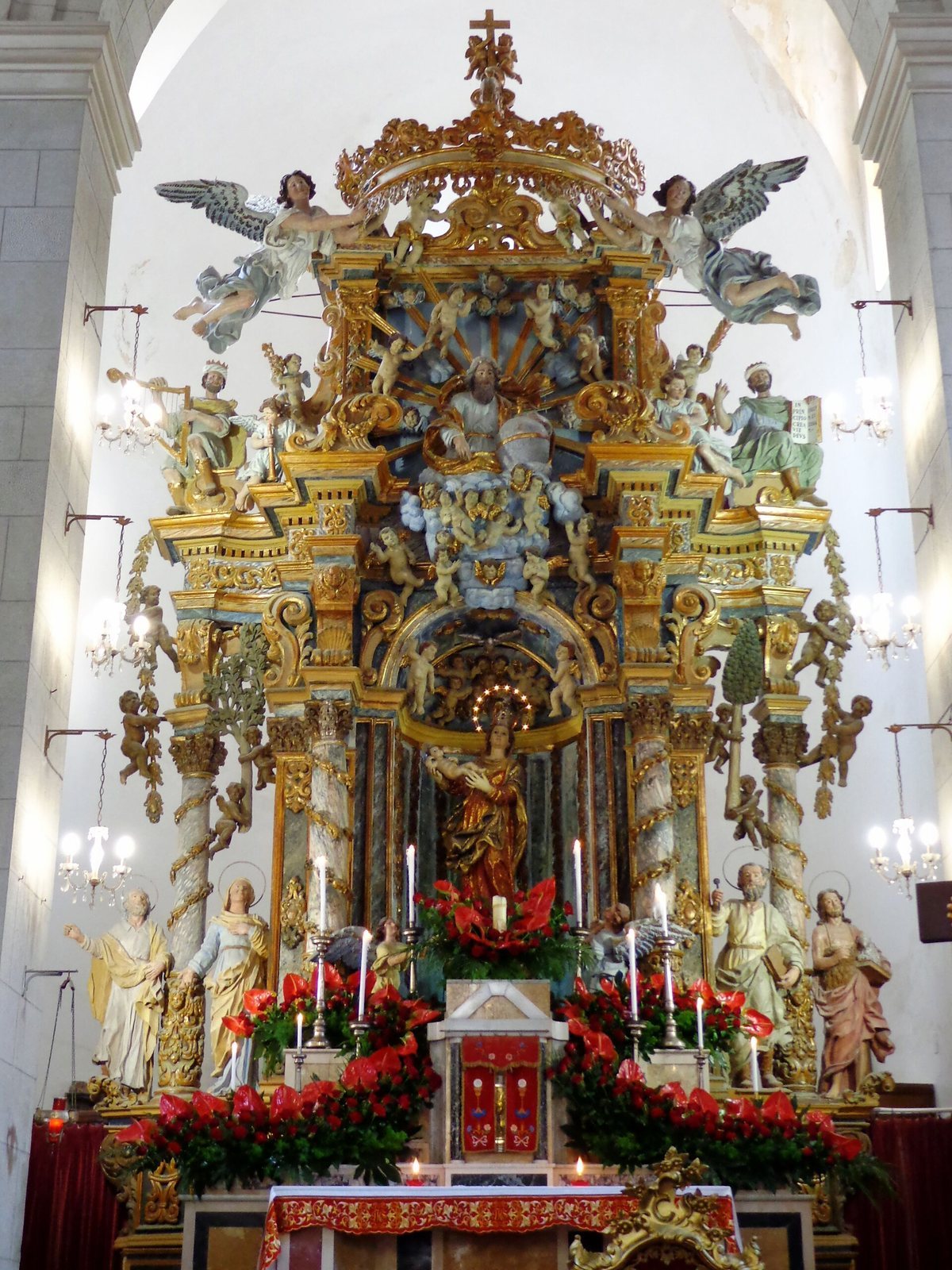
A post-conciliar altar, arranged according to Catholic liturgical practice following the Second Vatican Council and facing the congregation, stands in the centre of the transept. Within the apse arch, an elaborate carved wooden structure surrounds the niche of the Madonna of Tindari, a devotional title for Mary. The paired columns have Ionic-style bases, plant decoration and garlands along their shafts, and Corinthian capitals. Their inner pair projects forward of the outer pair. Figures at the entablature’s ends play a stringed instrument and hold an open book bearing the words, “In the beginning God created heaven and earth.” Above, two flying angels lower a large crown. Joachim and Anne, traditionally identified as Mary’s parents, stand with Peter holding the Book of Life and John the Baptist.
The venerated statue of the Madonna occupies the centre of the carved composition, among numerous winged child figures and a dove representing the Holy Spirit. Figures beside her hold a stylized vine shoot and a palm leaf. Above the niche, God the Father sits on a throne of clouds, surrounded by child figures, with a globe topped by a cross in his left hand. Behind him, beneath the crown, a radiant group of musical angels and winged figures fills the upper space. The surrounding carving includes further figures, garlands, hanging ornaments, bands, curls, spiral forms, and shells.