Basilica of Saint Michael: An Early Christian Church in Albania
Site at a Glance
- Popularity
- Very Low
- Country
- Albania
- Primary era
- Medieval
- Eras represented
- Classical, Medieval
- Civilizations
- Byzantine
- Site type
- Religious
- Remains
- Basilica
On this page12 sections
History
Foundation and early use
The Basilica of Saint Michael, also known as the Arapaj Basilica, was an early Christian church at Arapaj in Albania, built in the 5th or 6th century, probably near the beginning of the 6th. It is believed to have been dedicated to the Archangel Michael, a leading angel in Christian tradition. The basilica is regarded as an early example of Christian architecture in Albania and as evidence of Christianity in the region.
A monogrammed pavement from the church’s western courtyard is dated to the reign of Byzantine emperor Anastasius I (491–518). The Byzantine Empire was the eastern continuation of the Roman Empire, centered on Constantinople. The pavement’s date supports the proposed chronology of the church. Its three-lobed arrangement has been associated with regional churches devoted to the veneration of saints and martyrs. The basilica may have served chiefly to preserve a relic.
Destruction and later use
The church remained in use until the 11th century. In 1081, during the Normans’ occupation of Dyrrachium, now Durrës, their army under Robert Guiscard may have set it on fire. The Normans were a medieval people whose rulers established states in southern Italy and Sicily.
After the destruction, members of Byzantine emperor Alexios I Komnenos’s bodyguard who had died in battle were buried in the basilica’s area. A later phase, dated to the 12th–14th centuries, involved changes to the complex and its use as a cemetery. Finds from the surrounding area suggest that people may have continued to live near the former church until the 13th century. The basilica was eventually forgotten for centuries.
Rediscovery and protection
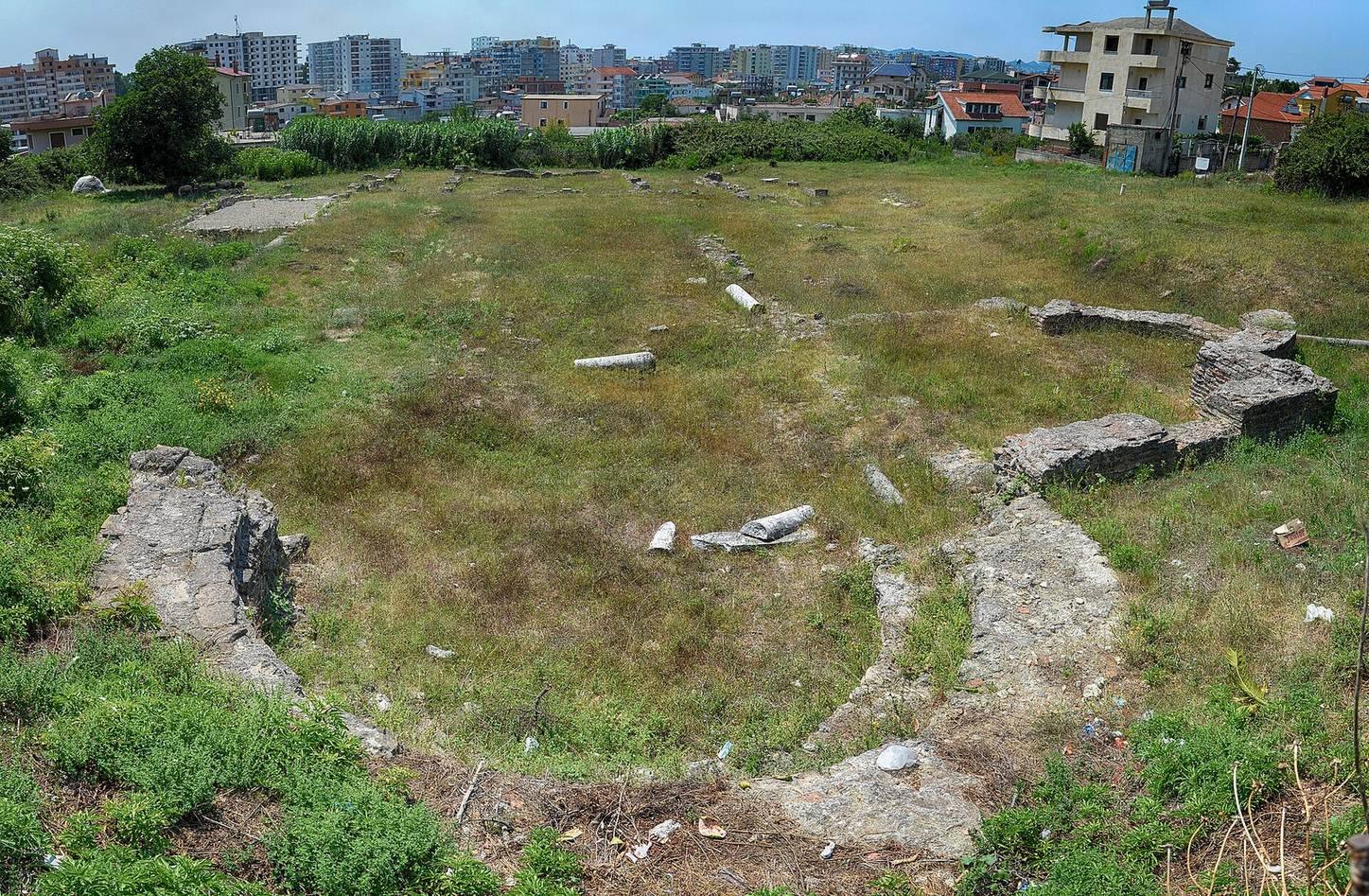
Albanian archaeologists Hava and Sali Hidri found the ruins in 1974. Excavations in 1981–1983 exposed the foundations and mosaic. Later restoration work helped conserve the mosaics and stabilize the structure. The site was approved for protection as a Cultural Monument of Albania in 1987.
Remains
The ruins stand on the southern edge of Arapaj, on the slope of Saint Michael’s Hill. The east-facing basilica had a long, three-aisled plan with a crosswise transept, built from worked stone and brick. At about 60 metres long, it is among Albania’s largest ancient basilicas by area.
Church plan and interior
Plan and entrances
The church measured about 20 metres across at the entrance vestibule, or narthex, and about 30 metres across the side aisles’ apses. At the eastern end, a rounded apse closed the central nave, with a smaller apse at the end of each side aisle. The central apse was about 7 metres in diameter, and its walls were 1.5 metres thick.
A western courtyard, or atrium, adjoined the narthex. Four doorways led from the narthex into the church: two opened onto the central nave and one onto each side aisle. Rows of columns and arches divided the interior into three aisles.
Sanctuary fittings
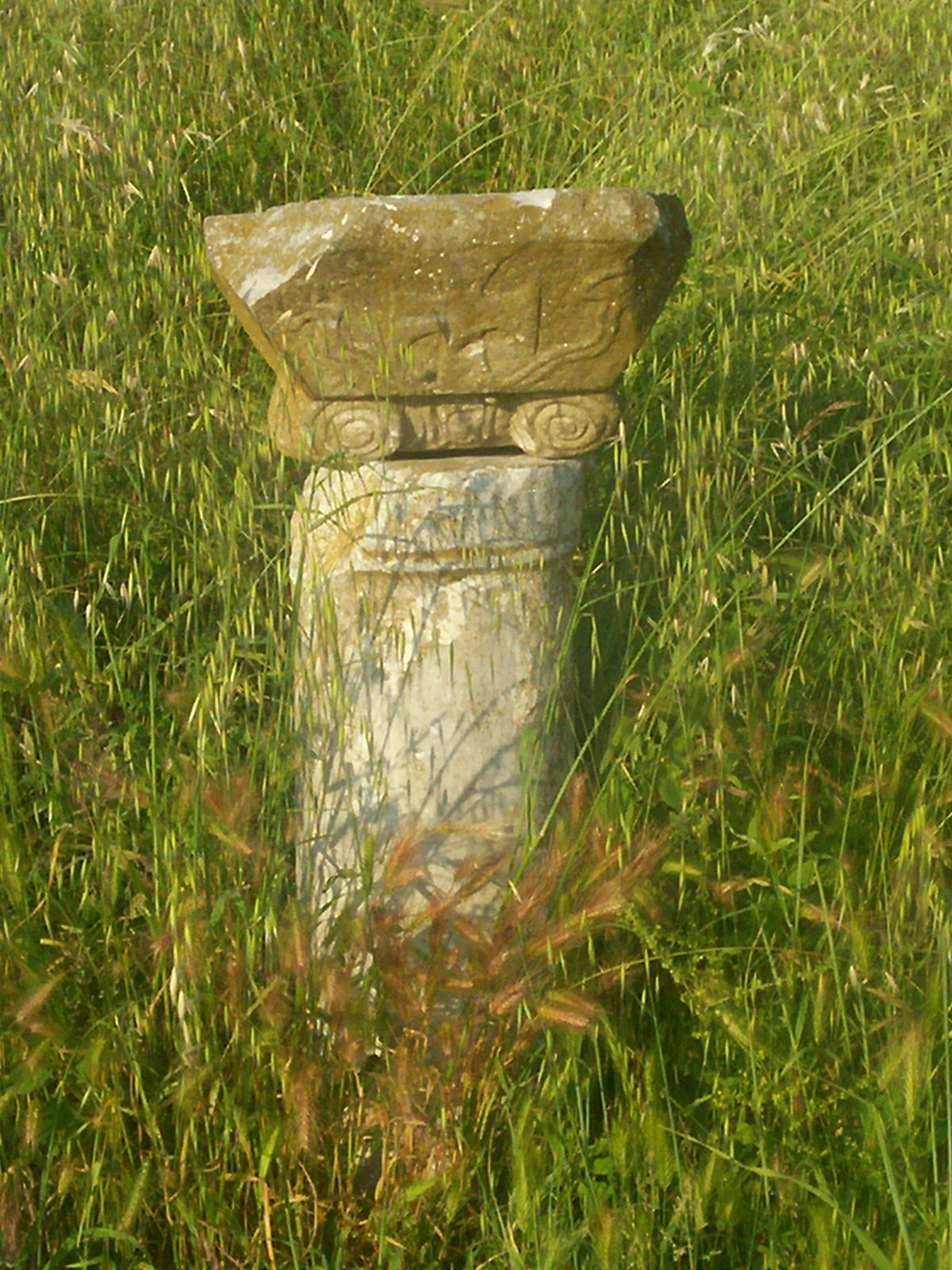
Before the presbytery, the area around the altar reserved for clergy, lay the bema, a raised sanctuary area. Columns, shallow wall-attached pilasters, and arches formed part of its fittings. Fragments of these features remained in place, and parts of the altar survive within the bema.
Burial chamber and decoration
Burial chamber
A small, partly underground burial chamber was attached to the basilica’s south side. Excavation recovered the remains of a man and a woman from within it.
Chamber mosaic
A richly coloured mosaic, covering 54 square metres, lies over the chamber. It is protected beneath a layer of gravel and cannot be seen. One scene shows a man and woman seated outdoors among dogs, horses, goats, and sheep. It has been interpreted as an image of the couple’s life in paradise. In another scene, a two-handled krater, an ancient vessel for mixing wine and water, pours wine in two streams as a stag and hind approach to drink. The wine has been read as an allusion to Christ’s death and the Eucharist, the Christian sacrament of bread and wine commemorating the Last Supper. It may also portray symbolic human figures drinking from the source of eternal life.
Church decoration and finds
Other mosaic and wall decoration features geometric and biblical designs, alongside Christian symbols including fish, doves, and nets. These decorations survive in good condition. Excavations also recovered pieces of stone and bronze statues, ceramic objects, and vessels used in Christian worship.