San Giovanni Battista Church: Parish Church of Induno Olona, Italy
Site at a Glance
- Popularity
- Low
- Country
- Italy
- Primary era
- Early Modern
- Eras represented
- Medieval, Early Modern, Modern
- Civilizations
- Duchy of Milan, Habsburg, Holy Roman Empire, Italian, Spanish
- Site type
- Religious
- Remains
- Church
On this page15 sections
History
San Giovanni Battista Church is the Roman Catholic parish church of Induno Olona, Italy, dedicated to Saint John the Baptist and served according to the Ambrosian rite, the liturgical tradition chiefly associated with Milan. Erected between the late fifteenth and early sixteenth centuries, probably over an earlier church, it became the parish church after a period when the medieval church of San Pietro in Silvis continued to serve the community.
Construction and parish development
Baptisms and marriages began to be entered in the church’s parish records in 1564, although some couples from Induno continued to marry elsewhere. San Giovanni was still being built in 1569–70, so San Pietro in Silvis retained its parish function during the work. A report on Cardinal Charles Borromeo’s visit to the Pieve of Arcisate in August 1574 indicates that the new church was complete. A pieve was a historic church at the center of an ecclesiastical district, and Induno belonged to the Arcisate district.
A visitation in 1606 described the church’s main altar, which had not yet been consecrated, along with a Rosary altar on the right-hand wall bearing a statue of the Virgin Mary. The Rosary is a Catholic devotion involving prayers and reflection on episodes in the lives of Jesus and Mary. The same account noted a chapel of Saint Anthony, later known as the Sacred Heart chapel. A plan depicting the church and its façade was drawn in 1619.
Seventeenth- and eighteenth-century changes
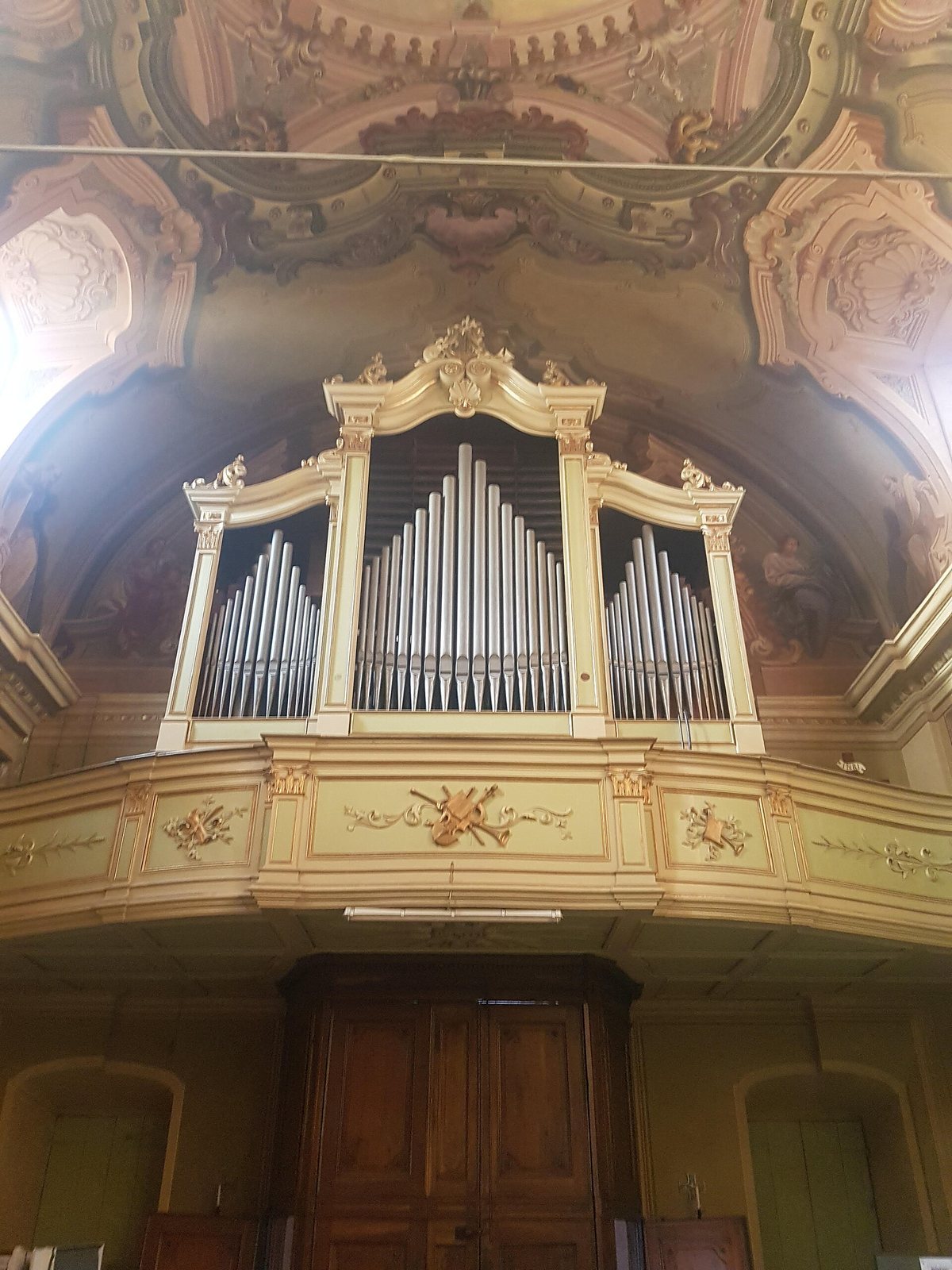
In 1655, the Buzzi family dedicated the chapel later associated with the Sacred Heart to Saint Charles and Saint Joseph. The church acquired an organ and choir gallery between 1740 and 1744, and new balustrades for the chapel of the Blessed Virgin in 1746. It also gained extensive artistic decoration. During a pastoral visit in 1751, Cardinal Giuseppe Pozzobonelli proposed a renewed vision for the church. A new main altar, made by Stefano Giudice and Giuseppe Buzzi, followed in 1769–70.
Enlargement and twentieth-century renewal
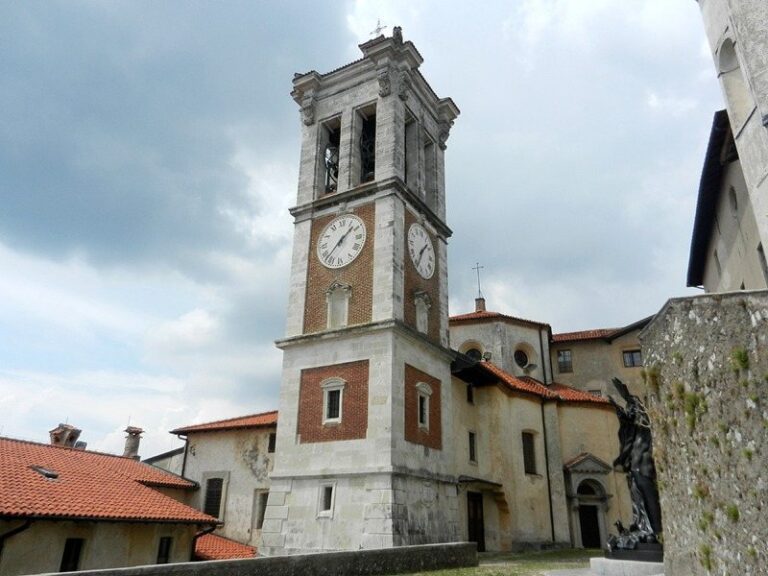
An enlargement in 1880 changed the church’s plan, and a new bell tower was built. The former main altar was taken down and sold to the parish church of Cocquio Sant’Andrea, where it remains. A fire in 1896 damaged the organ and choir gallery; a replacement organ was made in 1905.
A reinforced-concrete façade was built in 1926, and Angelo Comolli painted the apse semi-dome. Further decoration in the entrance area and side chapels followed between 1929 and 1940, with work by Carlo Cassani, Mario Grandi, Angelo Galloni, and Ettore Grandi. In 1944, the Dansi brothers of Viggiù and Caverzasi of Induno made the present main altar to a design by Milanese architect Ugo Zanchetta. Cardinal Ildefonso Schuster inaugurated it on 12 October 1945.
The side chapel formerly dedicated to Saint Charles was renovated in the 1960s and received its present dedication to the Sacred Heart in 1962. In 1970, the pulpit was dismantled. Some of its parts were reused in an altar facing the congregation and in new stands for reading Scripture, following the Second Vatican Council, the Catholic Church’s ecumenical council held in the twentieth century.
Remains
The church combines a central nave with a crosswise section, or transept, and a curved, semicircular apse at the east end. A portico fronts the building. The present layout reflects the church’s enlargement and the successive addition of paintings, furnishings, and sculptural work.
Layout and exterior
Nave, transept, and apse
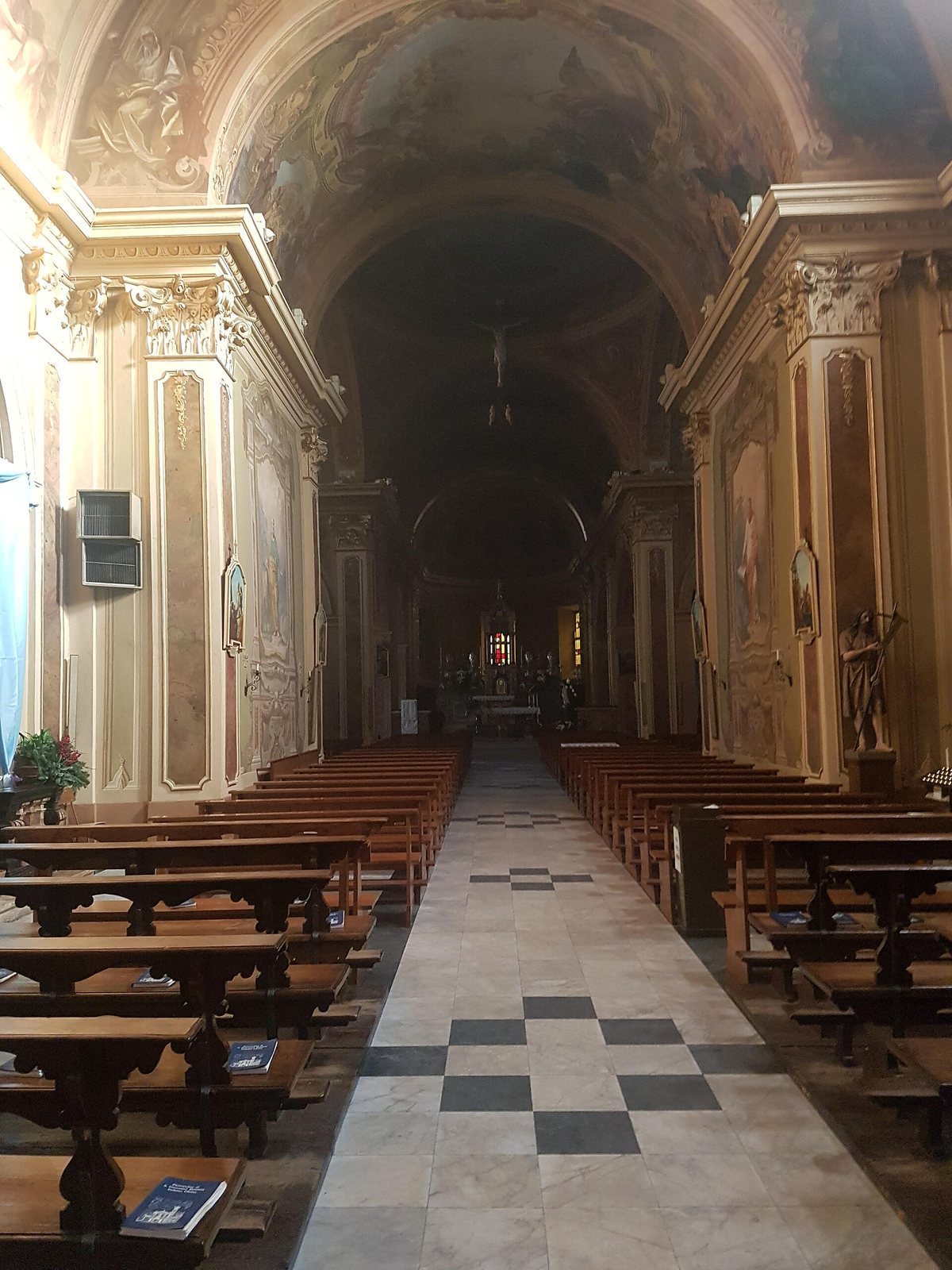
The 1880 enlargement lengthened the central nave and added a transept terminating in a semicircular apse, with the main altar placed before it. A plan from 1619 shows that the earlier church ended at the point now marked by frescoes of Saints Peter and Paul. Those paintings date to the eighteenth century and remain visible.
Bell tower
The bell tower was built using wall structures dating from the seventeenth and eighteenth centuries, incorporating earlier fabric into the later construction.
Façade and portal fresco
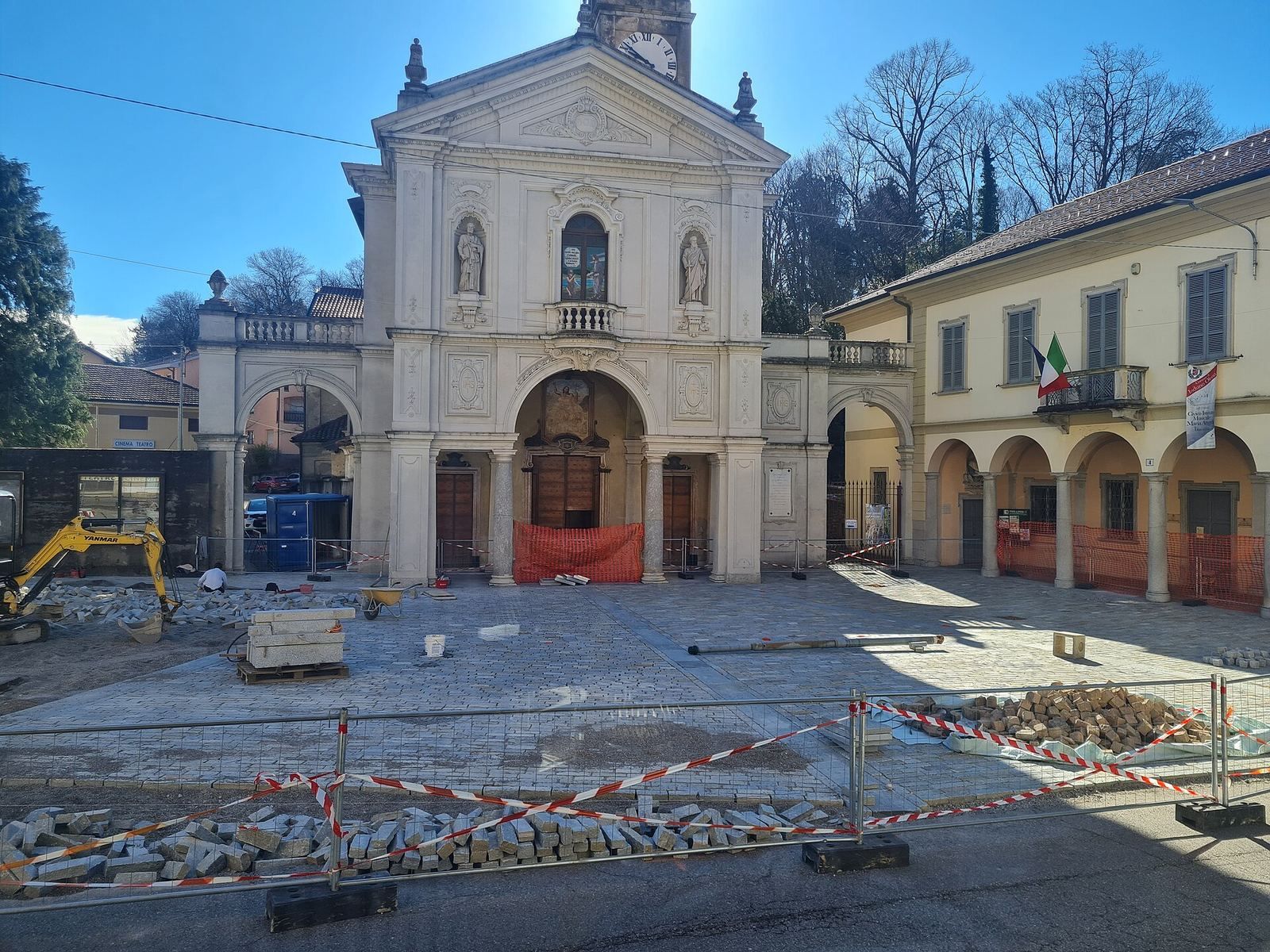
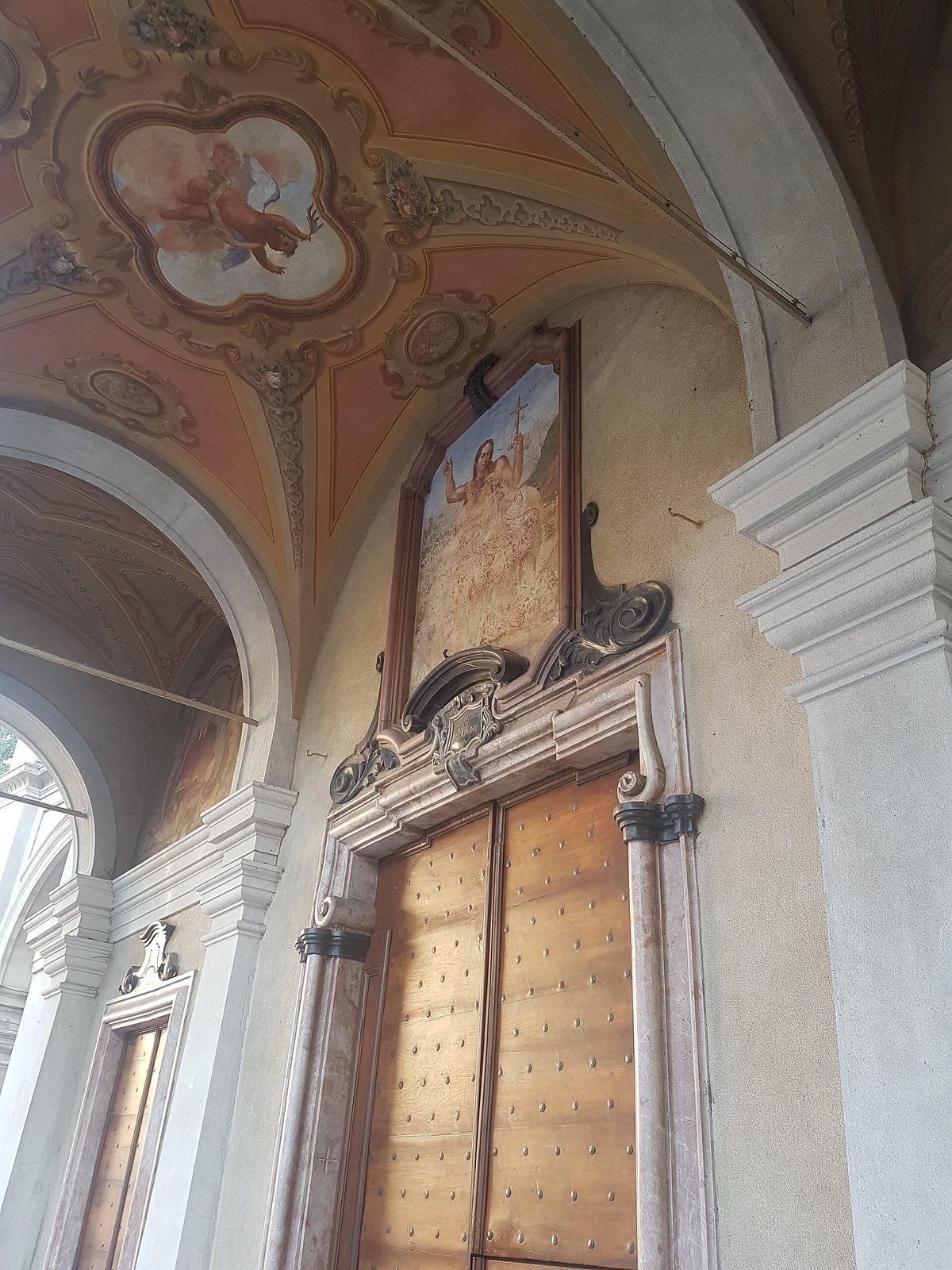
A portico stands on the façade, with a fresco of Saint John the Baptist above the main entrance. The eighteenth-century painting is best preserved in the saint’s legs; his face, arms, and torso were repainted in the twentieth century, and the work has undergone several restorations. Its delicate, almost feminine features depart from the customary image of John as a bearded preacher or as the baptizer of Jesus.
Paintings and furnishings
Main-vault fresco
The Glory of Saint John the Baptist, painted between 1746 and 1760, fills the main vault. Giovan Battista Ronchelli painted the central scene, while Giulio Baroffio added framing that creates the illusion of architectural depth. John raises one arm at the center, accompanied by two figures holding a staff and roses. Above him, God the Father sits among clouds; angels with trumpets and tambourines occupy the area below. A figure reclines on a painted balcony at lower right, while other figures look toward God, downward, or out toward the viewer. The composition’s upward movement may have been intended to guide worshippers’ attention from the entrance toward the altar. Nineteenth-century restoration and repainting altered parts of this and other eighteenth-century decoration; later ornament around the vault narrows the space occupied by the central fresco.
Chapel of the Blessed Virgin
Fifteen round paintings on copper surround a statue of the Virgin Mary in the chapel dedicated to her. Placed there shortly before 1751, they are attributed at least to the workshop of Morazzone, the name used by painter Pier Francesco Mazzucchelli. The series depicts episodes from the lives of Jesus and Mary, including the Annunciation, Nativity, Crucifixion, Resurrection, and Assumption, as well as events such as the Wedding at Cana and the Transfiguration. Comparisons have been made with a series of fifteen round paintings in Varese’s Basilica of San Vittore, accepted as works by Morazzone, and with his preparatory drawings for that series, now in the Uffizi collection in Florence. The wooden statue of the Virgin recorded at this altar in 1606 is probably the one still there.
Sacred Heart chapel
A wooden statue of Saint Charles is kept in the chapel now dedicated to the Sacred Heart. The statue was supplied for the chapel in the seventeenth century and later returned to it. The Sacred Heart is a Catholic devotion to the heart of Jesus as a sign of his love.
Transept canvases
Two early-seventeenth-century paintings hang in the transept. The Annunciation, above the sacristy entrance in the left arm, is by an unknown painter. Its image connects the praying Virgin on the left and the angel on the right through a circular movement rising toward the light of the Holy Spirit. The Adoration of the Shepherds in the right arm is attributed to the same painter. Its figures gather around the child on a raised surface, with Mary and Joseph set behind on the right and shepherds to the left. Beyond the stable fence, two figures converse beneath a scroll bearing the words “Glory to God in the highest.” Both canvases were cut down and enlarged with additions in 1931, changes that affected their imagery.
Main altar, pulpit, and organ
The present main altar includes Carrara-marble reliefs of the four Evangelists, the traditional authors of the Gospels, and an angel. These figures had formerly supported a lectern. The pulpit stood on a column on the left side of the transept; after its removal, some of its sculpted parts and other decorations were reused in the altar and in the reading stands. The organ is positioned on the interior wall opposite the main façade.