Varvarina Gora: Bronze Age Rock Paintings in Buryatia
Site at a Glance
- Popularity
- Low
- Country
- Russia
- Primary era
- Bronze Age
- Eras represented
- Bronze Age
- Civilizations
- Unclassified
- Site type
- Civic
- Remains
- Rock Art
On this page13 sections
History
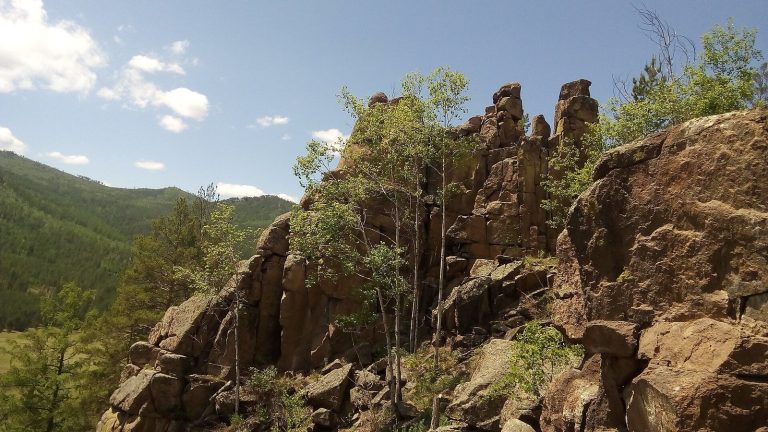
The Varvarina Gora rock paintings are on Golubinka Mountain in Zaigrayevsky District, Buryatia, Russia. They date to the first millennium BCE and belong to the Bronze Age.
Discovery and identification
A. P. Okladnikov, V. I. Molodin, and A. K. Konopatsky found the paintings in 1976 while excavating a nearby settlement from the Late Paleolithic, the final phase of the Old Stone Age. They were part of the Sayan field unit of the North Asian Complex Expedition, directed by Okladnikov. His first publication used the name Golubinka Mountain. After further investigation, local historian A. V. Tivanenko found substantial inconsistencies in the recorded tracings and linked the paintings instead to the nearby Varvarina Gora settlement. An expedition led by Tivanenko inspected the paintings in 1978.
Later study and protection
In 2017, an expedition from Griffith University led by archaeologist I. A. Ponomareva surveyed and documented the site. Ponomareva noted indications of worship there. The paintings are recognized as an archaeological monument and heritage site, and are listed as a Russian cultural heritage object. The Varvarina Gora protected natural area, covering 56.8 hectares, was established on 2 December 1981 as a Category III natural monument, a protected area intended to conserve a particular natural feature.
Remains
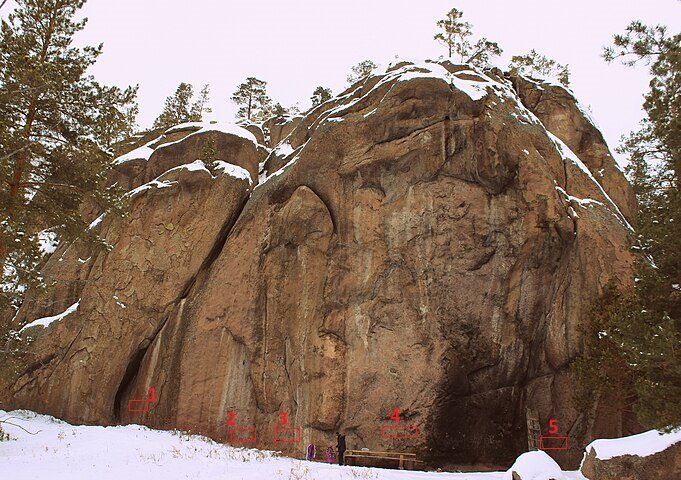
The paintings occupy lower vertical faces of a coarse-grained pink granite outcrop on Golubinka Mountain, also called Shaman Mountain. The outcrop rises 10 to 15 metres, and the images lie from 10 centimetres to 2.5 metres above the ground. Twenty-eight images form three groups spaced apart across the rock. They belong to the Selenga group, a regional classification of Transbaikalia rock art, and share a cultural character and connected narrative. Together, the images form an information-rich assemblage.
Group I: fifteen images
Birds, marks, and damaged forms
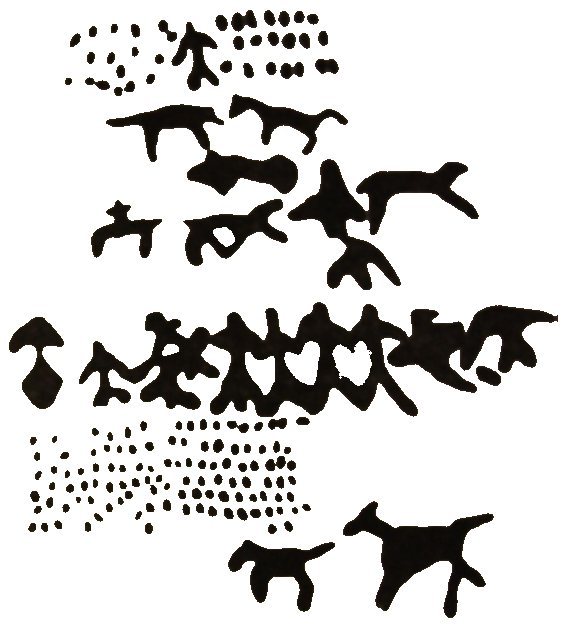
Birds appear in several images. The first is poorly preserved, with only heads and parts of bodies remaining. Another has a rounded head, spread wings, and a broad forked tail. The largest image in this group shows a bird with widely spread, slightly lowered wings and a broad tail that widens downwards, with only a faint fork. A further bird has broad, slightly spread wings and a faintly drawn head. Other surviving marks include a circular enclosure filled with rounded dots, an irregular oval blot thought to be a remnant of a drawing, several poorly preserved shapeless forms, and an image that could represent either a bird or a person. One largely destroyed image leaves a vertical stripe of uneven width; another consists of two horizontal lines joined by five vertical stripes.
Human figures
Several figures have widely spread limbs and unusual proportions. One has exceptionally long limbs and a small head; another has a disproportionate torso and holds a boomerang-like object in its left hand. A third has a distorted torso and a head that seems to continue its outline. Another has a somewhat elongated torso, lowered arms, a clearly marked head, and legs drawn as one continuous line. In an image just 20 centimetres above the ground, two schematic people have spread limbs and circular heads that seem to merge with their bodies. A rounded blot lies beside the smaller figure.
Group II: twelve images
Human figures
Images 2 to 7 show people with arms and legs spread wide. Their heads vary in size, while most have proportionate torsos; the last two have very short torsos. The figures are linked as part of a single narrative.
Stripes and other marks
The first image is a downward-running vertical stripe of burgundy ochre with small branches and two parallel lines. An unpreserved drawing is represented by an irregular ochre blot; other marks include an oval dot with blurred edges and an uneven ring with an unfilled centre. A branching zigzag stripe may be part of a destroyed drawing. The twelfth image was on a lower rock face that broke away, leaving three vertical stripes.
Group III
The third group consists of one image showing three people holding hands. Their torsos are disproportionate, their heads indistinct, and their limbs spread widely.
Pigment and preservation
The figures were painted in red ochre, a mineral pigment that has faded to pale pink, close to the colour of the granite. When the paintings were traced, they were in poor condition and could be made out only when the rock was wet. Some images were lost as flakes detached from the granite, while small overhangs shelter others. Weathering and vandalism have since left the paintings heavily damaged.
Nearby features
A ritual cairn, a pile of stones, stands near the rock. Ceremonial scarves adorn branches on trees around it.