Old Bryan Pisanitsa: A Bronze Age Rock-Art Cave in Russia
Site at a Glance
- Popularity
- Low
- Country
- Russia
- Primary era
- Bronze Age
- Eras represented
- Bronze Age
- Civilizations
- Unclassified
- Site type
- Civic
- Remains
- Rock Art
History
Old Bryan Pisanitsa is a cave containing Bronze Age rock art in Russia. Its images belong to the Selenga group, a regional classification of rock art in Transbaikalia.
Discovery and archaeological study
N. V. Komissarova, a researcher at the M. N. Khangalov Museum of History, is credited with discovering the cave in 1973. She traced some of the images and gave the tracings to local historian A. V. Tivanenko for publication. Soviet archaeologist and academician A. P. Okladnikov visited in 1974 and asked Tivanenko to study the site. In 1978, an expedition led by Tivanenko surveyed the cave and recorded further images and compositions. Tivanenko published information about the rock art in a book in 1990.
The cave became a regional natural monument in 1980 and received state protection as an archaeological monument in 1983. In 1992, a team from the Buryat Institute of Social Sciences, led by archaeologist L. V. Lbova, uncovered Bronze Age deposits and evidence of a prehistoric hunters’ camp associated with the drawings.
The exact discovery date and discoverer remain uncertain. Lbova and E. A. Khamzina in 1999, and P. B. Konovalov in 2011, dated the discovery to 1974 and credited Okladnikov’s expedition. However, sketches in Okladnikov’s collection dated 1973 include images matching some that were documented in 2017 but not published by Tivanenko. A drawing labelled “New Bryan” in a letter Tivanenko sent to Okladnikov on 28 March 1975 resembles a scene in the “Old Bryan-73” sketches, but has two fewer lower rows of dots and does not match published images from Old Bryan or another nearby rock-art site. I. A. Ponomareva concluded that the discoverer and exact date cannot be established, though the discovery was no earlier than 1973.
An archaeological team from the Buryat Scientific and Production Center for the Protection and Use of Historical and Cultural Monuments surveyed the cave in 2010. In 2017, an expedition from Griffith University led by Ponomareva examined and documented the site. That year, the rock art was registered as a federal cultural heritage site.
Remains
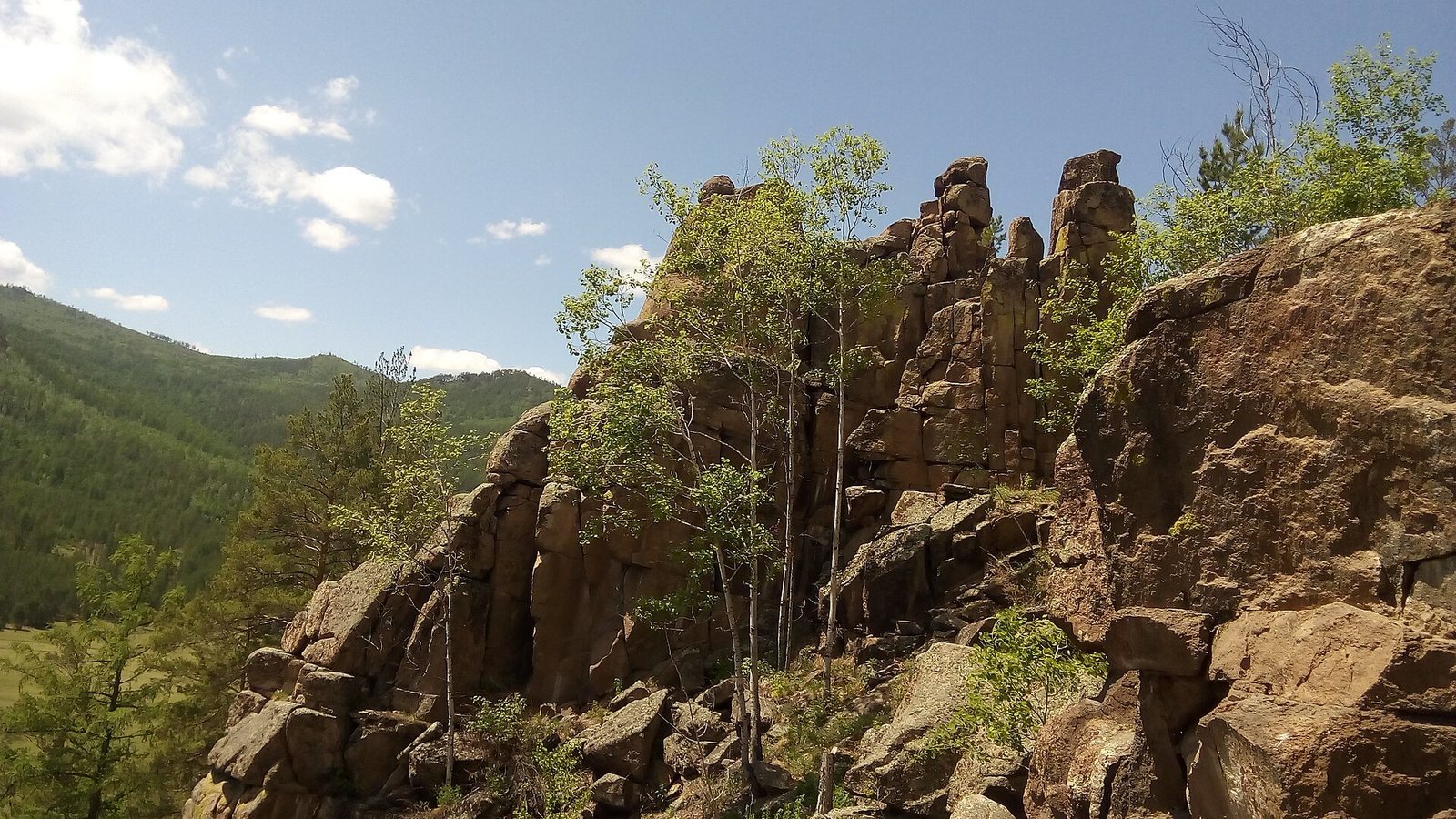
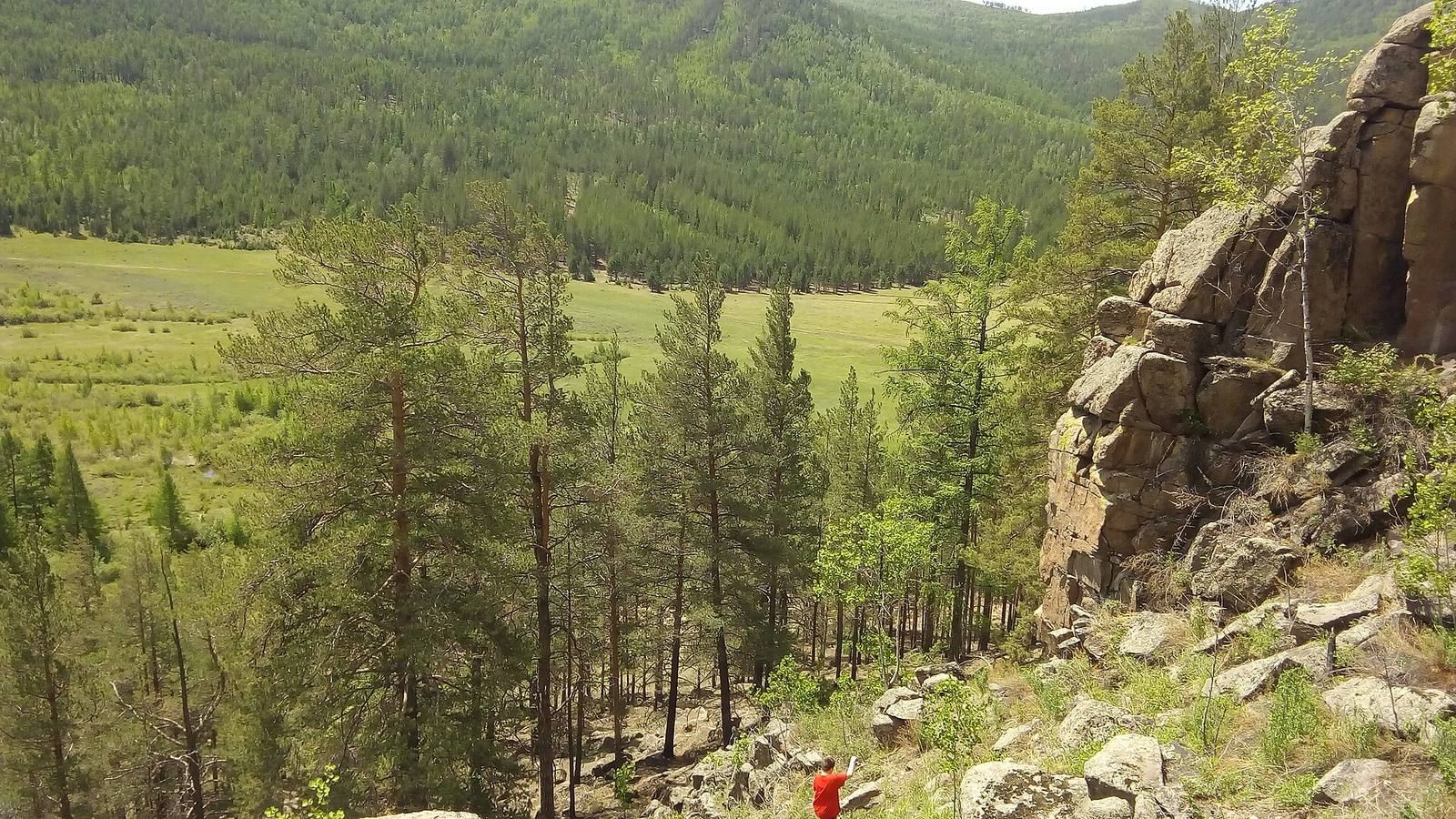
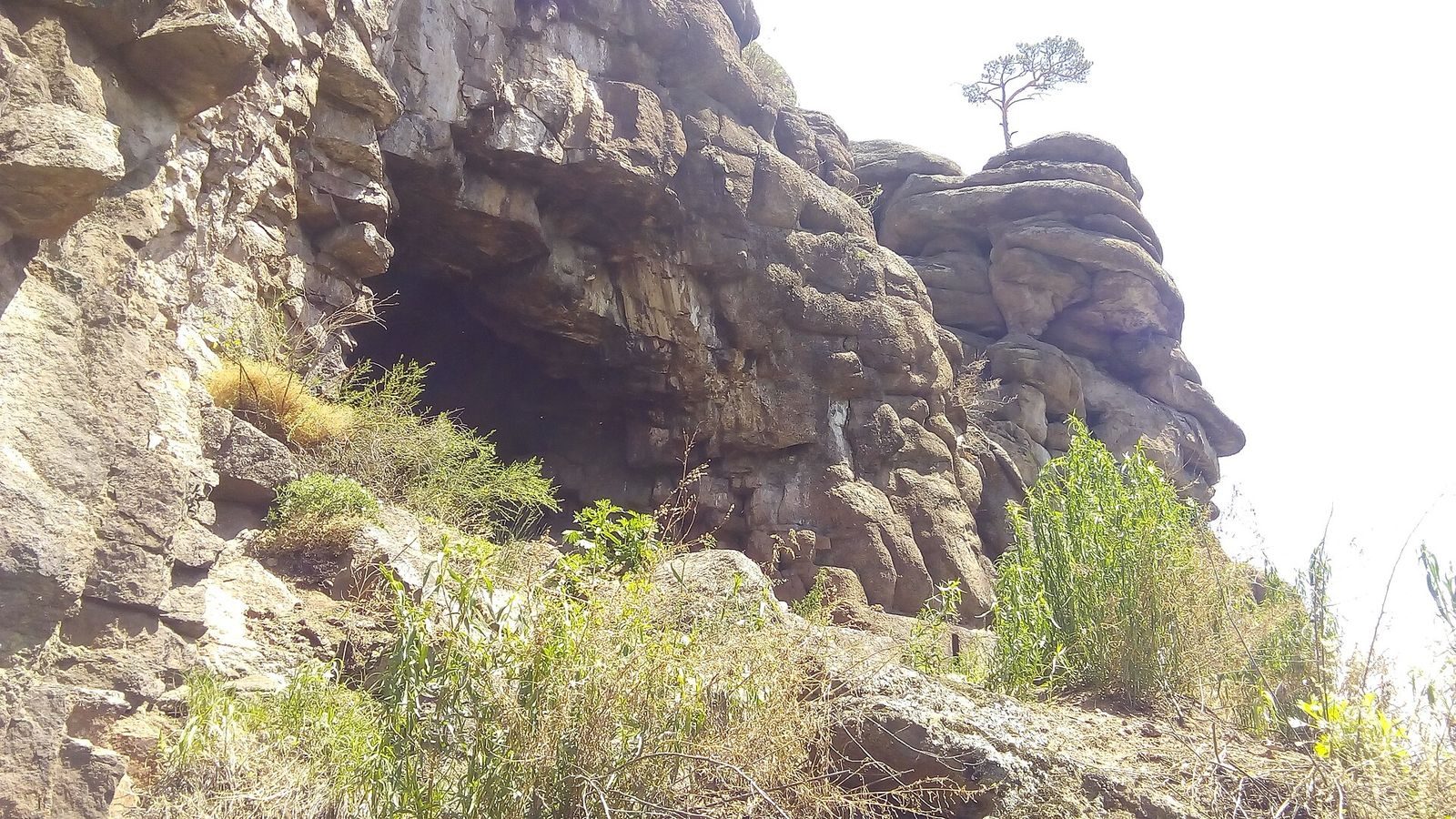
The cave lies on the right side of the Bryanka River valley, about 3.5 kilometres southeast of the village of Old Bryan and 120 to 130 metres above the valley. Red ochre images cover parts of its walls, with most on the better-lit right wall and fewer on the left and rear walls. Further images appear on rock faces left of the entrance, including two on separate rocks 10 and 20 metres away.
Sixty-seven images are known, including 44 groups of dots and vertical lines. Other motifs include ochre spots, arrangements in rows of two or three, birds and human figures surrounded by spots, sun-like symbols, and other human and animal figures. Modern inscriptions also appear in places on the cave walls.