Holy Trinity Church in Troitskoe-Golenischevo: A 17th-Century Russian Orthodox Church
Site at a Glance
- Popularity
- Medium
- Country
- Russia
- Primary era
- Early Modern
- Eras represented
- Early Modern, Modern
- Civilizations
- Russian
- Site type
- Religious
- Remains
- Church
On this page18 sections
History
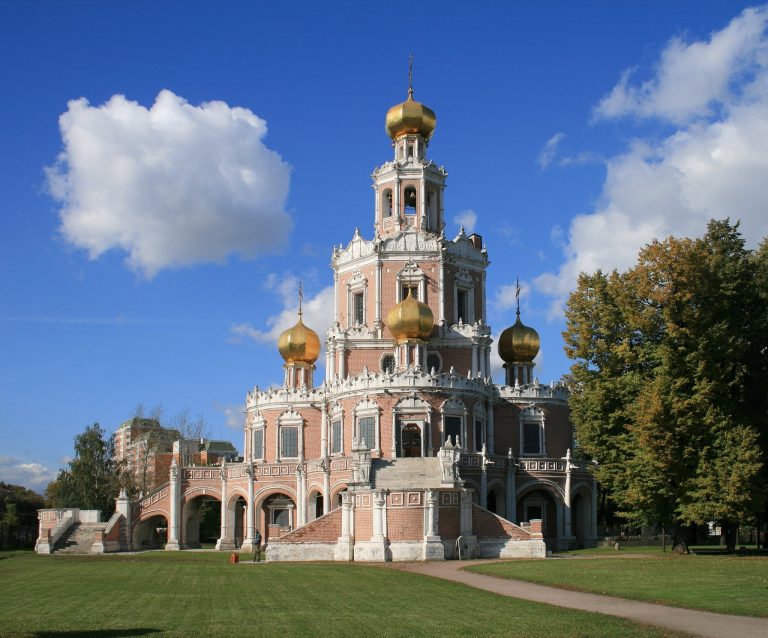
Holy Trinity Church in Troitskoe-Golenischevo, Russia, is a Russian Orthodox church built in 1644–1645 in the Russian stone tent-roof style, whose roof rises in a steep, tent-like form. It became part of a summer residence for Moscow’s patriarchs and has served as a place of worship through periods of damage, closure, and restoration.
Early settlement and Metropolitan Cyprian
Golenishchevo was an established settlement by the late fourteenth or early fifteenth century. Metropolitan Alexius, a senior Eastern Christian bishop, was associated with the area, where a metropolitan garden and cells stood. In the late fourteenth century, Metropolitan Cyprian selected the meeting point of the Setun and Ramenka rivers for a country residence. There he built a church dedicated to the Three Holy Hierarchs, the early Christian theologians Basil the Great, Gregory the Theologian, and John Chrysostom.
Cyprian also established a center for writing and translating books. He ordained bishops and issued charters there, and shortly before his death in 1406 he composed his testament at the residence. His relics were later transferred to the Cathedral of the Dormition in the Moscow Kremlin.
In 1474, Metropolitan Gerontius moved the settlement to the site of the present church. A fifteenth-century church there was dedicated to St John the Theologian, the apostle John in Christian tradition. The former settlement site became known as Old Golenishchevo and is now called Three Saints Hill. By the seventeenth century, a wooden Trinity church had replaced the earlier church at the new settlement; it included a chapel dedicated to St Leontius. The village took the name Troitskoye-Golenishchevo from the Trinity dedication.
The stone church and patriarchal residence
The present stone church replaced the wooden building. Its side chapels were added later, while a bell tower and refectory, a hall adjoining the church, were built in 1660. In the seventeenth century, the village served as a summer residence for the Moscow patriarchs, the successive heads of the Russian Orthodox Church. An orchard and fishponds formed part of the estate. Tsar Alexei Mikhailovich visited and attended services, and Patriarchs Joseph, Nikon, Joasaph II, Joachim, and Adrian also served at the church.
War, repairs, and changing use
During the French invasion of Russia in 1812, Napoleon’s troops occupied the village and used the church as a stable. A fire destroyed the old iconostasis, the screen of icons between the sanctuary and the main body of an Orthodox church. Some icons survived because they had been sent away for restoration shortly before the fire. The building underwent substantial repairs after the fighting. In 1860, the chapel of St Agapius was enlarged with a new refectory, and the bell tower was rebuilt and shifted slightly. Further renovation followed in 1898–1902.
The church closed in 1939. Its iconostasis was used by Soviet film director Sergei Eisenstein in Ivan the Terrible and was not returned. The building subsequently served as a factory warehouse, was leased for a time to Soviet state television and radio, and was also used to collect waste paper and glass. Restoration work took place in the 1970s, but the church was abandoned and deteriorated during that decade.
The Russian Orthodox Church received the building back in 1990. A prayer service followed on 8 January 1991, and after the grounds were cleared and warehouse structures dismantled, worship resumed in 1992. Repairs continued in the mid-1990s, and a wooden chapel-baptistery dedicated to St Cyprian was added beside the refectory in 1999. The church is a federally protected cultural heritage monument.
Three Saints Hill and its memorials
Three Saints Hill preserves the memory of Cyprian’s earlier residence and the church of the Three Holy Hierarchs. A wooden cross was erected there in 1991 at the place believed to have held the church. A memorial with a plaque and prayer area followed in the early 2000s, with Bulgarian Embassy involvement. Archaeological investigations on the hill took place between 1975 and 2014. The nearby archaeological site known as Stone Dam received state protection in 1992, with its protected boundaries confirmed in 2018.
Defensive works built in 1941 during the German advance on Moscow were found in the area. Construction work uncovered a pillbox, a small fortified military position, on the hill in November 2019. During the 2010s the hill was removed from the Setun River Valley nature reserve. Construction of the West Garden residential complex began in 2019 and cut away most of the hill; a road was built about 50 metres from the memorial. After access became difficult, the memorial cross and pedestal were moved on 12 June 2020. Work on a replacement platform was completed in 2021, and a path was laid in 2022. Archbishop Foma consecrated the memorial in 2025, when two pines were planted beside it.
The church’s north chapel has an altar dedicated to Tikhon, Confessor and Patriarch of Moscow, and to Russian hieromartyrs, clerics honored as martyrs, as well as other martyrs and confessors. On the night of 4–5 July 1991, a service in their honor was held there. At dawn, a cross was carried to a hill west of the church and erected in place of an older, poorly preserved one. It commemorates people whose graves are unknown and serves as a cenotaph, a memorial that does not contain the remains of those commemorated. The hill had also served as the village cemetery, especially around the church. Bones of a woman and an infant found during installation of a gate were later reburied. A large white cross was erected on the hilltop on 29 August 2020 and consecrated on 26 May 2024.
Springs and parish traditions
Jonah Spring is associated with Metropolitan Jonah, whose name was also given to one of the church’s side chapels. In the early twentieth century, Patriarch Tikhon visited the spring with the congregation. An old oak beside it was traditionally said to have been planted by Jonah; it was cut down in the winter of 1941 because wartime fuel shortages affected Moscow. After worship resumed, parish priest Sergey Pravdolyubov arranged for a cross to be placed at the spring in 1991. Parishioners cleared and improved the site, which became part of processions and prayer services. Later, runoff and mudflows filled the ravine and buried the spring beneath about 1.5 metres of clay and sand. In May and June 2024, parishioners excavated the spring and its drainage channel.
A second spring, about a kilometre west of the church, is linked by local tradition to Cyprian. One story says he dug a well there himself; another says the spring appeared after his prayers. People of Bulgarian descent, with the participation of the Bulgarian Embassy, placed a commemorative plaque there in the 2000s. Vandals broke it, and its base was removed in 2018.
Remains
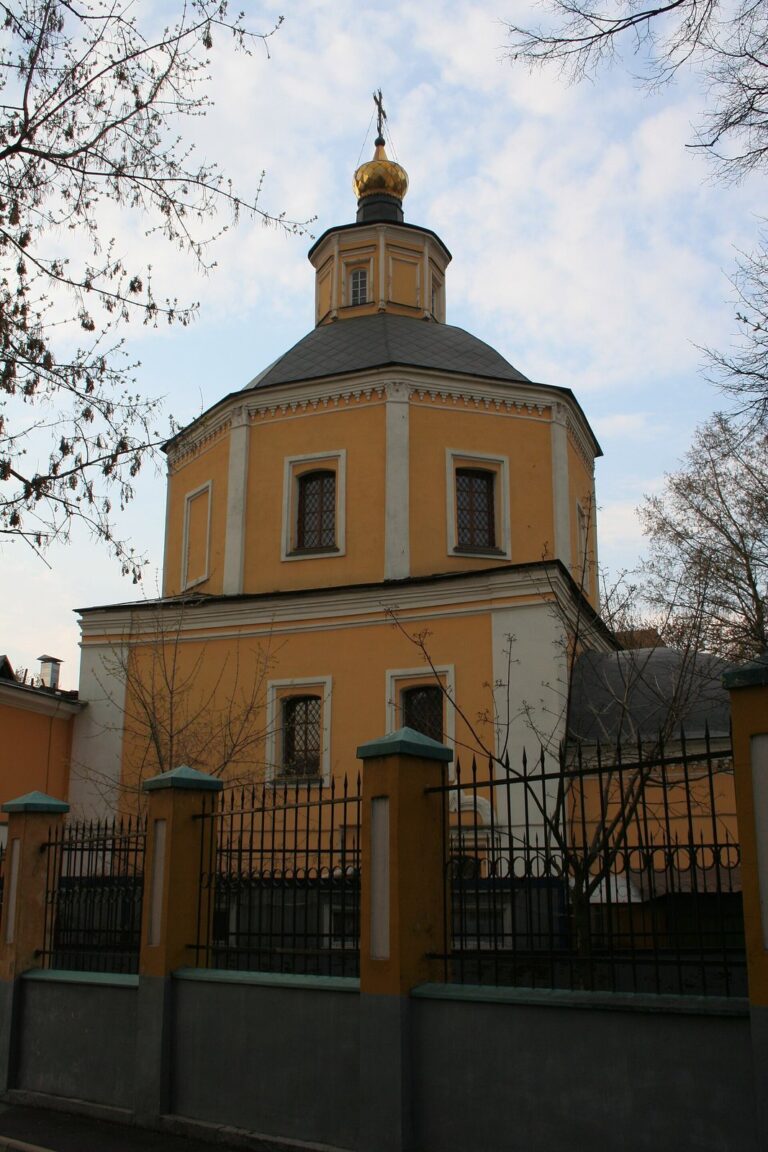
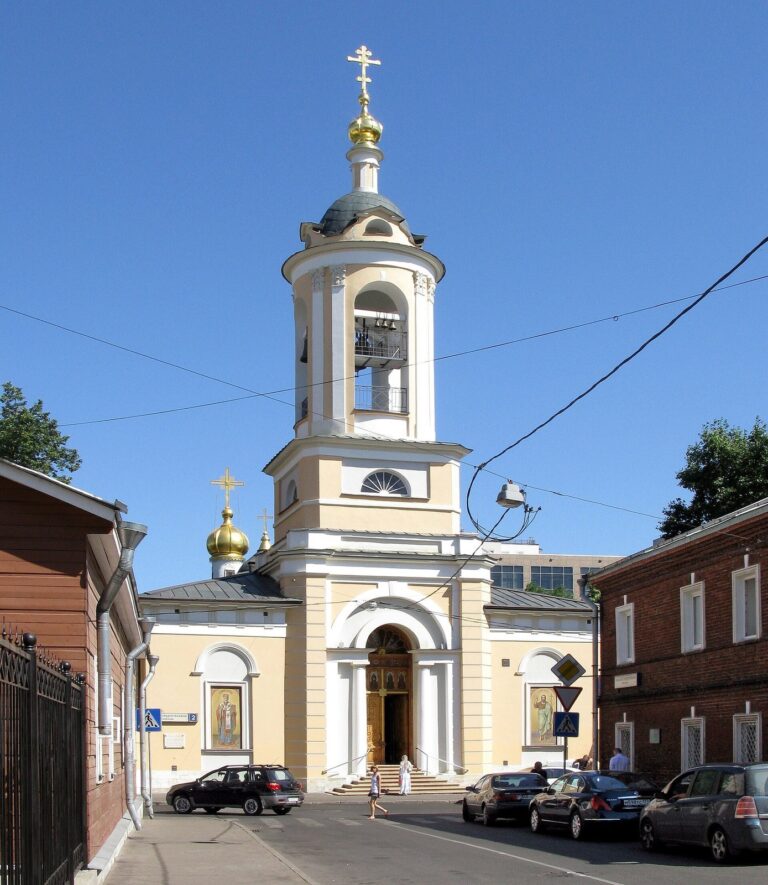
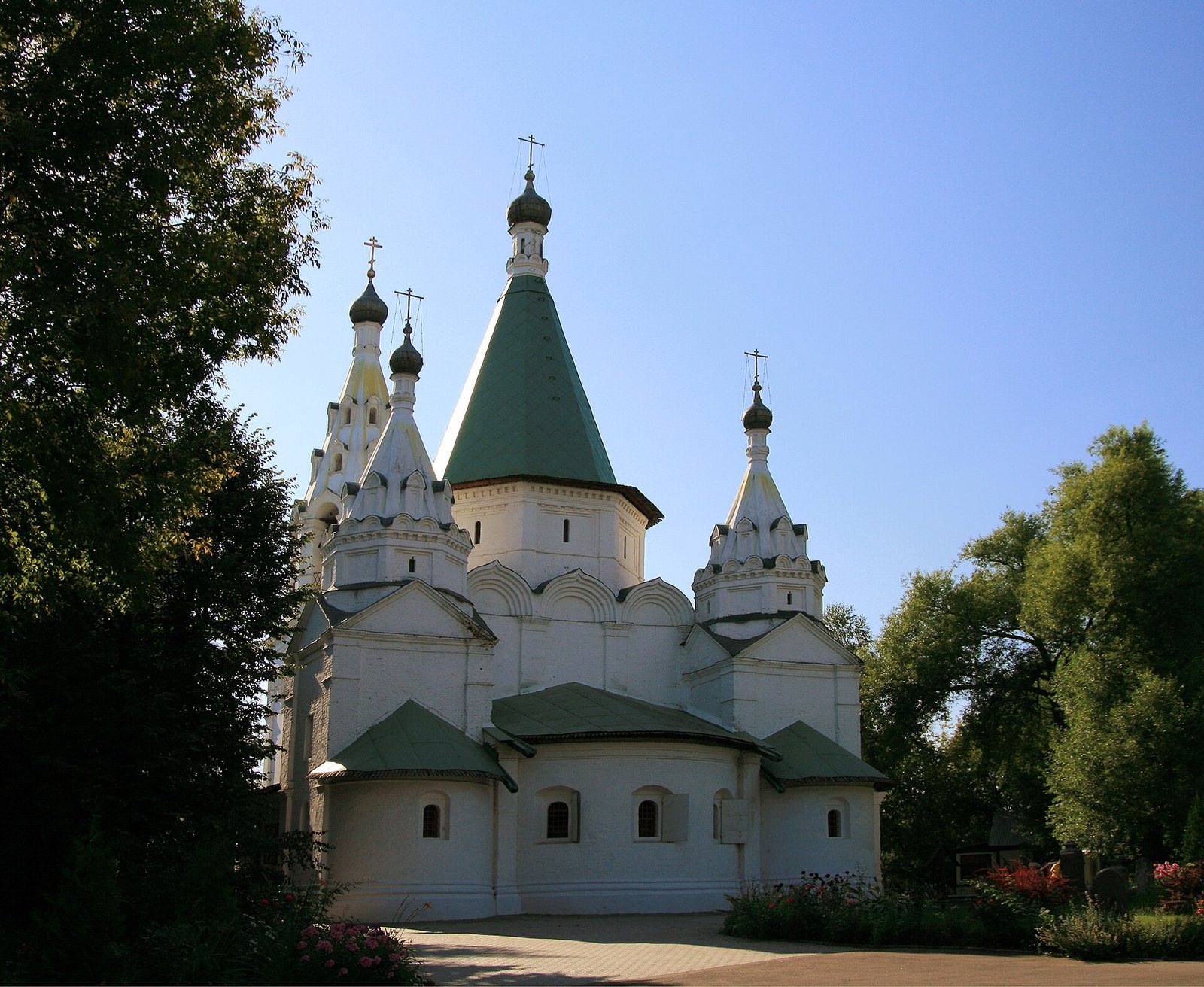
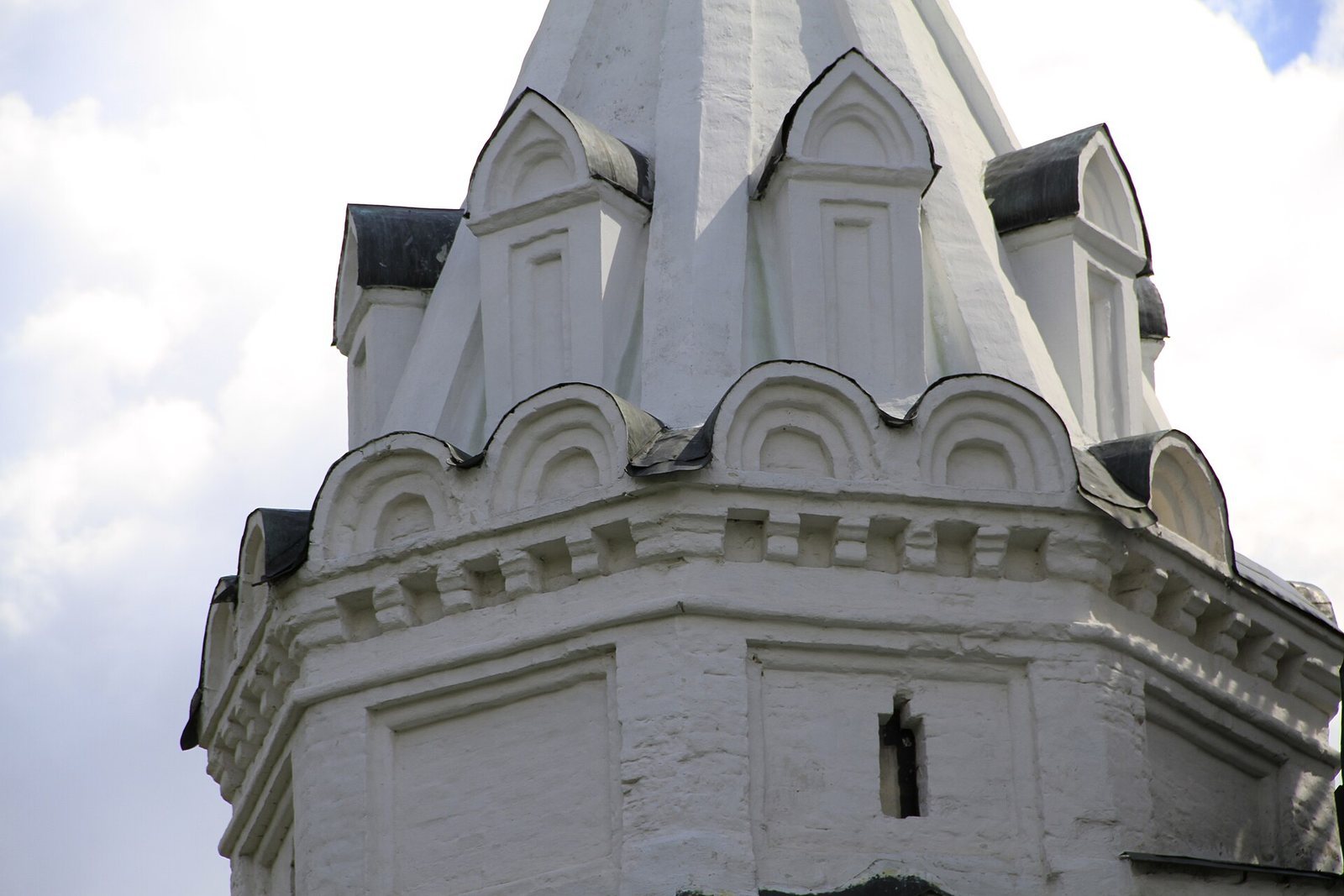
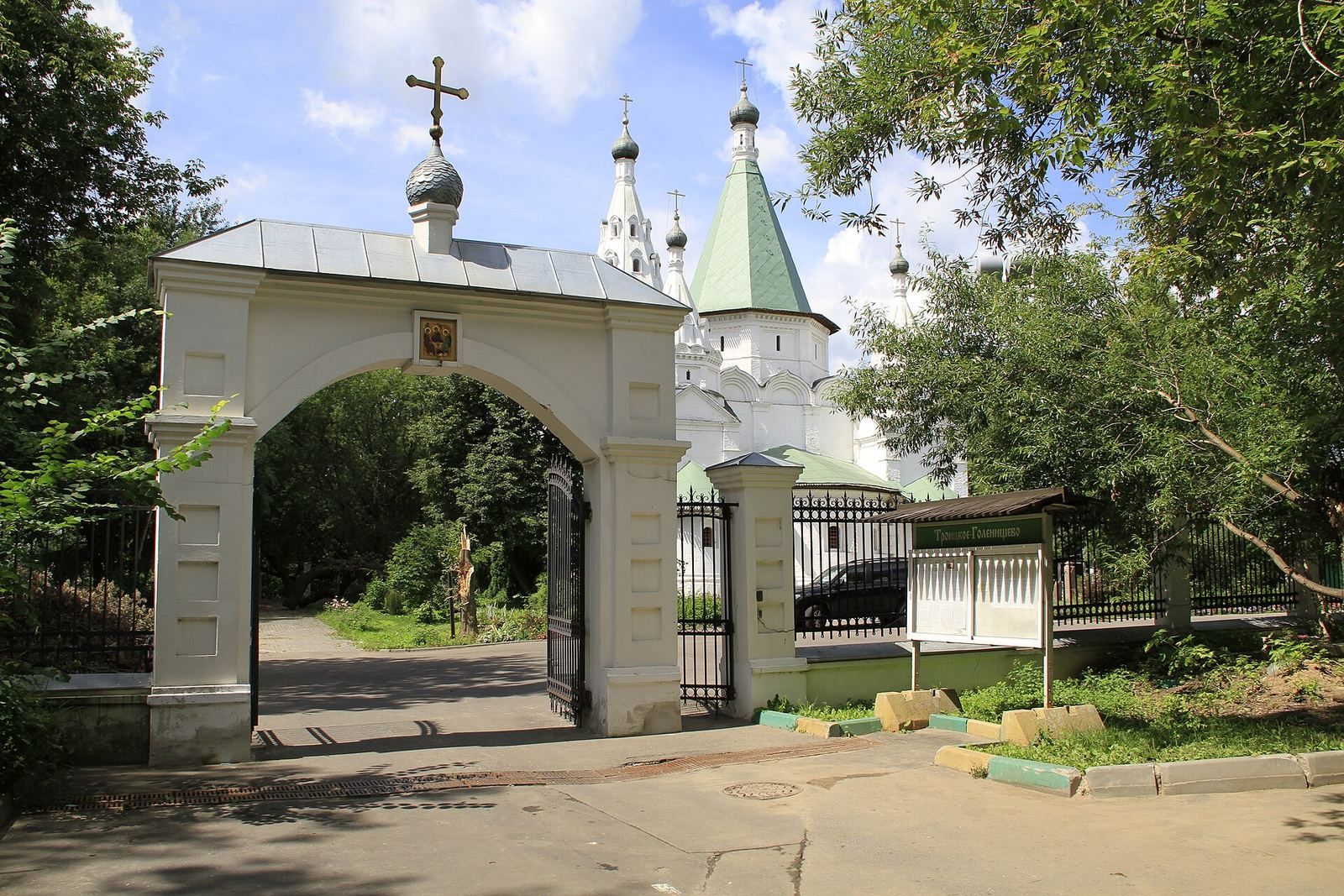
The church complex combines a brick church with a bell tower, refectory, side chapels, and a wooden chapel-baptistery. The main building’s square mass, three domes, surrounding galleries, and steep central roof form its principal architectural arrangement.
Church complex
Main church
The central building is square in plan and has galleries along its west and south sides. Curved, keel-shaped forms mark the roof ends, while the central tent roof carries a later iron covering. The church has three domes, and its main altar is dedicated to the Trinity.
Side chapels
The chapels dedicated to Metropolitan Jonah and Hieromartyr Agapius adjoin the main church near its altar ends, and each has an altar end of its own. Their tent roofs are topped by domes on narrow, eight-sided supports. Openwork rows of small arches decorate the supports, while decorative false window openings appear on the chapel roofs.
Bell tower and adjoining halls
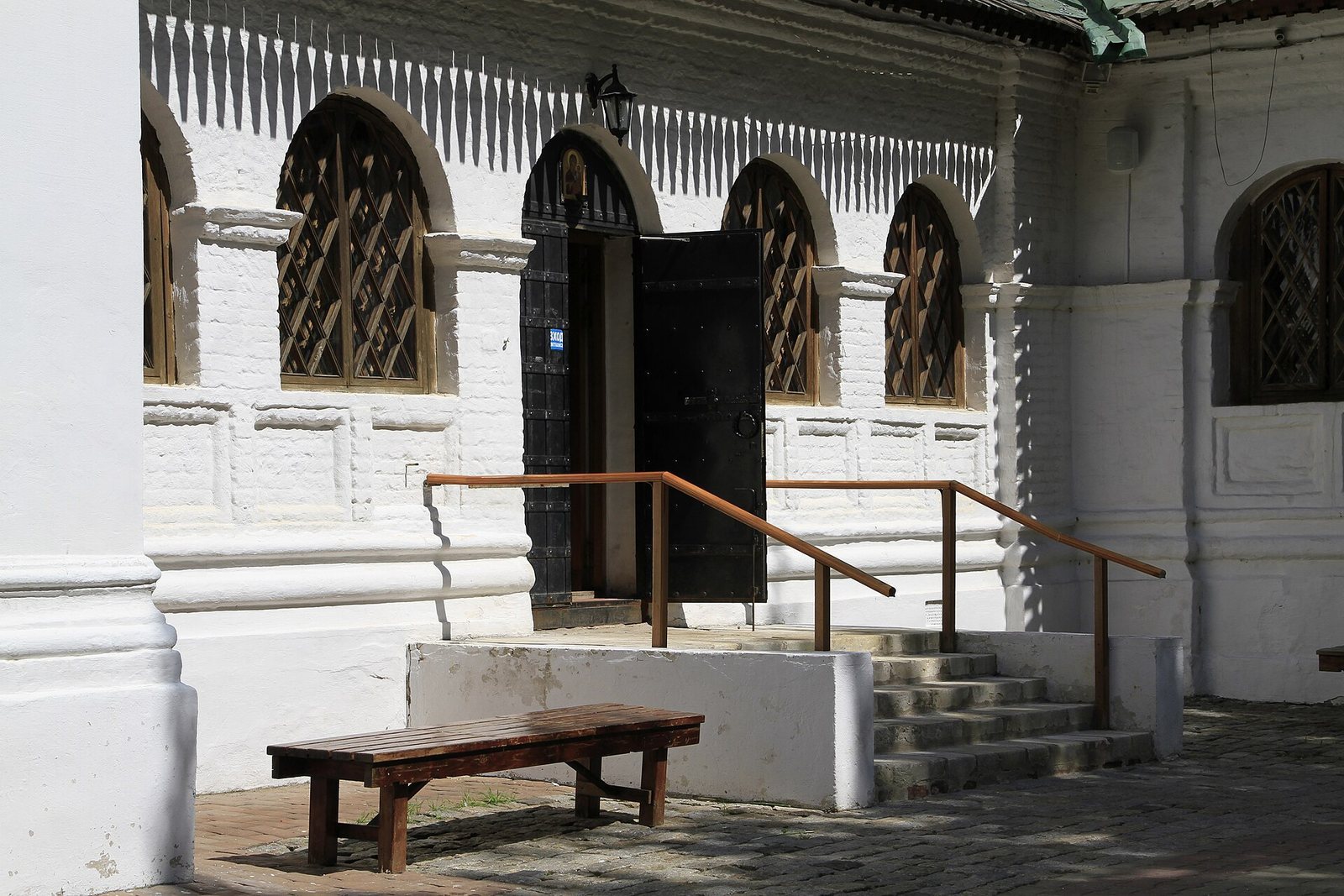
The bell tower was rebuilt and shifted slightly in 1860. The church complex also includes the refectory, a hall adjoining the church, and the wooden chapel-baptistery dedicated to St Cyprian, which is attached to it.
Icons and relics
The church’s sacred objects include icons of Tikhon, Patriarch of All Russia; Sergius of Radonezh; Seraphim of Sarov; Ambrose of Optina; and Matrona of Anemnyasevo. The icon of Ambrose is associated with a fragment of his relics. Other relics include fragments associated with the Great Martyr Panteleimon, Agapitus of the Caves, Daniel of Moscow, and Philaret of Moscow. A stone and a ring are said to have come from the hand of the Great Martyr Catherine.
Memorials on Three Saints Hill
Cyprian memorial
The memorial to Cyprian consists of a cross on a pedestal, a commemorative plaque, and a prayer area. The plaque identifies the hill as the site of his residence and gives his birth year as 1330 in Bulgaria, with his leadership of the Russian Church dated to 1376–1406. The approach includes a stone-paved section and a larch-paved stretch with small entrance gates.
Cemetery cross
The large white cross stands at the hilltop, on the former village cemetery. Its nearby plaque commemorates Russian martyrs and the cemetery. The memorial is distinct from the Cyprian cross and plaque elsewhere on the hill.
Springs
Jonah Spring
Jonah Spring lies in the Kipyatka River valley, in Golenishchevo ravine, about 50 metres northwest of Mosfilmovskaya Street. Steps, a brick wall, and a tap provide access to the spring water.
Spring of St Cyprian
The spring of St Cyprian is a right tributary of the Setun, about 20 metres upstream from the Old Rublyovsky Bridge. Water issues from a pipe roughly two metres from the riverbed, and the area is inundated by the Setun in spring. The spring lies within the Setun River Valley nature reserve. An analysis found slightly elevated total hardness in its water.