Mother Church of Saint George the Martyr: Caccamo’s Principal Church
Site at a Glance
- Popularity
- Low
- Country
- Italy
- Primary era
- Early Modern
- Eras represented
- Medieval, Early Modern, Modern
- Civilizations
- Crown of Aragon, Italian, Kingdom of Sicily, Spanish
- Site type
- Religious
- Remains
- Church
On this page25 sections
History
The Mother Church of Saint George the Martyr is Caccamo’s principal Roman Catholic church in Italy and the largest church in the town. Dedicated to Saint George, it belongs to the Archdiocese of Palermo and the local ecclesiastical district of Caccamo. Its history reaches back to the Norman period, while the present building is a Sicilian Baroque church dated to 1616.
Norman beginnings and medieval history
The dedication to Saint George is associated with the Normans, the medieval ruling dynasty that established control over Sicily. It commemorates their victory over Muslim forces near Cerami in 1090. Popular tradition names the ruined Church of Saint Anne and Saint Venera, near the Terravecchia quarter below the castle, as Caccamo’s first cathedral.
Around 1094, a first mother church was built, probably as a small chapel serving the Norman court. An inscription now inside the church records this early foundation. A separate early church dedicated to Saint George probably stood on the present site and may have been sponsored by the Chiaramonte, a prominent Sicilian noble family. During the Swabian period, when the Hohenstaufen dynasty ruled Sicily, the lower part of the bell tower served as a castle outpost under Manfredi I Chiaramonte.
Expansion and rebuilding
Between 1477 and 1480, the church was enlarged and gained artworks through the patronage of the Enríquez, Prades, and Cabrera aristocratic families. Even after this work, it remained modest in size.
In 1606, Caccamo’s jurors, members of the Enríquez and Amato families, and Canon Paolo Muscia agreed that a larger church was needed for the growing population. They commissioned a design from Vincenzo La Barbera, an architect from Termini Imerese. Donations from the patrons supported rebuilding in 1614, and the present church is dated to 1616. The new building brought together artworks from the earlier church, newly commissioned works, and pieces transferred from abandoned or ruined places of worship.
Later changes
Lightning destroyed the bell tower’s upper spire in 1790. Nicolò Pruiti designed its replacement, and the bell chamber was rebuilt in carved stone. In the early nineteenth century, parts recovered from the former church were put back together in the Chapel of the Most Holy Sacrament. The newer organ was restored in 1996.
Remains
The church combines a cross-shaped plan, with a long central nave, and three aisles divided by columns. Its interior includes transept chapels, a dome, an apse and choir, and an underground burial area. The façade and square form its principal exterior features, while paintings, sculpture, furnishings, and church objects preserve works from several centuries.
Exterior and square
Piazza Duomo
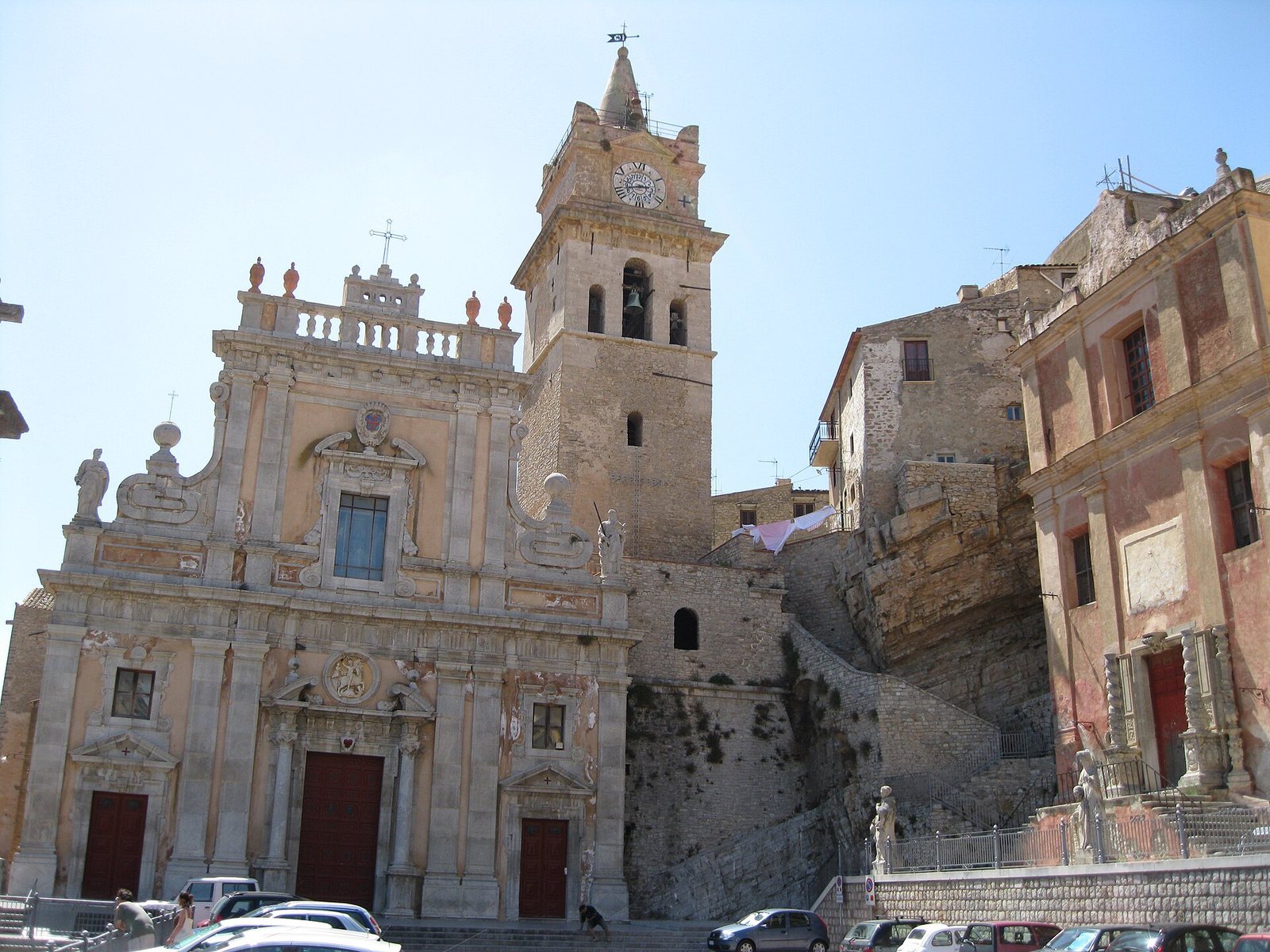
The church faces Piazza Duomo. On the retaining wall in front of the former Monte di Pietà stand stone statues of Caccamo’s co-patrons: Blessed Giovanni Liccio, a Dominican friar, Saint Rosalia, Saint Nicasio the Martyr, and Saint Teotista. The statues are attributed to Giuseppe Ponti and dated to 1682. A stone column topped with a cross stands in the middle of the square. During the Inquisition, it was used to bind people convicted of offenses that were not heresy.
Façade
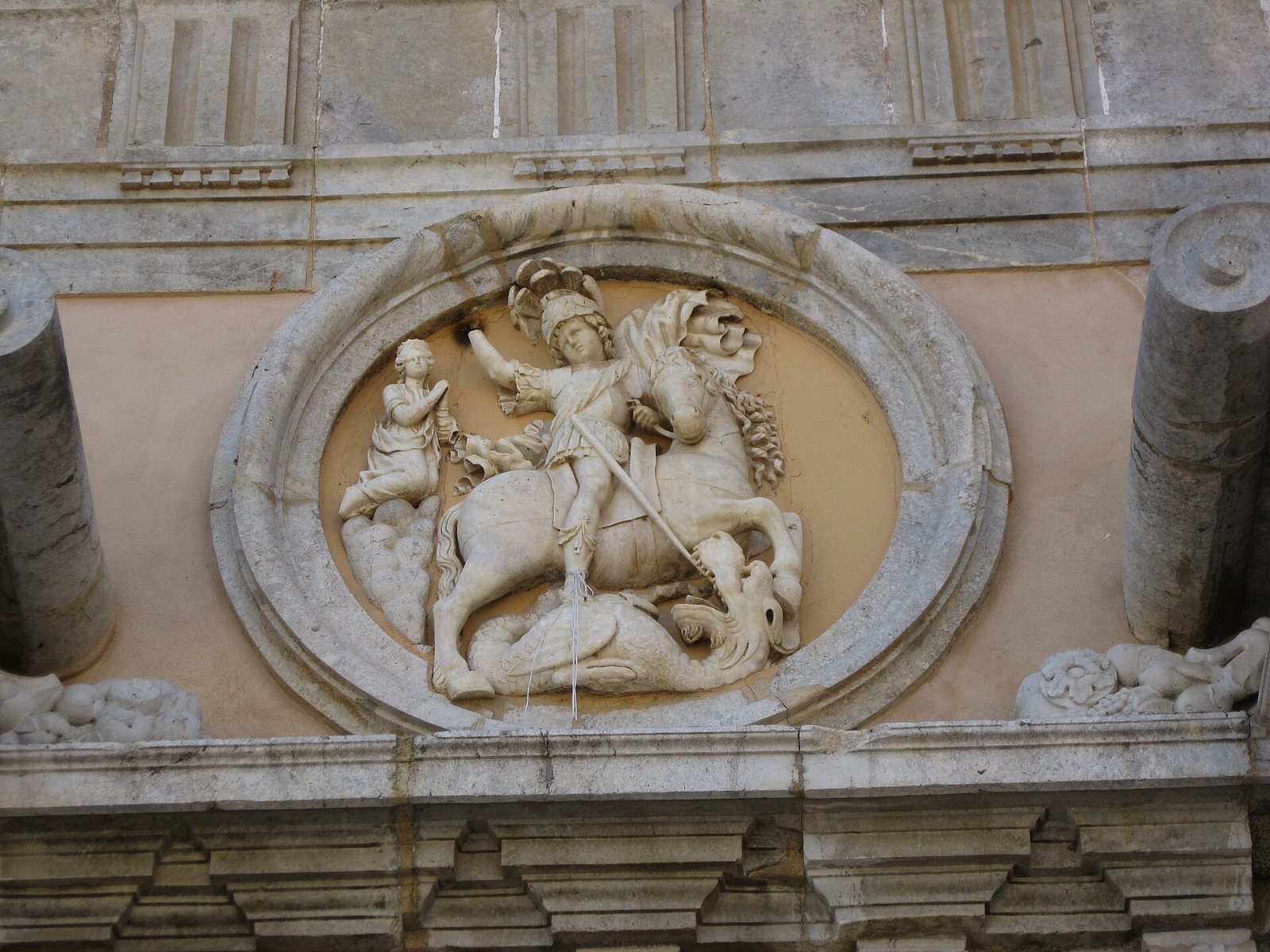
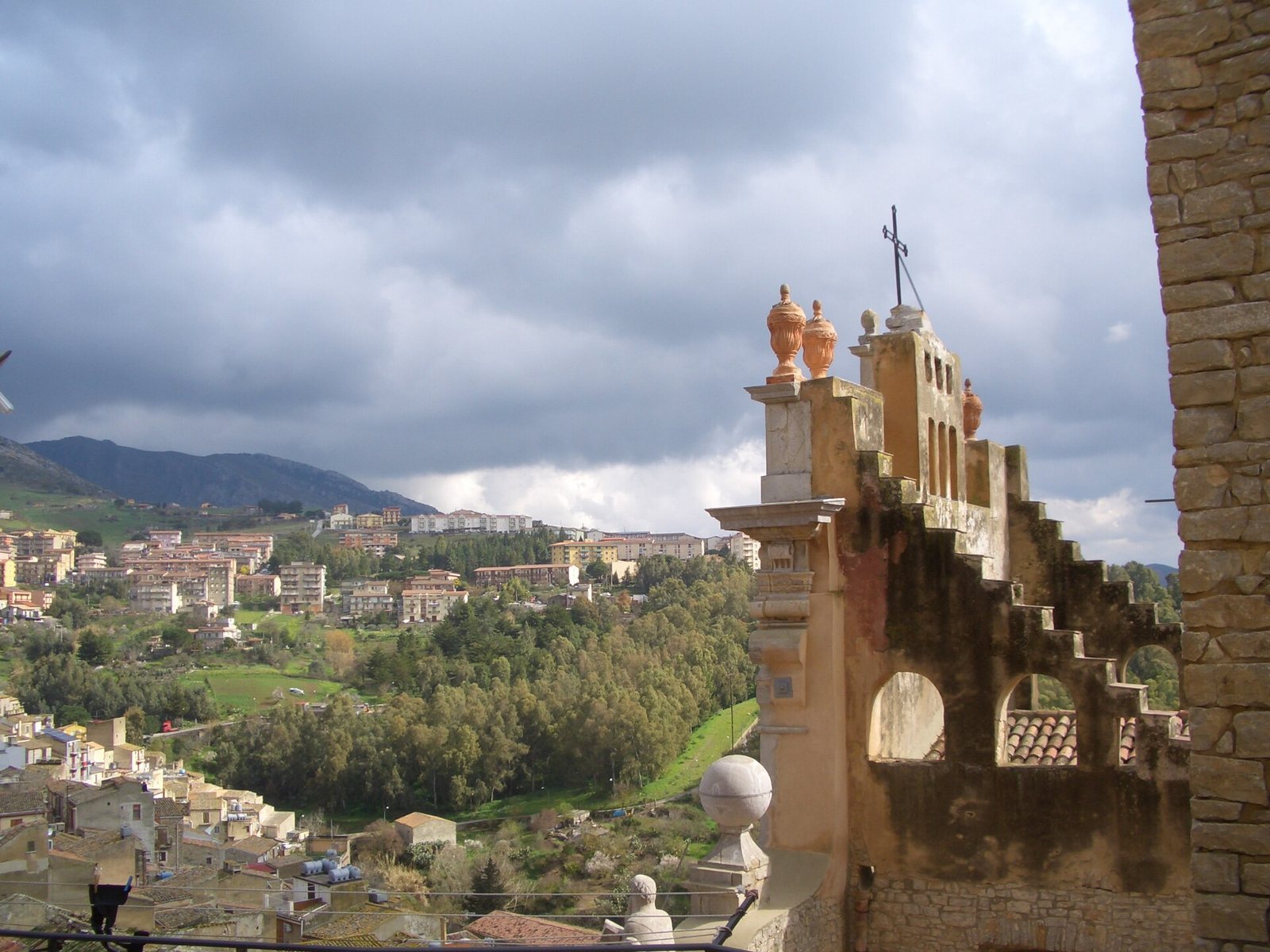
The façade is dated to 1651 and arranged in two levels separated by a projecting horizontal band. Flat wall supports frame the central section in pairs and mark the outer sections singly. Their capitals are Doric at the level of the portals and Ionic above. The main entrance has Corinthian columns supporting a carved horizontal band and a broken, symmetrical pediment with a medallion. The medallion, carved by Gaspare Guercio in 1660, shows Saint George rescuing a maiden. Smaller entrances have complete pediments and windows. Statues of Saints Peter and Paul stand at the ends of the dividing band, while curved scroll forms with decorative spheres connect the two levels. A balustrade with paired vases finishes the façade; central pinnacles support a cross.
Bell tower
The tower’s lower section is its oldest part. Its upper section has a conical form, above a bell chamber rebuilt in carved stone. On 17 June 1650, Canon Maio commissioned Onofrio Cosentino to make 4,200 tin-glazed tiles showing Saint George. They were installed across the tower’s four faces.
Interior structure
Nave and dome
Three aisles are separated by single-piece columns of local stone, which support rounded arches. Gray, black, and pink Carrara marble covers the floor, replacing an earlier floor of decorated tiles. In 1950, Giuseppe Bella Vasta and his son painted the vaults and the curved wall sections beside them. Nineteenth-century decoration in the Empire style, associated with the Napoleonic era, also covers the vaults and walls.
The dome has a cubic exterior and rests on four pillars. Giovan Battista Cascione raised it in 1772. Aloisio Romano decorated it in 1765 with stucco medallions of popes, bishops, and Doctors of the Church, Christian teachers recognized for the influence of their theology. On the curved supports beneath the dome, Ottavio Violante’s 1780 stucco work depicts Moses, Elijah, Isaiah, and Jeremiah.
Crypt
Underground rooms beneath the church contain the burials of Princes Filippo and Antonio Amato and members of the De Spucches family.
Side aisles
Right aisle
The first bay contains a 1939 canvas of Blessed Giovanni Liccio, with a view of Caccamo, painted by Carlo Ameglio. In the second is an eighteenth-century Martyrdom of Saint Sebastian, attributed to Giuseppe Velasco, also known as Velasquez. The third bay holds a three-panel painting of the Madonna and Child between Saints Peter and George, dated either 1468 or 1472. A goldfinch in the image led to an attribution to Giuseppe Cardillo, while later studies have associated it with Guglielmo da Pesaro. The fourth bay has a Madonna of Graces with Saints Roch and Francis of Assisi, attributed to the school of Pietro Novelli. In the fifth, an altar supports a painted wooden statue of Saint George crushing the dragon, made by Onofrio Ruggeri in 1657. Craftsmen from eastern Sicily made its Baroque platform for carrying the statue in processions.
Left aisle
The first bay contains an eighteenth-century Stigmata of Saint Francis, attributed to Giuseppe Testa. A canvas of Saint Cajetan of Thiene by Giuseppe Velasco occupies the second, and an unidentified fifteenth-century panel of the Crucifixion the third. The fourth bay holds a seventeenth-century Pentecost by Vincenzo La Barbera. A wooden statue of the Immaculate Conception stands on the fifth-bay altar. Near the last column is La Barbera’s painting of the Madonna and Child with Saint Anne and Saint Venera.
Transept chapels
Right transept
The curved-ended Chapel of the Madonna Libera Inferni is dedicated to the Virgin Mary under that devotional title. Its altar frame has two slender columns of porphyry, a hard decorative stone, set among agate, amethyst, topaz, and lapis lazuli. Andrea Mancino and Antonio Vanella made its Carrara-marble statue of the Madonna of Graces in 1499. The base shows the Nativity, with the Annunciation on either side. Gold Empire-style decoration covers the shrine’s vault and walls. Behind glass beneath the altar table is a wax image of the Assumption of Mary.
The Chapel of the Sacred Heart occupies the right transept wall. Its seventeenth-century altar, dedicated to the Sacred Heart of Jesus, has gold decoration in geometric patterns and a small, temple-shaped tabernacle at its center. Beside the sacristy entrance, an eighteenth-century canvas of the Seven Angels by Antonio Spadafora sits in a stucco frame; a Martyrdom of Saints Crispin and Crispinian hangs to its right.
The sacristy doorway is framed by a three-part marble ensemble attributed to Francesco Laurana. Saints Peter and Paul appear on its sides, and the center shows the Madonna and Child with angels. Two panels beside the doorway depict the Annunciation and the Deposition. Nearby, a marble holy-water basin from the Gagini sculptural tradition depicts the Baptism of Jesus.
Left transept
The Chapel of the Most Holy Sacrament has a Baroque marble altar decorated with hardstones, carved scrolls, cherubs, and floral designs. Above it, a white-marble canopy over the altar, called a ciborium, bears high reliefs of the Resurrection and scenes from the story of Redemption. They include the risen Christ, the Madonna and Child, and God the Father above, and are attributed to Francesco Laurana. Four side canvases by Vito D’Anna depict the Multiplication of the Loaves, Melchizedek offering bread and wine to Abraham, the Sacrifice of Aaron, and the Supper at Emmaus. Frescoes of the theological virtues decorate the vault.
The Chapel of the Relics on the left transept wall has a gilded wooden structure with stucco work by Castelli. Its altarpiece, attributed to Pietro Novelli, shows the crucified Christ with Saints Rosalia and Roch asking protection for Caccamo from plague; the town appears in the scene’s left background. Beside it is a three-part, painted terracotta Pietà from the church of Saint Francis of Assisi. Made in the fifteenth century by an unidentified artist from central Italy, it shows Mary holding her dead son, with Mary Magdalene and Saint John the Evangelist at either side. A wooden statue of Our Lady of Sorrows stands to the left.
Apse, choir, and instruments
Chapel of Saint George
The main altar in the Chapel of Saint George is made of colored marble with gilded wooden details and panels. It holds Vito D’Anna’s 1751 canvas of the Triumph of Saint George. A side niche contains an alabaster statue of Saint George on horseback. Plaster figures of the Beatitudes and the Works of Mercy occupy the transept and choir. Emanuele Martinez made them in 1955, along with the panels of the Stations of the Cross.
Choir and organs
Vincenzo Marchese made the wooden choir in 1756. It has two levels and 54 seats. The older organ was built in 1652 by Santo Romano of Messina, following the model of the organ in Palermo Cathedral. Giuseppe Lugaro built the newer organ in 1863 and signed and dated it. He probably reused parts of the earlier instrument, including some pipes.
Baptismal font
Beside the Eucharistic table, under the dome, stands a one-piece white-marble baptismal font dated to 1466 and associated with the Gagini sculptural tradition. Its four faces carry reliefs of the monogram of Jesus Christ, Saint George on horseback, and the coats of arms of the Cabrera and Prades families.
Sacristy collection
Furnishings and devotional objects
The sacristy’s rooms contain church furnishings and works of art, including reliefs, paintings, sculptures, statues, lecterns, furniture, and commemorative objects. Its books and manuscripts include lives of saints, books of daily prayer, missals, local songs and liturgies, and decrees written on parchment. The collection includes seventeenth- and eighteenth-century vestments embroidered with gold, a Baroque wooden altar frontal, and an eighteenth-century sedan chair. Seventeenth-century armor in the collection was used in Good Friday processions. A ceiling fresco by Vito D’Anna in the second room depicts the Glory of Saint George; an unsuccessful restoration attempt damaged it.
Among the metalwork are chalices, vessels for displaying the consecrated Eucharistic host, and reliquaries, containers for religious relics, dating from the fifteenth to nineteenth centuries. A wooden statue of Saint Rosalia, co-patroness of Caccamo, is covered with embossed, chased, and cast silver. It bears a crown of roses, a shell on the chest, and a staff in the right hand, symbols of earthly pilgrimage. Agostino Natoli made the work, which Gioacchino Garraffa, consul of Palermo’s gold- and silversmiths’ guild, certified in 1778.
Paintings and icons
Five canvases from a private collection, attributed to Flemish-school painter Jan Van Houbraken and dated 1635, represent the senses. Sight shows a woman at a mirror as a young man offers perfumes; in Hearing, a young woman plays a small keyboard instrument while a flautist accompanies her. Taste depicts an innkeeper pouring wine for a young knight, and Smell shows a young man smelling a melon as its seller waits. In Touch, a blind man grips a raggedly dressed boy who is trying to escape.
A signed 1582 panel by Simone de Wobreck shows Jesus falling beneath the cross on the way to Calvary as Veronica wipes his face. The painting was inspired by Raphael’s depiction of Christ on the ascent to Calvary. The sacristy also holds Matthias Stomer’s signed 1641 canvas of the Miracle of Saint Isidore the Farmer, transferred from the church of Saint Augustine. Other works include two Byzantine icons of the Mother of God and Saint Teotista, a seventeenth-century wooden statue of Saint Sebastian, and a sixteenth-century wooden statue of Saint John the Baptist.