Church of Saint Lawrence in Riano: A Medieval Parish Church
Site at a Glance
- Popularity
- Very Low
- Country
- Italy
- Primary era
- Early Modern
- Eras represented
- Medieval, Early Modern, Modern
- Civilizations
- Duchy of Parma and Piacenza, Italian
- Site type
- Religious
- Remains
- Church
On this page11 sections
History
Medieval chapel and parish
The Church of Saint Lawrence is a Roman Catholic church of the Roman rite in Riano, a hamlet of Langhirano in Parma province, Italy. It originated in the medieval period. In 1230, it was named the Chapel of Ruliano, dependent on Castrignano’s principal baptismal parish church, which held baptismal rights and served a surrounding district.
The church’s dedication to Saint Lawrence, an early Christian deacon and martyr, is recorded by 1354. It became an independent parish in 1564, when six endowed church offices had been established there. It is now a parish in the Diocese of Parma.
Sixteenth-century rebuilding and Baroque remodelling
During the second half of the sixteenth century, the bell tower and the church’s eastern sanctuary end were rebuilt.
Between the late seventeenth and early eighteenth centuries, the medieval church underwent extensive remodelling in the Baroque style. The bell tower and presbytery, the area around the main altar, were retained.
Later repairs and restoration
The adjoining rectory was rebuilt in 1814. An earthquake on 7 September 1920 seriously damaged the church, and repairs followed in 1921.
Work in 1957–1958 replaced the roof coverings and interior floors, rearranged the facade, and altered the presbytery. A further earthquake, on 23 December 2008, damaged the building. Restoration and structural reinforcement were carried out from 2009 to 2011.
Remains
The church has a single nave, the main body of the building, with two chapels on each side. Its entrance is at the west end and its presbytery, the area around the main altar, is at the east. The rectory adjoins the church.
Exterior
Facade
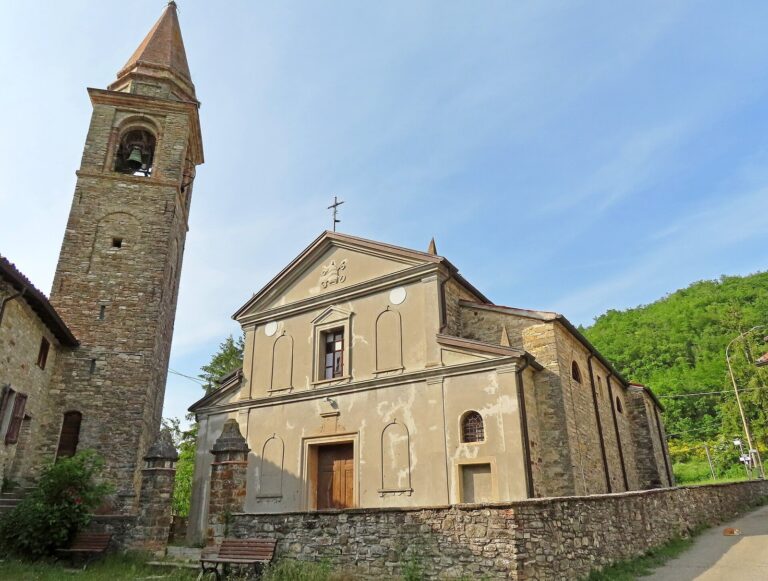
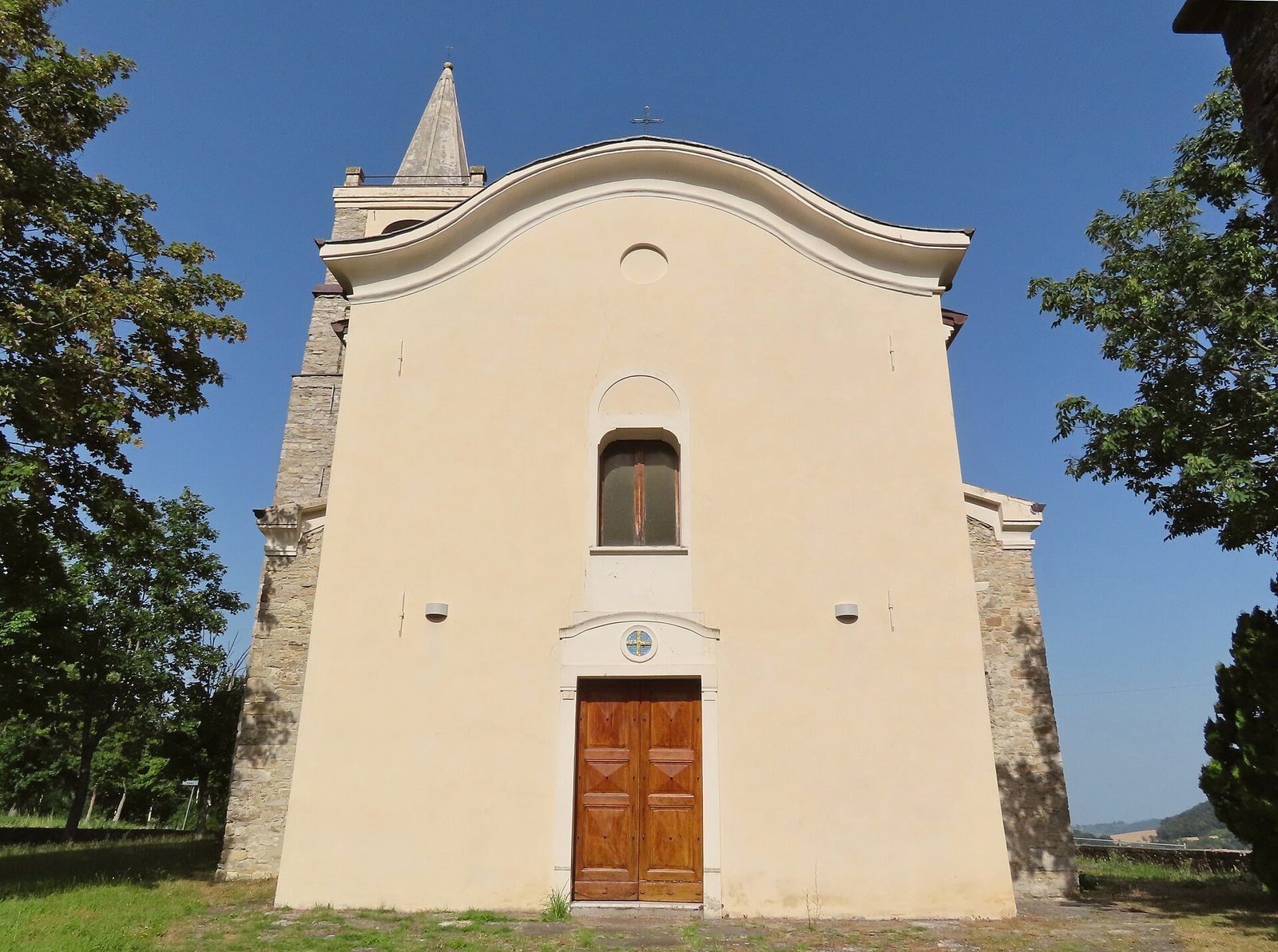
The symmetrical facade is plastered and organized around a broad central entrance framed by two jambs, the vertical sides of a doorway. Above it, a broken arched pediment, a gable with an interrupted outline, encloses a mosaic medallion showing a Greek cross. Higher up are a window with an arch combining straight and curved lines and a small, round decorative recess without an opening. A curved cornice crowns the facade.
Bell tower and side walls
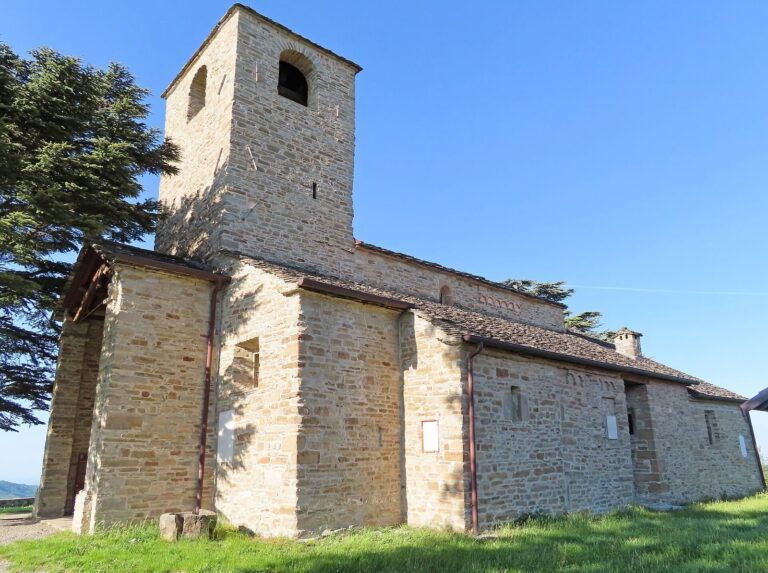
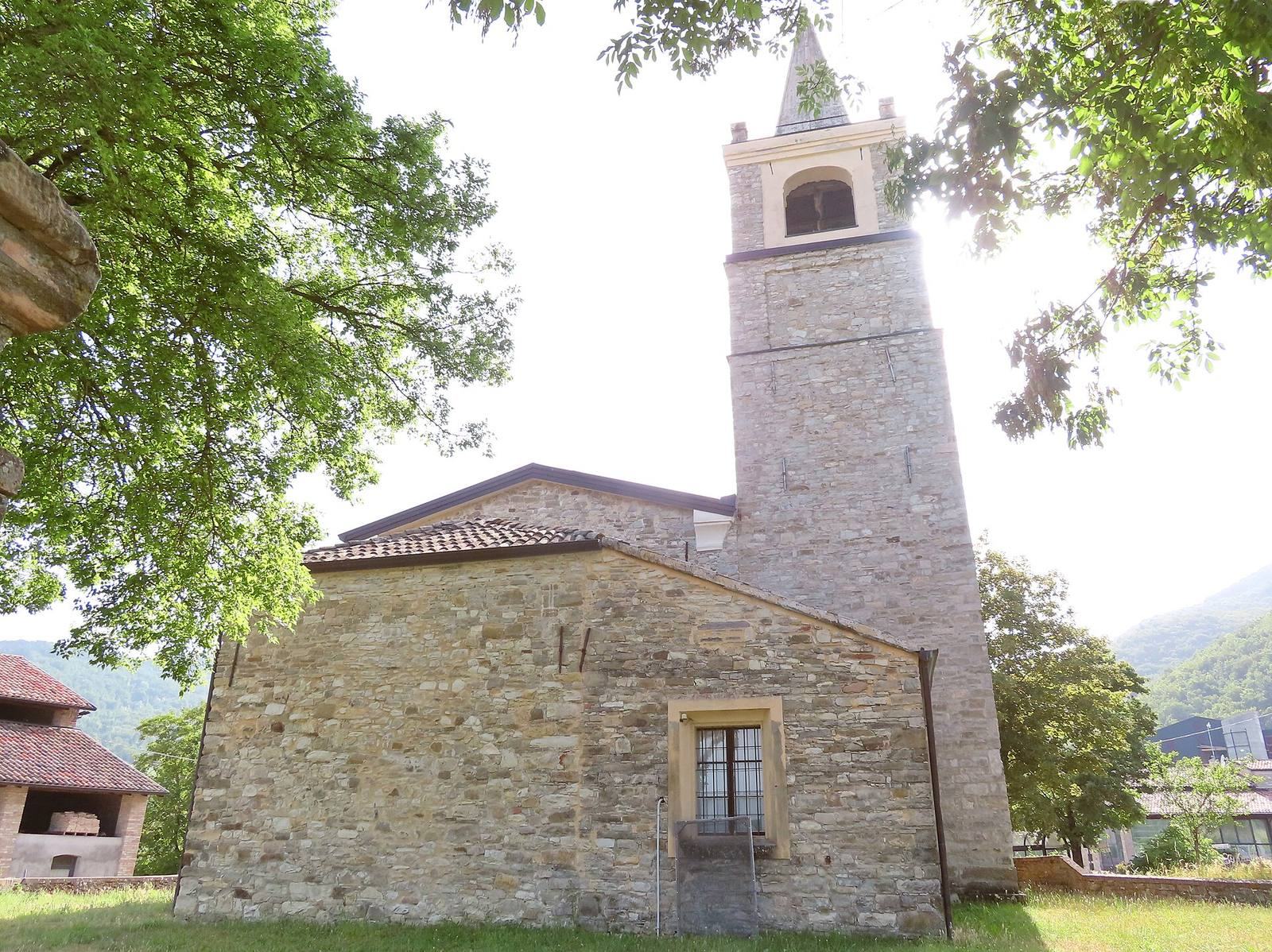
The church’s side walls are faced with stone, and the side chapels project outward from them. The bell tower stands on the left. It rises in three tiers, with broad, round-arched windows, each containing a single opening, on all four sides of its bell chamber. An octagonal-based spire rises from the center of the tower’s crown.
Interior
Nave and chapels
The plastered nave has a barrel vault, a long, curved ceiling, with lunettes, curved sections set into the vault. Pilasters, flat wall projections resembling columns, support a molded stucco cornice along the sides. Each side chapel has a barrel-vaulted ceiling and opens into the nave through a broad round arch.
The first chapel on the right contains an oil painting dated 1719, showing the Madonna and Child with Saint Anthony Abbot, an early Christian ascetic associated with the beginnings of monasticism. Above the altar in the second chapel, an eighteenth-century altarpiece holds a wooden statue of the Virgin Mary as the Immaculate Conception, the Catholic belief that Mary was conceived without original sin.
Presbytery and furnishings
The slightly raised presbytery is entered beneath a stucco-decorated triumphal arch, a broad arch marking the transition to the sanctuary. Its sixteenth-century interior has a pavilion-shaped vault with lunettes. A wooden table altar was added around 1980. At the rear, an older main altar dating to about 1740 supports an altarpiece from approximately the same period. It depicts the Assumption, the belief that Mary was taken body and soul into heavenly glory, together with Saints Maurus, Lawrence, and Genesius and an unnamed holy martyr.
The furnishings include a seventeenth-century armchair, two storage benches from the late seventeenth century, and an eighteenth-century kneeler. Other pieces are an eighteenth-century sideboard, a seventeenth-century cabinet, a processional throne from around 1780, and a censer, a vessel for burning incense, dating to about 1770.