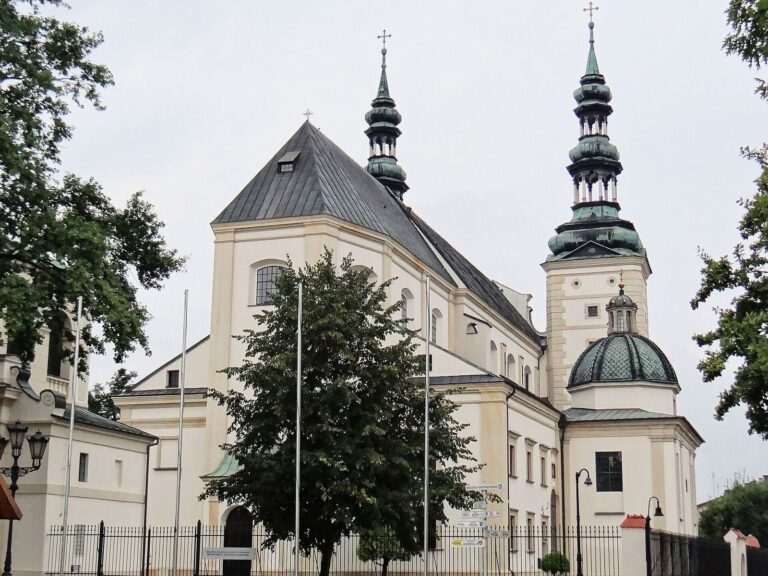
Church of Our Lady of Graces and Saint Adalbert of Prague in Łowicz: A Baroque Piarist Church
Site at a Glance
- Popularity
- Medium
- Country
- Poland
- Primary era
- Early Modern
- Eras represented
- Early Modern, Modern
- Civilizations
- Polish–Lithuanian Commonwealth, Russian
- Site type
- Religious
- Remains
- Church
On this page10 sections
History
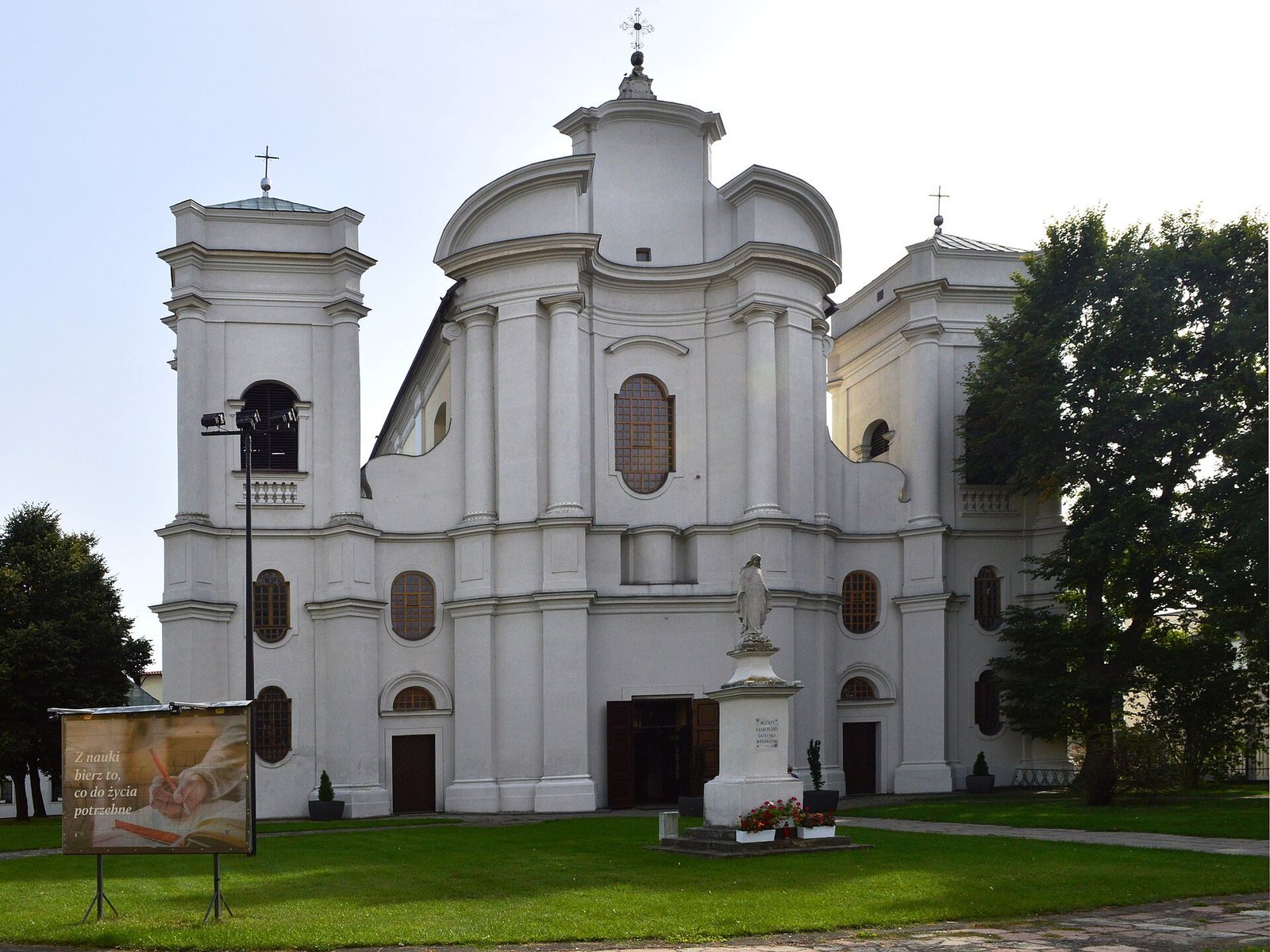
The Church of Our Lady of Graces and Saint Adalbert of Prague is a Baroque Roman Catholic church in Łowicz, Poland, founded in 1668 by Jan Szamowski, castellan of Gostynin, an official associated with a castle and its district. Its dedication honors Mary under the title Our Lady of Graces and Saint Adalbert of Prague, a medieval bishop and missionary venerated as a Christian martyr.
Foundation and construction
Szamowski established the church, and Michał Radziejowski, Stanisław Szembek, Teodor Potocki, and Krzysztof Antoni Szembek also contributed to its construction. The presbytery, the sanctuary area, was built between 1672 and 1680, after which building work halted. A commemorative tablet’s inscription linked the church’s establishment with Pope Innocent XI and King John III of Poland. It credited Bishop Albert Stawowski, a suffragan bishop serving under the archbishop of Gniezno, with laying the first stone, and named Szamowski, M.D. Pstrokoński, and other benefactors. It also identified the Piarist provincial superior and the rector at Łowicz.
Construction resumed on a larger scale in 1720. Jakub Fontana designed the main body, facade, and towers, which were built between 1720 and 1731. The facade was also associated with a design by royal architect Karol Antoni Bay and was completed during the eighteenth century. The church was consecrated in July 1749, although the upper part of the eastern tower and the tower spires were still unfinished. In 1762, Wojciech Zimny, a peasant from Bobrowniki, paid for the church to be built in masonry.
Piarist education and changing use
The church’s history was tied to the Piarists, a Catholic religious order with a longstanding emphasis on education. Provincial chapters of the order met at the Łowicz Piarist College. In 1753, through the efforts of Piarist priest and educational reformer Stanisław Konarski, a reform was adopted initially for Piarist schools and approved by Pope Benedict XIV. The reform later helped spur the creation of the Commission of National Education, an educational authority in the Polish-Lithuanian Commonwealth.
During Prussian rule, the church was used as a hospital. After the January Uprising, the Piarist order was dissolved in 1864, and diocesan priests took responsibility for the church.
Repairs and Piarist return
The floors were replaced in 1888, and the roof tiles were relaid in 1897. Between 1898 and 1900, the facade was renovated and the towers completed. German shelling in 1914 damaged the facade and roof.
The Piarists returned to Łowicz in 1958, resuming pastoral work at the church and educational work through primary, lower-secondary, and upper-secondary schools. The church is a rectoral church, served by a rector rather than functioning as an ordinary parish church. It belongs to the Diocese of Łowicz, and its parish is the Cathedral Parish of the Assumption of the Blessed Virgin Mary in Łowicz.
Remains
Plan and vaulting
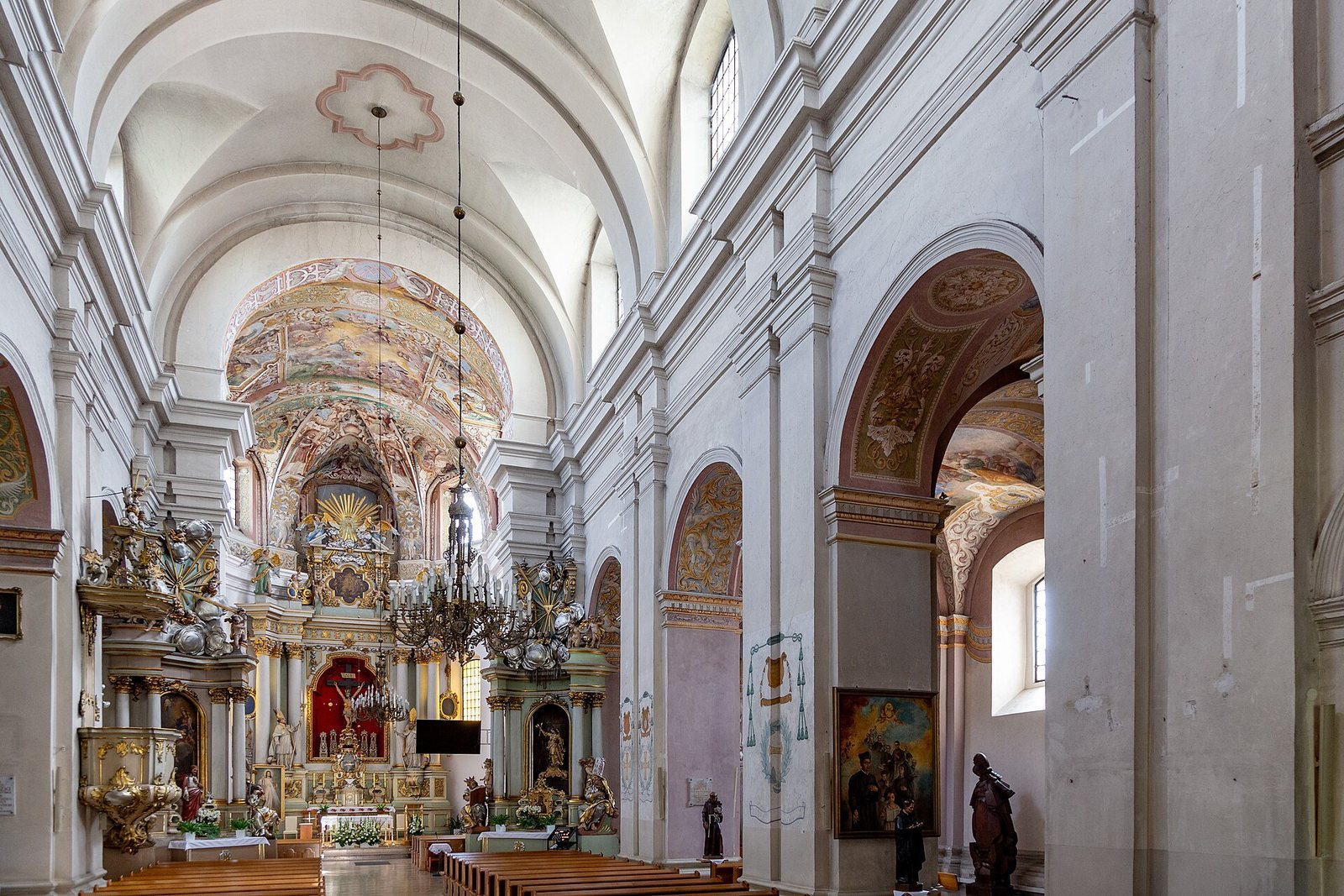
The church has three aisles and a presbytery ending in a semicircular apse, a rounded termination of the sanctuary. The presbytery and main nave have barrel vaults, or continuous arched ceilings, with lunettes, curved sections where a vault meets a wall. Paired crosswise arches support these ceilings. The annexes beside the presbytery have groin vaults, formed by intersecting barrel vaults. Cross vaults, ceilings formed by intersecting arches, cover the side aisles and the area beneath the choir, while the galleries have barrel-vaulted ceilings.
Interior furnishings and decoration
Main altar
The wooden main altar, designed by Jakub Fontana, dates to 1720. It includes a late-Baroque cross, probably made by Jan Jerzy Plersch, and sculptures of bishops.
Side altar
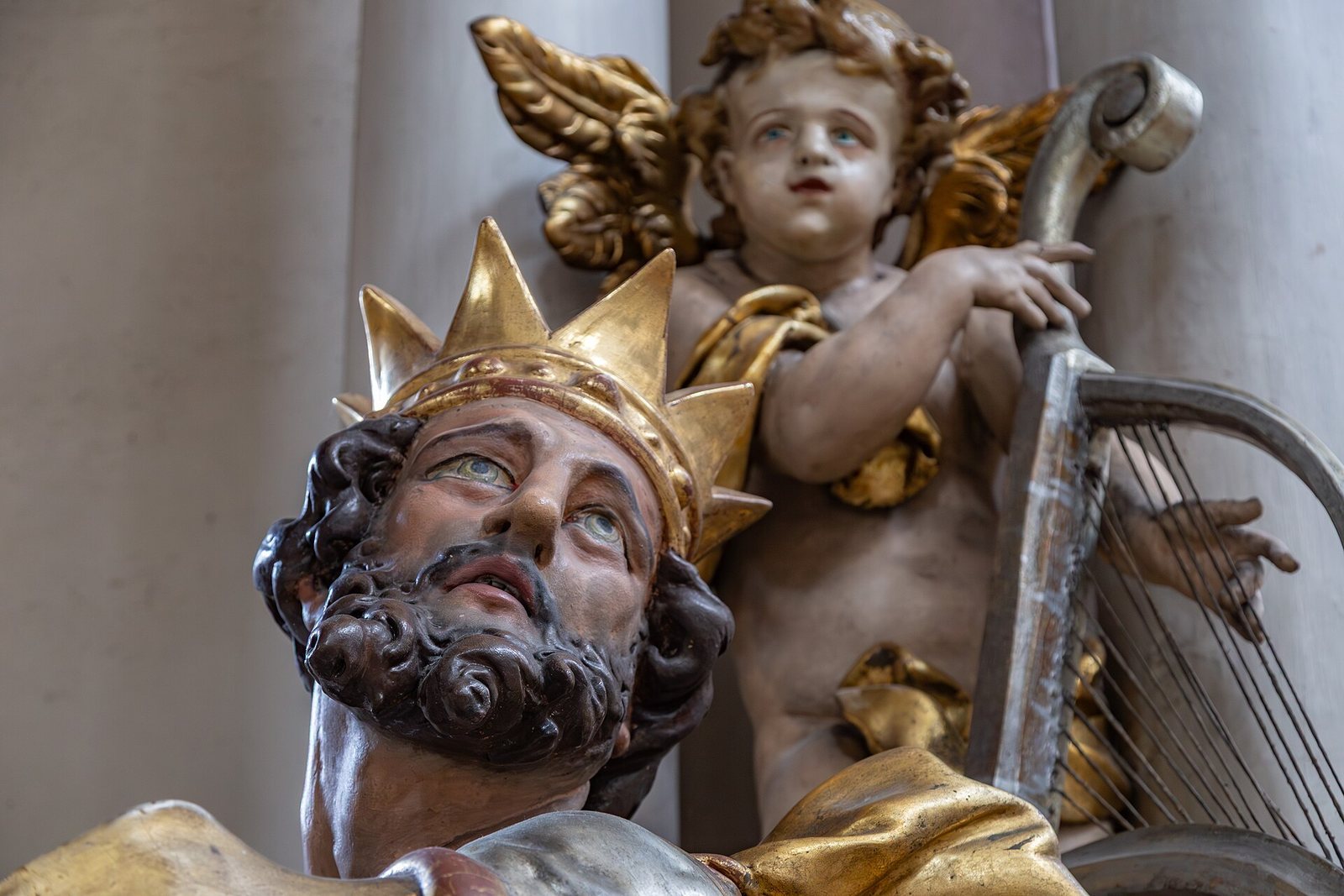
A side altar holds a sculpture of Our Lady of Graces and figures of Solomon and Moses. The sculptures of Solomon and Moses are believed to be by Jan Jerzy Plersch.
Frescoes
The church’s frescoes date to about 1725 and are attributed to the Italian painter Michelangelo Palloni.