Skály: A Medieval Castle in Czechia
Site at a Glance
- Rating
- 4.5
- Popularity
- Low
- Country
- Czechia
- Primary era
- Medieval
- External website
- Open
- Eras represented
- Medieval, Early Modern
- Civilizations
- Holy Roman Empire, Kingdom of Bohemia
- Site type
- Military
- Remains
- Castle
On this page12 sections
History
Skály is a medieval castle in Czechia, located near Teplice nad Metují, probably founded in the late fourteenth century. It replaced an older fortified manor at Stárkov as the seat of the estate and later became known as Katzenštejn and Bischofstein. Its history includes Hussite-era expansion, military raids, a siege in 1513, abandonment in the sixteenth century, and later ecclesiastical ownership.
Foundation and the Hussite Wars
The castle was probably established by Matěj Salava of Lípa, although another tradition attributes its foundation to Rubín of Žampach, who owned Stárkov between 1353 and 1371. Skály is first recorded in 1393 as the property of Matěj Salava of Lípa. During the Hussite Wars, religious and political conflicts in Bohemia that began in 1419 after the death of Jan Hus, Salava supported the Hussite cause and enlarged his possessions at the expense of the Broumov monastery. After changing allegiance to Catholicism, he retained these acquisitions following the Battle of Lipany in 1434, which ended the main phase of the Hussite Wars and strengthened moderate Hussite and Catholic forces in Bohemia.
After the wars, the castle garrison used Skály as a base for raids against towns in Silesia and Lusatia. Silesian forces and the towns of Zittau responded by purchasing the castle from Matěj Salava the Younger in 1447 and demolishing it. By 1454, however, a man known as Kočka had rebuilt the damaged stronghold and began using the name Katzenštejn. It belonged to Hanuš of Varnsdorf from 1466 to 1484, passed to Zbyněk Buchovec of Buchov in 1488, and was acquired by Jan Špetle of Janovice in 1497. Jan Špetle attached it to the Náchod estate.
The siege of 1513
Prince Bartoloměj of Münsterberg acquired Skály in 1513. He was a Silesian prince and grandson of the Bohemian king George of Poděbrady. His servant, Zikmund Kaufunk, burned several farmsteads in the suburbs of Świdnica, raided two or three nearby villages, and brought the loot to Skály.
Prince Frederick II of Legnica besieged the castle on 21 August 1513 with about 2,000 men. Artillery bombarded Skály from 25 to 27 August, but the besiegers withdrew to Silesia after learning that people from Prague were organizing a relief force. During the retreat, they plundered villages and small towns in the surrounding area. The castle therefore withstood a siege that lasted several days.
Bartoloměj of Münsterberg had not paid the full purchase price, so Skály returned to Jan Špetle after Bartoloměj’s death in 1515. Before 1517, Špetle agreed to transfer the castle to Petr Adršpach of Dubá as settlement for debts, but neither party completed the arrangement. Petr Adršpach nevertheless sold Skály in 1528 to Zdeněk Lev of Rožmitál and Jan Krušina of Lichtenburg for 2,000 kop groschen. In this monetary context, a kop was an accounting unit equal to 60 groschen.
Estate ownership and abandonment
In 1528 the Skály estate included the town of Stárkov, the villages of Bystré, Skalka, Studnice, Vernéřovice, Jívka, Janovice, and Metuje, as well as the abandoned castle of Adršpach. The purchasers were expected to settle Jan Špetle’s claims. Zdeněk Lev and Jan Krušina later sold their extensive holdings to Jan of Pernštejn. The transfer, including Skály, Rýzmburk, and several abandoned castles, was completed in 1536. Bernard Žehušický of Nestajov acquired the estate in 1544.
By then Skály was so dilapidated that Bernard Žehušický chose not to restore it. He established the chateau at Stárkov as his residence instead, and the castle had lost its function as an aristocratic home by the second half of the sixteenth century. It was recorded as abandoned in 1576. The fortress below was subsequently converted into an agricultural yard.
From Bischofstein to a protected ruin
During an inheritance settlement in 1625, the Skály, or Katzenstein, estate was divided, and Bernart Hertvík Čertorejský of Čertorej, governor of the Hradec Králové region, received the Stárkov estate. After the Battle of White Mountain, the Smiřický family was dispossessed because of its participation in the Bohemian Estates Revolt.
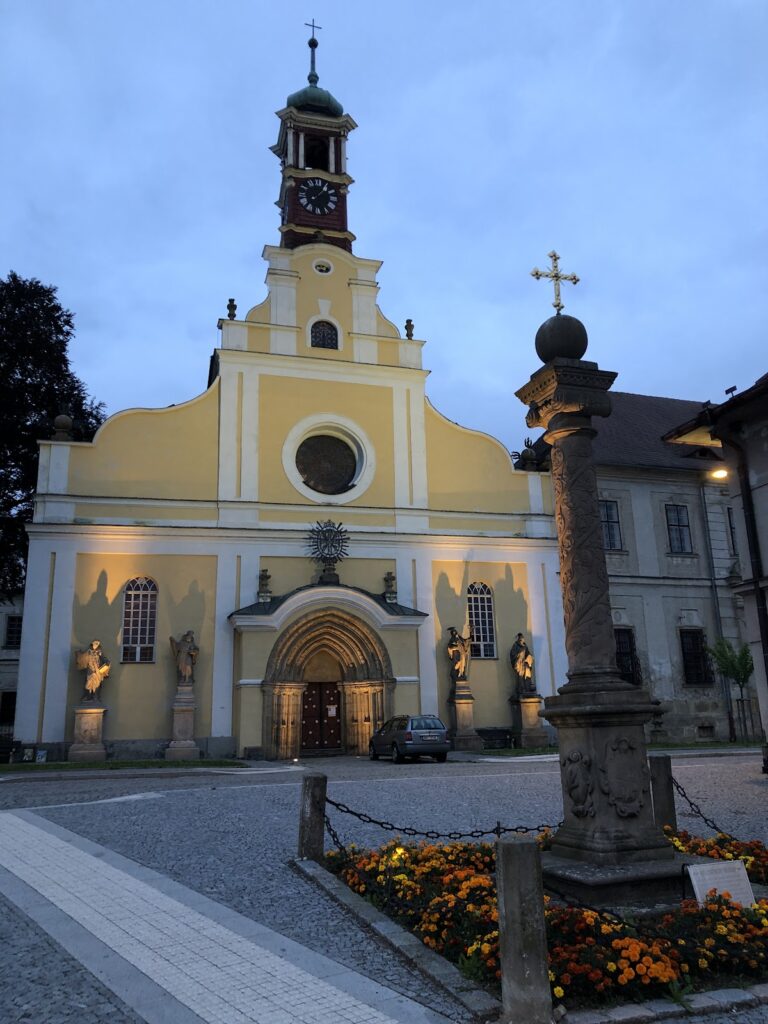
In 1662 the newly established Hradec Králové bishopric acquired the decaying castle and its agricultural yard as an endowment for the cathedral chapter. The settlement and castle were then renamed Bischofstein. Matthäus Ferdinand Sobek of Bilenberg, the first bishop of Hradec Králové, had a small chateau built in the former castle forecourt. The cathedral chapter used it as a summer residence, and the chateau and Bischofstein estate remained in diocesan ownership until February 1948.
The castle and the settlement below it were later portrayed by the Czech historical novelist Alois Jirásek in his novels Skály and Skaláci. The ruins are protected as a Czech cultural monument and lie in the Skály cadastral area, about four kilometres from Teplice nad Metují, near the Adršpach-Teplice rock town.
Remains
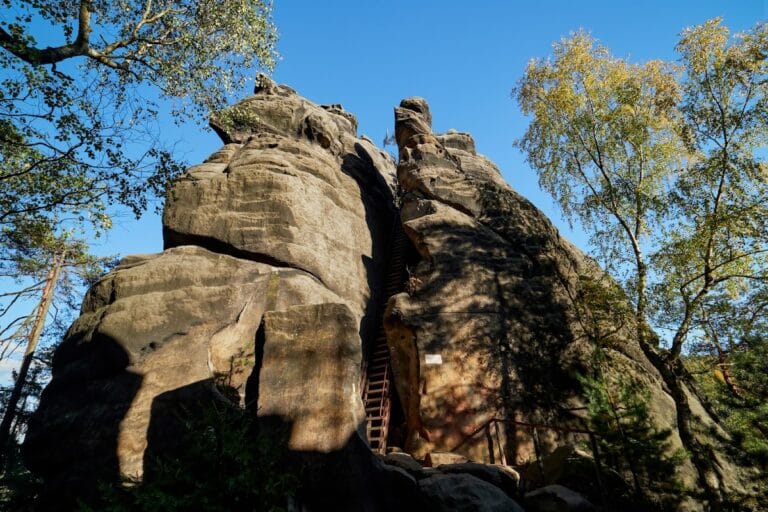
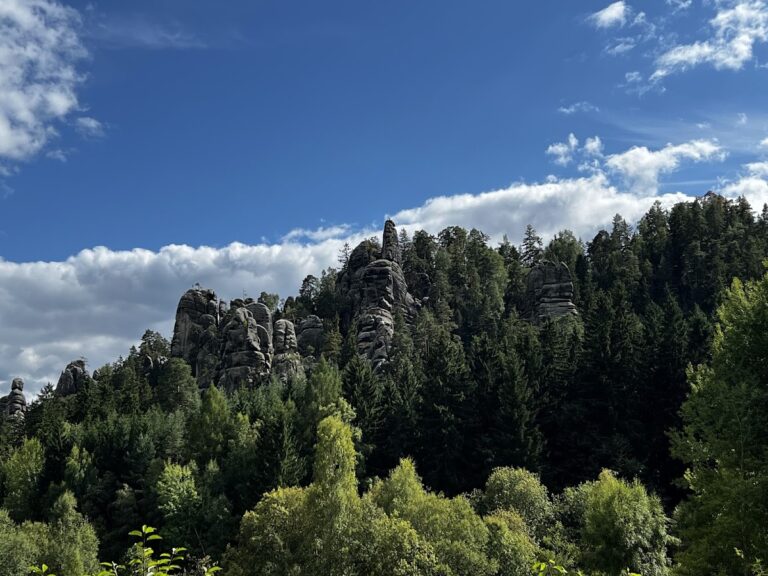
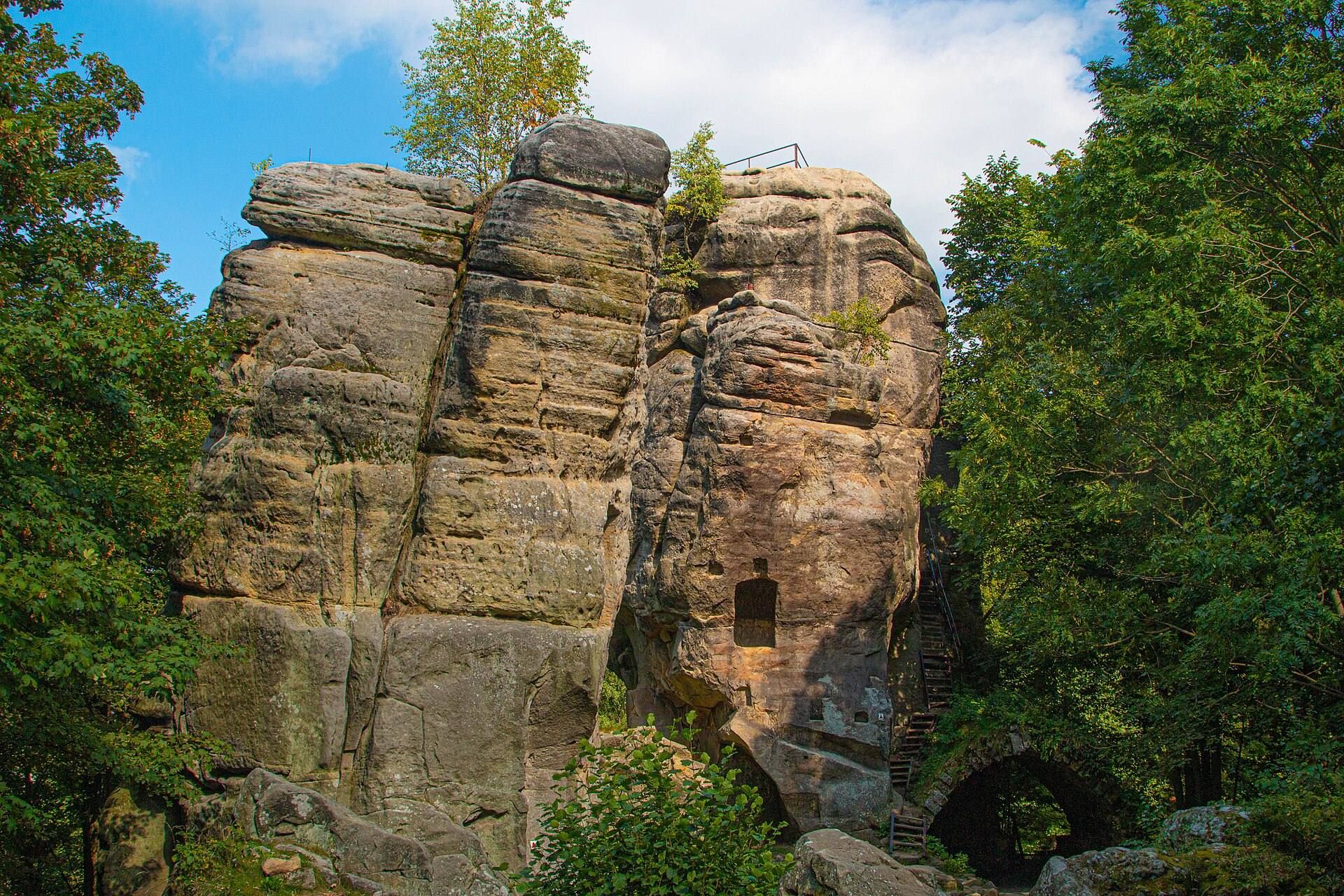
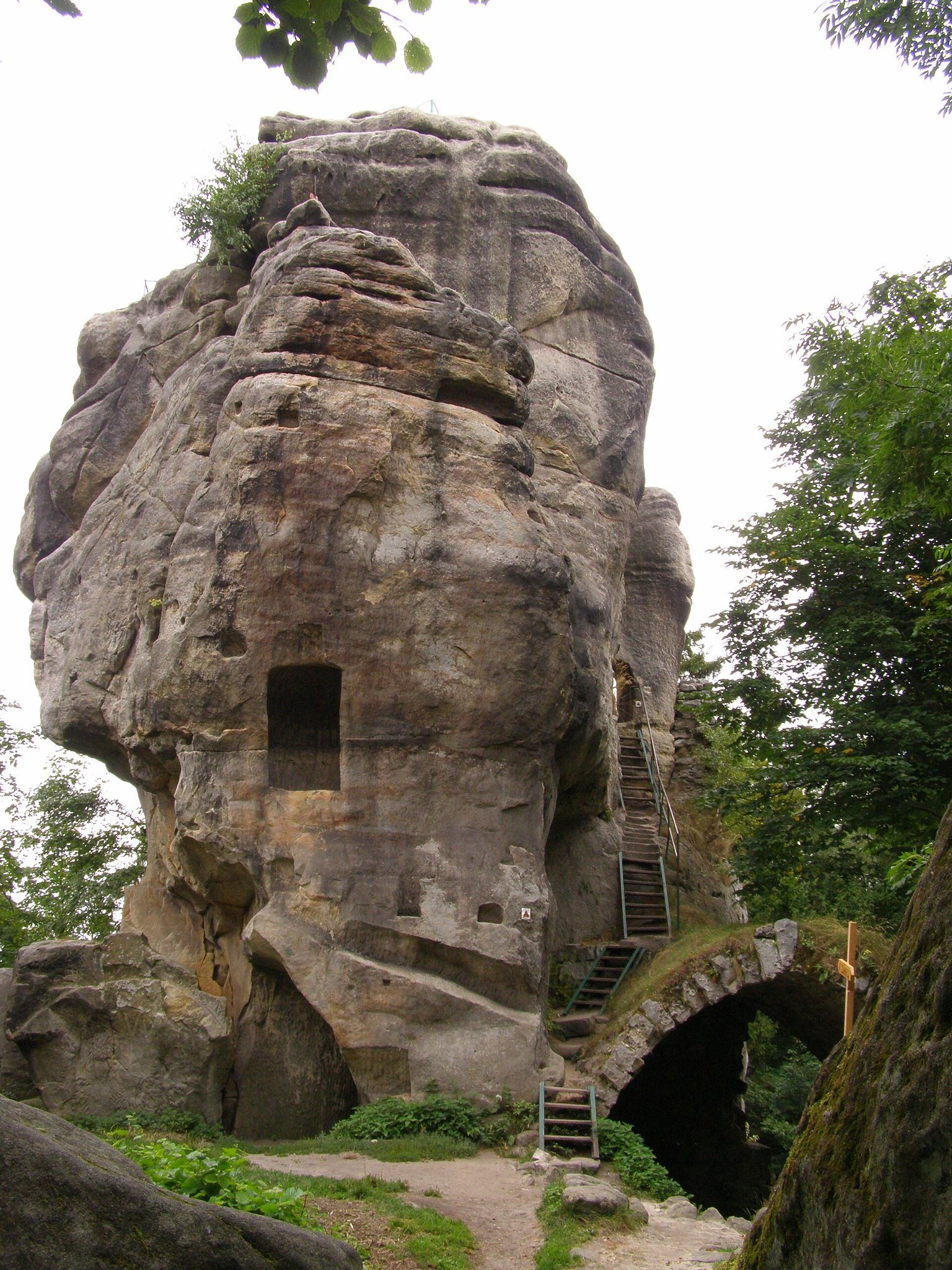
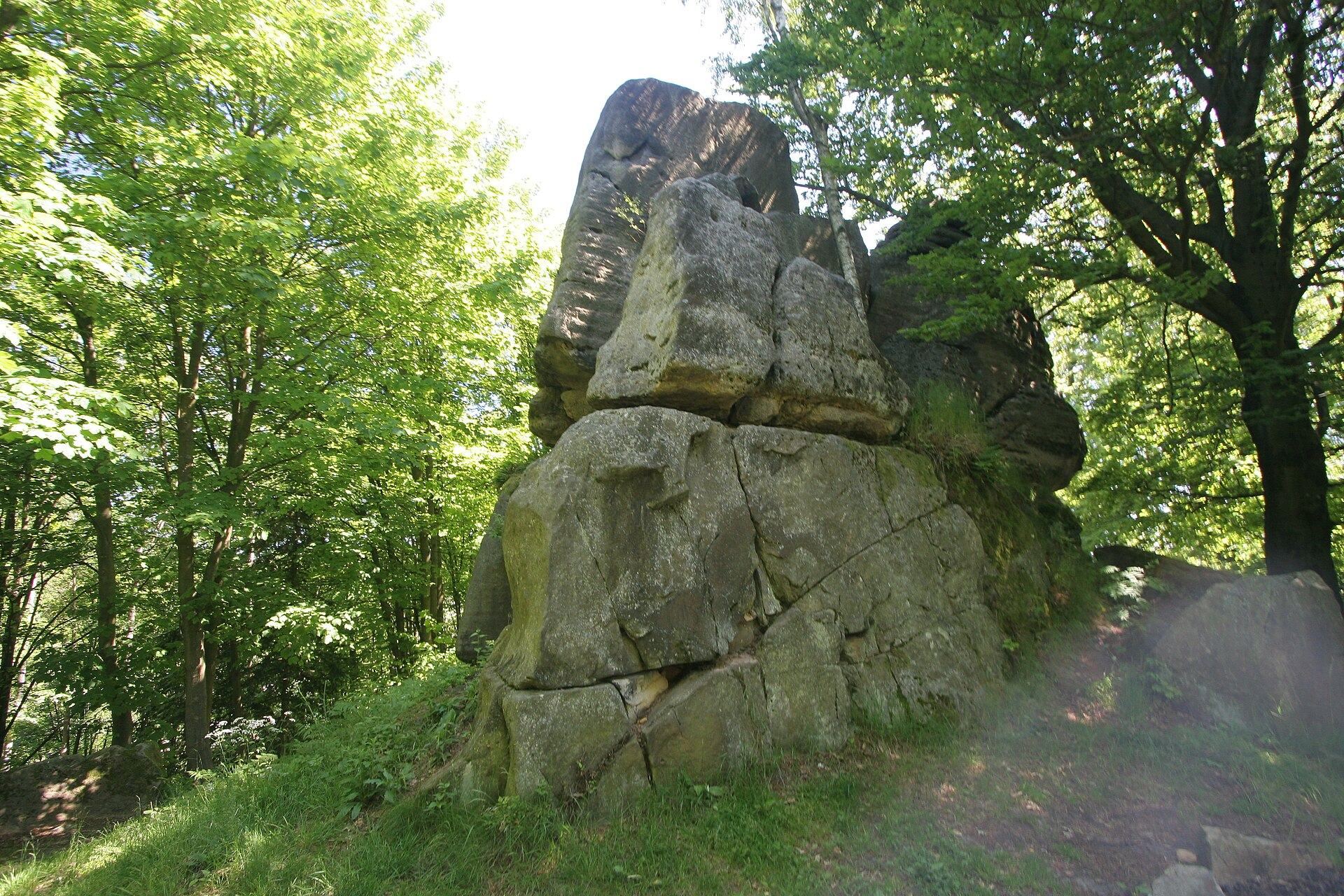
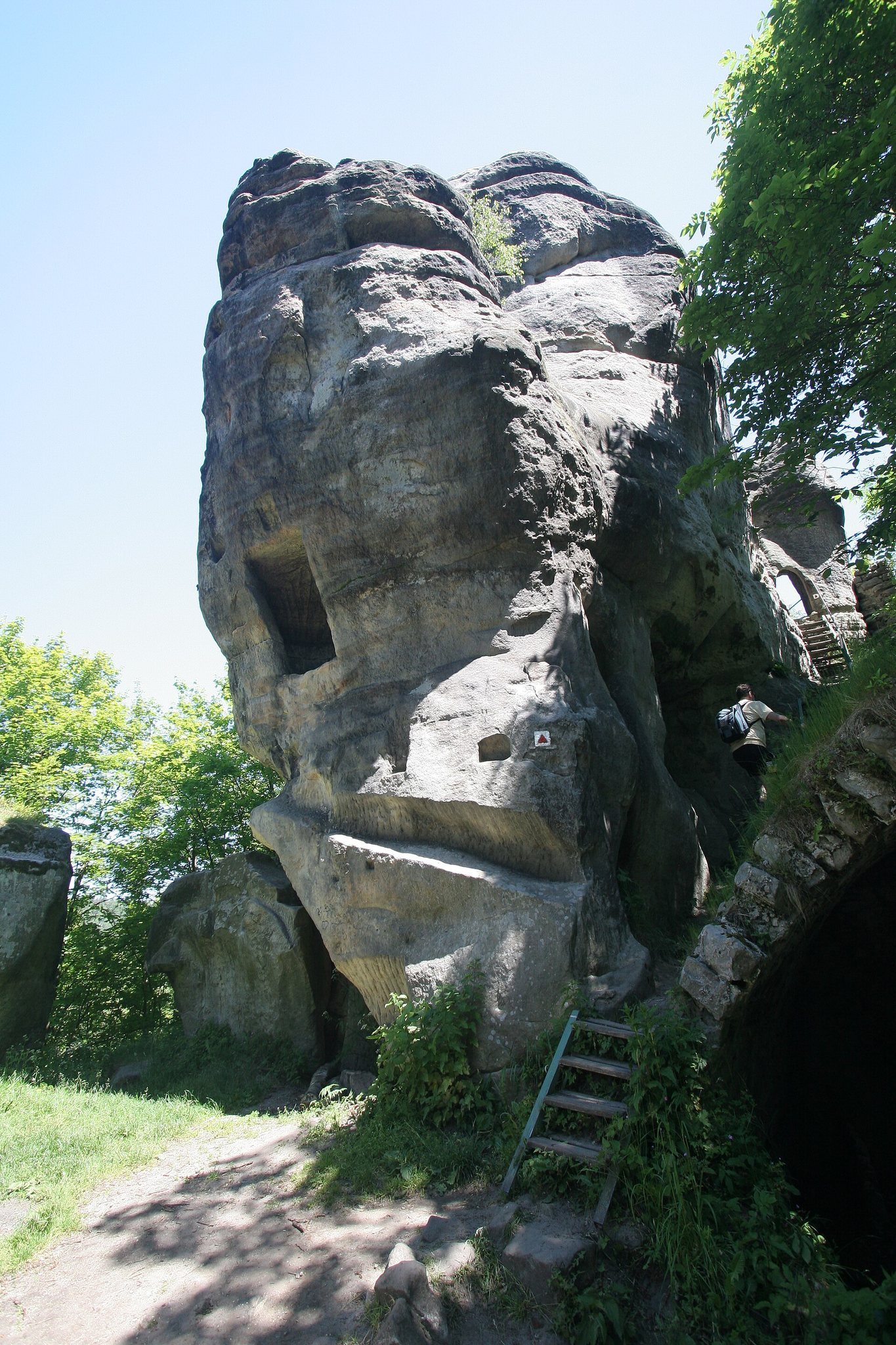
Skály occupies part of a sandstone rock city at the southern edge of the Teplice Rocks. The natural formations contributed both to the castle’s defence and to its construction, although the site was not a conventional rock castle. Individual rock towers and outcrops mainly took the place of structural elements that would otherwise have been built in masonry. The castle’s full extent remains uncertain, but it most probably consisted of a principal palace forming the core of the defensive and residential complex, with outer fortifications linked by an enclosure that has since disappeared.
Outer fortifications
Northern platform and cistern
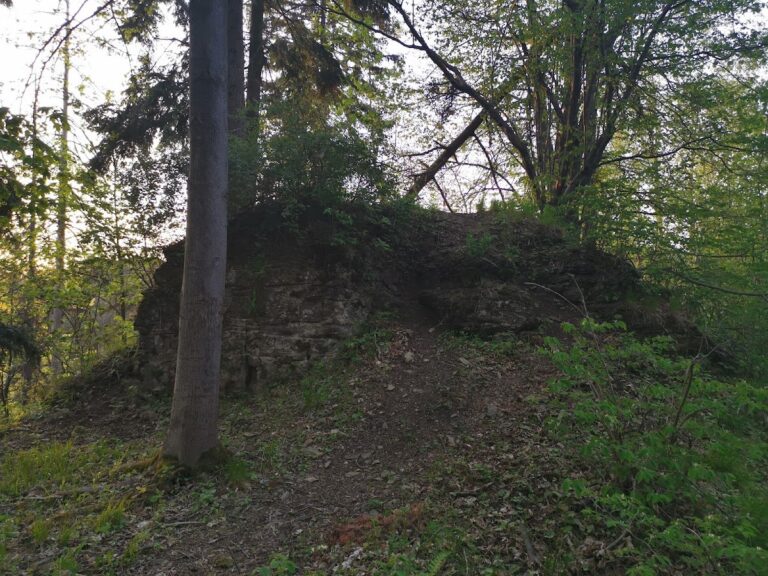
The only outer area certainly belonging to the castle is a walled platform in the northern part of the site. It contains a cistern, a water-storage installation intended to secure supplies for a garrison during occupation or siege. The platform formed part of the castle’s outer defensive area, while the surviving wall preserves evidence of how the natural rock formations were incorporated into the complex.
South-western defences
The castle core was protected on its south-western side by a partly preserved ditch and an outer rampart. In front of the rampart, the terrain retains the relief of a square bastion, a projecting defensive work used to protect nearby walls or approaches. Other traces of the outer works survive as altered rock surfaces, fragments of masonry, and features in the ground.
Castle core and palace
Rock-supported palace
The castle core stood on the eastern side of the complex. A large palace was attached to the largest rock tower and enclosed a smaller rock formation within its structure. Chambers and stairways were carved into the sandstone, combining built walls with the existing geology. Surviving remains include sections of the stone perimeter wall and a room covered by a pointed barrel vault, a continuous tunnel-like vault with a pointed profile.
Surviving rock and masonry
The remaining fabric consists of modified rock formations, fragments of masonry, and terrain traces belonging to the fortifications. Together, these elements preserve the relationship between the castle’s constructed spaces and its rocky setting. The rock formation and castle remains also function as a lookout platform.