Crookston Castle: A Ruined Medieval Castle in Glasgow



Site at a Glance
- Rating
- 4.4
- Popularity
- Low
- Country
- United Kingdom
- Primary era
- Medieval
- External website
- Open
- Eras represented
- Medieval
- Civilizations
- Kingdom of Scotland
- Site type
- Military
- Remains
- Castle
On this page13 sections
History
Crookston Castle is a ruined medieval castle in Glasgow, Scotland, United Kingdom, built by the Stewarts of Darnley around 1400 on a hill above the Levern Water. It is described as the only surviving medieval castle in Glasgow and the city’s second-oldest building after Glasgow Cathedral. The castle replaced an earlier timber-and-earth fortification and later became the principal house of the earls of Lennox.
Early Fortification and the Stewarts of Darnley
The site was fortified in the twelfth century by Sir Robert de Croc, who constructed a timber-and-earth castle surrounded by a defensive ring ditch. He also founded a chapel there in 1180. The ring ditch remains visible, while archaeological work has uncovered evidence of the chapel. Sir Alan Stewart acquired the lands of Crookston in 1330, and they passed to Sir John Stewart of Darnley in 1361. The Stewarts of Darnley then replaced the earlier fortification with the present stone castle around 1400.
Lennox Power and Destruction in 1489
Crookston became linked with the earls and dukes of Lennox and was regarded as the principal house of the earls of Lennox. In 1489, the Stewart Earl of Lennox rebelled against James IV, king of Scotland from 1488 to 1513. James brought Mons Meg, a large historic Scottish cannon, from Edinburgh and used it to bombard the castle. The attack virtually destroyed Crookston’s western end and led to its rapid surrender.
Sixteenth-Century Siege and Royal Associations
On 3 April 1544, James Hamilton, 2nd Earl of Arran, and Cardinal David Beaton besieged and captured Crookston while the Earl of Lennox was defending Glasgow Castle. Arran, a leading nobleman and regent for the young Mary, Queen of Scots, installed five gunners at Crookston in May. The castle was extensively repaired after the siege.
Crookston was later included among the dower lands of Margaret Douglas, Countess of Lennox. A dower estate consisted of lands assigned for the support of a widow or noblewoman. Her son, Henry Stuart, Lord Darnley, became the second husband of Mary, Queen of Scots. A tradition holds that the couple may have become betrothed beneath a yew tree at Crookston, although the tradition remains uncertain.
Later Ownership and Preservation
In 1572, Crookston was granted to Charles Stuart, Earl of Lennox. The Duke of Lennox sold the castle to the Duke of Montrose in 1703, and it remained with the dukes of Montrose until William Graham, 2nd Duke of Montrose, sold it to the Maxwells of Pollok in 1757.
After several years of abandonment, the Maxwells partially restored Crookston in 1847 in connection with Queen Victoria’s visit to Glasgow. During the Second World War, the north-eastern tower was used as an aircraft-watch tower. Sir John Maxwell Stirling-Maxwell, a founder member and the first Vice President of the National Trust for Scotland, presented Crookston to the Trust in 1931, making it the organisation’s first acquired property. Historic Environment Scotland is responsible for its maintenance.
Archaeological excavation took place in 1973 and 1974, followed by non-invasive geophysical investigation between 1997 and 1999 to detect buried features and remains. Crookston has been a scheduled monument since 1920, protected under Scottish heritage law because of its archaeological and historical importance. It was also a Category A listed building, the highest level of protection for Scotland’s listed buildings, from 1966 to 2015.
The castle has also entered Scottish literary tradition. Robert Burns, William Motherwell, and Robert Tannahill mentioned Crookston in poetry. In his 1820 novel The Abbot, Sir Walter Scott suggested that Mary, Queen of Scots, watched the Battle of Langside from beneath the castle’s yew tree. The site’s topography makes that scene impossible.
Remains
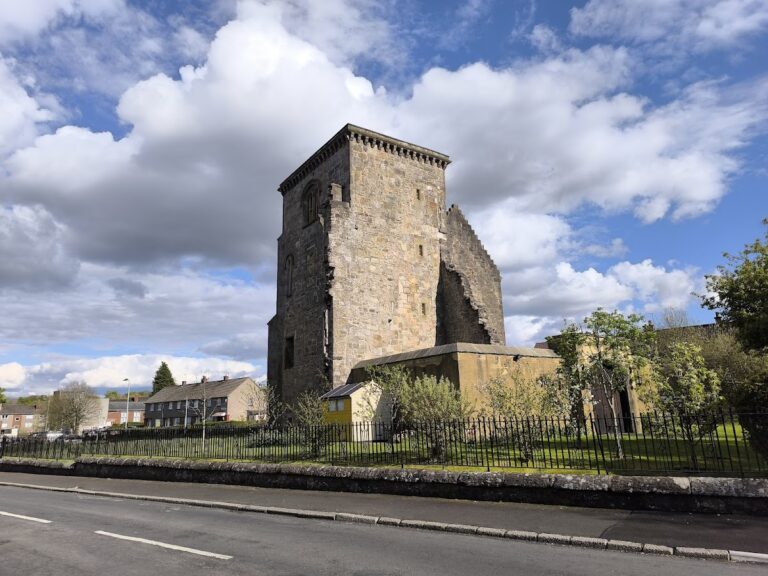
Crookston Castle occupies the summit of a natural hill enclosed by a defensive ring ditch. A steep northern slope descends towards the Levern Water. The main stone building is a rectangular block about 19 by 12 metres, with walls up to 3.7 metres thick. A tower originally reinforced each corner, creating an irregular X-shaped plan, an unusual arrangement also found at Hermitage Castle.
Towers and Exterior Defences
North-Eastern Tower
The north-eastern tower survives to its former height and measures approximately 6 metres square. It contains four storeys, with one room on each floor, and a basement prison reached only from above. Modern iron ladders provide access to the upper levels and roof. The upper part of the tower, including its projecting stone supports, was rebuilt in the nineteenth century.
Western and South-Eastern Towers
The two western towers were destroyed in the fifteenth century and were never rebuilt. Nineteenth-century repairs obscured the traces that remained. The basement of the south-eastern tower survives, and a spiral stair in its corner connected the hall with an additional storey and upper rooms in the eastern towers.
Entrance and Interior
Castle Entrance
The entrance is on the northern side beside the north-eastern tower. A vertically sliding portcullis and two doors defended the approach. A straight stair built into the thickness of the wall rises to the right of the entrance.
Basement and Hall
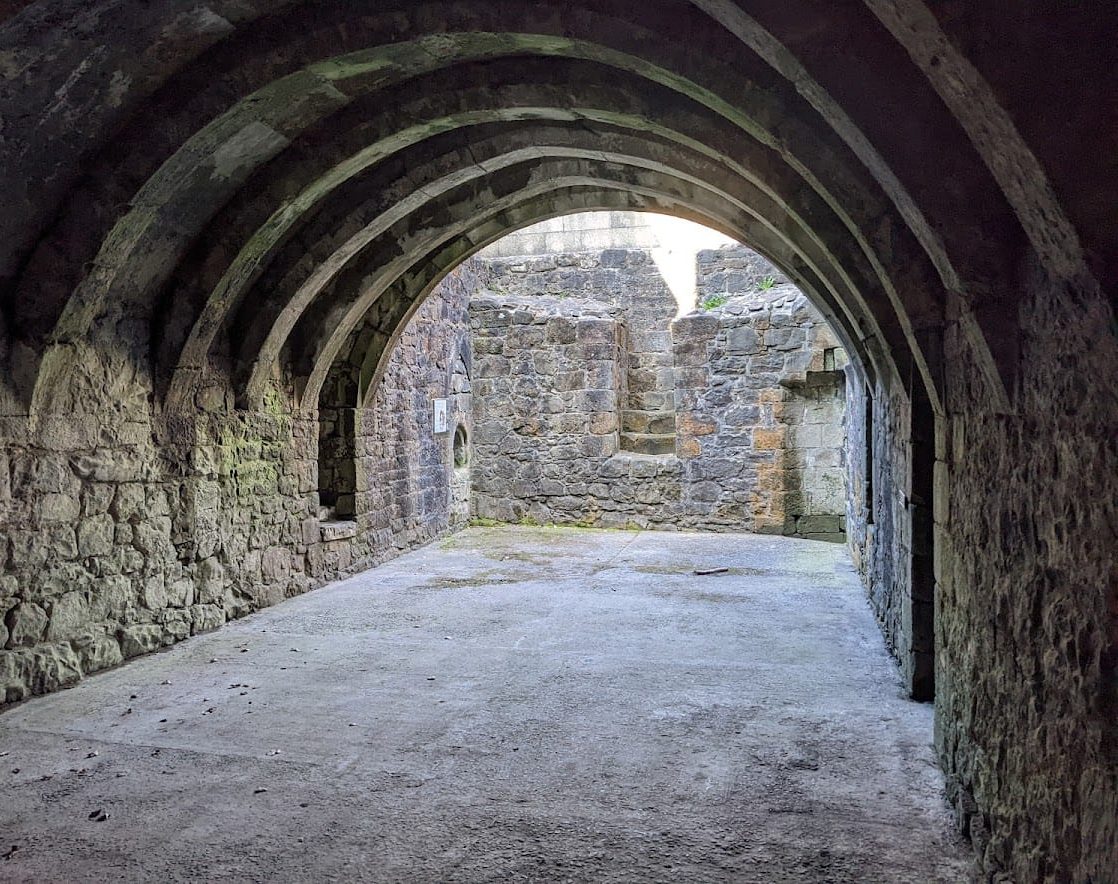
Immediately beyond the entrance lies a basement with a barrel-vaulted ceiling, slit windows, and a well. The hall occupied the first floor and was also vaulted, reaching approximately 8.3 metres in height. The winding stair in the south-eastern corner continued upwards to the additional storey above the hall and to rooms in the eastern towers.
Chapel and Yew Tree
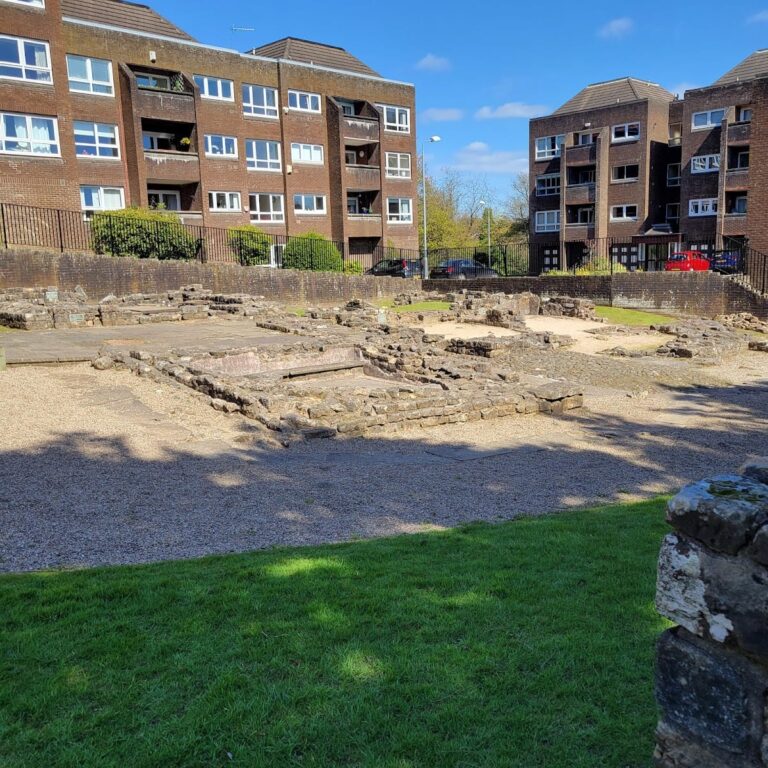
Remains of the chapel founded by Robert de Croc in 1180 have been uncovered at the site. The yew tree associated with the tradition concerning Henry Stuart, Lord Darnley, and Mary, Queen of Scots was felled in 1816. A model of Crookston Castle carved from its wood is displayed at Pollok House.