Hammershus: A Medieval Fortress on Bornholm, Denmark



Site at a Glance
- Rating
- 4.6
- Popularity
- Medium
- Country
- Denmark
- Primary era
- Medieval
- External website
- Open
- Eras represented
- Medieval, Early Modern
- Civilizations
- Danish
- Site type
- Military
- Remains
- Castle
On this page13 sections
History
Hammershus is a medieval fortress on Bornholm, Denmark, traditionally associated with the early to mid-thirteenth century. Its precise foundation date and founder are uncertain, but its origins may involve an agreement between King Valdemar II and Anders Sunesen, Archbishop of Lund. Another tradition places its construction around 1255 under Archbishop Jakob Erlandsen, possibly as an expansion of an earlier refuge fortress. The castle became a major stronghold in the political rivalry between the Danish monarchy and the archbishopric of Lund, the senior ecclesiastical institution centered on Lund and a powerful force in medieval Scandinavia.
The archbishops of Lund and the Danish crown
Hammershus belonged to the archbishops of Lund for much of the period from the thirteenth century until 1522. Its position and defenses made it valuable in the struggle between royal authority and the archbishopric, especially during the leadership of Archbishops Jens Grand and Esger Juul. Control repeatedly shifted between the two powers. King Erik V Klipping captured the fortress in 1265, but it was returned to the archbishop in 1276.
King Erik VI Menved ordered the next royal seizure in 1319 because he feared that outlaws might find refuge at Hammershus. His marshal, Ludvig Albertsen Eberstein, initially held the fortress for the king. When King Christoffer II restored it to the archbishopric in 1321, Eberstein became its commander on behalf of Lund. He defended Hammershus during an attack and sixteen-month siege led by the royal marshal Peder Vendelbo in 1324 and 1325. Eberstein eventually surrendered. King Valdemar IV Atterdag took control briefly before returning the fortress to the archbishopric.
From medieval stronghold to royal possession
In 1522, King Christian II claimed Hammershus and imprisoned Jens Andersen Beldenak, Bishop of Odense, there. Lübeck captured the fortress during the same year, then repaired and enlarged it. After receiving Bornholm in pawn from 1526, Lübeck used Hammershus as its base on the island. Danish royal control was restored in 1576.
After that date, Danish rulers allowed the fortress to deteriorate. Improvements in firearms had made its medieval defenses technologically outdated, although its cannons still drove away two Swedish warships in 1645. The fortress again became a military objective after the Treaty of Roskilde in 1658 placed Bornholm under Swedish control. Johan Printzensköld was appointed governor, but during an uprising led by Jens Pedersen Kofoed, Villum Clausen killed him in Rønne. The insurgents captured Hammershus the following day and returned Bornholm to the Danish king.
Prison, quarry, and historic monument
Once its strategic importance had declined, Hammershus served as a state prison. Corfitz Ulfeldt, a Danish nobleman and royal official, and his wife Leonora Christina Ulfeldt, daughter of King Christian IV, were imprisoned there from 1660. They escaped from the Mantlet Tower but were recaptured. They were then confined in a dark castle chapel before being transferred to separate floors of the Blue Tower. Johann Conrad Dippel, a German physician, alchemist, and occultist, was held at Hammershus from 1719 to 1724.
The fortress was evacuated in 1743 and later used as a stone quarry. Its masonry contributed to buildings including the Main Guardhouse in Rønne and the fortress on Christiansø. Hammershus received protection as a historic monument in 1822. From 1880, extensive overgrowth was cleared in work that continued for more than forty years. Wall restoration began in 1990 and has sought to preserve the appearance of a ruin rather than rebuild demolished sections. The fortress is protected as an ancient monument in Denmark and is described as Northern Europe’s largest castle ruin and largest medieval defensive structure.
Remains
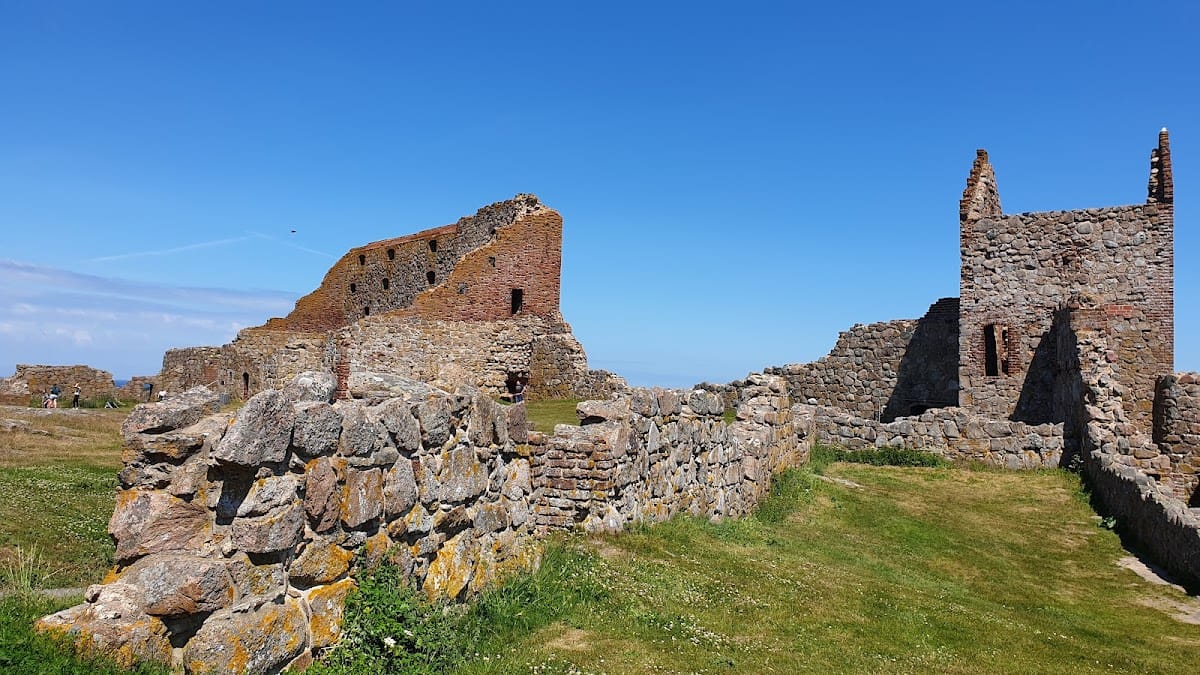
Hammershus occupies a rocky outcrop 74 metres above sea level in northwestern Bornholm, south of Hammerknuden and beside the coast. The fortress covers approximately 35,000 square metres when its outer defenses are included. It consists of a main castle and two outer baileys, or enclosed areas belonging to a castle. The enclosing walls extend for about 750 metres.
Outer defenses and water supply
Fortifications and approach
Steep cliffs protect Hammershus toward the sea, while rocky and difficult terrain strengthens the natural defenses on the other sides. A moat, bridge, outer wall, and several rings of fortification added further protection. The approach across the bridge was curved, which made it harder for attackers to bring a battering ram directly against the entrance. Defensive towers stood at the corners, and cannon positions formed part of the fortress’s later military system.
Mantlet Tower
The Mantlet Tower was built by Bernt Knop, who also strengthened the fortress defenses. It formed part of the fortified complex and later served as a prison. Its association with the imprisonment of Corfitz and Leonora Christina Ulfeldt remains part of the physical and historical character of Hammershus.
Ponds
Ponds associated with the fortress may have supplied fresh water. One was positioned in the northwestern corner of the site, adding a water source within the defended area.
Main castle and internal buildings
Slotsgården
The main courtyard, known as Slotsgården, was enclosed by an inner ring wall and surrounded by numerous large and small buildings. Stores and stables held tax revenues, while domestic buildings for the castle household occupied the southern side of the courtyard. These structures formed the working and residential core within the wider defensive enclosure.
Castle chapel and Blue Tower
A dark castle chapel was later used as a prison after the escape and recapture of Corfitz Ulfeldt and Leonora Christina Ulfeldt. The Blue Tower was another prison structure associated with Hammershus, and the couple were eventually confined on separate floors there.
Survival as a ruin
Hammershus now survives as a partially ruined fortress. Restoration of the walls has been carried out without reconstructing demolished parts, retaining the fragmentary appearance produced by centuries of military change, deterioration, prison use, and quarrying.