Burg Rahden: A Medieval Territorial Castle in Germany
Site at a Glance
- Rating
- 4
- Popularity
- Low
- Country
- Germany
- Primary era
- Medieval
- Eras represented
- Medieval
- Civilizations
- Holy Roman Empire
- Site type
- Military
- Remains
- Castle
On this page7 sections
History
Burg Rahden is a medieval moated castle in Germany, built to protect several trade routes that crossed the Große Aue by a ford. First recorded in 1296, it was rebuilt or enlarged between 1310 and 1320. The castle was one of five territorial fortresses maintained by the Bishop of Minden to defend and administer the region against the Counts of Diepholz and Hoya.
Foundation and Episcopal Defense
The other four episcopal strongholds were Reineburg near Lübbecke, Schalksburg in Hausberge, Burg Schlüsselburg in Petershagen, and Petershagen Castle. Burg Rahden therefore formed part of a wider defensive system rather than standing as an isolated residence. Hardecke von Engelingborstel held the office of Drost at Rahden in 1320. A Drost was a territorial official whose duties could include administration, justice, and military command.
By 1351, shares in the castle were held by the knights of Gesmele and Schele, the Counts of Hoya, and Gerhard vom Berge. The castle was repeatedly pledged to different families. The von Münchhausen family held it in 1361, while the von dem Bussche family held it from 1391 to 1395. These arrangements connected control of the stronghold with the financial and political obligations of its territorial rulers.
Destruction, Pledges, and Recovery
Troops of the Bishop of Osnabrück destroyed Burg Rahden in 1431. Later officials and Drosten included members of the von Grapendorff family around 1450, the von Mandelsloh family in 1464, and the von Münchhausen family until 1533. In 1538, the Bishop of Minden redeemed the castle from its conquerors by making a payment.
The castle remained involved in disputes over pledged rights. In 1591, during a conflict with a pledge-holder, the bishop ordered both Burg Rahden and the town of Rahden to be burned in order to force the surrender of the castle. Its administrative role continued for more than a century afterward, but Burg Rahden ceased to be the official administrative seat in 1711. Those functions moved to the New Amtshaus, an administrative office and residence for governing a territorial district, built approximately where present-day Rahden Castle stands.
Later History and Archaeological Investigation
A noble family possibly named after Rahden, or after an associated place-name, appears in records from the thirteenth century. Its members held fiefs and property in Fiestel and Rahden. Later descendants used the name von dem Rode. Following marriages, the resignation of fiefs, and renewed enfeoffment, their possessions and feudal titles passed in 1454 to the von Westorp, or Westrup, family, and ultimately to the von der Recke family of Obernfelde.
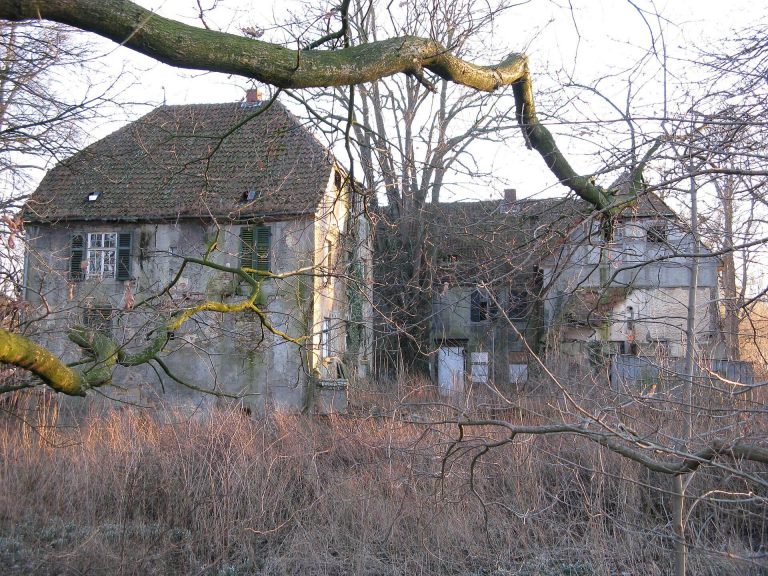
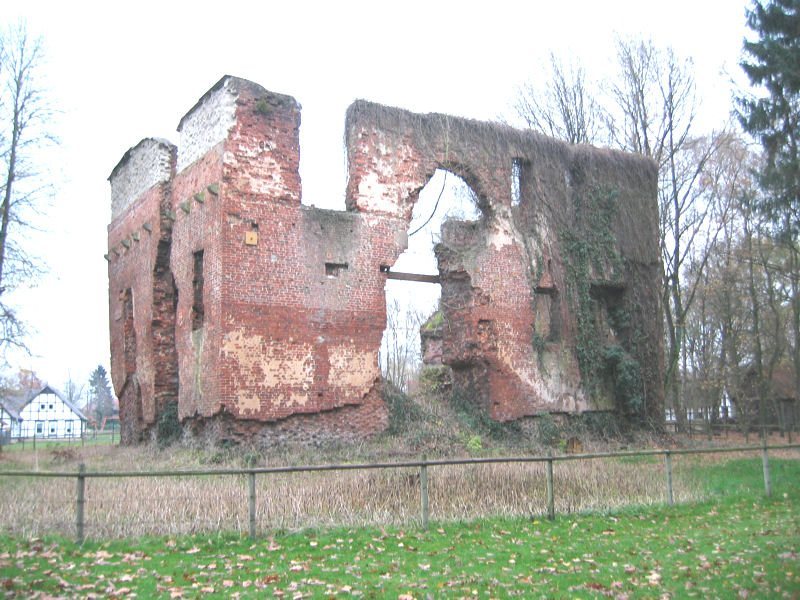
Burg Rahden burned out during the winter of 1878, leaving the ruin visible today. Heinrich Bretthauer, a Rahden local historian, investigated the castle’s extent through test excavations in 1969. Conservation work in the 1990s added substantial steel girders and tension rods to prevent the ruin from separating, while the removal of extensive vegetation in 2008 made more of its structural details visible. Burg Rahden is designated as an architectural heritage monument in North Rhine-Westphalia.
Remains
Moated Castle Layout
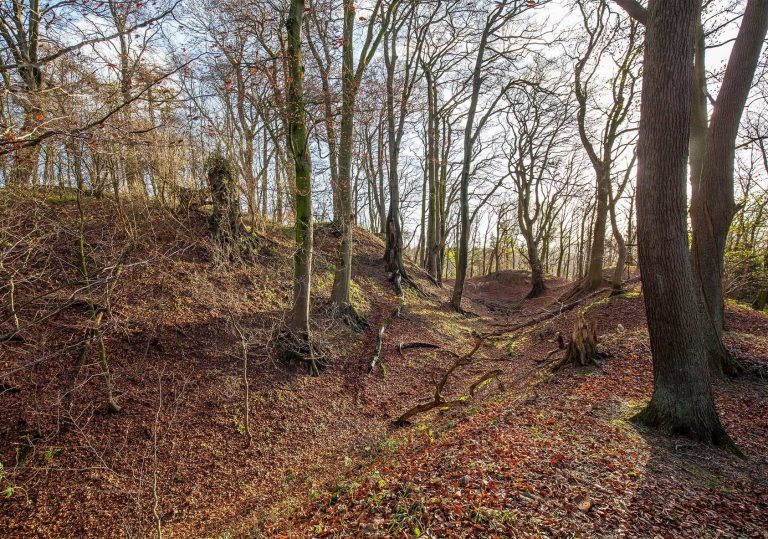
The castle complex covered approximately 63 by 53 metres and was enclosed by a water-filled moat supplied by the Große Aue. Access was provided from the south, where a drawbridge was reached via the present Lemförder Straße. The complex included a main castle building, which now forms the principal ruin, together with a stable, a gatehouse, and a connecting building. A massive keep was attached to the main building, while additional towers stood on the north and south sides toward the entrance.
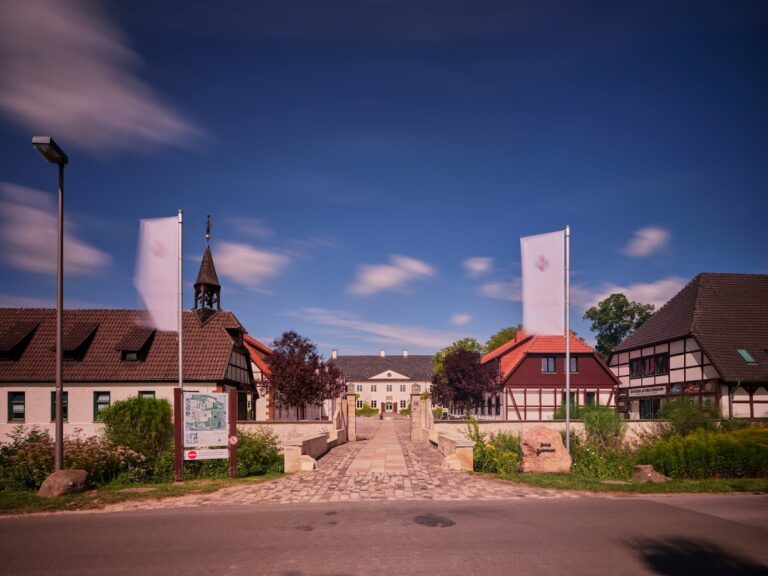
The former arrangement of the buildings can still be recognized across the site. During the 1969 test excavations, the dimensions of the complex were marked with erratic boulders. These markers remain visible in the area of the Heimatpark and Museumshof, helping define the earlier extent of the castle buildings.
Inscribed Lintel and Stabilized Ruin
In the early 1980s, members of the Rahden local-history society recovered an old stone door lintel from the ruin. Its inscription commemorates Duke Christian of Brunswick and Lüneburg, the 59th bishop of the Minden prince-bishopric, who lived from 1566 to 1633. The lintel was probably installed in the castle in 1619 and was later erected in front of the ruin.
The site survives as a ruin supported by twentieth-century stabilization measures. Steel girders and tension rods were inserted during the conservation work of the 1990s. The north wall remains visibly inclined to one side at the points where it meets the half-timbered supports, preserving a visible indication of the structure’s longstanding instability.