Burg Weißenburg: A Medieval Hilltop Castle in Germany
Site at a Glance
- Rating
- 4.5
- Popularity
- Low
- Country
- Germany
- Primary era
- Modern
- External website
- Open
- Eras represented
- Medieval, Early Modern, Modern
- Civilizations
- Holy Roman Empire
- Site type
- Domestic
- Remains
- Castle
On this page9 sections
History
Burg Weißenburg is a hilltop castle in Germany, located in Weißen, a district of Uhlstädt-Kirchhasel in Thuringia. The medieval complex stands on a rocky escarpment near the Saale and probably originated around 1248 during a division within the Weimar-Orlamünde comital dynasty, a medieval ruling house of central Germany. The former dynastic seat is certainly a thirteenth-century structure.
From comital seat to ducal fief
In 1344, the castle passed to Margrave Frederick II of Meissen. Count Henry IV of Orlamünde retained a lifelong right of residence under the terms of the sale. During the first half of the fifteenth century, successive owners altered the castle’s appearance and character. Ducal officials were followed by the Lords of Entzenberg, and around 1443 the Lords of Kochberg held Weißenburg as a fief, meaning property granted by a superior lord in return for service or allegiance.
Eucharius von Kochberg sold one half of the property in 1488. His brother Ernst sold the remaining half in 1501 to their relative Friedrich von Thun, also known as Friedrich von Thüna. Thüna was a respected adviser to Saxon electors and dukes. On 18 April 1521, he accompanied Martin Luther to the Diet of Worms, the imperial assembly at which Luther defended his religious views, and he was reportedly involved in arranging Luther’s removal to the Wartburg for protection.
The Thüna residence
During the Peasants’ Revolt of 1525, Georgius von Thüna, the last abbot of the Benedictine monastery at Saalfeld, fled to Weißenburg to his cousin. He died there two years later. Local tradition says that he died seated on his treasures in the deepest cellar.
In 1529, Friedrich von Thüna converted the old castle into a more comfortable residential palace. He died no later than 1535, after which the enlarged property passed to his sons. It remained in Thüna family hands for more than 150 years and was eventually administered jointly with the Lords of Lengefeld, who were vassals of the House of Schwarzburg.
The Lords of Lengefeld owned Weißenburg alone from 1707 to 1761, but debts forced them to sell it. Their departure ended the long succession of local noble families who had held the Weißenburg fief. Charlotte von Lengefeld, later the wife of the poet and dramatist Friedrich Schiller, remembered the former family property with nostalgia in a description of her childhood home at the Heißenhof in Rudolstadt.
Fire and reconstruction
Johann Wolfgang von Goethe visited Weißenburg repeatedly in July 1777, cared for three boys of the family there, and made drawings. In 1792, a major fire destroyed large parts of the old castle and the Thüna palace. Reconstruction began in 1796 and produced a complex broadly similar in form to the present one. The property had become a free hereditary fief in 1795, a form of hereditary tenure with fewer traditional feudal obligations. Its owners were then the administrators Breithaupt and Fränkel, followed around the turn of the nineteenth century by Baron von Elking.
State ownership and modern uses
The Saxon-Meiningen domain treasury, a state institution that administered the property and revenues of the ruling dynasty or state, acquired the estate in 1878. In 1881, the merchant Krüger bought the northeastern half of the palace grounds, including the villa, and added another story to it. The southwestern section became the seat of the Meiningen Reichenbach forestry office, later known as the Weißenburg senior forestry office and the Thuringian Weißenburg forestry office.
Baron Eduard von Derenthall, the Prussian envoy at the Weimar court, became owner of the palace in 1893. His widow leased it in 1927 to the Zwickau youth welfare office, which operated a children’s home there until 1932. A retraining home for unemployed girls was established in 1936. From 1941 to 1945, the antisemitic publicist Johann von Leers, a professor at the University of Jena who worked on behalf of the Nazi Party, lived at the castle with his family.
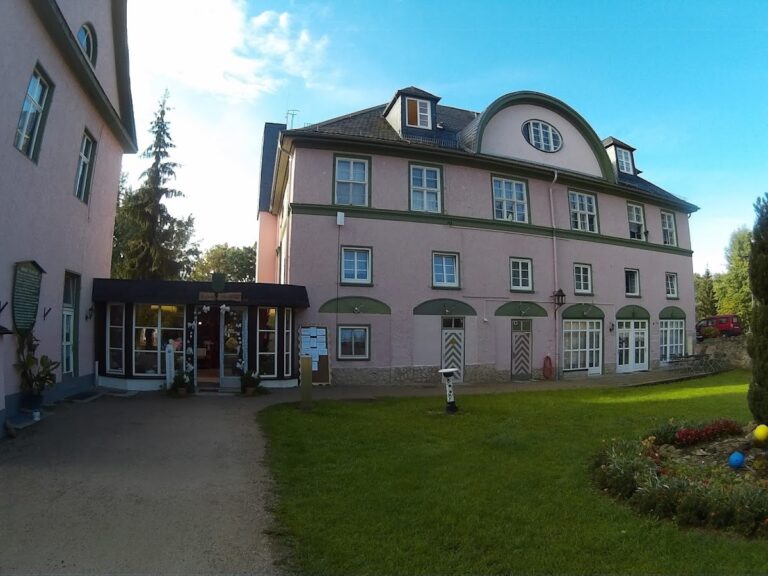
After the Second World War, Schloss Weißenburg and the neighboring Weißeneck estate became public property. The buildings first housed expellees and refugees. In 1946, the Rudolstadt district administration established a sanatorium for people with pulmonary diseases. After German reunification, the complex was privatized and a rehabilitation clinic for oncology and rheumatology was established. The addition of a modern interdisciplinary therapy center beside the historic castle enabled reconstruction work to begin. The former servants’ house now houses the Thuringian regional association of the German Rheumatism League. Burg Weißenburg is recognized as a cultural monument.
Remains
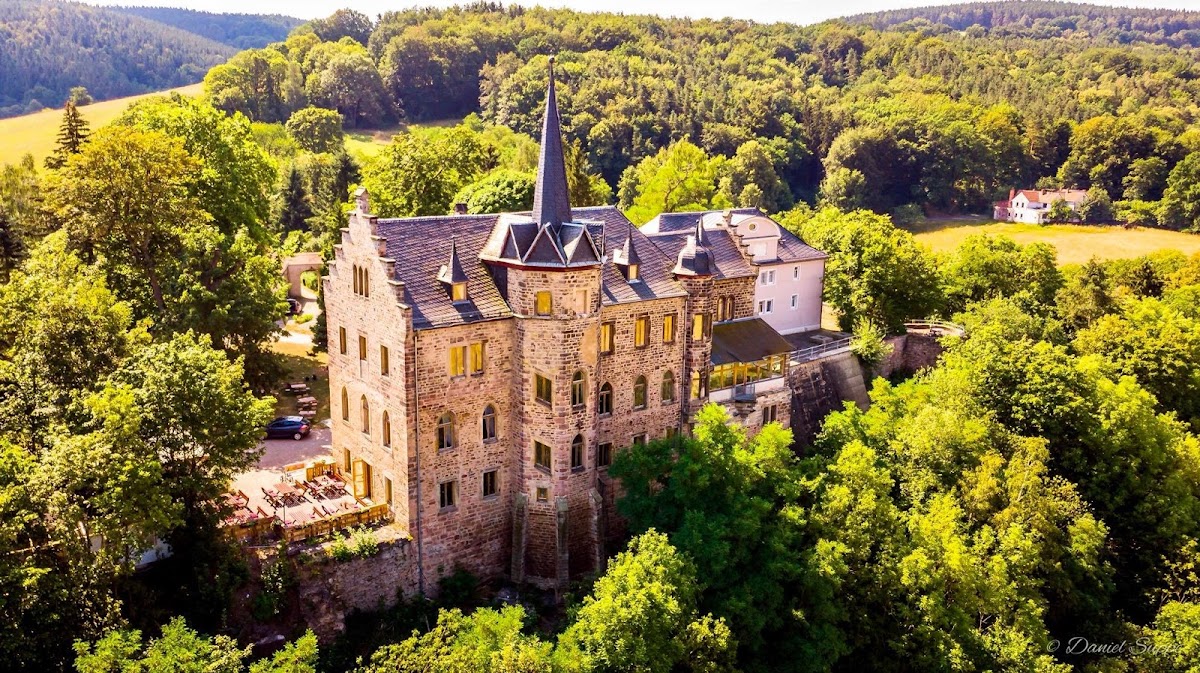
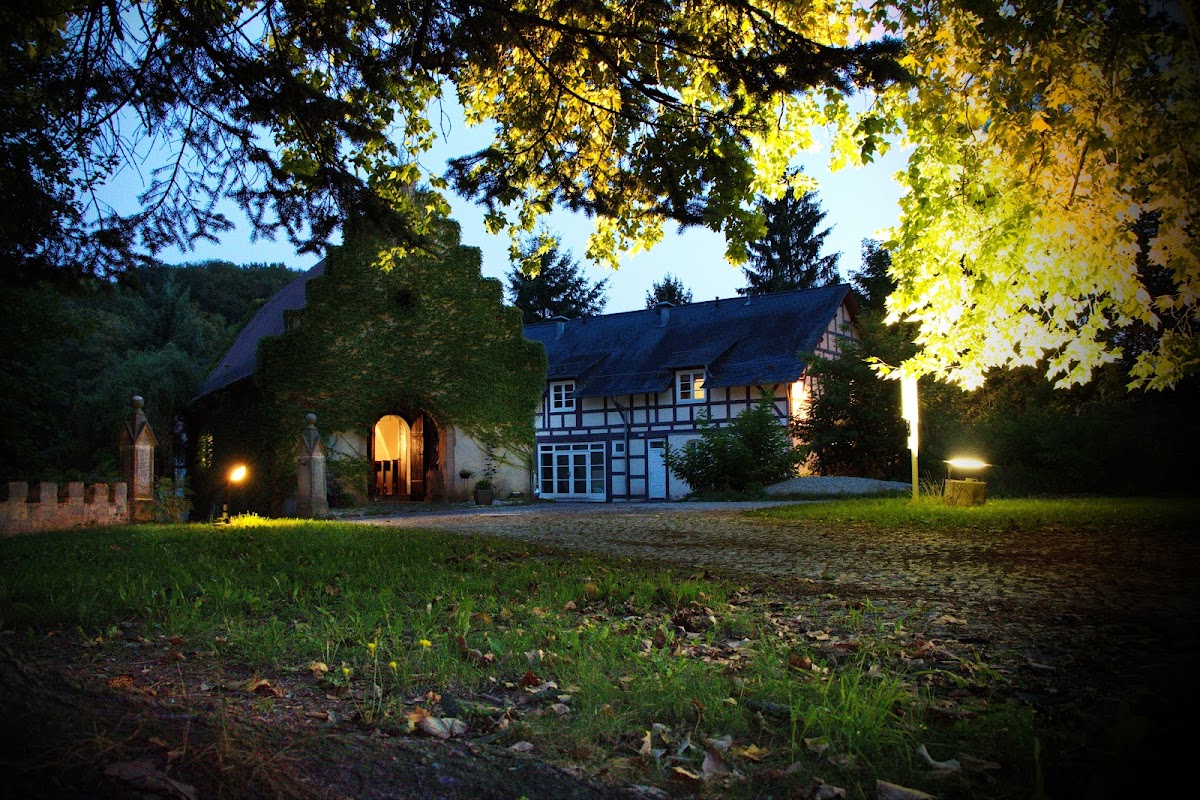
The surviving complex combines traces of the medieval fortification with the palace buildings shaped by the fire of 1792 and the reconstruction that followed. The earlier castle occupied the higher part of the present palace grounds, while the reconstructed buildings were arranged in two principal sections on the elevated southwestern area and along the foremost edge of the rocky plateau.
Medieval defenses
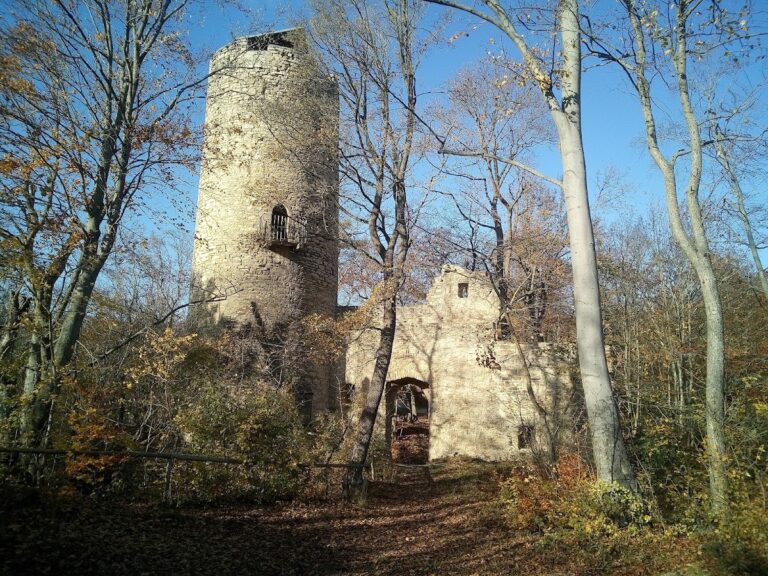
The medieval castle, known in its period as “Wizzenburgk,” was a castle-like complex with five towers. A steep drop toward the Saale protected its northern side. The other sides were defended by a rampart, a ditch, and a castle wall with a strong gate. Tower remains were still visible toward the end of the nineteenth century, and parts of the ditch and castle wall can still be recognized. The ground floor of the gate building survived the fire and later rebuilding, including its cross vaults, ceilings formed where two barrel vaults intersect. The lower part of the octagonal northern tower probably also belongs to the earlier castle.
Sandstone cellar installations
Extensive, branching cellar installations cut into the sandstone beneath the southwestern part of the complex are known as the “Schleiflöcher.” They may date from the period of the Orlamünde dynasty. These underground spaces preserve an early element of the site beneath the later residential buildings and are also associated with the local tradition concerning the death of Georgius von Thüna.
Reconstructed palace buildings
The rebuilding begun in 1796 created a two-story residential building in the elevated southwestern section and a larger palace building on the foremost edge of the rock plateau. The latter was initially lower than it is today. Later changes further shaped the grounds. Krüger’s northeastern villa received an additional story in 1881, while the southwestern section was adapted for forestry administration. The former servants’ house beside the castle continues in a later institutional use through the Thuringian branch of the German Rheumatism League.