Arta Castle: Medieval Citadel of Arta, Greece



Site at a Glance
- Rating
- 4.3
- Popularity
- Low
- Country
- Greece
- Primary era
- Medieval
- External website
- Open
- Eras represented
- Classical, Medieval, Early Modern, Modern
- Civilizations
- Ancient Greek, Byzantine, Ottoman, Venetian
- Site type
- Military
- Remains
- Castle
On this page13 sections
History
Arta Castle is a medieval fortification in Greece, developed on the site of the lower town of ancient Ambracia and traditionally dated to 1230. Its principal medieval construction is associated with the Despotate of Epirus, a Byzantine Greek state founded after the Fourth Crusade, when Arta served as its capital.
Ancient foundations and medieval development
The lower town of Ambracia had been abandoned after Nicopolis was founded nearby in 31 BC. The hill was later reoccupied, although the exact date of Arta’s return to the site is uncertain. Fortifications were apparently already present when a Norman army besieged Arta in 1082. The castle incorporates ancient construction or reused material from the fifth and fourth centuries BC, followed by major medieval work most probably undertaken under Michael II Komnenos Doukas, who ruled the Despotate of Epirus from 1230 to 1266/68.
As the citadel of the Epirote capital, Arta Castle became involved in repeated struggles among the Epirote state, the Byzantine Empire, the Angevin Kingdom of Naples, the Serbian Empire, Albanian rulers, and the Ottoman Empire. The Angevin kingdom, ruled by the Angevin dynasty, sought to expand in the Balkans and came into conflict with Epirus. The castle withstood sieges by Charles II of Anjou in 1303, Andronikos III Palaiologos during his reign from 1328 to 1341, and Liberakis Gerakaris in the seventeenth century.
Changing rulers
Byzantine forces captured Arta in 1338 or 1339, and the city soon passed under Serbian rule. Nikephoros II Orsini restored it to the Epirote state in 1356 or 1357, but Simeon Urosh ruled Arta after 1359. Peter Losha later established the Despotate of Arta. In 1416, after a long siege, Carlo I Tocco captured the city and re-established the Epirote state under his rule.
The Ottoman Empire conquered Arta in 1449 and retained it until 1717, apart from a Venetian occupation during the Morean War of 1684 to 1699. From 1717, Arta was a mainland dependency of the Venetian Ionian Islands. Following the fall of the Venetian Republic in 1797, the city came under French control before Ali Pasha conquered it two years later. Ali Pasha ruled from 1796 to 1820 and oversaw additions to the castle. Ottoman rule continued until Arta was annexed to the Kingdom of Greece in 1881.
Prison, residence, and modern interventions
During the Ottoman period, the castle served both as a prison and as the governor’s residence. Ioannis Makriyannis, one of the leaders of the Greek Revolution, was imprisoned there. Greek forces besieged Arta in November 1821, but the castle withstood that assault.
A hotel occupied part of the enclosure during the twentieth century. The construction of a Xenia hotel in the 1960s destroyed almost all of the archaeological remains inside the castle. Part of the site containing an open-air local theatre has been used for cultural events since 1987. Restoration, repairs, and limited conservation were carried out between 2011 and 2015, including the construction of paved paths. Arta Castle is recognized as an archaeological monument of Greece.
Remains
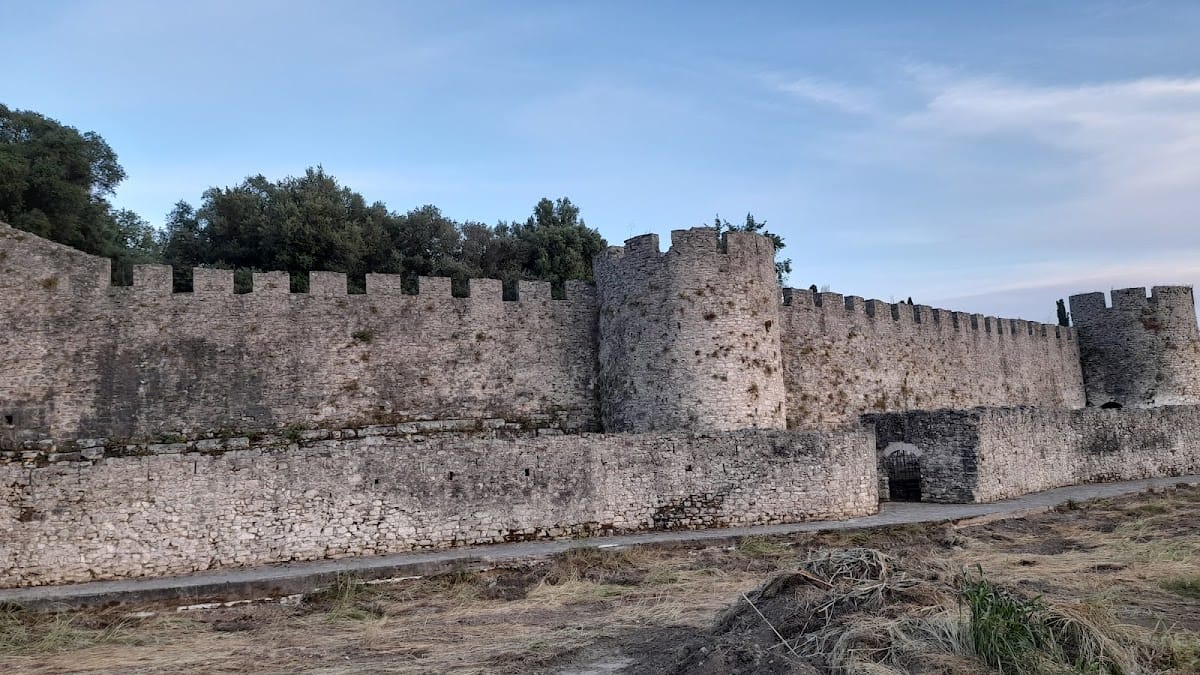
The castle occupies a low hill at the northeastern edge of Arta beside the Arachthos River. The river once ran directly alongside the fortification but now flows about 200 metres to the east. An irregular, roughly polygonal enclosure extends about 280 metres along a northeast to southwest axis and reaches up to 175 metres in width.
Walls and defensive system
Ancient eastern wall
On the eastern side, a single wall incorporates part of the ancient city wall of Ambracia. Ancient ashlar blocks, carefully shaped stone units, remain visible within this defensive line and show how the earlier urban site was reused in the castle’s construction.
Concentric walls
The other sides are protected by two enclosing walls. The inner wall rises approximately 10 metres and is strengthened by towers, while the outer wall, about 4 to 5 metres high, surrounds the towers of the inner circuit. The walls average roughly 2.5 metres in thickness. The inner wall survives intact, whereas the outer wall remains in isolated stretches.
Towers and artillery modifications
Eighteen towers were set at intervals of approximately 25 metres around the fortification. Their plans are semicircular, triangular, or polygonal. Ottoman and Venetian builders reinforced the defenses with numerous bastions, projecting structures that strengthened the walls and allowed fire along their faces. They also altered the towers and parapets to create artillery embrasures, openings through which cannons could be fired.
Inner castle and surviving buildings
Southwestern inner castle
An inner castle occupies the southwestern corner of the enclosure. Building remains in this area may indicate the location of a fifteenth-century palace belonging to the Komnenos Doukas family.
Byzantine church and palace evidence
Remains of a Byzantine-period church and another building may represent the palace and palace church of the Despots of Epirus. A monogram attributed to Michael II Komnenos Doukas was found in a tower near the main gate, linking that part of the fortification with the medieval ruling dynasty.
Clock tower
A high clock tower was added to the castle walls in 1875, becoming part of the later form of the fortification.