Sázava Monastery: A Benedictine Abbey in Bohemia
Site at a Glance
- Rating
- 4.6
- Popularity
- High
- Country
- Czechia
- Primary era
- Early Modern
- External website
- Open
- Eras represented
- Medieval, Early Modern, Modern
- Civilizations
- Austria-Hungary, Duchy of Bohemia, Habsburg, Holy Roman Empire, Kingdom of Bohemia
- Site type
- Religious
- Remains
- Monastery
On this page14 sections
History
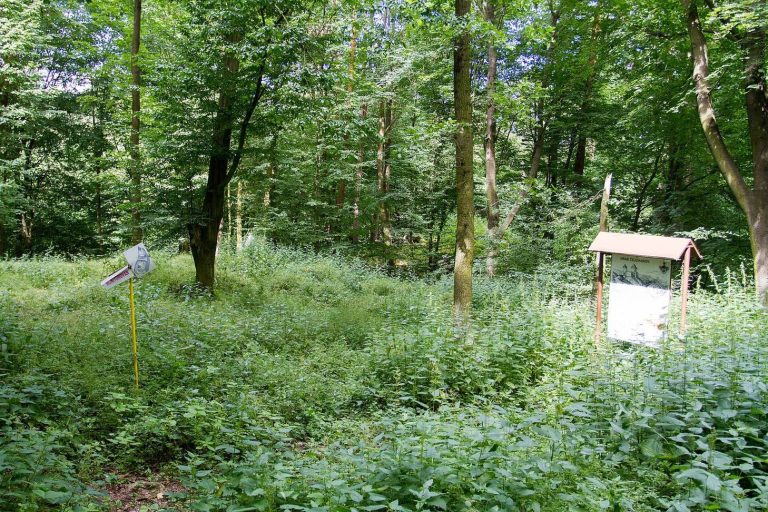
Sázava Monastery is a former Benedictine abbey on the right bank of the Sázava River in Sázava, Czechia. Its foundation is traditionally dated to 1032, and it became a leading center of Old Church Slavonic worship and religious writing in Bohemia. It is counted among the oldest Bohemian monasteries and is described as the fourth oldest.
Procopius and the Slavonic community
Around 1009, the Bohemian hermit Procopius settled in the woods beside the river and gathered followers. Accounts of the monastery’s beginnings differ. One credits Duke Břetislav I with confirming its foundation and making Procopius the first abbot, although Břetislav did not become ruler until 1035. A chronicle written at Sázava around 1170 instead tells how Duke Oldřich met Procopius while hunting and offered him the abbacy, which he declined. In this story, Procopius changed water into wine for his guest, and Oldřich granted the monks pasture and woodland along the river. The story may have helped support the abbey’s claims to its lands.
The community followed the Benedictine Rule, the code of monastic life used by the Order of Saint Benedict. Its monks initially celebrated the Roman rite, a tradition of Christian worship, in Old Church Slavonic, an early Slavic literary and liturgical language. Procopius died in 1053, and his nephew Vít succeeded him as abbot. In 1056, Duke Spytihněv II expelled the Slavonic monks, who went into exile in Hungary. When Duke Vratislaus II recalled Vít and the community in 1061, the monks returned and maintained their Slavonic tradition for about 35 years. During exile they made contacts with Kievan Rus, a medieval East Slavic polity, and brought relics of Boris and Gleb, early Christian princes revered as Russia’s first saints, to Bohemia.
Efforts to extend Slavonic worship beyond Sázava were unsuccessful. In 1080, Pope Gregory VII rejected Vratislaus II’s request to allow Slavonic services in the Prague diocese. Duke Břetislav II ordered the monks to leave in 1096. On 3 January 1097, Latin-rite Benedictines from Břevnov, a monastery in Prague, took control under Abbot Diethard. The Slavonic community ended, and Cosmas of Prague wrote that its books had been destroyed or scattered.
The Latin abbey and medieval pilgrimage
The Latin abbey continued to produce religious and historical writing. An unknown monk continued Cosmas of Prague’s chronicle in the second half of the twelfth century. From the twelfth to the early fifteenth century, the abbey’s lands extended from the Vltava River to areas south of Ledeč nad Sázavou, although its estate remained relatively small.
Procopius was canonized in 1204, making Sázava a pilgrimage destination and prompting extensive rebuilding and expansion. The canonization took place at Sázava on 4 July in the presence of Ottokar I, the first hereditary king of Bohemia.
Hussite attack and decline
In 1421, Hussite forces captured and sacked the monastery during the Hussite Wars, religious and political conflicts in the Bohemian lands. They expelled the monks, halting the abbey’s development. Sázava lost most of its property and did not regain its former position. It became dependent on Břevnov, whose superiors appointed administrators and, at times, abbots. Parts of the estate also passed into secular hands, including those of the Lords of Kunštát and Poděbrady. By the mid-sixteenth century, only a few monks remained.
In 1588, Archbishop Martin Medek of Müglitz had Procopius’s relics removed from the deteriorating monastery church and taken to Prague. Their removal brought pilgrimages to Sázava to an end.
Revival, dissolution, and modern history
A revival began in the seventeenth century. Abbots of Břevnov bought back former Sázava lands between 1663 and 1667, and the monastery was revived in 1664. Part of Procopius’s relics returned in 1669, followed by restoration and renewed pilgrimages. A major fire in 1746 led to further rebuilding. Emperor Joseph II’s reforms, which included the suppression of some monasteries, brought Sázava’s abbey to an end in 1785; the complex became a château.
From 1809, the estate passed through secular ownership. Wilhelm Tiegel of Lindenkrone acquired it first, followed by Johann Friedrich Neuberg in 1869 and Friedrich Schwarz in 1876. The Schwarz family retained the château until 1951. In 1932, part of the estate was sold to Benedictines from Emmaus Monastery in Prague, who hoped to establish a community at Sázava. The monk and priest Method Klement moved there in 1940 to prepare for the plan, but the Second World War and the communist regime prevented its completion. The site came under state management in 1951.
Excavations from the 1960s through the 1990s, including work by Ivan Borkovský and Petr Sommer, investigated the monastery’s history and buildings. An exhibition on Old Slavic Sázava opened in 1983. The site received cultural-monument protection in 1962 and national cultural monument status in 1998. The property returned to Marie Hayessová, an heir of the Schwarz family, in 2003, and the state purchased it in 2006. Under the 2013 church restitution law, parts were returned to the Roman Catholic parish of Černé Budy and to Emmaus Monastery. The National Heritage Institute is responsible for restoration and conservation.
Remains
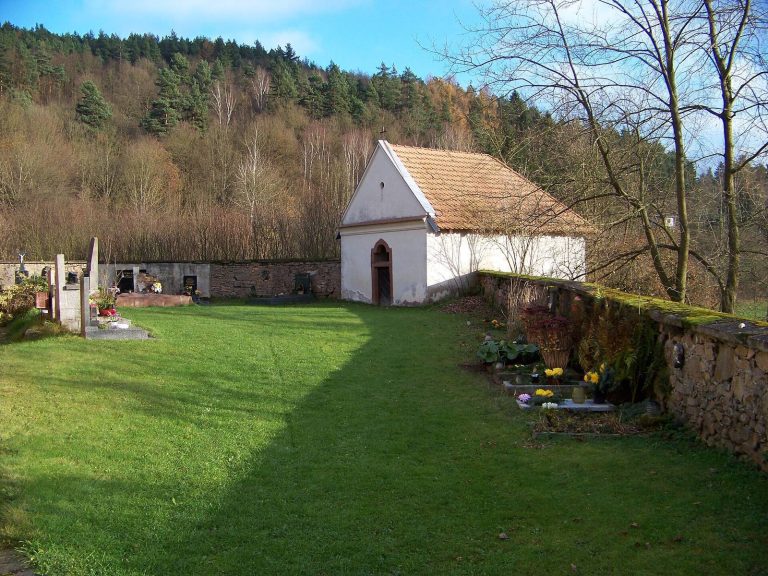
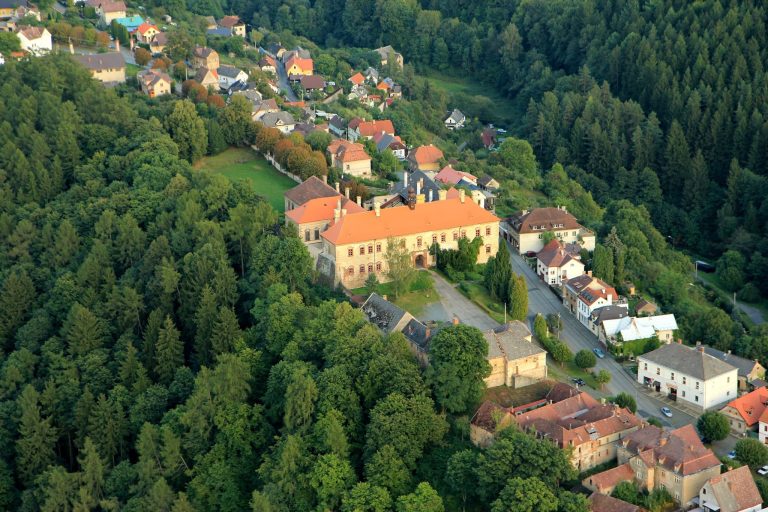
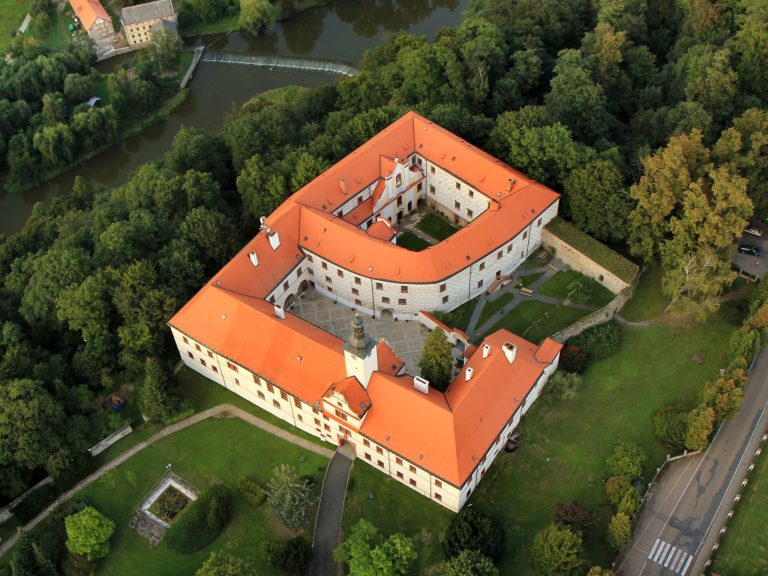
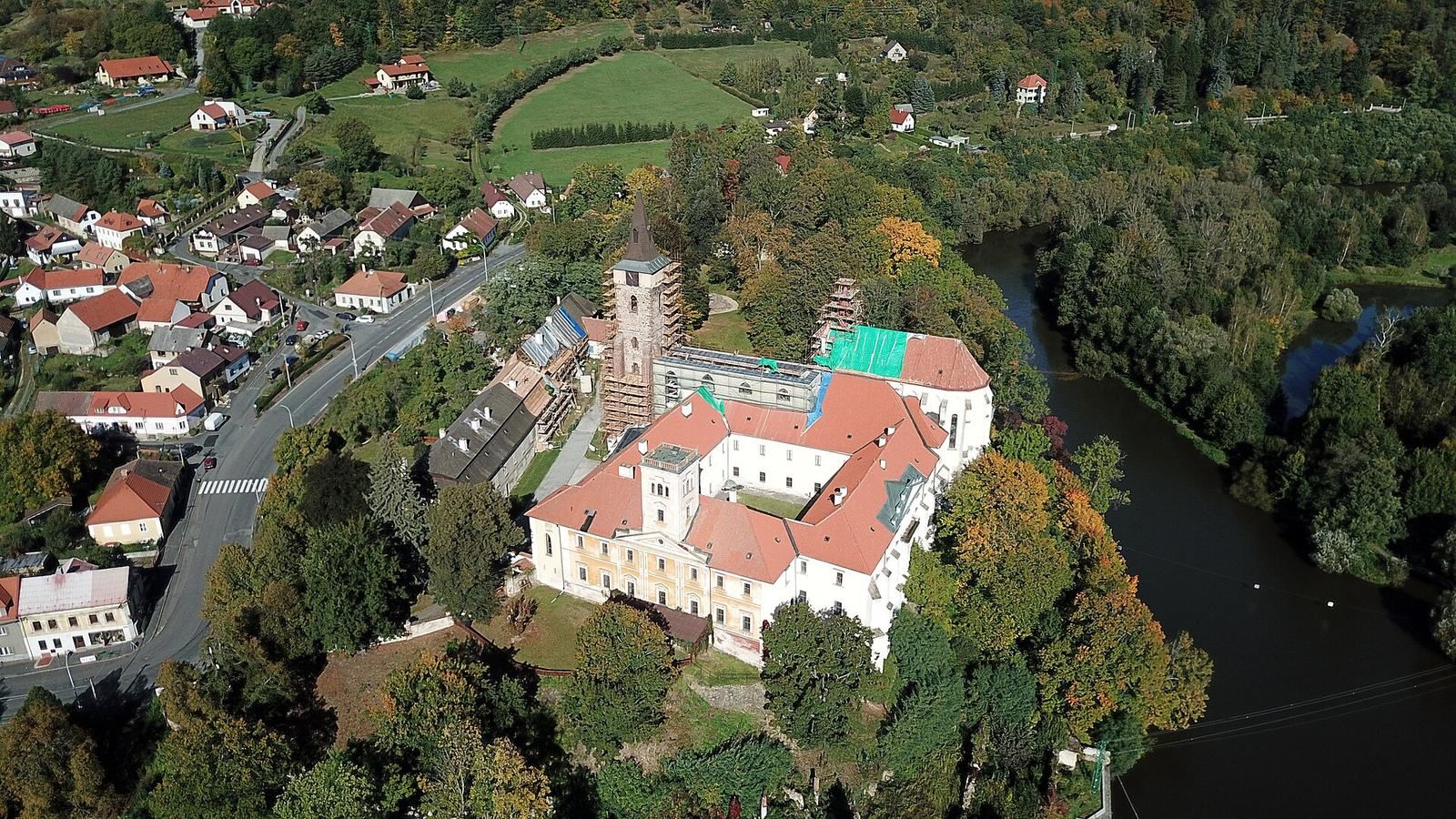
The monastery complex occupies the river’s right bank, and the town of Sázava developed around it. Its surviving buildings are principally Baroque, with nineteenth-century Neo-Renaissance additions and medieval Gothic remains. Archaeological evidence also reveals earlier wooden buildings, showing that the complex’s construction changed considerably over time.
Early churches and the Romanesque abbey
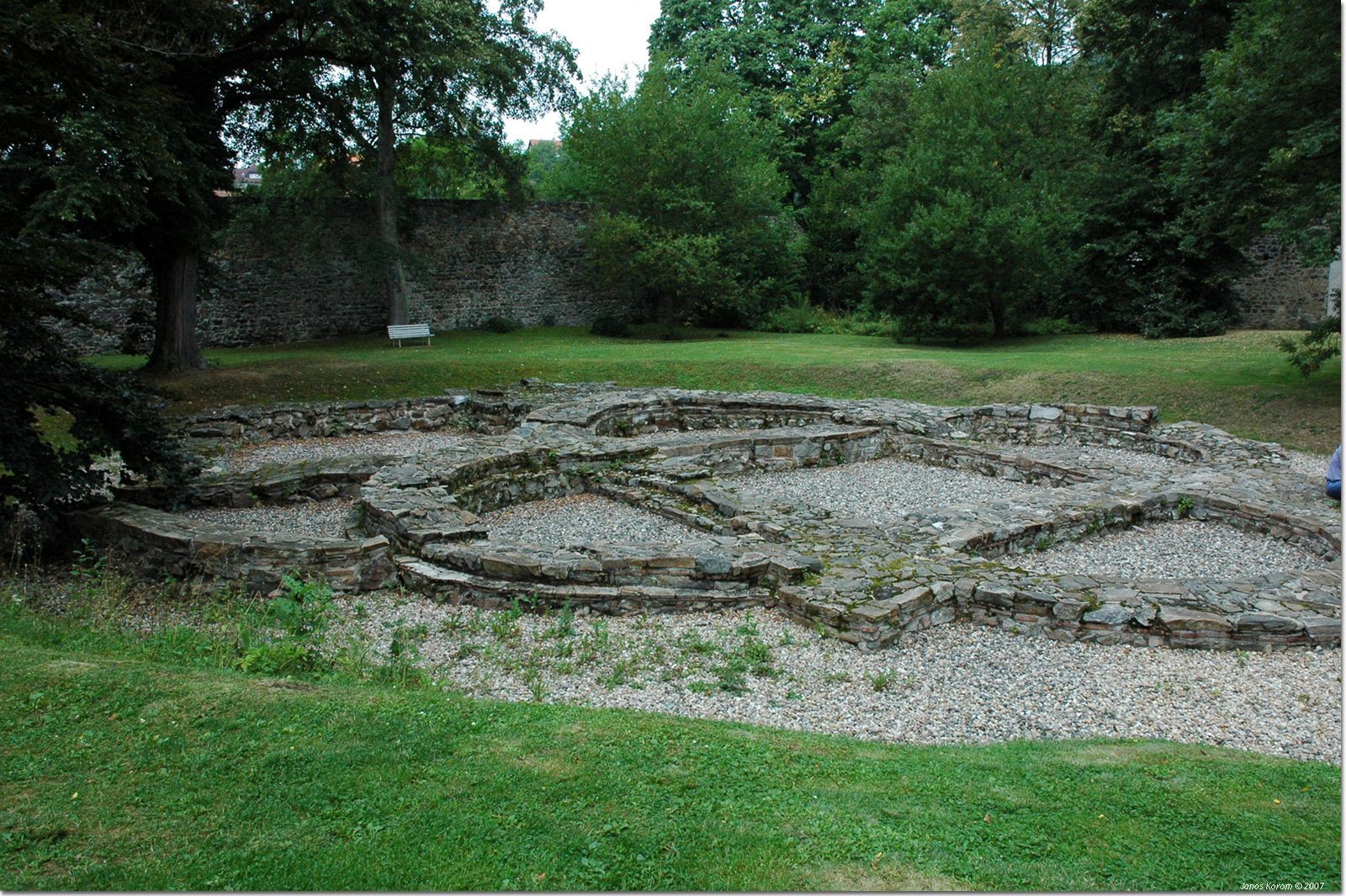
The earliest church and the first monks’ living quarters were built of wood. A stone Church of the Holy Cross, built around 1070 for a neighboring lay settlement, had a central plan shaped as a Greek cross. Its foundations belong to a tetraconch, a central building with four apses, and can be seen in the monastery garden, where they have been conserved. A Romanesque basilica, a long church with a central nave and side aisles, was begun under Božetěch, the last Slavonic abbot, and completed in the second half of the twelfth century. During the Latin period, the monks’ wooden living and service buildings were also replaced with stone structures.
Gothic buildings and decoration
Gothic construction, a medieval architectural style, took place at Sázava from about 1250 until the Hussite sack of 1421. The earlier work is attributed to the Augustinian building workshop at Roudnice nad Labem.
Chapter house
The chapter house, where the monastic community met, was built around 1340. Around 1370, artists associated with the circle of Emperor Charles IV painted its walls. The images include Mary pregnant with Jesus and Mary rebuking the child Jesus. Another fresco, the Madonna of Sázava, shows Mary walking beside Jesus at about five years of age.
Unfinished Gothic church
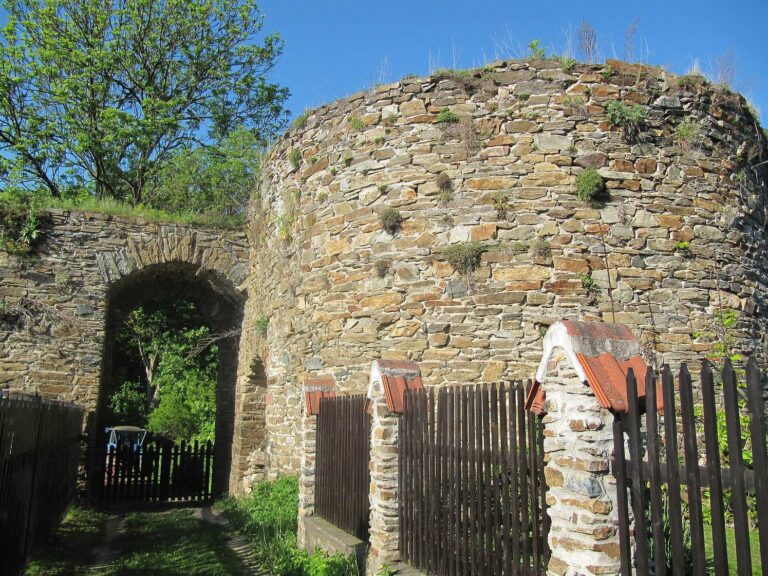
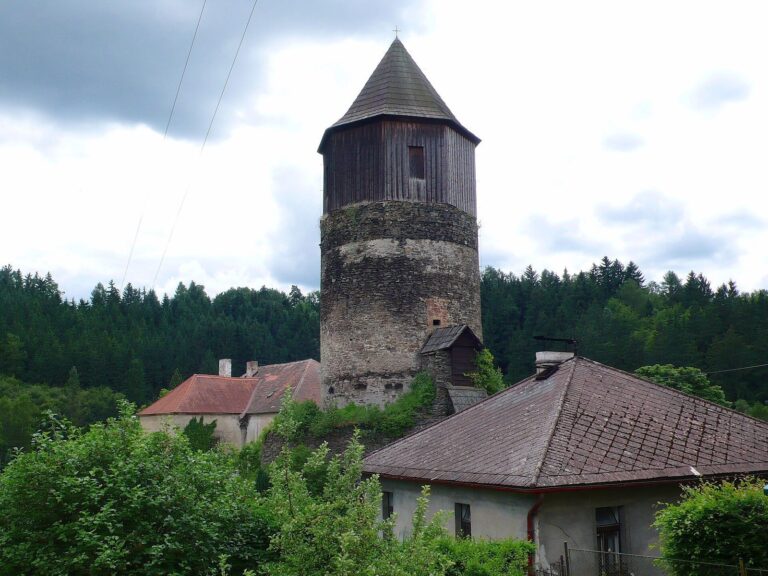
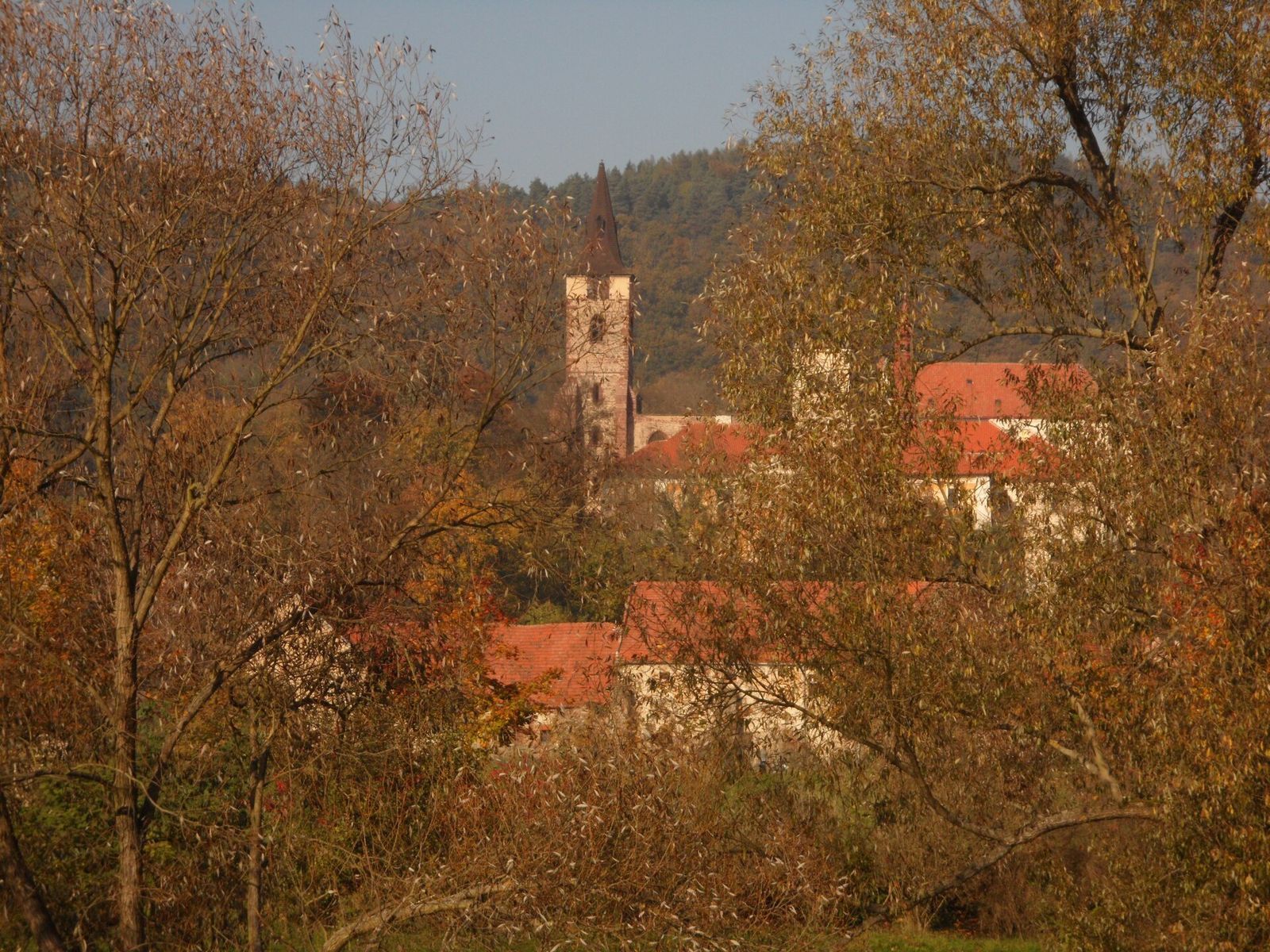
From about 1360, the architect Matthias of Arras directed plans to transform the monastery church into a large Gothic building dedicated to Mary and John the Baptist, also known as the unfinished Gothic Church of St Procopius. Designed as a three-aisled hall and built of red sandstone, it was never completed. Its 56-metre tower is joined to arcades planned for the hall. The southern arcade wall, a three-storey south tower, a choir with side chapels, and foundations for a vestibule were also completed. The exposed stone has weathered since the fourteenth century, and restoration began in 1997.
Baroque and later buildings
Church and refectory
The Church of St Procopius was remodelled between 1663 and 1687 in the Baroque style, an ornate European architectural style. Its interior includes an eighteenth-century altarpiece by painter Jan Petr Molitor and sculpture by Richard Prachner. Later, architect Kilian Ignaz Dientzenhofer directed a late Baroque remodelling of the church and refectory. Their surviving forms include the church façade and the refectory’s design.
Monastic enclosure and interior decoration
Around 1870, Jan F. von Neuburg adapted the monastic enclosure as a representative residence, adding a new façade and tower. Nineteenth-century work also introduced Neo-Renaissance features, a revival of Renaissance architectural forms. Investigation of the convent’s white-painted interior began in 2007. It revealed sections of Baroque wall decoration beneath the whitewash, as well as Gothic paintings dating to the time of Charles IV.
Manuscripts
Two surviving manuscripts are believed to have been produced at Sázava. The older part of the Reims Gospel comprises sixteen pages written in Cyrillic, an alphabet used for many Slavic languages. Charles IV presented it to Emmaus Monastery as a purported autograph by Procopius. It later became part of an elaborately decorated Gospel book, reached Reims in the sixteenth century, and was used by the last French kings at their coronations.
The Prague Glagolitic Fragments contain Passion songs and hymns written in Glagolitic, an early Slavic alphabet. The Vita Minor, the oldest legend of Procopius, survives in a Latin translation.