Spasskaya Tower: The Kremlin’s Ceremonial Gate in Moscow
Site at a Glance
- Popularity
- Very High
- Country
- Russia
- Primary era
- Medieval
- Eras represented
- Medieval, Early Modern, Modern
- Civilizations
- Russian
- Site type
- Military
- Remains
- Tower
On this page16 sections
History
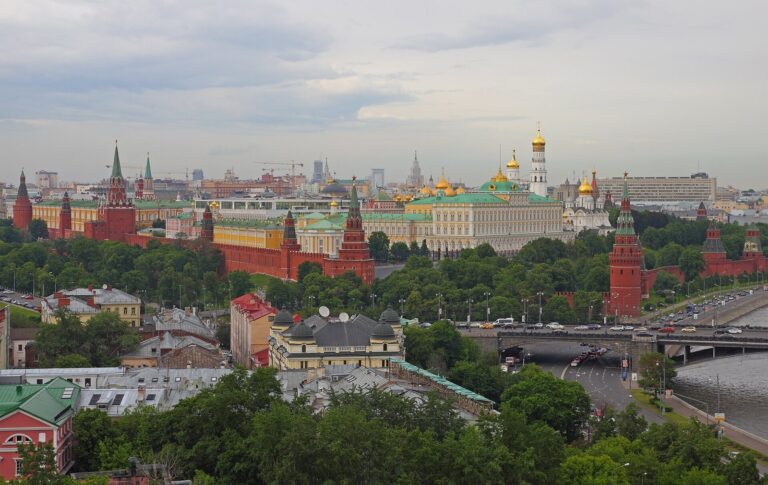
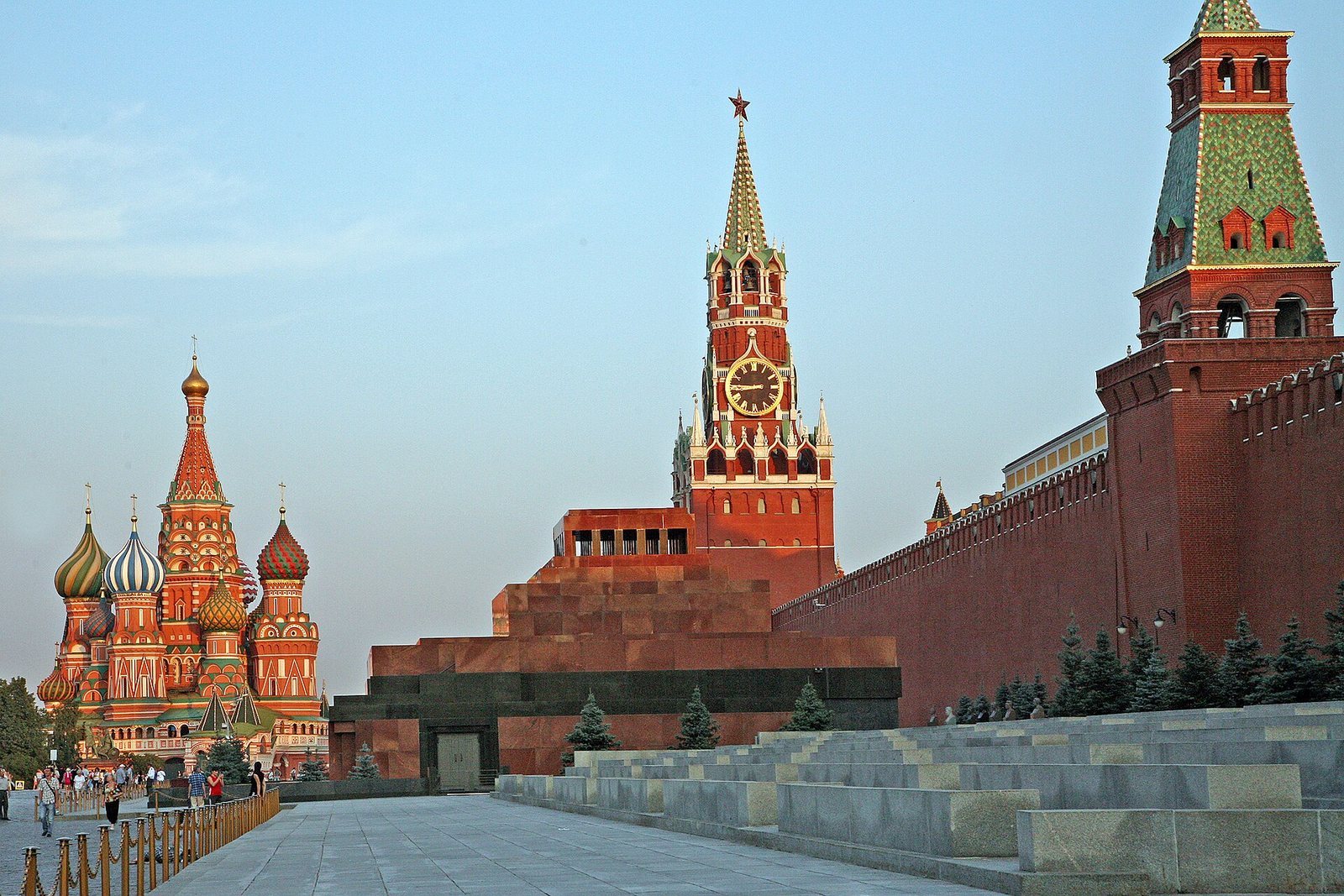
Spasskaya Tower is the eastern entrance tower of the Moscow Kremlin, facing Red Square in Moscow, Russia. Grand Prince Ivan III commissioned its construction in 1491 on or near the site of an earlier tower, with the work carried out by Italian architect Pietro Antonio Solari. A Gothic-style upper structure was added in the 1620s. The tower became the Kremlin’s principal ceremonial gateway, serving both state occasions and religious processions.
Early towers and Ivan III’s rebuilding
A white-stone tower called Frolovskaya stood in the eastern Kremlin during the reign of Dmitry Donskoy. In 1464–1466, Vasily Yermolin decorated it with reliefs of Saints George and Demetrius of Thessaloniki. A fire in Moscow in 1488 burned the wooden floors of its three fighting levels and a nearby cannon house.
Ivan III’s new tower replaced the earlier structure in 1491, either on its site or close by. The old tower’s name, Frolovskaya, and the variant Frololavrskaya referred to the Church of Saints Florus and Laurus, toward which the road through the gate led. The church was demolished during Ivan’s clearance of buildings near the fortress, which were considered a fire risk and an obstruction to entry. The gateway was also known for a time as the Jerusalem Gate, after a church dedicated to the Entry of the Lord into Jerusalem.
Names, ceremonies, and the Savior image
After the construction of the Aleviz Ditch and moat in 1508, a wooden drawbridge connected the gate to a guardhouse. Heavy use led to its replacement with an arched stone bridge, known as the Spassky Bridge. Prints were sold there, and people seeking alms gathered at its approaches. The bridge and ditch were later removed as the entrance area was altered.
The gateway had a sacred as well as a civic role. Riders were prohibited from passing through it, and men were expected to uncover their heads before the image of the Savior. A decree in 1648 formalized the rule and prescribed fifty prostrations for disobedience. A popular belief held that the Latin inscription above the gate cursed anyone who passed wearing a hat. Water-blessing ceremonies and religious processions also took place nearby.
Tradition links the name Spassky, meaning “of the Savior,” to an icon brought from Vyatka. On 12 July 1645, the coronation day of Tsar Alexei Mikhailovich, a blind man named Pyotr Palkin was said to have regained his sight while praying before an image of the Savior Not Made by Hands. The image reached Moscow in a procession on 14 January 1647. Alexei, his family, and Patriarch Joseph received it at the Yauza Gate, then carried it through the Frolov Gate to the Assumption Cathedral. A decree of 17 May 1658 made Spassky the official name of the gate; the tower later took the same name.
The origin of the gate’s religious images remains uncertain. One tradition says that, during the Crimean Khan Mehmed I Giray’s invasion in 1521, a nun saw a procession leaving the Kremlin. After the khan withdrew, images of the Savior and the Virgin were painted on the tower’s eastern and western sides. The story became associated with an annual procession on 21 May in the Julian calendar. The images may instead date from the seventeenth century, perhaps following the plague of 1654–1655.
Spasskaya Gate received foreign envoys and military regiments, as well as Russian rulers entering for coronations from the reign of Mikhail Fedorovich onward. Ivan IV passed through it after the capture of Kazan, while Marina Mniszech, the wife of False Dmitry I, left the Kremlin by this route. Palm Sunday processions used the gate, with the route covered in red cloth and decorated with willow branches. Miraculous icons brought from across the country were received there. A nearby petition box, where people could appeal to the sovereign, was removed on Peter I’s orders.
Rebuilding and repair in the seventeenth and eighteenth centuries
In 1624–1625, or possibly 1626, Scottish architect Christopher Galloway and Russian master builder Bazhen Ogurtsov added a multi-tiered Gothic-style upper structure. By order of Tsar Mikhail Fedorovich, stone statues on the tower were covered. They were reportedly badly burned and removed in 1628, though another chronology associates their damage with the fire of 1654, which also affected the upper structure and clock. The tower and clock were subsequently repaired.
An inventory made in 1667 described serious damage to the tower and adjoining wall, including displaced masonry, unstable supports and railings, damaged roofs, leaks, and cracks. Repairs followed. Simon Ushakov’s 1668 icon depicts the Kremlin in red, while written references to whitewashing the buildings begin in 1680.
In the early eighteenth century, Peter I ordered surveys and new defenses as Russia fought Sweden in the Great Northern War. Timber fortifications were placed beside the tower, and a stone guardhouse with a gallery was built against its rear wall. Duties on beards were collected at the gate during Peter’s reign. In 1706, a clock ordered from the Netherlands replaced the older one; it followed the German style and had a twelve-hour dial. After the imperial court moved to St Petersburg, Kremlin buildings gradually deteriorated.
The Trinity Fire of 1737 burned the tower’s wooden gates, shutters, roofs, and floors. Falling bells broke through its vaults. Empress Elizabeth ordered repairs, including renewal of the Savior image above the gate, and the damaged clock was replaced in 1770.
Nineteenth-century alterations
Two stone chapels were built symmetrically beside the gate in 1802–1803. During the reconstruction, workers added a portal with Corinthian columns and removed the gate’s portcullises and the bastions built in Peter’s time. The Aleviz Ditch was filled in and the Spassky Bridge dismantled; remaining bridge structures were cleared in 1816–1819. A guardhouse and clockmaker’s residence stood on the Kremlin side of the tower.
During the French occupation of Moscow in 1812, Napoleon ordered preparations to defend the Kremlin, and the gate was blocked with earth and logs. French troops planned to blow up the fortress as they withdrew, but the tower was defused and escaped damage. The chapels, damaged during the occupation, were rebuilt on raised stone platforms.
Repairs continued through the nineteenth century. Ivan Mironovsky directed work in the 1820s and 1830s; the tower was painted light pearl in 1824, its oak gate shutters were replaced in 1831, and new keys bearing Nicholas I’s monogram were made in 1833. The keys were transferred to the Armoury in 1887. In 1851–1852, clockmakers Nikolai and Ivan Butenop built a new mechanism using some older parts.
A wider Kremlin restoration began in 1861. In 1862, artist Jean-Baptiste Artari restored the gate icons and repainted walls and vaults using surviving fragments. Work in 1866–1868 removed the early nineteenth-century portal and sloping roof, changed the outwork’s roofline, restored the tower’s red color, and replaced the chapels with new buildings designed by Pyotr Gerasimov.
Revolution, war, and conservation
Artillery fire during the armed uprising of 1917 badly damaged the gate, chapels, and clock. Architect Nikolai Markovnikov directed the tower’s reconstruction. The chapels were restored in 1921 under Ilya Bondarenko, I. V. Pylsky, and A. A. Latkov, then dismantled around 1925–1929. In 1935, the tower’s two-headed eagle was replaced by a five-pointed star bearing the hammer and sickle. Designed from Fyodor Fedorovsky’s sketches and decorated with Ural gems, it gave way in 1937 to an illuminated ruby-glass star. That year, the exterior Smolensk Savior image was plastered over.
During the Second World War, the star was extinguished and covered with wooden shields. White stripes were painted on the gate to help drivers navigate at night, and Kremlin buildings were camouflaged. The camouflage was removed for the 7 November 1941 parade. A bomb exploded between the Spasskaya and Nabatnaya towers in March 1942, causing only minor damage; the camouflage was removed in April 1945.
After the war, a copper roof resembling tile was made for the spire, although its installation may have taken place about twenty years later. Major works in 1973 restored white-stone decoration and decayed elements, and reinforced cracked walls and vaults with steel ties and reinforced concrete. The tower is part of the Moscow Kremlin, which entered the UNESCO World Heritage List in 1990, and is also designated a Russian cultural heritage site of federal importance.
The Smolensk Savior image was uncovered and restored in 2010, and a protective frame with anti-glare glass and ventilation was installed the following year. Repairs in 2014–2015 renewed the star’s glass, restored the clock faces, and conserved the masonry and white-stone elements. The image on the tower’s western side was restored in 2023 and consecrated by Patriarch Kirill. Since a 1999 decision, the gate has been closed to ordinary traffic, although it remains in use for selected official occasions, including presidential inaugurations and Victory Day parades.
Remains
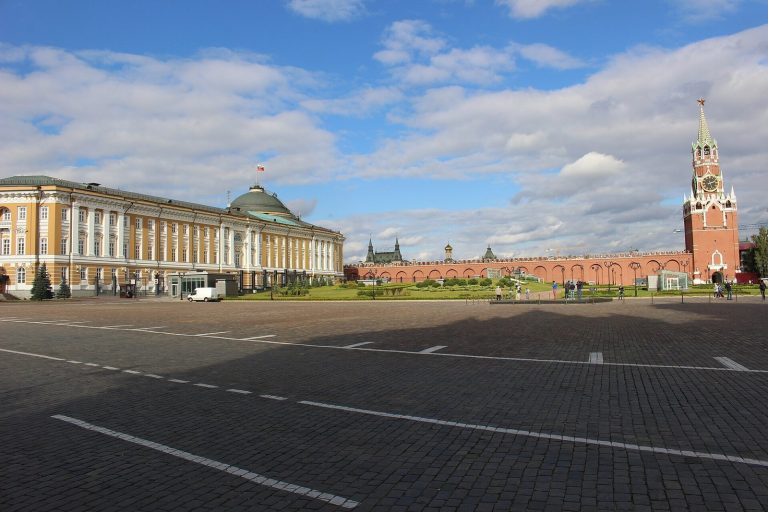
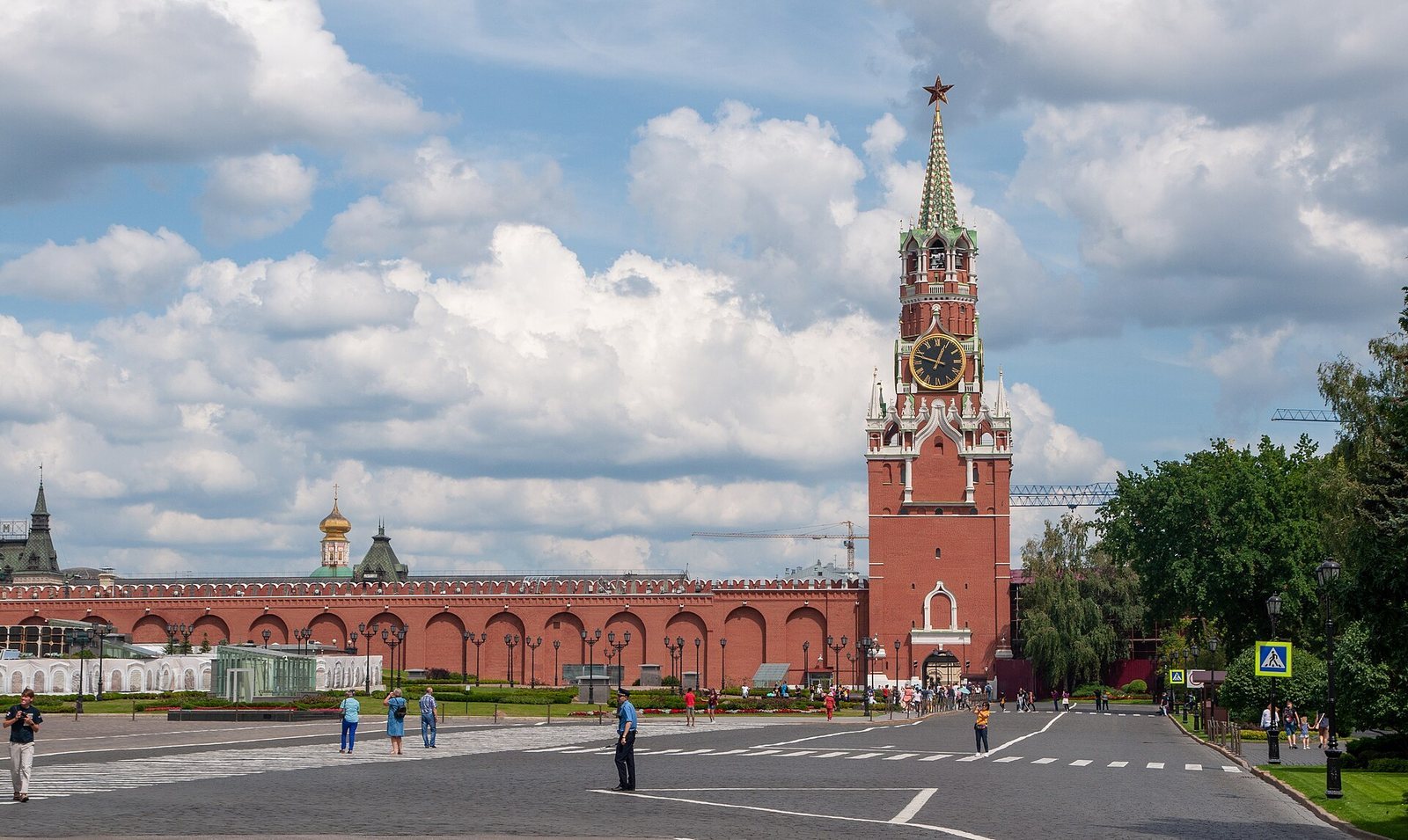
The tower forms part of the Kremlin’s eastern wall, opposite Red Square. It is built of heavy red brick, with shaped brick used for the base and architectural details. The structure reaches 71 metres with its star and 67.3 metres without it. Its double walls are linked by stone supports and contain passage galleries, stone and wooden stairs, and routes for soldiers within the thickness of the masonry.
Tower and entrance defenses
The tower’s structure
The lower tower is an elongated rectangle. Near the top of each face, seven semicircular window frames sit above a white-stone band, with elongated windows higher up. Pointed Gothic-style pediments facing Red Square and the Kremlin interior rest on Doric columns, a plain classical column form.
A row of arches crowns the lower section. Its white-stone decoration includes small turrets, carved columns, gables, battlements, shell forms, and rosettes. Stone lions and bears hold flagpoles topped with balls, while gilded weather vanes rise from white-stone corner pyramids. Above this lower mass, the clock occupies a square stage, topped by an eight-sided structure with arches, columns, and railings. The roof above has Gothic-shaped openings divided by paired columns.
The gate and outwork
The entrance is protected by an outer barbican, an outwork guarding a gateway, with two side bastions in its earlier defensive arrangement. The rectangular outwork is narrower than the lower tower and has battlements along its top and raised vertical strips at the corners. An iron portcullis, a gate lowered vertically across a passage, could trap an attacker inside. Defenders could fire from a second-storey gallery through openings in the battlements. The iron gate shutters were painted with gold-colored floral designs.
White-stone plaques above the gateway carry the 1491 commemorative inscriptions, in Latin on the exterior and Old East Slavic on the interior. A damaged copy is displayed outside the gate, while the original Latin plaque is held by the Moscow Kremlin Museums. A gallery linking the Spasskaya and Nabatnaya towers was later filled with stone cannonballs.
Clock, bells, and star
The clock and its chimes
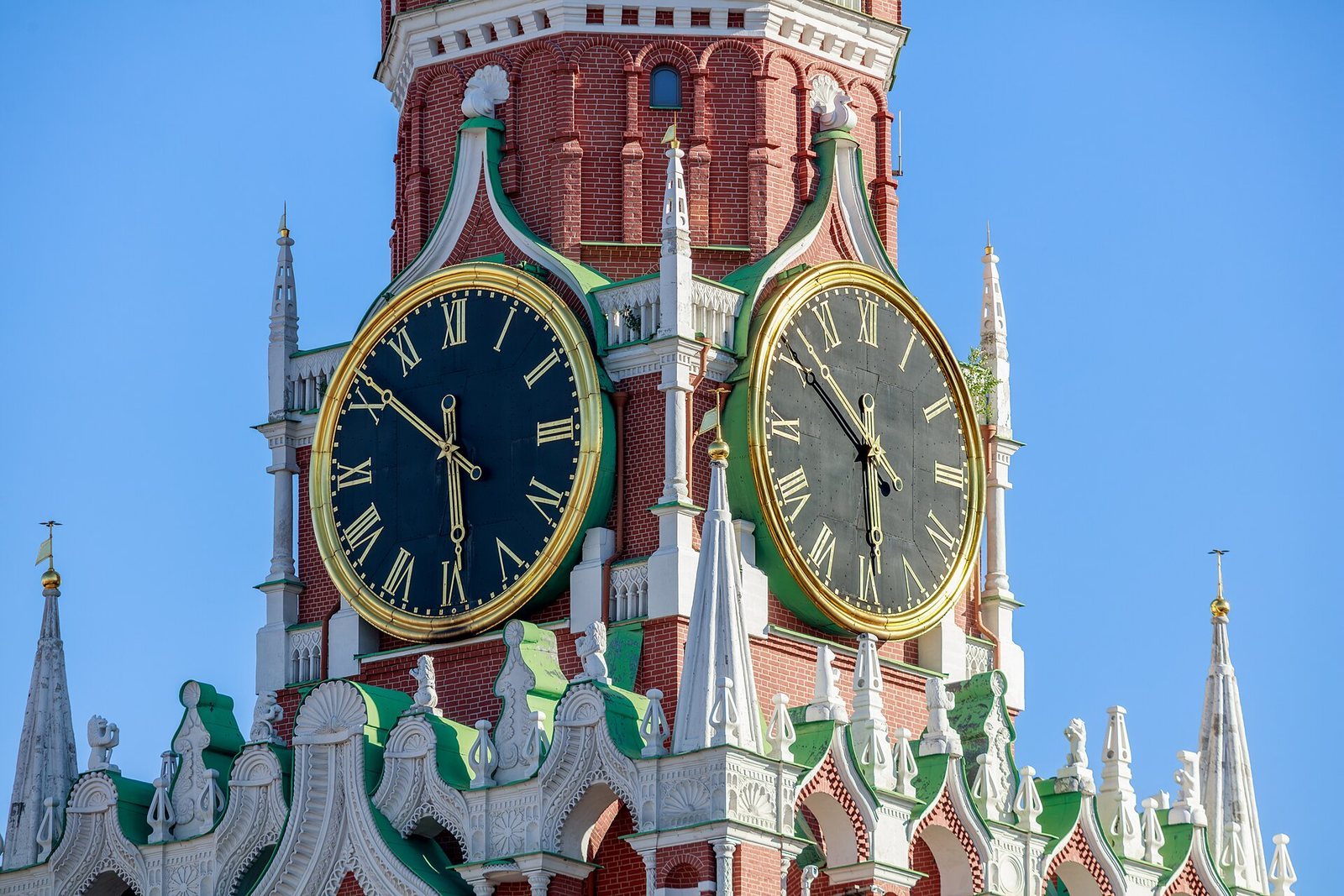
Four clock faces point toward the cardinal directions. Each is 6.12 metres across, with Roman numerals 0.72 metres high; the hour hand is 2.97 metres long and the minute hand 3.27 metres. The rims, numerals, and hands are gilded. The mechanism weighs about 25 tonnes and occupies the tower’s tenth storey. The clock’s installation date is uncertain: it may have been present in 1491, but the first clockmakers appear in records only in the sixteenth century. Its time signals were used by the city’s church bells.
Peter I’s 1706 clock had a twelve-hour dial. In 1851–1852, the Butenop brothers made a replacement mechanism, reusing some older components and installing it across the eighth to tenth storeys. The clock’s musical program changed over time. In the nineteenth century it played the Preobrazhensky Regiment March at six and twelve, and Dmitry Bortnyansky’s hymn “How Glorious Is Our Lord in Zion” at three and nine. After repairs in 1918, it played “The Internationale” at noon and “You Fell as Victims” at midnight, with its chimes broadcast by radio. From 1938 it struck only the hours and quarters. Following later changes, it played the Russian national anthem after the 1999 restoration; the anthem was officially adopted in 2000.
The bell chamber held 13 bells at the start of 2020, while historical evidence indicates that as many as 35 had been used at different times. At the beginning of the 1999 reconstruction, the quarter-striking mechanism was connected to nine bells weighing more than 300 kilograms each, along with a separate hour bell weighing more than two tonnes. The chimes were temporarily stopped in October 2020 while twelve newly cast bells were added, and the expanded set sounded on 4 November.
The tower’s star
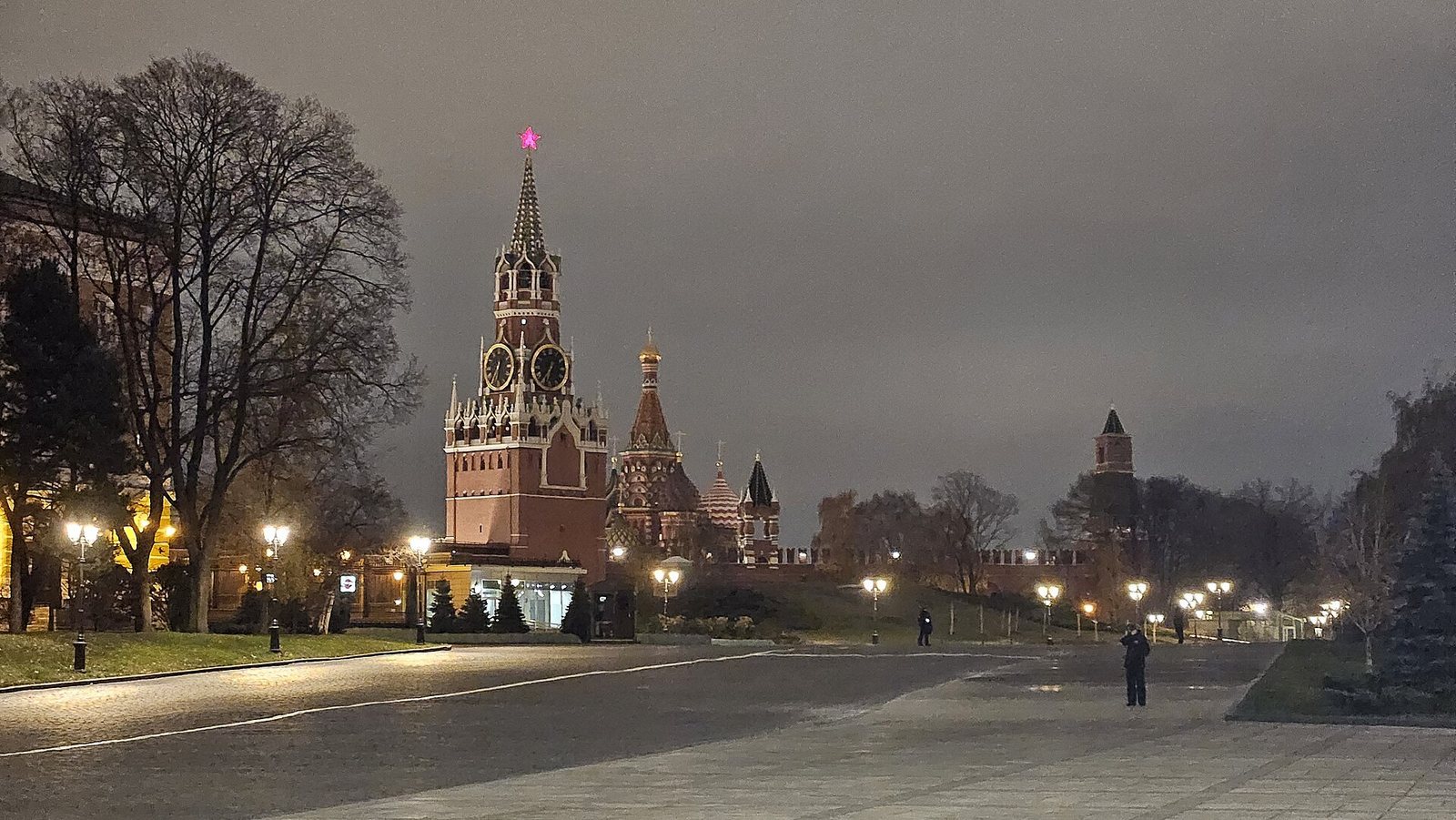
Two-headed eagles crowned the tower from the sixteenth century; the earliest may have been wooden, while later versions were made of gilded copper. The last eagle was installed in 1912. The current ruby-glass star can rotate, and its rays span 3.75 metres. Autonomous lamps inside it illuminate at five kilowatts each. Its predecessor, the 1935 star decorated with Ural gems, weighed about one tonne and had rays 4.5 metres apart.
Gate icons
The eastern Smolensk Savior
Above the eastern gate, the Smolensk Savior depicts Christ standing with an open Gospel, with Saints Sergius of Radonezh and Varlaam of Khutyn at his feet. A metal canopy, stone frame, and glass covering were added over time. The image was renewed after the 1737 fire and restored in 1851, 1866, and 1896. Conservation revealed painted layers from different periods, including a tempera layer from the first half of the eighteenth century and parts of a nineteenth-century repainting. The painted surface survived to about 80 percent; conservators retained its gilding and retouched losses with watercolor and acrylic.
Images above the western gate
Images above the western gate include the Savior Not Made by Hands and the Pechersk Mother of God, shown with Saints Peter and Alexius. The Mother of God image may have been painted at the same time as the Smolensk Savior. The Savior image brought from Vyatka in 1647 was placed in the Novospassky Monastery; a copy went to Khlynov, and another was painted for the gate under the direction of Armoury painter Ivan Filatovich Yaroslavtsev. By the eighteenth century, the gate images had a copper canopy, framed setting, lantern, and ever-burning lamp. The Pechersk image shows the Virgin seated with the Christ Child, flanked by Saints Peter and Alexius.