Biblioteca Malatestiana: A Renaissance Library in Cesena
Site at a Glance
- Popularity
- High
- Country
- Italy
- Primary era
- Medieval
- Eras represented
- Medieval, Modern
- Civilizations
- Italian, Papal States
- Site type
- Civic
- Remains
- Library
On this page20 sections
History
The Biblioteca Malatestiana is a Renaissance library in Cesena, Italy, built for the city’s Franciscan friary between 1447 and 1452 under architect Matteo Nuti. It opened on 15 August 1454 as a civic institution shaped by humanism, the Renaissance movement emphasizing classical learning and texts. Its design drew on Michelozzo’s library at the convent of San Marco in Florence.
Foundation and civic governance
The friary already had a study center and a modest book collection when the Franciscans sought a larger library around 1440. A papal bull, a formal document issued by a pope, authorized the use of a charitable bequest for the project in 1445. Domenico Malatesta, known as Malatesta Novello, led the undertaking and paid for the reading hall after the city council had been reluctant to support his projects. In a second bull in 1450, Novello promised books worth 500 florins.
The library was intended for scholars and intellectuals, but it was managed as a civic institution rather than as the private property of either the friars or Novello’s family. In 1461 Novello placed its administration in the hands of the city’s governing bodies. Twelve municipal elders, serving in rotation every two months, were responsible for keeping the catalogue up to date. Novello also required a trained librarian, usually selected from the friars, and specified that the post be paid. Francesco da Figline was in office by 1461. An annual income of 100 gold ducats came from a debt owed by Venice, after Novello transferred the Cervia saltworks to the city. His will in 1464 confirmed public management; he died the following year.
The collection grew through commissions, purchases, gifts and bequests. In 1458 Novello and his wife, Violante Malatesta, persuaded Cardinal Bessarion to give Cesena a group of manuscripts he had commissioned around 1450. Seven were choirbooks intended for a Franciscan convent in Constantinople, a plan Bessarion abandoned after the Ottoman conquest of the city. In 1474 the library received 119 manuscripts from the estate of physician Giovanni di Marco, who had served the Malatesta brothers and Pope Sixtus IV. Scholars and patrons, including Francesco Filelfo, also contributed books.
Custody and disputes
Responsibility for the collection was divided between the city and the Franciscans, who kept separate keys to the library. After Cesena returned to papal rule, Pope Paul II issued protection in 1466, threatening excommunication for anyone who tried to remove books. Two manuscripts nevertheless disappeared in 1496. The librarian, Friar Evangelista, was dismissed and replaced by Master Utino, but the missing volumes were not recovered. In 1532 the bishop of Verona, Gian Matteo Giberti, borrowed a work by John Chrysostom only after depositing 1,000 ducats as security.
Disagreement over control sharpened around 1671, when the friars withheld one of the keys. The dispute carried into the early eighteenth century and ended with the city prevailing. The library thus remained subject to both religious and municipal oversight, even as its books and administration became closely connected with Cesena’s civic institutions.
Disruption and return
French occupation and the suppression of religious orders put the library and its collection at risk from 1797. The books were confiscated and entrusted to local writer Niccolò II Masini della Massa, who gathered them at the former San Tobia hospital with books taken from other religious institutions. A proposal he made in 1798 for a separate national library there was rejected. Two early printed books, Ortographia and Cosmographia dictionum, were taken by the French, probably in September 1797 or September 1798; the Jacobin government provided seventeenth-century copies in compensation.
From February 1798 the Franciscans were pressed to leave their convent for troops. The library’s books were moved first to San Filippo church and then to upper rooms in the Filippini dormitory, where librarian Serafino Zanotti inventoried the collection and recovered the four keys. In November 1798 French forces took over the convent, church and library. The church and reading hall served as dormitories, while the refectory was used as a stable. The collection survived this period of military occupation.
In 1801 the municipal authorities began plans to reopen educational institutions and return the library to its former site. Architect Leandro Marconi inspected the deteriorated convent and proposed repairs and alterations, but lack of funds delayed the work. The books returned from San Tobia to renovated convent rooms in February 1807, and the historic collection was placed back in the Aula del Nuti. The libraries were inaugurated that year, although records give two possible dates, 26 April and 15 August. A separate municipal collection, assembled partly from confiscated books and private gifts, developed alongside the historic one.
The suppression of religious orders in 1810 brought further book confiscations. The city’s return to papal rule after the Napoleonic period did not restore the friars to their convent, which passed under public jurisdiction. The library’s activities also broadened beyond books: later collections and archaeological material joined its holdings.
Public access and the changing convent
The two libraries remained socially restricted until 1868–69, when they became public in the modern sense. The municipal collection grew through books taken from religious corporations suppressed by the new Italian state, as well as private donations. In 1870 officials counted 17,385 usable items after removing duplicates and books considered unfit for use. Major gifts included 1,327 medical books from Teodoro Cavallotti in 1873 and about 8,000 items from physician Maurizio Bufalini in 1875.
A separate collection assembled by Pope Pius VII, a native of Cesena, became known as the Biblioteca Piana. Pius had left it to the Benedictine abbey of Santa Maria del Monte for the Chiaramonti family, which retained legal ownership. The Italian state took the books in 1866 and entrusted them to Cesena’s municipality. After a legal dispute lasting decades, the state purchased the collection in December 1941 for the library.
The convent precinct changed substantially during the nineteenth century. Its bell tower was demolished in 1807 and the church’s sacristy in 1824. Part of the convent was adapted for classrooms from 1837; a classical secondary school occupied them from 1860. The church itself was demolished between 1842 and 1844. In the late nineteenth century the municipal library moved into the former friars’ dormitory to reverse structural alterations associated with Marconi’s plans. It returned to the former convent in 1926.
Conservation and modern organization
In the 1920s director Manlio Dazzi began work to make the Aula’s original humanist arrangement more legible. His successor, Augusto Campana, extended the work to the room opposite, which houses the Piana collection. Both the historic and municipal libraries survived the Second World War intact.
In 1980 the municipality began reorganizing and expanding the library. The historic library, the Piana and Comandini collections, Risorgimento materials related to the nineteenth-century movement for Italian unification, and choirbooks were grouped in a conservation and research department. Other restored convent rooms became an information and public-reading department, with open-shelf books arranged by the Dewey Decimal Classification system and a children’s collection. These departments opened in 1983. The library later joined a regional bibliographic network connected to Italy’s National Library Service.
UNESCO entered the Malatestiana in its Memory of the World Register, a program recognizing documentary heritage, in 2005. It was the first Italian cultural property to receive that recognition. The historic library is also noted for being the only humanist-Renaissance library of its kind to have survived intact to the present. A separate count in 2019 recorded 561,746 items across the library’s holdings.
Remains
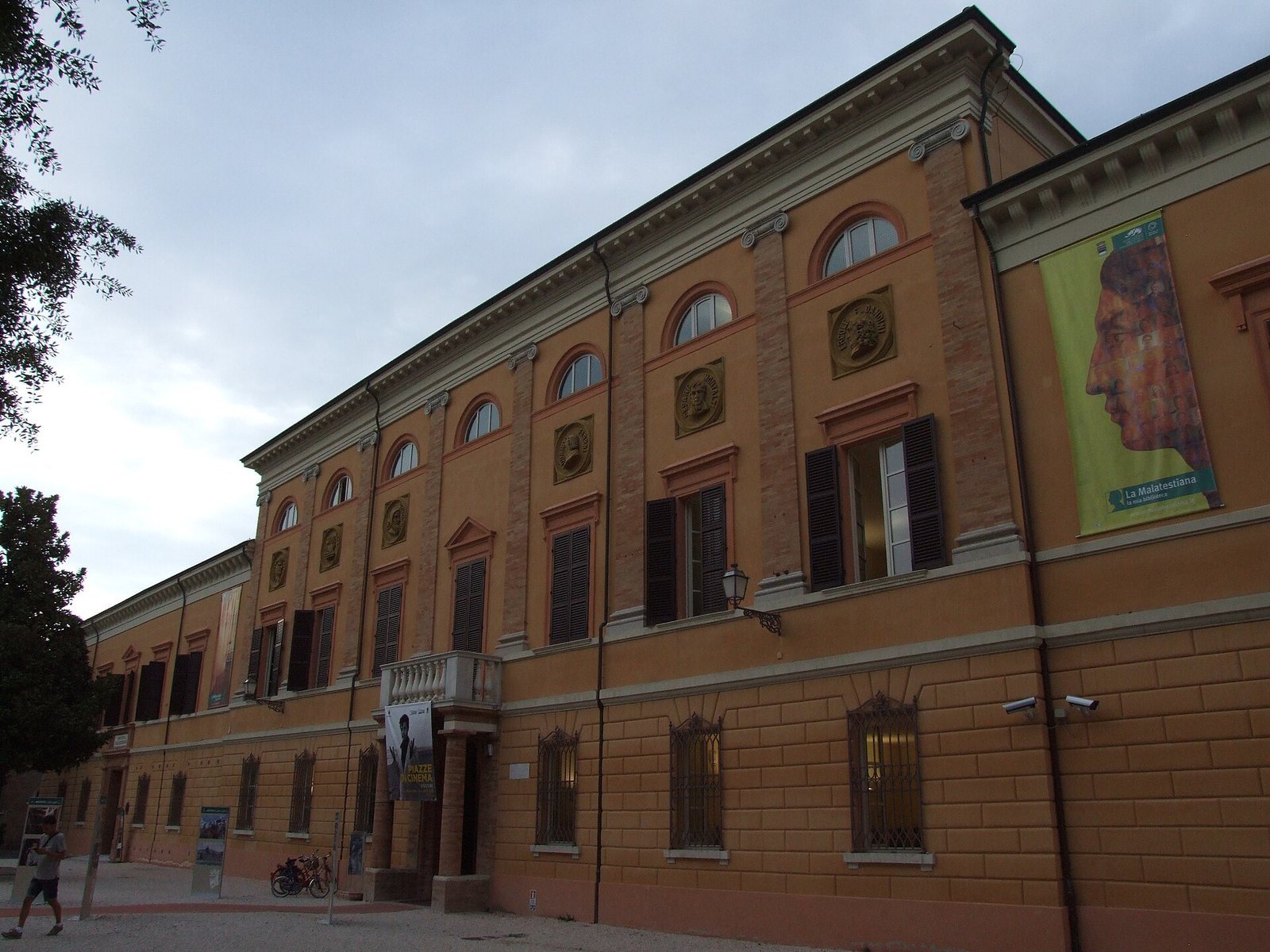
The library occupies part of the former Franciscan convent on the north side of Piazza Bufalini, within Cesena’s historic center. The precinct extends between Via Montalti to the west, private buildings to the east and part of the convent’s second cloister to the north. Buildings on its eastern side incorporate the former apse of San Francesco church, while the square covers the church site. The library’s brick exterior has a rose-shaped opening in its end wall, small pointed-arch windows along its sides and a ceramic cornice. Inside, corridors and stairs link the entrance area, the upper-floor Aula del Nuti, the Biblioteca Piana opposite it and other rooms.
Library rooms
The Aula and Biblioteca Piana
A vestibule separates the Aula del Nuti from the rectangular Biblioteca Piana. The Aula is a long, three-aisled hall, while the Piana occupies the room directly opposite. The Sala Lignea, off the first-floor corridor, received early twentieth-century paneling in an eighteenth-century style and served as a reading room until 1983. Its decorative cornices are original pieces, restored from the late 1990s and returned to their places in 2006. The corridor was restored in 2015.
The Aula del Nuti
Plan and natural light
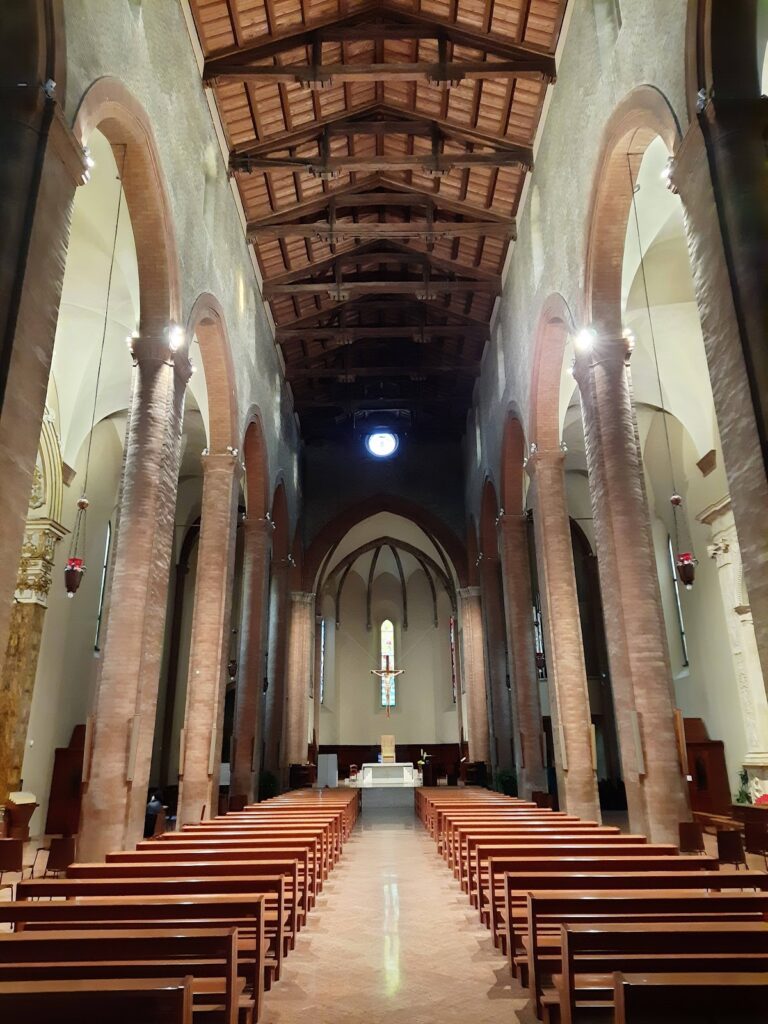
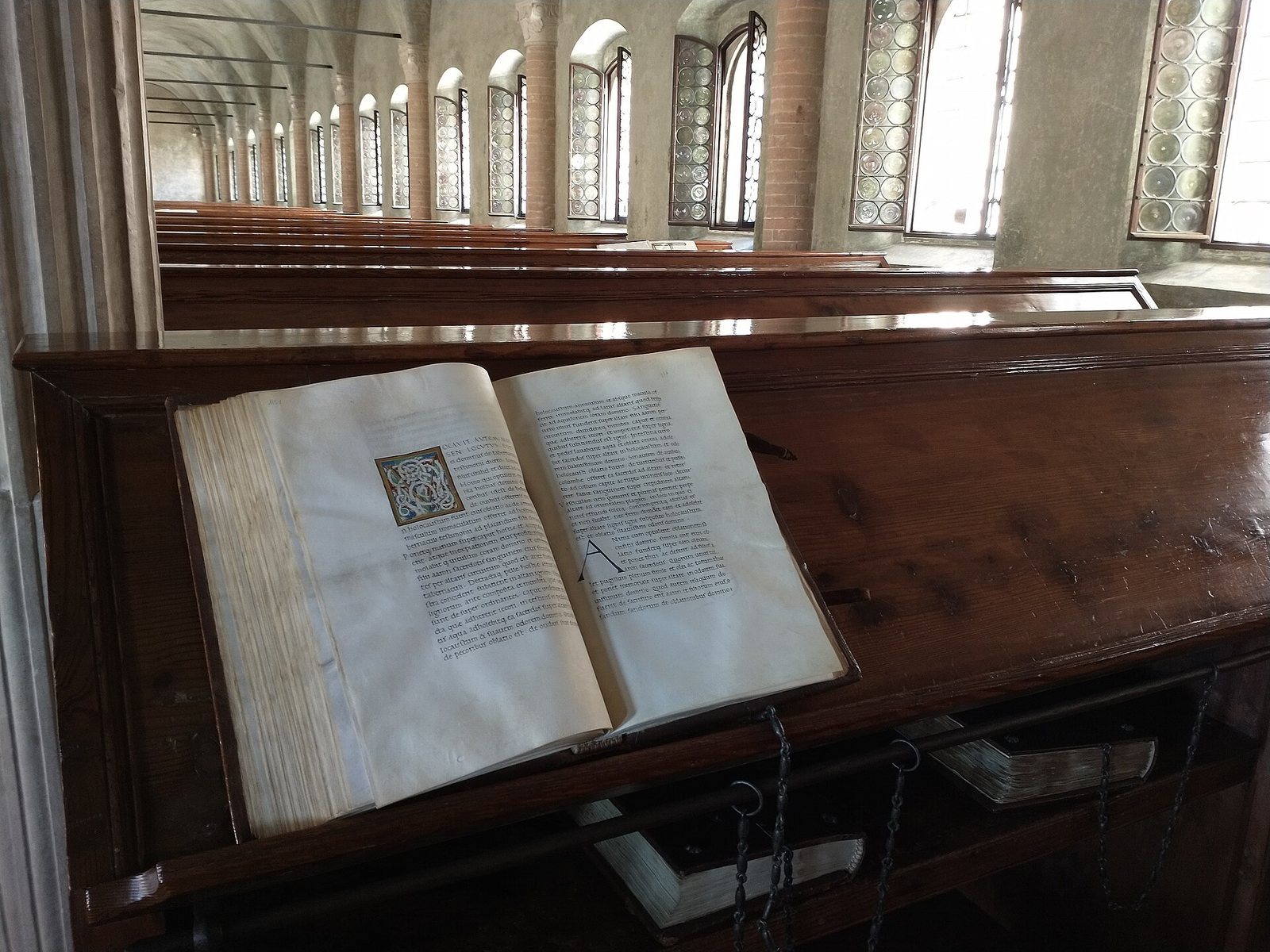
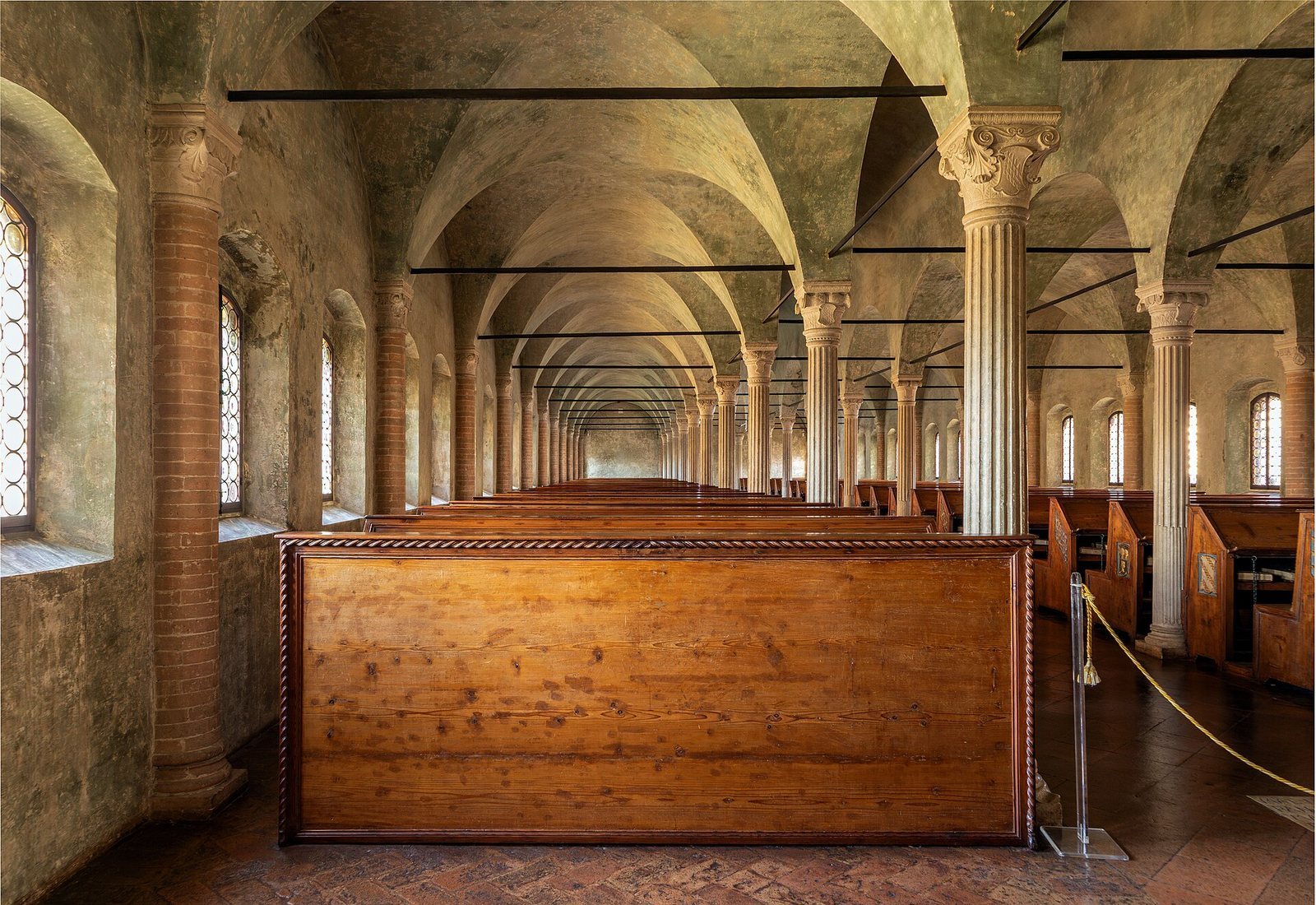
The Aula measures 40.85 metres long and 10.40 metres wide. Limestone columns divide the rectangular hall into three aisles, with a narrower central aisle beneath a barrel-shaped vault and side aisles beneath intersecting cross-vaults. Each column has a distinct capital and connects by an arch to a brick wall support; eleven arched bays run along each side. Foundations found by chance suggest that twelve bays may have been planned. A local tradition links the shorter hall to the wreck of a ship carrying manuscripts from the East, which supposedly reduced the need for space.
Twenty-two pairs of pointed-arch windows provide light along the sides, and a rose window lights the end of the central aisle. Their placement was intended to spread daylight through the hall and reduce reliance on candles. The stated color scheme combines white columns and ceilings, green walls, and red brick supports and terracotta flooring. The green has faded over time, and the colors correspond to those of the Malatesta lordship.
Entrance portal and door
The stone entrance portal has a lintel measuring 2.336 by 1.550 metres and fluted half-pillars with capitals loosely modeled on the Ionic style. An elephant, the Malatesta emblem, appears with the Latin motto Elephas Indus culices non timet, meaning “The Indian elephant does not fear mosquitoes.” A larger elephant device framed by eight Malatesta coats of arms crowns the pediment. An inscription beside the entrance honors Nuti; a possible contribution by Renaissance architect Leon Battista Alberti remains conjectural. The portal is also attributed to sculptor Agostino di Duccio.
Cristoforo da San Giovanni completed the dark walnut entrance door in August 1454. Its two leaves contain 24 panels apiece, 44 of them decorated with rounded or Gothic designs. The Malatesta family’s heraldic grille, three-head emblem and chequerboard pattern recur on the capitals and reading furniture.
Lecterns and memorials
Fifty-eight pine lecterns stand in the side aisles, 29 on each side. Each combines a sloping reading desk and seat with a shelf below for a manuscript. Chains attached to the books connect to horizontal wrought-iron bars, securing the volumes and keeping them in their assigned order. Malatesta emblems decorate the lecterns, while stone panels in the central aisle commemorate Novello’s patronage. His tombstone lies beneath the rose window; it was moved there after San Francesco church was demolished in the mid-nineteenth century.
The Aula retains its original arrangement and fittings. Its design brings together a humanist library layout and the form of a religious building, and it became a model for monastic libraries in Milan, Perugia and Parma.
Manuscripts and printed books
Manuscripts commissioned for Novello
Novello commissioned 126 manuscripts, produced in a workshop established at Cesena that brought together scribes, binders and illuminators from across Europe. Many were made from goatskin, with folded sheets sewn using bovine sinew and attached to beechwood boards. Their goatskin covers often have nine raised bosses on the front and five on the back, with designs impressed into the leather. The decoration ranges from restrained ornament to miniatures, with white vine-scroll patterns sometimes picked out in red. Red, green and gold also echo Malatesta heraldry. Italian hands often use a linear, classical script, while French, Dutch and German examples tend toward Gothic forms.
The historic collection includes a thirteenth-century Bible with fine miniatures, legal works of Bolognese origin and manuscripts by Church Fathers, Greek authors in translation, classical writers and scientific authors. A legal manuscript known as the Pandects contains a compilation of Roman law, and its successive stages of illumination can be traced. Greek holdings include Homer’s Odyssey, dialogues and the Republic of Plato, and two works by Demosthenes. The only work in the vernacular is Fazio degli Uberti’s fourteenth-century Dittamondo.
Other historic manuscripts and early printed books
The oldest manuscript is Isidore of Seville’s Etymologiae, copied in the ninth century and brought to Cesena, perhaps in the early fourteenth century. This twenty-book encyclopedia includes catechetical texts, annotations and later additions. The collection’s most lavishly decorated volume is Augustine’s De Civitate Dei, which opens with an image of the saint in his study. Other notable works include a copy of Boethius from around 1400 illuminated by Michelino da Besozzo, a fourteenth-century Parisian Bible and Roberto Valturio’s Res militares, a gift from Sigismondo Pandolfo Malatesta.
The collection includes seven books printed before 1501. Six were printed in Venice, among them De evangelica preparatione, De honore mulierum and Sententiae; two plays, Historia Baetica and Fernandus servatus, are bound together. The seventh, Pronosticon dialogale, was printed at Cesena in 1495. Its eight leaves in Gothic script imagine a discussion of a planetary alignment in 1484. Later holdings include books printed in Bologna, Venice, Cesena, Paris and Lyon, including a Cesena edition of De gelidi potus abusu from 1587 with a woodcut title page. Most seventeenth-century printed books were bound in Cesena by the Neri publishing house, and the eighteenth-century collection includes works by mathematician Giuseppe Verzaglia.
The Biblioteca Piana and liturgical books
The Biblioteca Piana contains about 5,000 printed books from the fifteenth to nineteenth centuries and about 100 manuscripts. Its holdings include 69 valuable manuscripts given to Pope Pius VII by the Lepri family and seven surviving volumes from Bessarion’s original group of 18. A walking stick given by Pope Pius VI to his native city is also associated with the room.
Six choirbooks and a kyriale, a book of chants for parts of the Mass, are displayed open in glass cases. They belong to a group of eight volumes commissioned by Bishop Giovanni Venturelli in the 1470s or 1480s and richly illuminated. The books came to the Piana in 1923 from the archive of the chapter of Cesena Cathedral.
Among the Piana manuscripts is a Gospel book from 1104, written in Carolingian script and decorated with gold miniatures showing Eastern influences. One image depicts three lay donors presenting an offering to Christ, flanked by two saints. The Decretum Gratiani, a collection of canon law, has an elaborate program of vivid illustrations. An early fifteenth-century Roman missal, a book of prayers and readings for Mass, contains a miniature of the Crucifixion. A copy of Ptolemy’s Cosmographia bears the date 1462, although its printing is assigned to 1477–82; its colored maps are attributed to Taddeo Crivelli.
Art and archaeological remains
Corridor fragments and the Saint George relief
A corridor displays architectural and archaeological fragments recovered mainly from the San Francesco cloister and other parts of Cesena. Installed in the twentieth century, its wall pieces include tombstones, inscriptions, coats of arms, cornice and column fragments, plaques and epitaphs dating from the fourteenth to eighteenth centuries.
The relief Saint George Slaying the Dragon, dating to about 1420, is carved on an Istrian-stone slab measuring 1.63 by 3.91 metres. Its central panel shows the saint striking the dragon; side panels include helmets, a leopard and a helmet with an elephant-shaped crest. The imagery has been interpreted as commemorating a Malatesta victory over the Visconti of Milan near Porta Vercellini. The relief remained for centuries in the keep of San Giorgio castle, moved to the town hall in 1820 as the castle was dismantled, and later came to the library at an uncertain date.
Refectory paintings and archaeological holdings
Two large painted lunettes survive in the former Franciscan refectory. Made in tempera, they depict the Passion of Christ and may be the work of Bartolomeo di Tommaso, whom Novello engaged in 1439. Plaster concealed the paintings when French troops used the room as a stable in 1797. They were rediscovered in 1901 and restored in 1953.
The library’s archaeological holdings include a large ancient vase found during roadworks and received by the institution in 1813.