Kirkcudbright Tolbooth: A Scottish Civic and Prison Building
Site at a Glance
- Popularity
- Medium
- Country
- United Kingdom
- Primary era
- Early Modern
- Eras represented
- Early Modern, Modern
- Civilizations
- British, Kingdom of Scotland
- Site type
- Civic
- Remains
- Town Hall
On this page14 sections
History
Kirkcudbright Tolbooth is a Scottish civic building and former prison in the United Kingdom, constructed in 1627–29. A tolbooth commonly combined local administration and law enforcement with a prison. This building also supported the town’s commercial administration and served as a meeting place for its council.
Earlier buildings and construction
At least two earlier buildings served as Kirkcudbright’s tolbooth. The medieval building’s location is uncertain. In 1570, the burgh council acquired a former church a short distance east of the present tolbooth and converted it for civic use. Several years later, the council sold the medieval tolbooth’s site and building materials.
By 1625, the council was complaining about the condition of the church building. The replacement tolbooth was built in 1627–29. The council assembled funds from local landowners, fines imposed by magistrates, and the sale of rights to booths within the new building. It also borrowed £2,000 from Sir John Gordon of Lochinvar.
Religion, imprisonment and conflict
After Charles II returned to the throne in 1660, the Church of Scotland abandoned adherence to the Covenant, and the movement was outlawed. John Neilson of Corsock was imprisoned in the tolbooth for allowing Covenant-aligned ministers to preach at his home. He paid a fine of 2,000 pounds Scots, Scotland’s currency before the 1707 Union, and was released. He was later captured at the Battle of Rullion Green and hanged in Edinburgh.
In summer 1671, Bessie Paine, Janet Hewat, Grissall McNae, also known as Rae, Margaret McGuffok and Margaret Fleming were arrested in Dumfries and brought to Kirkcudbright in restraints. They were held in the tolbooth’s dark dungeon in severe deprivation. Paine died that winter; the other four were released in summer 1672 after being judged to have been maliciously portrayed as guilty.
In late 1684, during the Killing Time, the persecution of Covenanters in Scotland, more than 100 Covenanters raided the tolbooth and freed some of its prisoners. A guard was killed. John Graham of Claverhouse pursued the raiders, and several days later at Auchencloy captured a number of people, including William Hunter and Robert Smith. They were taken to the tolbooth and held until their trials and executions.
Elspeth McEwen, from Balmaclellan and also called the old wife of Bogha, was imprisoned from 1696 to 1698 on an accusation of bewitching animals. Harsh conditions led her to wish for death and confess. She was executed and burned on 24 August 1698.
Eighteenth-century changes and cases
A fire in the steeple led to extensive repairs in the 1720s. The council added the external stair in 1742, repaired the roof during the 1740s and 1750s, and modified the stair in 1763 to accommodate a fresh-water pump. In 1642, the council had raised a tax for a tower to hold the town clock and bell; the tower was ready to receive them in 1644.
The Witchcraft Act of 1735 applied in England and Scotland. It ended penalties for practising witchcraft in the traditional sense, but allowed prosecution for pretending to have supernatural powers, including for financial gain. In 1805, Jean Maxwell, whom people in her community regarded as a witch, received a year’s imprisonment for pretending to practise witchcraft, sorcery and related arts.
In 1770, John Paul Jones was arrested and held in the tolbooth over the death of ship’s carpenter Mungo Maxwell. Jones had ordered Maxwell flogged aboard the brig John. Maxwell later died of yellow fever while serving on the Barcelona Packet, and his father alleged that the flogging wounds contributed to his death. Jones was released on bail and acquitted after the packet’s master testified that Maxwell had been in good health when he joined the crew.
New civic buildings and changing use
By the late eighteenth century, the council considered the tolbooth too small for its records, county meetings and elections. A larger town house across the High Street was completed in 1788, and the council offices and courthouse moved there. The tolbooth continued to hold prisoners into the early nineteenth century. It had four cells, two for debtors and two for people accused or convicted of crimes.
A new prison block with 17 cells was built in 1815–16 beside the courthouse at 85 High Street, ending the tolbooth’s use as a prison. The courthouse was rebuilt in 1868 and later succeeded by the County Buildings. When Kirkcudbrightshire County Council was formed in 1890, the County Buildings became its meeting place.
The council retained ownership of the tolbooth after the prison closed. During the nineteenth and twentieth centuries, it served at different times as a coastguard station, offices for a volunteer rifle company and a glove factory. Balls and concerts took place in the upper room, which the Rifle Company occupied by 1878. Walter Scott is believed to have drawn on the building when creating the dungeon of Freeport in his novel Guy Mannering.
The tolbooth, its fountain and the town’s market cross received Category A listed-building status in 1971, Scotland’s highest listed-building protection category. The council renovated the building in 1993, and Queen Elizabeth II reopened it as an art centre.
Remains
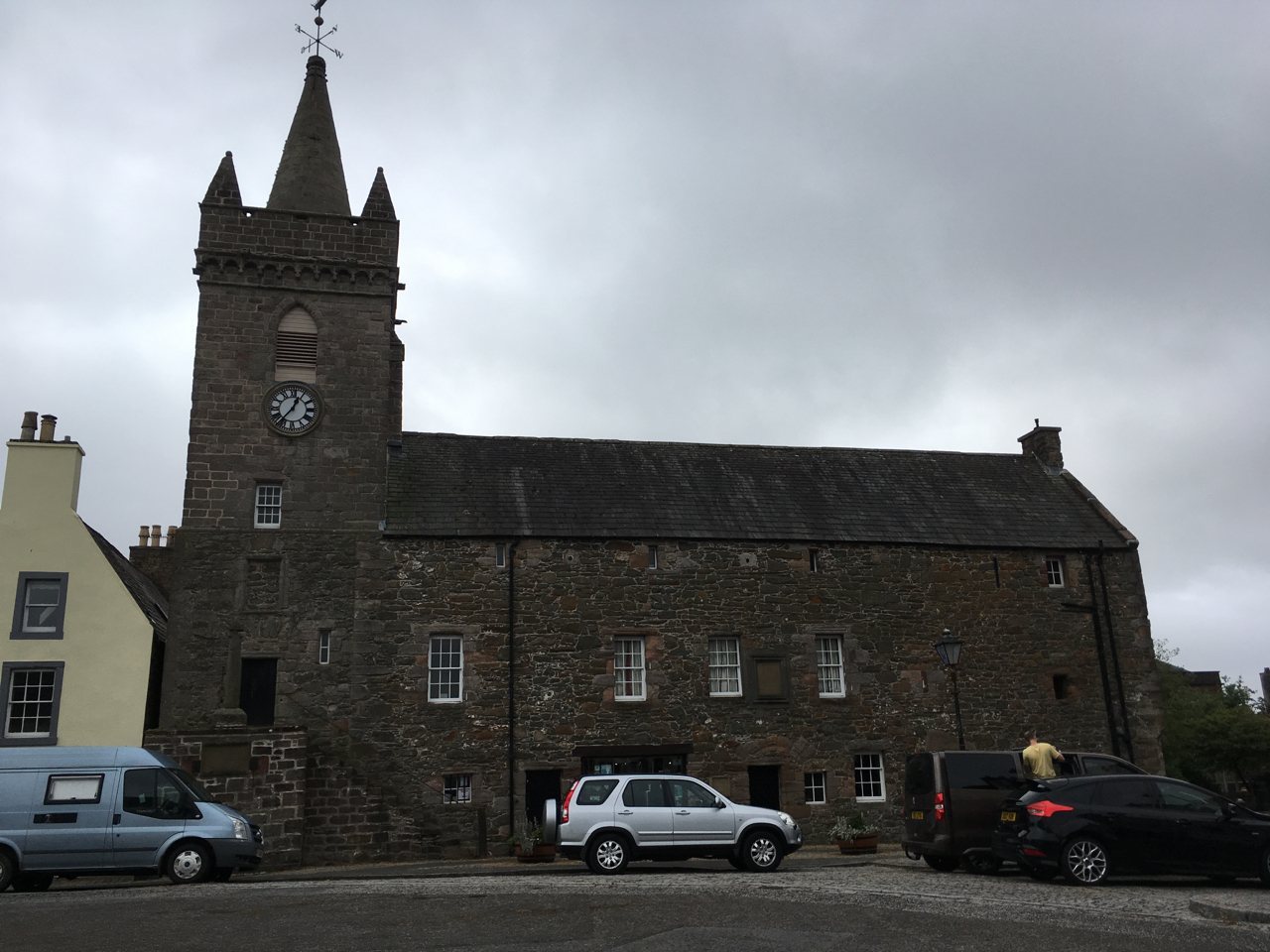
The tolbooth stands at a corner of Kirkcudbright’s right-angled High Street, near MacLellan’s Castle. Its long, three-storey main block runs roughly east to west, with a square tower attached at the eastern end. The main structure and lower tower are built of rubble masonry with red sandstone dressings; the walls were originally covered with a rough exterior coating.
Main block and façade
The main block measures 22.1 by 6.6 metres. Its north-facing High Street façade is asymmetrical, with windows of varying sizes and placements that reflect different building phases. A central opening with a shallow arch has been filled with masonry. A plaque above it identifies the Royal Burgh of Kircudbrightshire and gives the dates 1455–1755. A royal burgh was a Scottish town with privileges granted by the Crown, including rights connected with markets and trade. Narrow slit windows below the roof relate to the second floor’s former use as a prison.
Tower and steeple
The tower is 4.7 metres square and 19.8 metres high, with walls 1.2 metres thick. Its upper stages use finely cut stone laid in regular blocks. An external stair once led to a first-floor entrance; the former arched doorway and the window above it are now blocked. A separate prison door at the tower’s north base is also blocked by the external stair. Higher up, a nineteenth-century clock face sits beside a pointed-arch opening. Above them, a projecting stone parapet has openings, called machicolations, through which objects could be dropped onto people below. Stone spouts drain the parapet, and pyramid-shaped ornaments mark its corners. A conical stone spire rises from the centre, topped by a boat-shaped weather vane associated with the Battle of Trafalgar.
External stair and civic features
Forestair and market cross
The north-side forestair, an external stair leading to an entrance, is built of finely cut stone. The town’s market cross stands on its landing. A market cross was associated with civic and market life. This one has a carved base, a stone shaft 1.95 metres high with bevelled edges, and a triangular top carved with the date 1610 and the initials EME.
Fountain
A well or fountain stands at the foot of the stair. Its lead spouts are set in a moulded frame. The inscription describes the water as a source of life rather than riches, praises the skill that provides what nature withholds, and asks future generations to bless the sons of Saint Cuthbert who paid for it. It records that water was introduced on 23 March 1763.
Iron restraints
Two sets of iron restraints, known as jougs, survive on the building. One is at the northwest corner, about 1.5 metres above street level; the other is at the top of the stair. They were fastened around a person’s neck to restrain and publicly shame people convicted of misdemeanours.
Bells and clocks
Two bells hang inside the steeple. The principal bell, cast in the Netherlands in 1646, is 52 centimetres high and 61 centimetres in diameter. Its inscription names its maker, Michael Burgerhuys, and gives the casting date. A smaller bell was made in London in 1841 by Thomas Mears. The tolbooth also displays the town’s little bell, cast in Rotterdam in 1724 by Quirin de Visser; it measures 34 centimetres high and 44 centimetres in diameter. A clock was installed in the tower in 1897. The earlier single-hand clock, probably made in the Netherlands before 1580, is now displayed at the nearby Stewartry Museum.
Interior
Most interior features are modern. Even before the renovation of the 1990s, most internal partitions were modern, reflecting repeated changes in the building’s use during the nineteenth and twentieth centuries. The upper part of the building is gallery space.