Stein Castle: A Medieval Hill-Castle Site in Germany
Site at a Glance
- Popularity
- Very Low
- Country
- Germany
- Primary era
- Medieval
- Eras represented
- Medieval
- Civilizations
- Holy Roman Empire
- Site type
- Military
- Remains
- Castle
On this page6 sections
History
Medieval castle
Stein Castle is a medieval hill-castle site on the boundary between Ranis and Pößneck in Germany. It was built before 1300, though its original lordly affiliation is unknown. The Lords of Stein appear in records from the Orla region in 1169. The castle was also known as “the castle at the stone.”
In 1274, Count Henry of Schwarzburg-Blankenburg inherited the castle from his father, Günther VII. In 1323, King Louis the Bavarian, also known as Louis IV, who later became Holy Roman Emperor, transferred it to the Counts of Schwarzburg-Blankenburg. The castle’s later history is uncertain. Around 1345, during the Thuringian Counts’ War, a conflict among Thuringian territorial rulers, it was probably damaged so severely that it was not rebuilt. A record from 1361 describes it as “broken,” meaning destroyed, and suggests that its history had ended, though it is unclear whether this was final.
Demolition and later investigation
In 1693, Christoph Adam von Breitenbauch had the ruin demolished, and its stones were used to rebuild Brandenstein Castle. The site may later have provided refuge for highwaymen.
The site was placed under monument protection in the 1930s to preserve its archaeological context. Staff of the Thuringian Museum of Prehistory and Early History in Weimar investigated it during the 1960s.
Remains
Setting and defenses
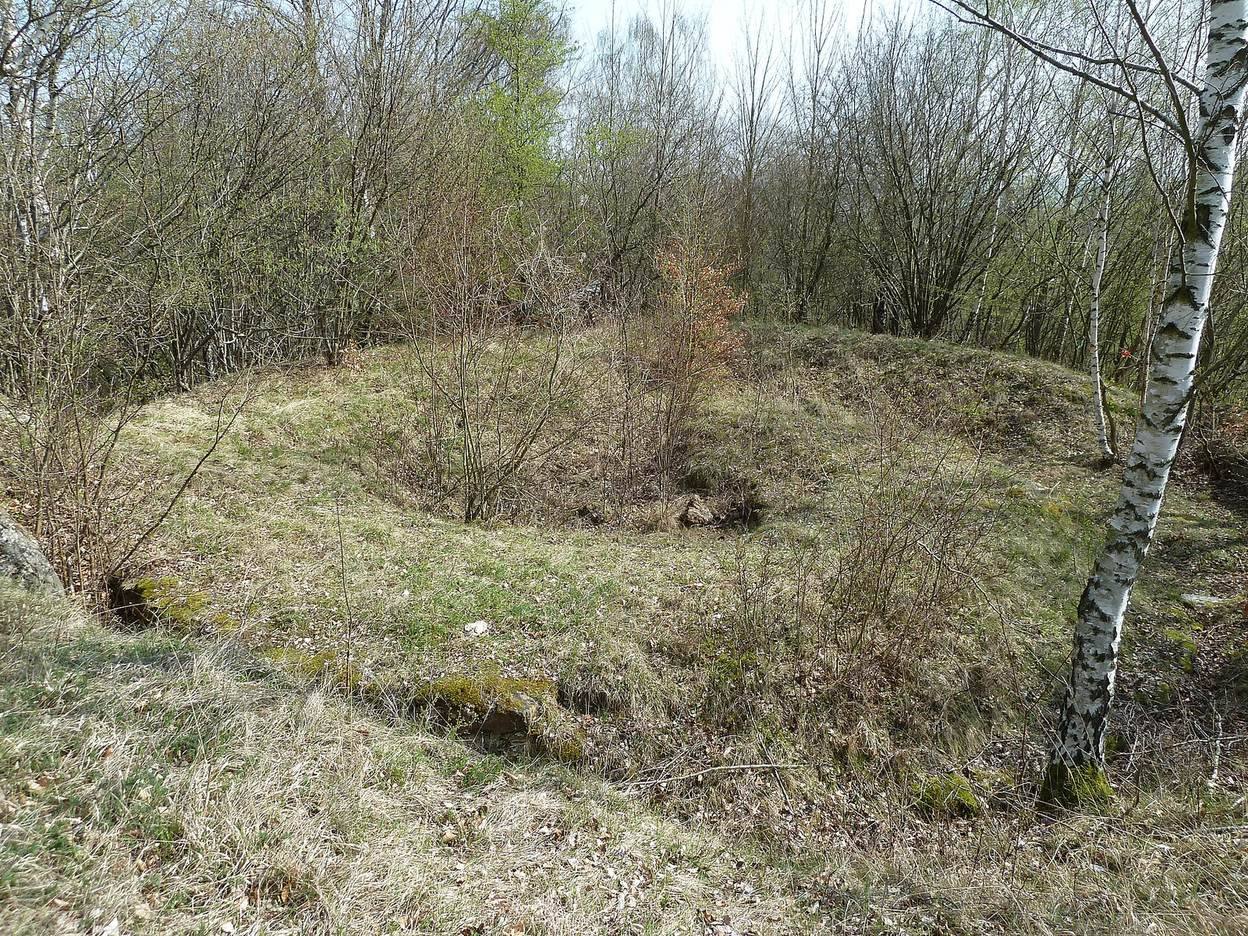
The castle occupied a narrow, rocky spur on the northeast-facing side of Kochberg, at about 340 metres above sea level. The site lies about 250 metres south of Pößneck’s town boundary and commanded traffic along Raniser Straße, now the K 516. The small inner castle was defended by two deep ditches, earthworks, and naturally steep slopes. Today, the forested site is used for forestry subject to restrictions; its surviving remains include earthworks, ditches, and slight traces of masonry.
Tower and archaeological finds
Excavation established the foundations of a round tower measuring 10 metres in diameter, with walls 3.4 metres thick. Local tradition also speaks of a second tower. Natural cavities within the castle area may have served as storage rooms. Pottery fragments point to two periods of occupation, with the earlier period consistent with the written record.