Guildhall Museum, Rochester: A Civic Hall Turned Museum
Site at a Glance
- Popularity
- Medium
- Country
- United Kingdom
- Primary era
- Early Modern
- Eras represented
- Early Modern, Modern
- Civilizations
- British, English
- Site type
- Civic
- Remains
- Town Hall
On this page8 sections
History
The Guildhall Museum occupies Rochester’s second guildhall, a meeting place for the city’s civic authority, built in 1697 on the city’s High Street in Kent, England. It succeeded an earlier guildhall farther south, on the site now occupied by Clock House.
Construction and civic role
The building served as Rochester’s council meeting place for much of the twentieth century. Its council chamber also features in Charles Dickens’s novel Great Expectations, published in 1861.
War, government, and museum
The Guildhall Museum began at Eastgate House, farther south on the High Street, in 1897. It was established to mark Queen Victoria’s Diamond Jubilee, the sixtieth anniversary of her reign. The museum moved into the Guildhall in 1979.
During the 1930s, the building’s basement became a civil-defence headquarters as preparations were made for the Second World War. The Guildhall ceased to be Rochester’s seat of local government in 1974, when the enlarged Borough of Medway was formed. It received Grade I listed status on 24 October 1950, a category of protection in England reserved for buildings of exceptional interest.
Remains
Exterior
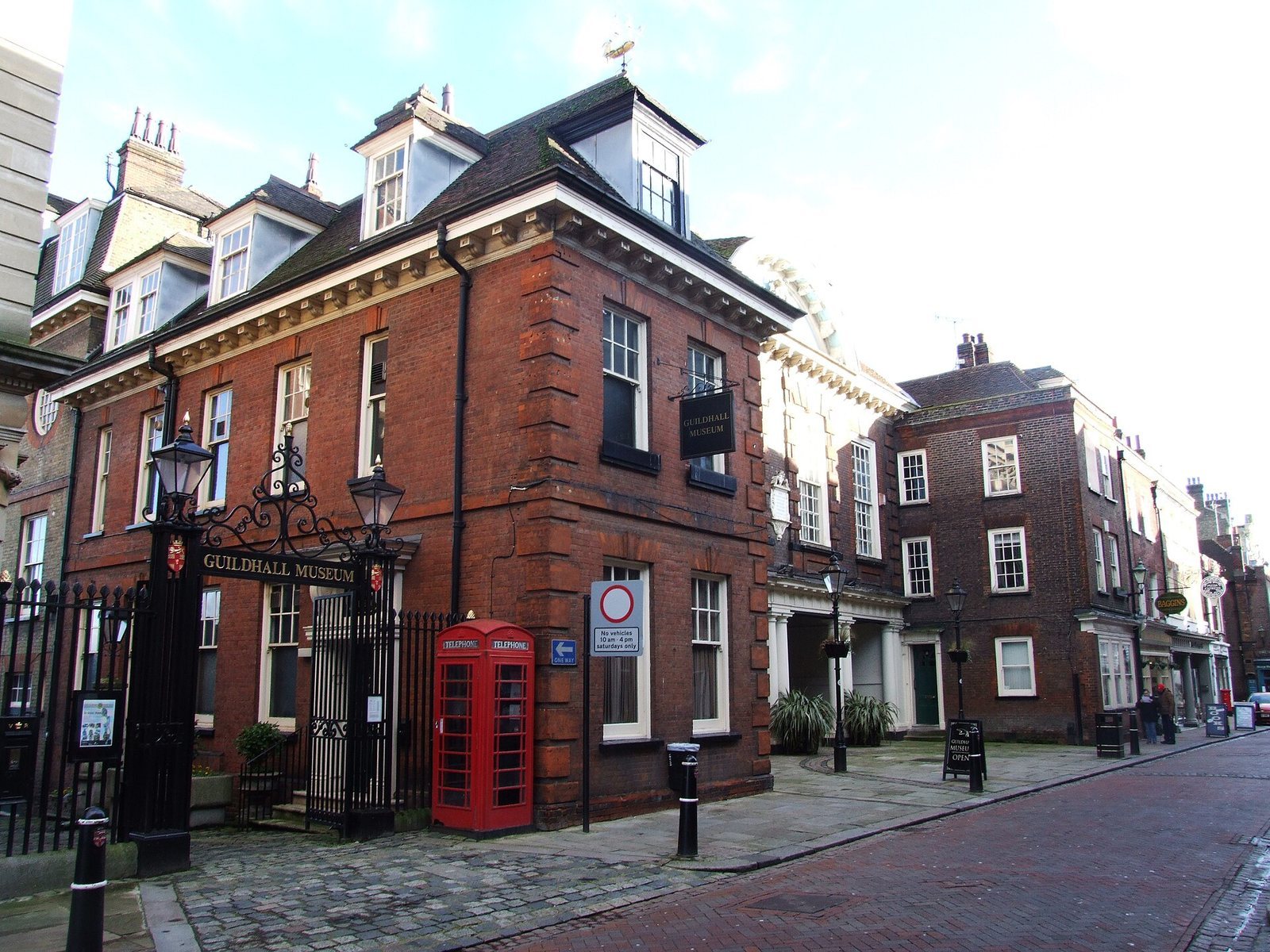
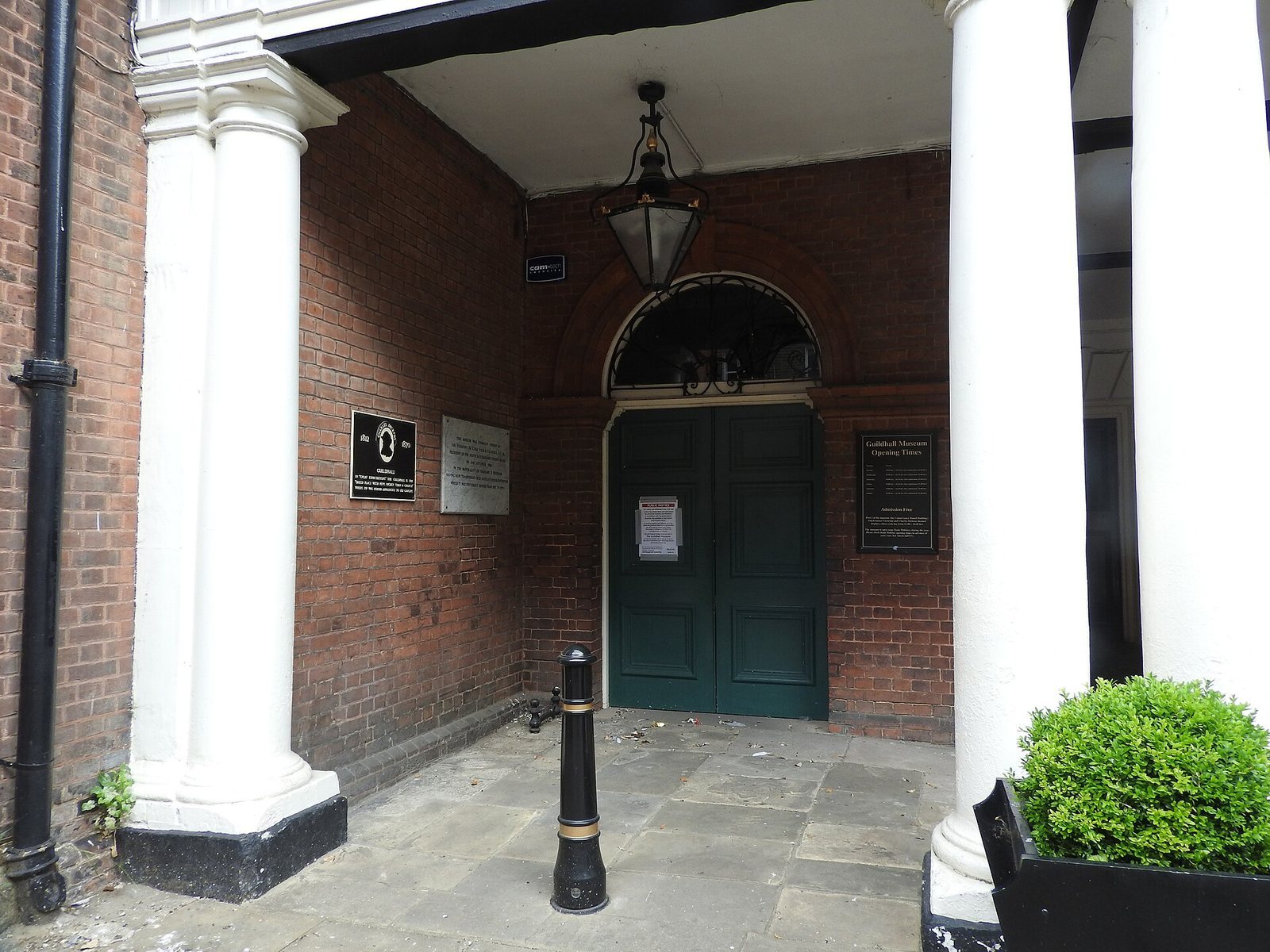
The Guildhall’s High Street frontage is divided into four bays, or sections. Its ground floor is open except for paired Tuscan columns, a relatively plain classical style, leaving space for markets. Four windows occupy the first floor. White plaques at the centre commemorate the building’s completion in 1697 and Sir Stafford Fairborne’s financial contribution. A large, round-headed pediment, a gable-like feature, crowns the roof, with a bell turret, a small tower housing a bell, above it. A weather vane depicting an eighteenth-century warship was added in 1780. Wings were added to the right in 1838 and to the left in 1893.
Interior and collections
Courtroom and plaster ceilings
The principal room was first used as a courtroom and later served as the council chamber. Its curved magistrates’ bench was arranged so attention could be directed to all the magistrates, rather than solely to the chief magistrate. In 1695, Admiral Sir Cloudesley Shovell, then Rochester’s Member of Parliament, gave the plaster ceilings in the chamber and on the staircase. A plaque also commemorates Sir Stafford Fairborne, a Royal Navy officer and politician, for his financial contribution.
Museum collections
The museum’s collection includes artefacts connected with Rochester from prehistoric times to the present. Its paintings include a classical Italian landscape by Flemish artist Hendrik Frans van Lint, a portrait of Shovell by Swedish-born portrait painter Michael Dahl, and a portrait of Fairborne by German-born British painter Godfrey Kneller.