Wildenroth Castle Site: A High-Medieval Hilltop Fortress
Site at a Glance
- Popularity
- Very Low
- Country
- Germany
- Primary era
- Medieval
- Eras represented
- Medieval, Modern
- Civilizations
- Duchy of Bavaria, German, Holy Roman Empire, Kingdom of Bavaria
- Site type
- Military
- Remains
- Castle
On this page11 sections
History
Wildenroth Castle Site is a former hilltop castle near Grafrath, Germany. It was probably built in the first half of the thirteenth century, during the High Middle Ages, the central part of the medieval period. The castle stood above an important crossing of the Amper, though the form of any crossing there remains uncertain. Its construction may have been connected with conflict between Bavaria’s ruling Wittelsbach dukes and the powerful counts of Andechs. Control of the site could have restricted the counts’ access to their lands north of the river.
Origins and Konrad von Wildenroth
The Wittelsbachs granted the castle as a fief, a lordship held under an obligation, to Konrad von Hegnenberg, who later took the name von Wildenroth from the stronghold. A loyal ducal follower, he served as the duke’s financial adviser and marshal.
Feud and transfer to Fürstenfeld Abbey
In 1297, the Munich court declared Konrad an outlaw after his fugitive son Engelschalk killed their relative, Winhart von Rohrbach zu Althegnenberg. Konrad was exiled and required to pay 22 pounds of pfennigs each year, with the pound serving as a unit of account. After the Rohrbachs received compensation, the outlawry was lifted. Konrad returned to his estates and became the duke’s court steward.
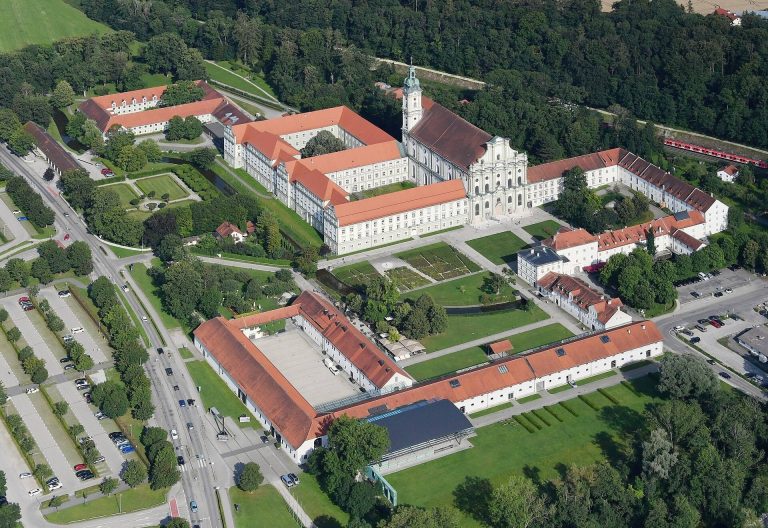
When Upper Bavaria was divided in 1310, Wildenroth fell within the portion ruled by Duke Ludwig IV, later Holy Roman Emperor. In 1311 Ludwig pledged the lordship to Konrad II, Engelschalk von Wildenroth’s son, for 200 pounds of pfennigs. Konrad II transferred the castle and its pledge rights to his uncle Berthold von Kühlenthal and his nephews Siegfried and Berthold in 1319. In 1322, King Ludwig granted the castle and its associated properties to nearby Fürstenfeld Abbey.
Abbey lordship and later tradition
Fürstenfeld Abbey apparently dismantled the fortress around 1350. The pledgeholders retained their claims until 1366, when they surrendered them for 200 pounds in Heller, a medieval monetary unit. Wildenroth then remained under the abbey’s manorial jurisdiction until 1803.
Local tradition associated Wildenroth with a castle of Saint Rasso, said to have been destroyed by the Hungarians. The early-medieval castle connected with this tradition is now placed near the church at Höfen, rather than at Wildenroth.
Remains
Enclosure and earthworks
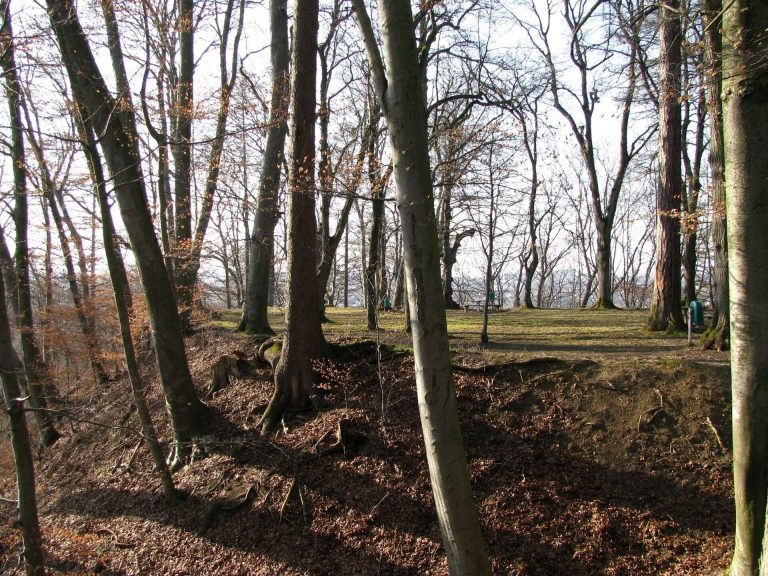
The former castle occupies the northern high bank of the Amper, about 30 metres above the river. Its oval enclosure measures approximately 150 by 100 metres and consists of a main castle and an outer bailey, the outer enclosed part of a castle complex. The main castle lies to the west and stands somewhat higher than the outer bailey.
Main castle
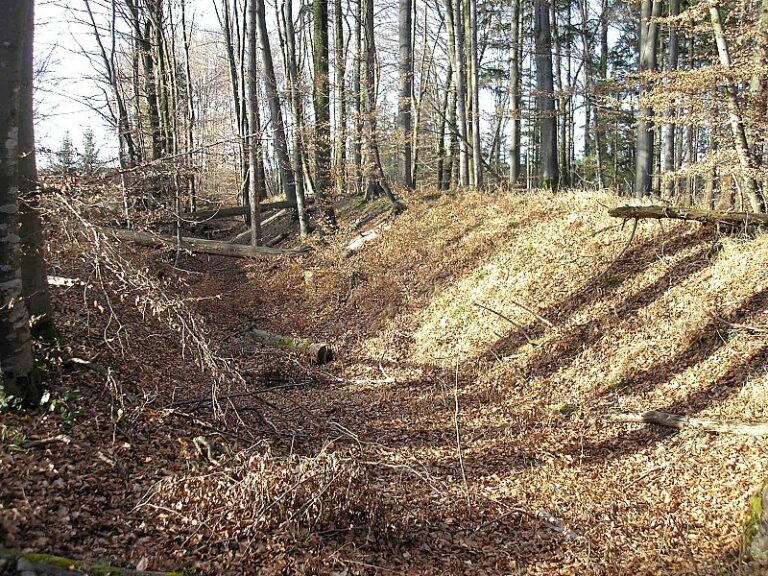
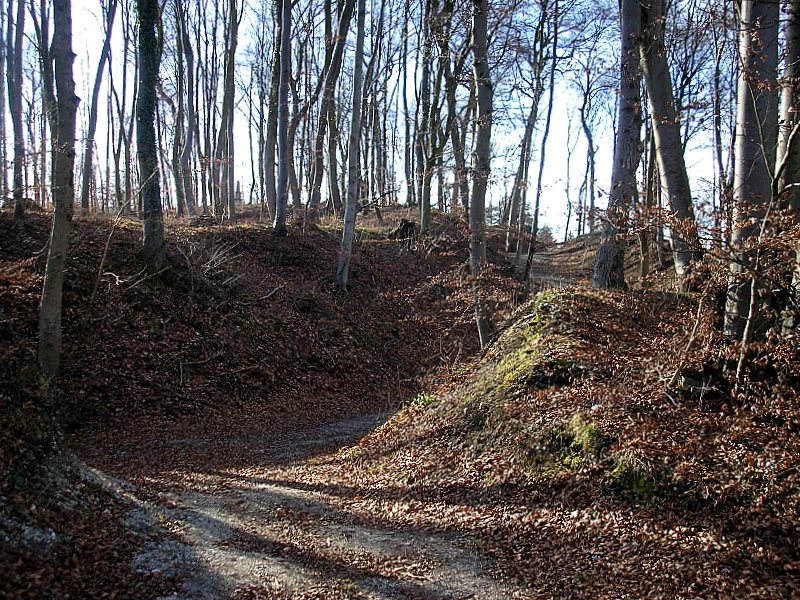
A ditch about three metres deep separates the main castle from the outer bailey. The southern area was substantially disturbed during construction of the grotto and chapel around 1900. The presumed ditch in the north and east is now faintly visible. Forestry machinery disturbed the northern part of the ditch, and further machinery damage affected the site after 2000, including in its core area in January 2008. The main-castle plateau has a wide view across the Amper valley and south toward the Alps.
Outer bailey
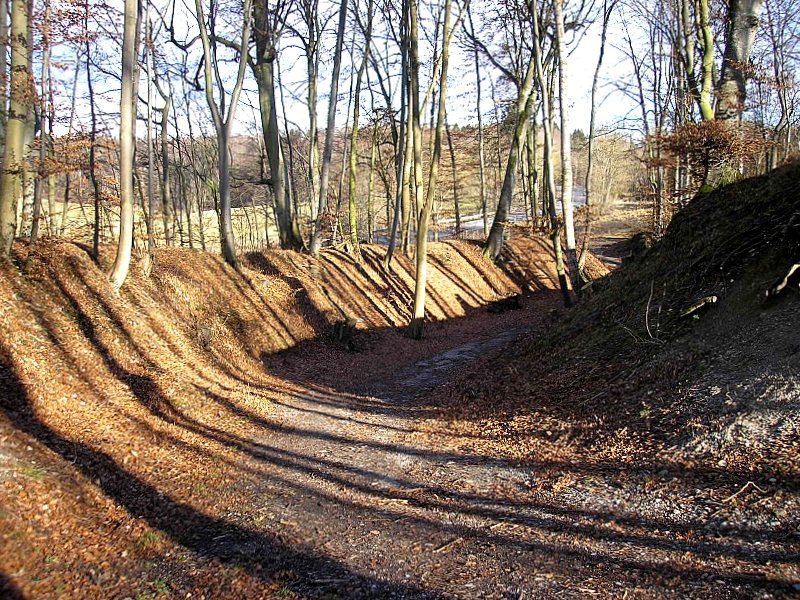
The outer bailey is approximately the same size as the main castle. Its curved outer ditch, which reaches up to six metres deep, is particularly well preserved, and a bank survives along part of it.
Religious and commemorative features
Grotto and obelisk
A Lourdes grotto, a devotional structure modeled on the grotto at Lourdes in France, lies within the main-castle area. Above it, on the southeast side, stands a stone obelisk dated 1900. Its inscription reads “Rassoburg 900,” connecting the site with the local tradition about Saint Rasso’s castle.
Chapels
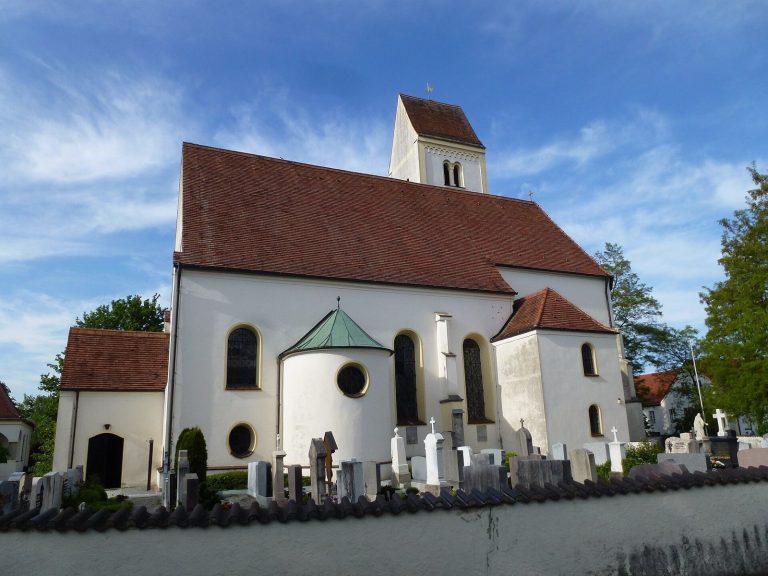
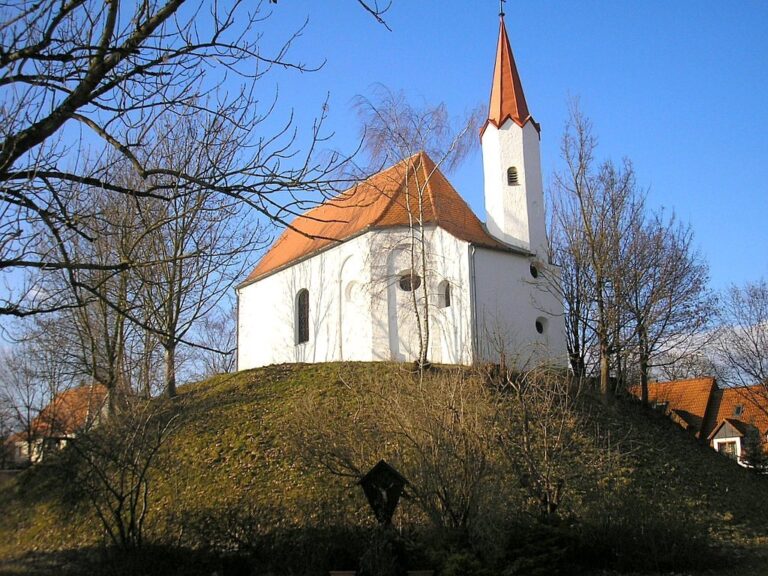
The simple St. Leonhard Chapel was built in 1900 in the southwest part of the main castle, succeeding an earlier castle chapel. The original castle church was dedicated to Saint Nicholas. After its demolition, a chapel was built in 1788 on the southern bank of the Amper below the castle; that building survives.