Galton Bridge: A Road Bridge over the Birmingham Canal New Main Line
Site at a Glance
- Popularity
- Medium
- Country
- United Kingdom
- Primary era
- Modern
- Eras represented
- Modern
- Civilizations
- British
- Site type
- Infrastructure
- Remains
- Bridge
On this page7 sections
History
Galton Bridge is a road bridge over the Birmingham Canal New Main Line at Smethwick, near Birmingham, in the United Kingdom. Designed as part of civil engineer Thomas Telford’s canal improvements, it opened in December 1829. The crossing helped the new canal route pass through Smethwick’s high ground without obstructing the waterway or its towpaths.
The canal improvements
Birmingham’s first canal, begun in the late 1760s, followed a winding course to Wolverhampton through the Black Country coalfields. At Smethwick, high ground made a tunnel impracticable, so boats crossed the hill by a flight of locks. By the 1820s, rising traffic had made the short, level stretch between the locks a bottleneck. Queues of boats and disputes among crews were common.
A proposed railway between Birmingham and Liverpool via Wolverhampton helped spur investment in the canal. The company engaged Telford, whose plan for a straighter New Main Line shortened the route. The old course became known as the Old Main Line. Making the new route required an artificial valley to be cut through Smethwick’s high ground. Work on the cutting began in 1827 and severed three local roads. Two received masonry bridges, but Roebuck Lane crossed the deepest and widest part. Galton Bridge provided the road crossing there. It was named for Samuel Tertius Galton, a local businessman and major investor in the canal company.
Galton Bridge belonged to a group of six related iron arch bridges built to Telford’s designs. Bonar Bridge, completed in 1810, served as the prototype; Craigellachie and Waterloo followed in 1814 and 1816, while Holt Fleet was completed in 1828. The Mythe Bridge preceded Galton by three years. Bonar was later washed away, and four of the others were strengthened with modern materials during the twentieth century. Galton is the only one of the six to remain standing without later modification. In 1830, the young engineer Isambard Kingdom Brunel visited and called it “prodigious.”
Railways, road changes, and care
During the 1840s and 1850s, the Stour Valley Railway built its line between Wolverhampton and Birmingham largely parallel to the new canal. Galton Bridge continued carrying road traffic for more than 140 years. In the 1970s, a road scheme diverted Roebuck Lane onto a wider route, Telford Way, and closed the bridge to vehicles. It has since been used by pedestrians and cyclists. The surrounding area is sometimes called Galton Valley, and the bridge also gave its name to Smethwick Galton Bridge railway station.
The bridge became a Grade I listed building in 1971, a designation that protects it from demolition or modification and includes the attached railway span. Minor structural repairs followed in 1987, when the original black paint was replaced with a scheme intended to emphasize the bridge’s features. An inspection in the 2000s found it in excellent condition and noted that the paintwork had held up well. The Canal and River Trust, formerly British Waterways, maintains the bridge.
Remains
The crossing spans the canal cutting on a single arch supported by tall brick structures built into the valley sides. The arch and its road deck form the central structure, with later railway bridges and changes to the canal corridor shaping the surrounding layout.
The iron arch
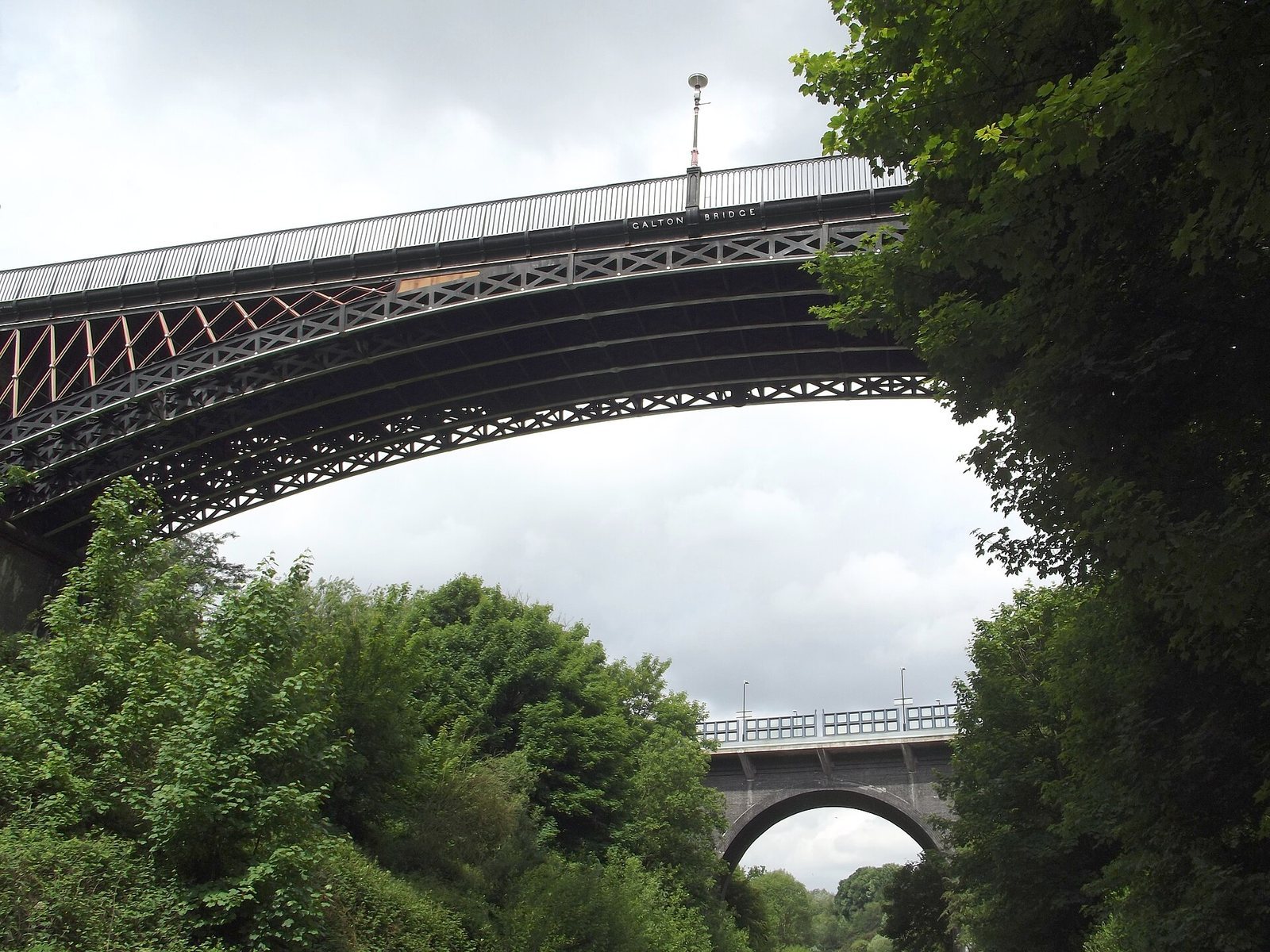
The arch is made of cast iron, produced by pouring molten iron into moulds. It measures 150 feet (46 metres) long and 26 feet (7.9 metres) wide, and stands 70 feet (21 metres) above the canal. When built, it was reputed to be the world’s highest single-span arch bridge and was also regarded as the longest bridge over a canal.
Six iron ribs form the arch, each assembled from seven bolted sections. Brick abutments, supports at the ends of an arch, carry the structure. X-shaped braces in the spandrels, the spaces between the arch and the deck, support the roadway plate. The bridge also has an iron parapet and decorative lamp-posts. Its name is cast below the parapet at the centre of each side; the words “Horseley Iron Works 1829” appear beneath the spandrels. The ironwork was cast at Horseley Ironworks in nearby Tipton and assembled on the abutments.
Telford described the span as extraordinary and argued that its light iron construction combined safety with economy. A stone bridge high enough to meet the sides of the cutting would have needed much larger supports, which could become waterlogged and bulge in heavy rain. The lighter arch allowed smaller supports.
Railway crossings
The railway company’s crossing is a separate masonry arch carrying the tracks, with an iron parapet designed to match Galton Bridge. It uses one of Galton’s abutments. Smethwick Station Bridge, another railway crossing, was built to the west in the 1860s.
Canal cutting and later changes
To the west, toward Wolverhampton, Smethwick Station Bridge now restricts the formerly open view down the valley. To the east, toward Birmingham, a partial infill of the cutting associated with the 1970s road scheme alters the corridor. That scheme placed the canal in a concrete tunnel, narrowing the waterway. The road crossing above is the A4252, known as Telford Way, and the canal tunnel is called Galton Tunnel.