Royal Observatory Edinburgh: A Centre for Astronomy and Instrumentation
Site at a Glance
- Popularity
- Medium
- Country
- United Kingdom
- Primary era
- Modern
- Eras represented
- Modern
- Civilizations
- British
- Site type
- Civic
- Remains
- Observatory
On this page12 sections
History
The Royal Observatory Edinburgh is a national astronomical institution on Blackford Hill in Edinburgh, Scotland, United Kingdom. Its institutional roots date to 1785, when the University of Edinburgh established a Regius Chair of Astronomy, a professorship created or recognized by royal authority.
Origins on Calton Hill
George III authorized the new chair by royal warrant, and Robert Blair became its first professor. Separately, Edinburgh citizens founded the Astronomical Institution of Edinburgh in 1811. The natural philosopher and mathematician John Playfair served as its president, and the Institution acquired land on Calton Hill for an observatory.
During a visit to Edinburgh in 1822, George IV gave the Calton Hill observatory the title “Royal Observatory of King George the Fourth.” In 1834, government funding provided the instruments needed to unite the observatory with the University’s astronomy chair. Thomas Henderson became the first Astronomer Royal for Scotland, a national astronomical office, and the second Regius Professor of Astronomy.
Timekeeping and the move to Blackford Hill
In 1852, Charles Piazzi Smyth proposed placing observatories on high mountains with favorable weather. He later traveled to Tenerife to assess possible sites, and the high-altitude approach became common internationally about a century afterward. A time service began in 1858. Observations of stars crossing a fixed line in the sky kept the observatory clock accurate, while telegraph wires connected it to the time ball on Nelson’s Monument and the time gun at Edinburgh Castle. The service supplied accurate time to shipping at Leith and also controlled a time gun in Dundee and a clock at Rosyth dockyard.
Chronic underfunding led Smyth to resign in 1888. When the government planned to close the observatory and abolish the Astronomer Royal for Scotland post, the Earl of Crawford offered the nation the instruments and astronomical library from his Dunecht Observatory. His offer depended on the government building and maintaining a replacement for the Calton Hill observatory. Ralph Copeland, appointed the third Astronomer Royal for Scotland, oversaw the transfer of instruments and observatories from Dunecht and Calton Hill to Blackford Hill. The new observatory opened in April 1896.
James Ludovic Lindsay, the 26th Earl of Crawford, gave his astronomical collection to the observatory in 1888. He had assembled most of it in the 1870s and 1880s. After Charles Babbage died in 1871, more than 2,500 items from Babbage’s library were added to the collection.
Research and national facilities
The time service continued at Blackford Hill, with telegraph links maintaining the signals at Calton Hill, Edinburgh Castle, Dundee, and Rosyth. Work in the 1910s and 1920s produced more accurate pendulum clocks. These remained in use until quartz clocks replaced them in the 1960s. At 1 a.m. on 21 May 1913, a bomb planted by suffragettes exploded at the observatory. No one was inside, but the blast damaged floors and stone walls.
During the first half of the twentieth century, the observatory developed photographic and photoelectric methods for recording the positions, brightness, and spectra of stars. From the 1950s, its work increasingly emphasized instruments and automation. In 1965, responsibility passed from the Scottish Office to the Science Research Council, renamed the Science and Engineering Research Council in 1981.
Between 1961 and 1973, an outstation at Earlyburn, about 30 km south of Edinburgh, tracked artificial satellites using optical observations. From 1967 to 1976, the observatory operated a 16/24-inch Schmidt camera at Monte Porzio Catone near Rome. It also used the GALAXY machine from 1967 to digitize photographic plates; an upgraded machine, COSMOS, operated from 1975 to 1993 before SuperCOSMOS replaced it. The observatory became one of six original nodes of the UK Starlink astronomical image-processing project when it began in 1980.
The observatory operated the UK Schmidt Telescope from its opening in 1973. Its blue-light photographic plates of the southern sky were combined with red-light plates from the European Southern Observatory (ESO) to create the ESO/SERC Southern Sky Survey, extending the Palomar Observatory Sky Survey farther south. The telescope passed to the Anglo-Australian Observatory in 1988, which operated it for Australia and the United Kingdom until 2010. Following the establishment of the Australian Astronomical Observatory in July that year, the telescope became part of a facility under Australian control.
The observatory built the 3.8-metre United Kingdom Infrared Telescope on Mauna Kea between 1973 and 1979, then operated it with the University of Hawaii and developed instruments for it. These included the first infrared camera made available to general users. In 1987, the 15-metre James Clerk Maxwell Telescope, also on Mauna Kea, was handed to the observatory after the Rutherford Appleton Laboratory completed its construction. The United Kingdom, the Netherlands, and Canada operated it in partnership until 2014.
Reorganization and continuing work
After Malcolm Longair left in 1990, Edinburgh astronomy was reorganized. Andrew Lawrence became the University of Edinburgh’s Regius Professor of Astronomy, while John Brown of the University of Glasgow became Astronomer Royal for Scotland. In 1993, the Royal Greenwich Observatory, the Royal Observatory Edinburgh, the Isaac Newton Group of Telescopes, and the Joint Astronomy Centre came under the direction of Alec Boksenberg.
The 1994 division of the Science and Engineering Research Council placed the observatory within the new Particle Physics and Astronomy Research Council. In 1995, the combined observatories were separated into four independent organizations. Edinburgh lost responsibility for the United Kingdom Infrared Telescope and the James Clerk Maxwell Telescope, which came under the Joint Astronomy Centre, but continued building instruments for telescopes and satellites. It also became the UK project office for the Gemini Observatory, a pair of 8.1-metre telescopes operated by seven countries.
A 1996 review proposed putting observatory operations and instrument construction out to competitive tender. The process was halted in 1997 in favor of reducing both the Royal Greenwich Observatory and the Royal Observatory Edinburgh to smaller organizations focused on astronomy technology. The Royal Greenwich Observatory closed in 1998. The newly formed UK Astronomy Technology Centre took over Edinburgh’s technology and project-management work as the research council’s local establishment. The University of Edinburgh received the Plate Library and SuperCOSMOS machine. The name Royal Observatory Edinburgh continued as an umbrella term for the UK Astronomy Technology Centre, the University’s Institute for Astronomy, and the Visitor Centre.
After its work on Gemini, the UK Astronomy Technology Centre managed construction of VISTA, a 4-metre f/1 telescope for wide-field infrared surveys. It uses 16 large infrared detector arrays and stands at ESO’s Paranal Observatory. The United Kingdom joined ESO as its tenth member country in 2002, and VISTA was handed to ESO in 2009 as part of the UK’s contribution to membership. The Blackford Hill site is owned by the Science and Technology Facilities Council. Its institutions work in astronomical research and university teaching, design and build instruments and telescopes, manage projects, train teachers, and undertake public outreach.
Remains
Buildings, instruments, and collections
Site layout
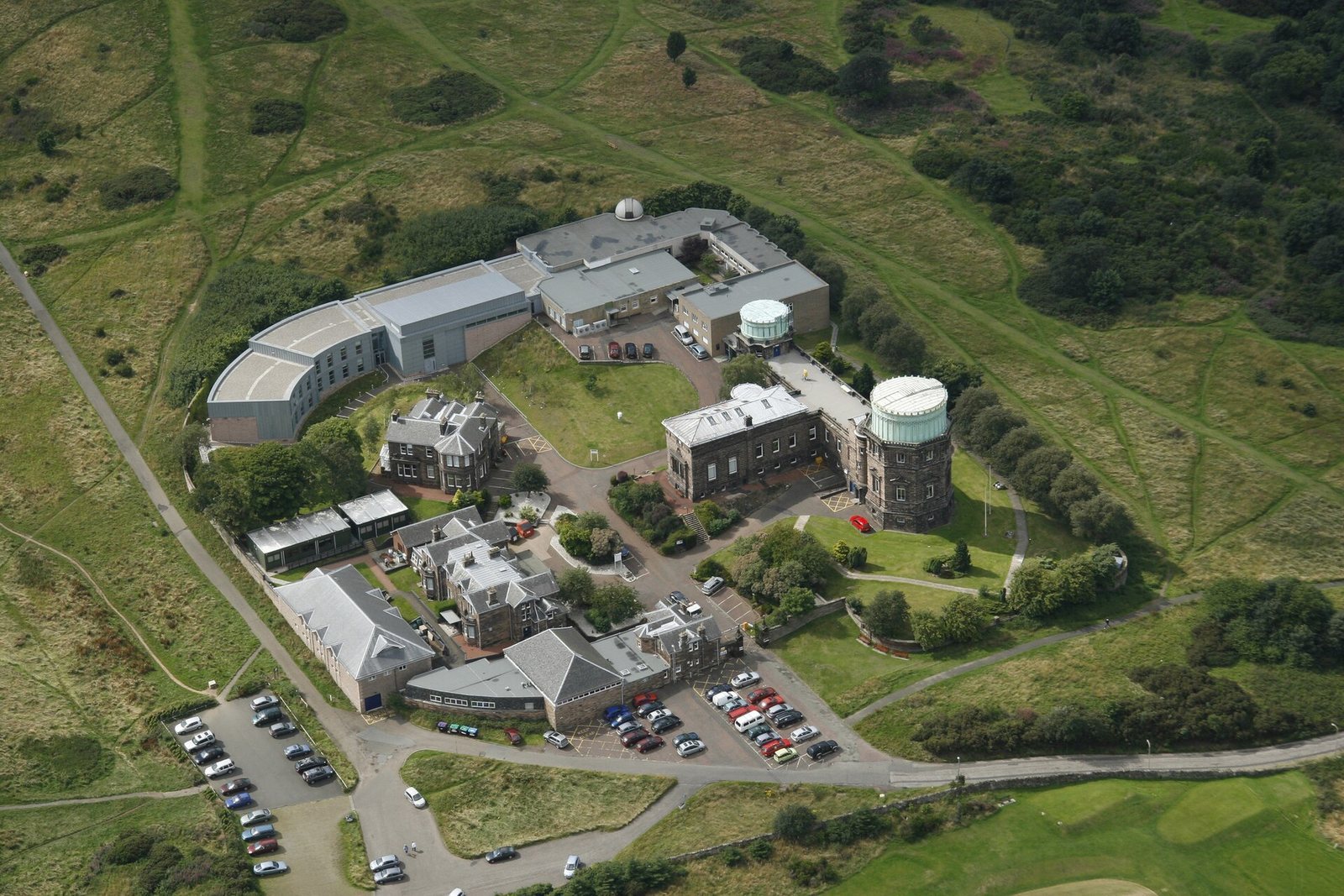
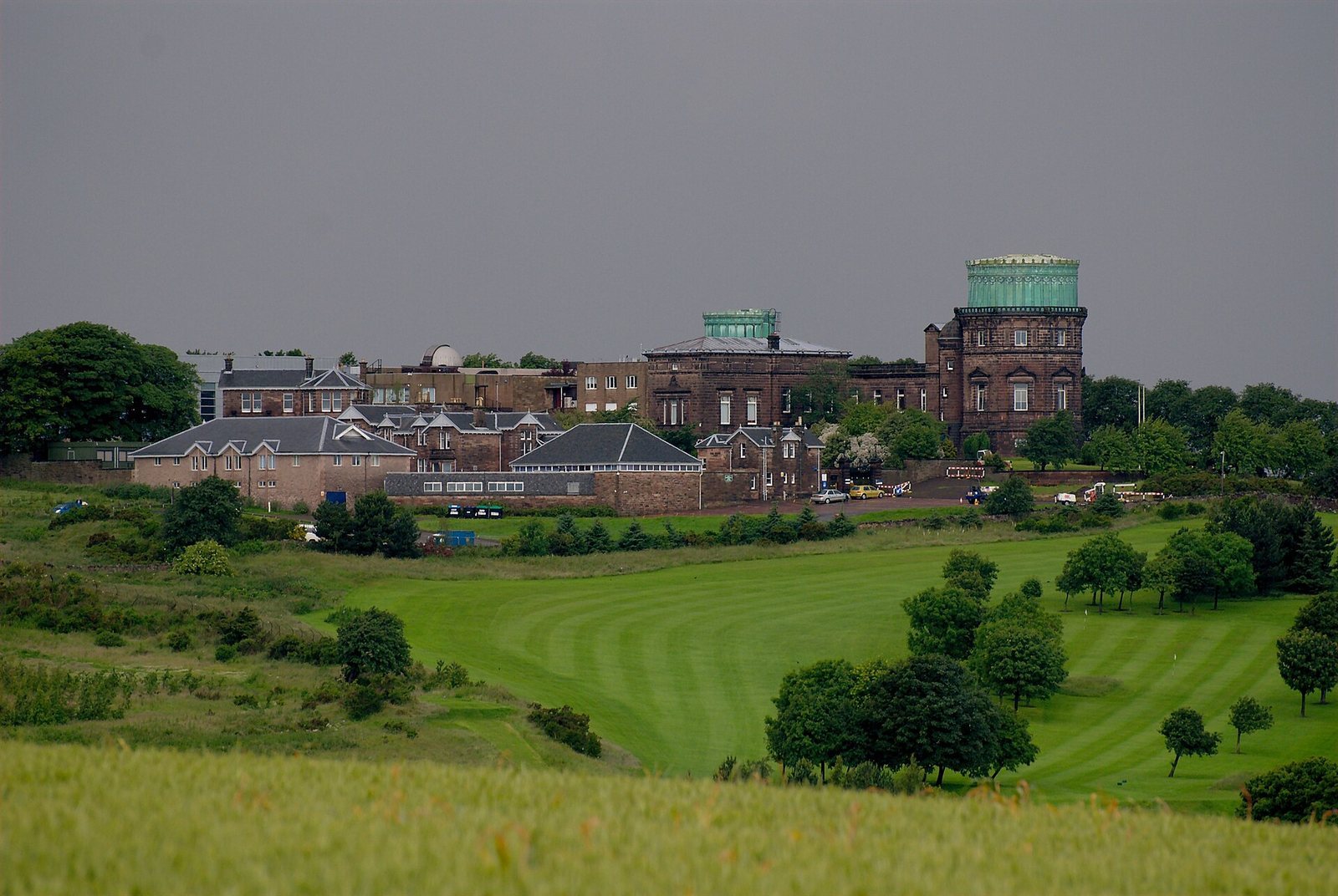
The observatory occupies Blackford Hill at an elevation of 146 m. Its complex includes the original observatory building, separate structures for astronomical work, a gate, teaching laboratories, and the UK Astronomy Technology Centre’s Crawford laboratories.
Main building and domes
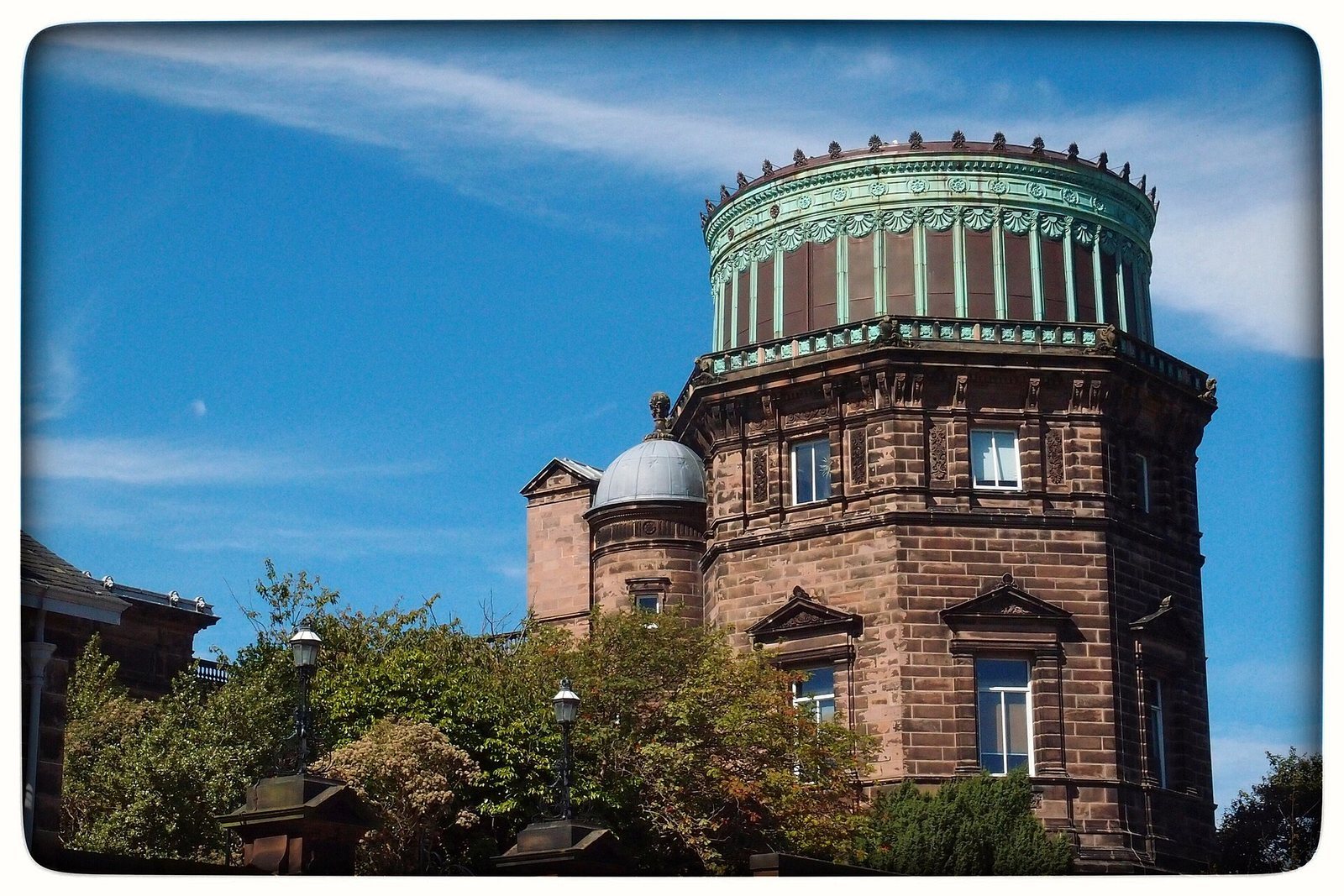
The original Blackford Hill building dates to 1894. Its East and West Towers are topped by cylindrical copper domes, refurbished in 2010. The building and domes form the central architectural group of the observatory complex.
Telescope installations
The original instruments included a 15-inch refractor in the East Dome and a 24-inch reflector in the West Dome. An 8.5-inch transit circle, which combines star-transit observations with a graduated circle to measure position, stood in a separate building farther west. A 36-inch Cassegrain reflector, which directs light back through an opening in its main mirror, was installed in the East Dome in 1930. It remains there as a non-operational exhibit in the Visitor Centre.
A 16/24-inch Schmidt camera, a wide-field instrument designed to reduce image distortion, was placed in the West Dome in 1951 and moved to the National Museum of Scotland in 2010. The only working telescope is a Meade MAX 20-inch ACF reflector in a hemispherical dome above the teaching laboratories, where it is used for undergraduate teaching. A telescope and mount dating to 1967 were moved to the Mid-Kent Astronomical Society in 2012.
Library and laboratories
The observatory library holds the Crawford Collection of books and manuscripts, including first editions by Tycho Brahe, Copernicus, Galileo, Kepler, and Newton. The photographic laboratory and plate library associated with the UK Schmidt Telescope remained in Edinburgh after the telescope itself moved. The Plate Library and SuperCOSMOS machine were transferred to the University of Edinburgh in 1998.
The Crawford laboratories belong to the UK Astronomy Technology Centre. A flexure rig there simulates how telescope instruments move as a telescope changes altitude, allowing instrument behavior to be tested under changing orientations.
Calton Hill building
The earlier Calton Hill observatory was designed by William Henry Playfair, John Playfair’s nephew. Its surviving building is known as the Playfair Building and forms part of the City Observatory.