Marble Arch: A Ceremonial Entrance in London
Site at a Glance
- Popularity
- Very High
- Country
- United Kingdom
- Primary era
- Modern
- Eras represented
- Modern
- Civilizations
- British
- Site type
- Civic
- Remains
- Arch
On this page10 sections
History
Marble Arch is a ceremonial arch in London, United Kingdom, designed by John Nash in 1827 as the state entrance to Buckingham Palace’s ceremonial courtyard. It was also intended to commemorate British victories on land and at sea during the Napoleonic Wars, the early nineteenth-century conflicts between France under Napoleon and coalitions of European powers.
Tyburn and London’s edge
Before the arch was built, the area was associated with the Tyburn gallows, a public execution site used from 1388 to 1793. In 1785, the gallows were moved about 50 yards north along Edgware Road to clear space for a tollhouse at the junction, where gates were placed across Edgware and Bayswater roads. Those executed at Tyburn included Jack Sheppard, an eighteenth-century criminal known for repeatedly escaping prison. After the monarchy returned in 1660, Oliver Cromwell’s body was exhumed and symbolically hanged at the site.
In the eighteenth century, the junction of Park Lane and Oxford Street marked one edge of London. Oxford Street was then called Tiburn Road. Tyburn was also the name of a stream that flowed from Hampstead to the Thames at Westminster, and Marylebone Lane followed its left bank.
Nash’s design and the royal commission
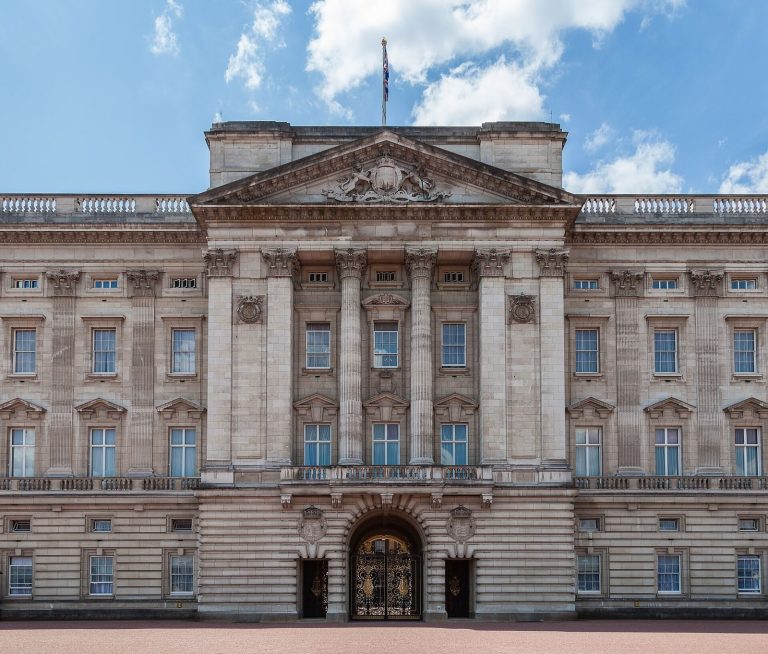
Nash designed the arch for the entrance to Buckingham Palace’s ceremonial courtyard, near the palace’s present central projection and balcony. Sculptor John Flaxman was selected to provide its commemorative sculpture. After Flaxman died in 1826, the work was divided among Richard Westmacott, Edward Hodges Baily and J. C. F. Rossi. In 1829, Francis Chantrey received a commission for a bronze statue of George IV on horseback, intended for the top of the arch.
Construction began in 1827 but stopped in 1830, following George IV’s death. His successor, William IV, considered the rising costs unacceptable. He also offered the unfinished Buckingham Palace to Parliament as a possible replacement for the recently destroyed Palace of Westminster.
Work resumed in 1832 under architect Edward Blore, who reduced the planned upper section and left out its sculpture, including the statue of George IV. The arch was completed in 1833. Some sculpture intended for it was put to other uses. Parts of Westmacott’s Waterloo frieze, a carved horizontal band, and the Nelson panels went to Buckingham Palace. Victory statues and Rossi’s sculpted representations of Europe and Asia went to the National Gallery. A figure once thought to represent Britannia was later identified as Minerva. Chantrey’s statue of George IV was installed on a pedestal in Trafalgar Square in 1843.
Buckingham Palace remained largely unfinished and unoccupied until Victoria became queen in 1837. Within a few years, it was considered too small for the court and the Queen’s growing family. A new east range was planned to enclose the palace courtyard, occupying the arch’s original site. Its public-facing side screened inner palace façades whose friezes and marble complemented those of the arch.
Relocation and ceremonial use
The arch was dismantled in 1847 as the palace extension took shape. Decimus Burton initiated its relocation, and builder Thomas Cubitt reconstructed it at Cumberland Gate. The work was complete by March 1851, in time for the Great Exhibition, an international exhibition held in London that year. The new position was intended to provide a prominent ceremonial entrance to Hyde Park.
Passage beneath the arch during formal processions was reserved for the royal family and royal forces, including the Royal Artillery, the British Army’s artillery corps. The state coach used for Queen Elizabeth II’s coronation in 1953 passed through the arch. This counters the story that it had been moved because it was too narrow for a royal carriage.
Three small rooms in the rebuilt arch housed a police station from 1851 until at least 1968. The Royal Parks Constabulary used the rooms first, followed by the Metropolitan Police.
Transport and changing surroundings
Marble Arch Underground station opened across the road in 1900 as a stop on the Central London Railway, an early underground railway whose route is now part of the Central line. The arch also gave its name to the station and to an informal district, especially the southern part of Edgware Road. The district is generally associated with parts of Mayfair and Marylebone, and sometimes St George’s Fields, all within the City of Westminster.
In 1905, the Royal Commission on London Traffic proposed moving both the arch and the park boundary south to reduce congestion. Instead, the arch stayed in place when the boundary moved in 1908, and Tyburn Way was created between them. In 1926, Marble Arch became one of London’s first sites to use a clockwise, one-way traffic system. The separate traffic islands were combined into a single large island around the arch.
In 1938, road planner Sir Charles Bressey recommended incorporating the road inside Hyde Park’s railings into a dual-carriageway Park Lane. The Park Lane Improvement Act followed in 1958. A road underpass was rejected as too costly and because its construction would require the demolition of buildings on Edgware Road. Road works took place from 1960 to 1962. In 1961, Park Lane became one-way southbound and East Carriage Drive one-way northbound. A larger rectangular roundabout was built around the arch, with a short south-to-north route through its centre. Drivers turning right from Park Lane into Oxford Street could use this route to avoid circling the roundabout, but it did not serve traffic heading for Edgware Road. The rectangle’s southern and western sides were named Cumberland Gate, and the shortcut became known as Tyburn Way.
In late 1963, police reported that vehicles emerging from Tyburn Way were causing congestion as they joined eastbound traffic. The route was closed first on a trial basis and then permanently to general traffic. It reopened in 1966 for the Red Arrow 500 bus service between Victoria and Marble Arch; from 1973 it was available to all London Transport services and remains bus-only. An underground car park was built beneath Hyde Park between 1960 and 1964, after parking places on East Carriage Drive were removed. As road schemes expanded, the arch became separated from Hyde Park and ceased to be part of the Royal Parks. Westminster City Council maintains it. The arch was listed at Grade I in 1970, the highest grade of listed-building protection in England.
Remains
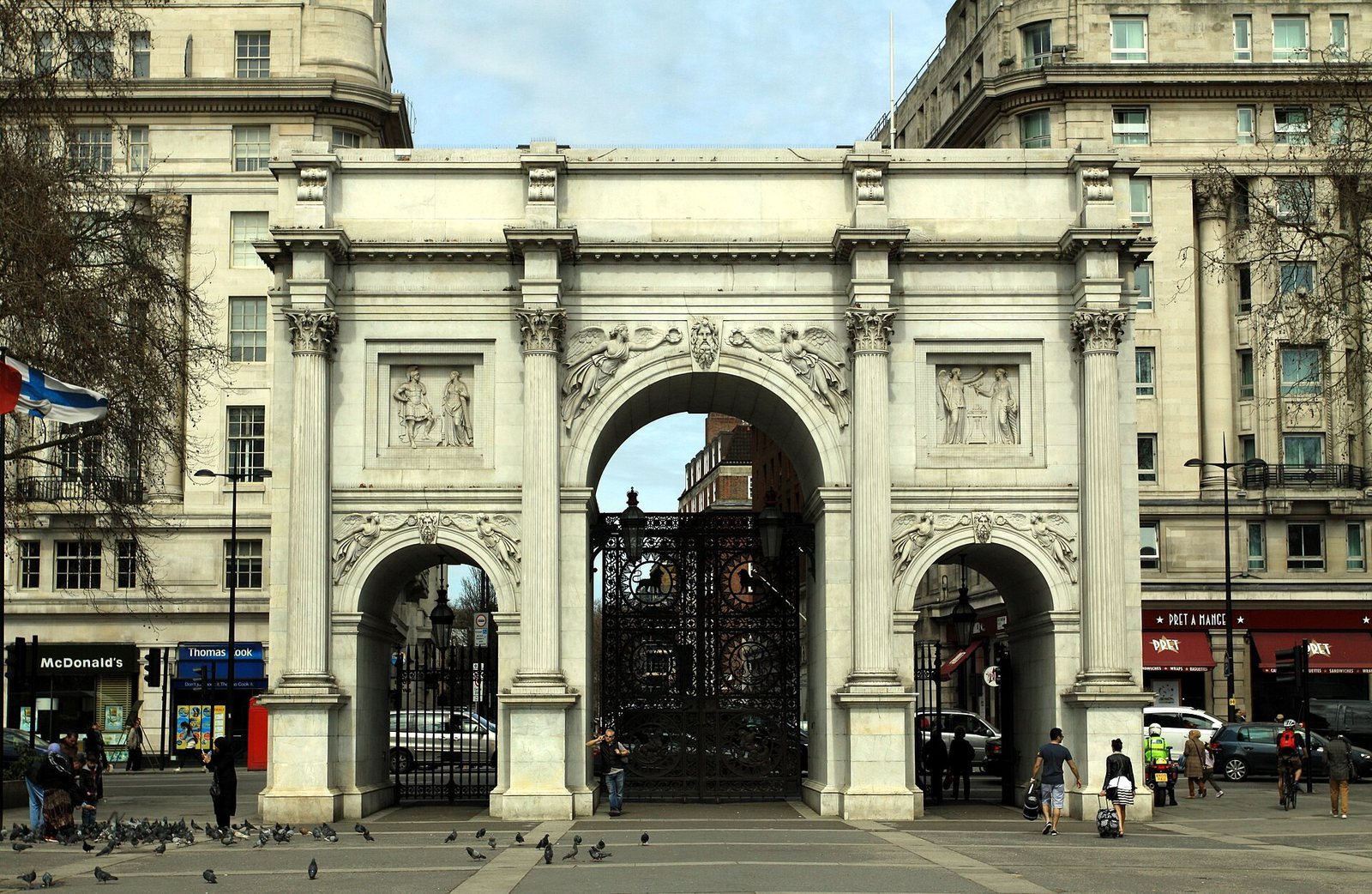
Marble Arch now stands at the centre of a large traffic island near Hyde Park’s northeast corner. The surrounding junction connects Oxford Street to the east, Park Lane to the south, Bayswater Road to the west and Edgware Road to the northwest. The arch, its three openings and the roads and gardens of the island form the main elements of the site.
The arch
The structure is faced with Carrara marble and includes decorative marble quarried near Seravezza in Tuscany. Its design drew on the Arch of Constantine in Rome and the Arc de Triomphe du Carrousel in Paris, both earlier triumphal arches. Marble Arch is 45 feet (14 metres) high and measures 60 by 30 feet (18.3 by 9.1 metres) from east to west and north to south.
Three small rooms occupy the attic, the upper section above the main structure. London’s smoke and damp had discoloured the marble’s pale surface by 1847.
The road island
Gardens occupy parts of the enlarged island around the arch. Tyburn Way crosses the island from south to north as a shortcut reserved for buses. A short road directly north of the arch also bears the name Marble Arch.
Underground car park
The underground car park beneath Hyde Park extends from Mount Street in the south to Cumberland Gate, and from Stanhope Place in the west to Park Lane.
Still Water
Still Water, a large bronze horse’s head by Nic Fiddian-Green, was unveiled east of Tyburn Way in 2011, a short distance from the arch.