Eastgate and Eastgate Clock: Chester’s Historic Gateway and Jubilee Clock
Site at a Glance
- Popularity
- High
- Country
- United Kingdom
- Primary era
- Early Modern
- Eras represented
- Medieval, Early Modern, Modern
- Civilizations
- Anglo-Saxon, British, English
- Site type
- Military
- Remains
- Gate
On this page9 sections
History
Roman and medieval origins
Eastgate and Eastgate Clock is the historic eastern gateway and clock on Chester’s city walls in the United Kingdom. Romans established the fortress and town of Deva Victrix, the Roman name for Chester, around AD 74 or 75, with Eastgate serving as the fortress’s eastern entrance.
In 907, the Saxon kings of Wessex re-established Chester as a burh, a fortified settlement or stronghold. The Roman gate probably remained in use at that time. By the medieval period, Eastgate had become the city’s most important entrance. The date when its Roman predecessor was replaced is unknown, but an early-fourteenth-century date is considered most likely. The design may have been influenced by Caernarfon Castle, a medieval royal fortress in north Wales.
Rebuilding for city traffic
By the eighteenth century, Chester’s walls had ceased to serve a defensive role and were adapted as walkways. Medieval gateways restricted traffic, prompting their replacement with wider openings. Eastgate was the first to be rebuilt: work began in 1768 and was completed in 1769. Richard Grosvenor, 1st Earl Grosvenor, paid for the project, whose design was prepared by his building surveyor.
A Victorian memorial clock
Plans to enhance Eastgate followed the Prince of Wales’s visit to Chester in 1869. In 1872, Hugh Grosvenor, then Marquess of Westminster, asked architect John Douglas to design an improvement and offered to pay half its cost. The Chester Improvement Committee declined to fund the scheme, and it was abandoned.
The idea returned in 1896 as a memorial to Queen Victoria’s Diamond Jubilee, marking sixty years of her reign. Proposals included support for the Queen Victoria’s Jubilee Institute of Nurses and a statue in the Town Hall square, but a committee selected a tower and clock for Eastgate. Douglas first designed a stone structure. A wooden model showed that it would reduce daylight in nearby properties, so subscribers chose a lighter ironwork design in October 1897. Douglas’s revised plan received approval in March 1898.
Local solicitor and city freeman Edward Evans-Lloyd paid for the clock faces and mechanism, while public subscriptions funded the tower. The city corporation took responsibility for its upkeep. The clock was officially opened on 27 May 1899, Queen Victoria’s eightieth birthday. J. B. Joyce & Company of Whitchurch made the mechanism in 1897, and supplied a technician who travelled to Chester weekly to wind it until 1974.
After souvenir-hunters stole the clock hands, the city council glazed the faces in 1988. An electric mechanism replaced the original winding system in 1992, and the faces were restored to their original colours in 1996. Eastgate and the clock were designated a Grade I listed building on 28 July 1955. Grade I is the highest category of listed-building status in England, for buildings of exceptional interest.
Remains
Roman fortress and approaches
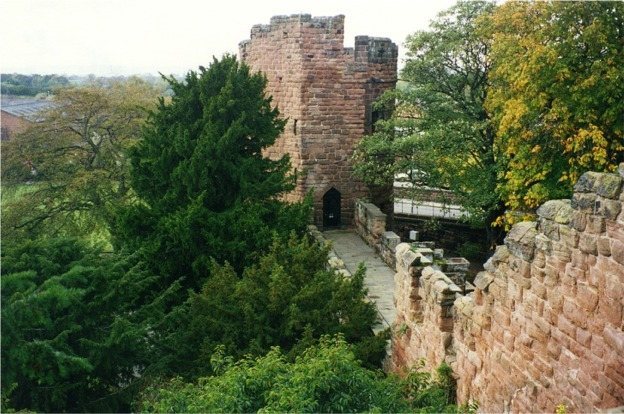
The present Eastgate combines a three-arched red-sandstone gateway with an openwork iron clock pavilion above it. The Roman fortress had a rectangular plan with rounded corners. Its earth-and-turf rampart was topped by a timber palisade, with a V-shaped ditch beyond. A road passed through the eastern entrance toward Manchester and continued across the Pennines to York. Timber buildings outside the fortress may have lined the road as shops or other commercial premises. An open area just north of the gate served as a parade ground.
Medieval gateway and excavated ditches
The medieval entrance consisted of a tall rectangular tower with octagonal corner turrets, flanked by lower towers that also had octagonal turrets. Excavation in 1971 uncovered part of the northern flanking turret, built from cream-coloured sandstone rather than the red sandstone commonly used in Chester.
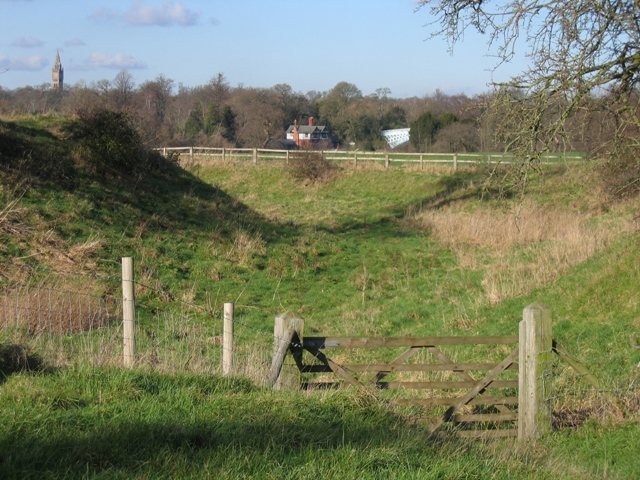
Three ditches from different periods were exposed outside Eastgate in 1991. The earliest, dating to the Saxon period, was wide and shallow, a little over 3 feet (1 metre) deep, and had been filled with rubble and masonry. A second ditch, probably dug when the replacement gate was built in the fourteenth century, reached a depth of 7.5 feet (2 metres). The third was probably created later in the medieval period for drainage. The two later ditches were subsequently used for rubbish disposal; waterlogging preserved organic material that rarely survives in Chester.
The eighteenth-century gateway
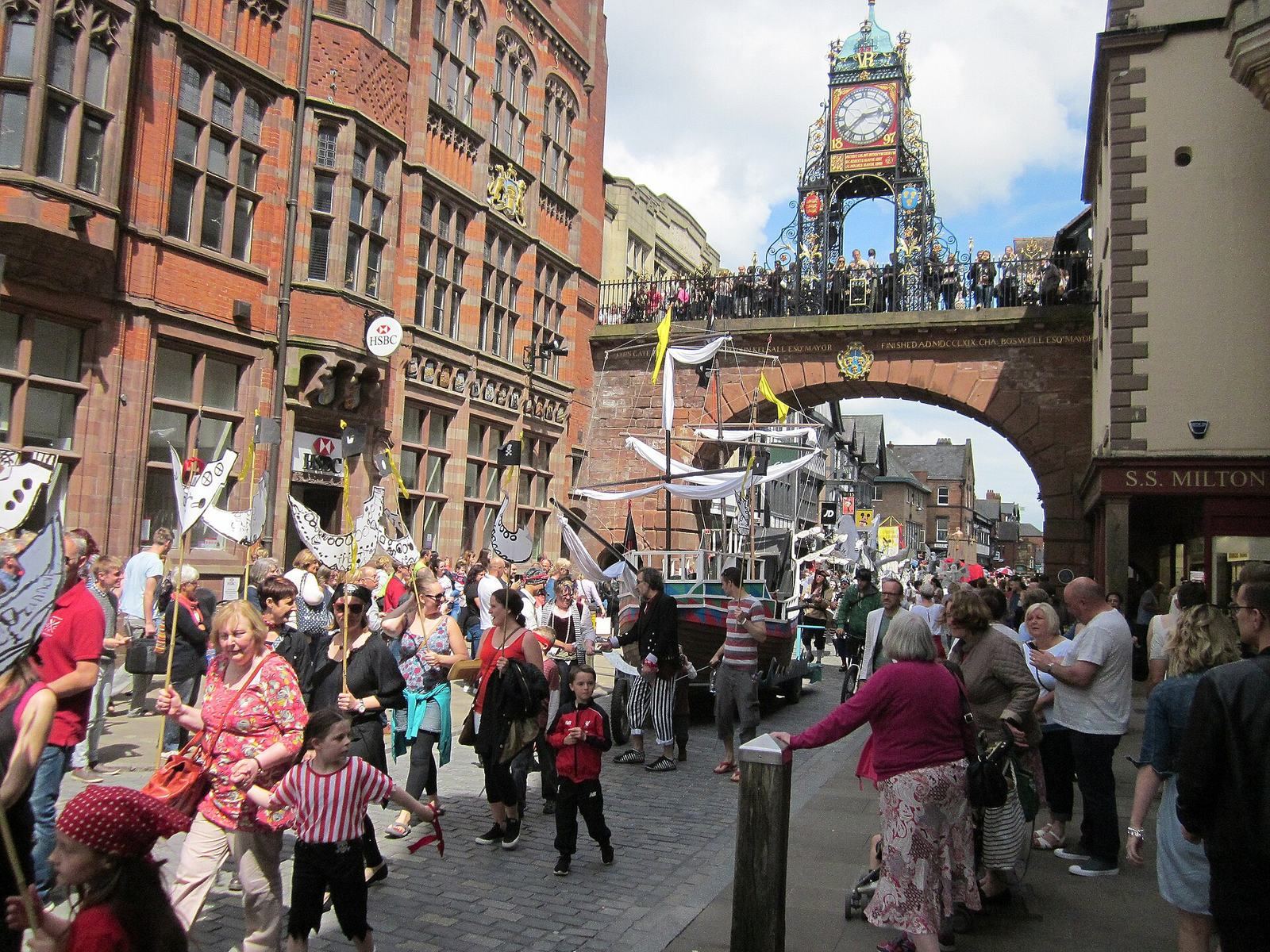
The surviving gateway has a broad central arch and a smaller pedestrian arch on either side. It is made of red sandstone, with rough-jointed jambs and wedge-shaped stones forming the arches. The walkway along the city wall crosses its top, and the gateway remains permanently open.
The inner keystone displays the arms of the county palatine, a territory where a ruler held certain powers otherwise reserved for the Crown. The arms show a sword of justice and three sheaves. The inscription on the inner band names the mayors John Kelsal and Charles Boswell and records the work’s start in 1768 and completion in 1769. On the outer side, the keystone bears Richard Grosvenor’s arms and the motto Nobilitate virtus non stemma character, meaning that virtue, not ancestry, marks nobility. The outer band credits him with paying for the gateway.
The clock pavilion
Above the gateway, an openwork wrought-iron pavilion stands on pylons, with a rounded arch on each side. Each of its four sides carries a clock face, and a copper double-curved cupola caps the structure. The ironwork was made by James Swindley of Handbridge, a cousin of John Douglas. The Coalbrookdale Iron Company made the cast-iron inscriptions.
The plinth inscriptions explain the memorial’s purpose and contributors. Its east face commemorates the sixtieth year of Queen Victoria’s reign. The west face names mayors B. C. Roberts and J. C. Holmes and includes a Latin phrase meaning “Let the ancients revere the Ancient of Days.” The south face credits Evans-Lloyd with erecting the clock, while the north records its funding by public subscription and completion in 1899. The date 1897 appears in gilt below each face, with the initials VR above. A weather vane tops the cupola, bearing gold lions rearing on a red field.