Aldford Castle: A Medieval Motte-and-Bailey Fortification in Cheshire


Site at a Glance
- Rating
- 4.3
- Popularity
- Very Low
- Country
- United Kingdom
- Primary era
- Medieval
- Eras represented
- Medieval
- Civilizations
- English
- Site type
- Military
- Remains
- Castle
On this page7 sections
History
Aldford Castle is a motte-and-bailey castle in the United Kingdom, near Aldford in Cheshire. Its origins are uncertain, but it is generally thought to have begun as an earth-and-timber fortification during the reign of Henry II, who ruled England from 1154 to 1189. The castle may have been established in the mid-12th century, although other claims place its construction earlier.
Origins and early ownership
One tradition attributes the foundation to Robert de Alford, while another names Richard de Aldford as the person who ordered its construction. In 1160, command of the castle was reportedly transferred to Robertus, a descendant of the de Bigod family, an Anglo-Norman noble family prominent in medieval England. An early written record places the castle in Richard de Aldford’s possession in the early 13th century.
Richard de Aldford died in 1213, after which the castle passed to the family of John de Aderne, who probably married Richard’s daughter Margaret. The precise basis of the family’s rights over the castle, its lands, and its title remains debated. They may have been hereditary, or they may have been connected with military service. Some claims also hold that the owners leased the castle and were required to pay for it until 1224.
Stone rebuilding and defensive purpose
Archaeological findings indicate that the fortification was rebuilt in stone as a shell keep during the 13th century. A shell keep formed a strong stone enclosure around the edge of a mound rather than a solid masonry tower.
Aldford Castle appears to have defended the area against hostile Welsh tribes and to have secured a crossing over the River Dee. Its position therefore combined a military function with control of an important point of movement across the river. The surviving remains are protected as a Scheduled Monument, a legally protected archaeological or historic site of national importance in England.
Remains
Earthworks and castle plan
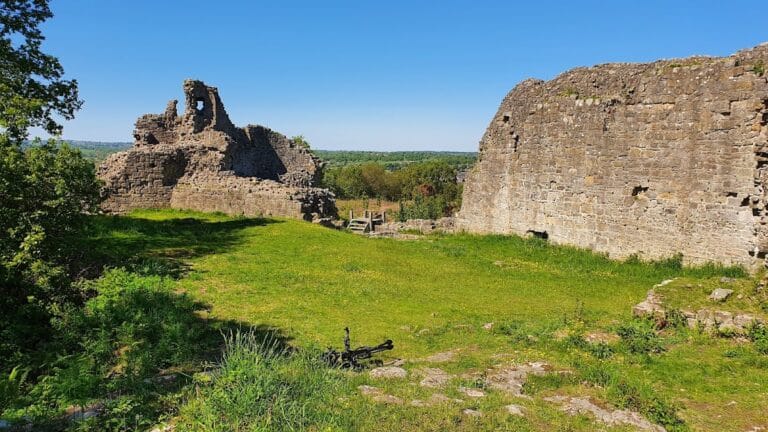
Aldford Castle survives chiefly as substantial earthworks and ruinous fragments of stonework. The former keep occupies a mound overlooking the River Dee, locally known as Blobb Hill. The castle appears to have had a triangular, or harp-shaped, plan, with the keep placed in its northwestern corner.
Motte and keep
The motte, a raised earthwork mound that supported a fortified position, lies north of St John’s Church. The mound represents the principal surviving form of the castle’s elevated defensive centre. Stone fragments around the bailey relate to the later masonry phase and to the shell keep enclosure built around the edge of the mound.
Bailey and church site
The bailey, the enclosed area for associated buildings and activities, occupied the lower part of the castle plan. St John’s Church now stands on the site of an infilled bailey ditch, while substantial earthworks and scattered stonework remain around the former enclosure. The site lies about five miles from Chester, near the point where a tributary stream joins the River Dee at an angle.
Nearby sites