St Anne’s Limehouse: An Anglican Parish Church and Thames Landmark
Site at a Glance
- Popularity
- High
- Country
- United Kingdom
- Primary era
- Early Modern
- Eras represented
- Early Modern, Modern
- Civilizations
- British
- Site type
- Religious
- Remains
- Church
On this page10 sections
History
St Anne’s Limehouse is an Anglican parish church in Limehouse, London, United Kingdom, built during the 1710s and 1720s and consecrated in 1730. Nicholas Hawksmoor designed the church, and Edward Strong the Younger was its builder.
Parish formation and construction
A new Limehouse parish was formed in 1709 from part of St Dunstan’s parish in Stepney. St Dunstan’s covered a broad, lightly populated area of East London reaching the Thames, while London’s growing population encouraged the division of large parishes. The Limehouse Parish Act of 1729 established Limehouse and part of Ratcliffe as a separate parish.
The church was one of twelve built under a parliamentary program launched in 1711 to serve London’s expanding population. The scheme aimed to provide fifty churches but fell short of that goal; those constructed became known as the Queen Anne Churches. St Anne’s may have been named for Queen Anne, who reigned from 1702 to 1714 and raised construction funds through a tax on coal carried along the Thames.
A river-facing role and architectural debate
Queen Anne directed that the church, close to the river, should provide sea captains with a place to register important events at sea. St Anne’s received permission to fly the Royal Navy’s White Ensign. Its tower also became a sea mark on Trinity House navigational charts. Trinity House is the British maritime institution responsible for aids to navigation, and regulations continue to allow the church to fly the ensign at all times.
In 1734–35, during a dispute over architectural taste, the Grub Street Journal defended Hawksmoor’s design against criticism in The Weekly Register. The journal’s argument appeared through Batty Langley’s Masonic persona, Hiram, and praised the church’s architecture.
Fire, restoration, and continuing use
A fire gutted the church on Good Friday in 1850. Philip Hardwick restored it between 1851 and 1854. Julian Harrap led another restoration from 1983 to 1993, followed by extensive work in 2007–09.
After burials ceased, the churchyard became public gardens with help from the Metropolitan Public Gardens Association. The church was listed Grade I in 1950; its churchyard pyramid and 1918 war memorial have separate Grade II listings. St Anne’s remains Limehouse’s parish church within the Diocese of London. It belongs to the Church of England’s Conservative Evangelical tradition and receives alternative episcopal oversight, pastoral supervision from a bishop other than the diocesan bishop.
Remains
Church and interior
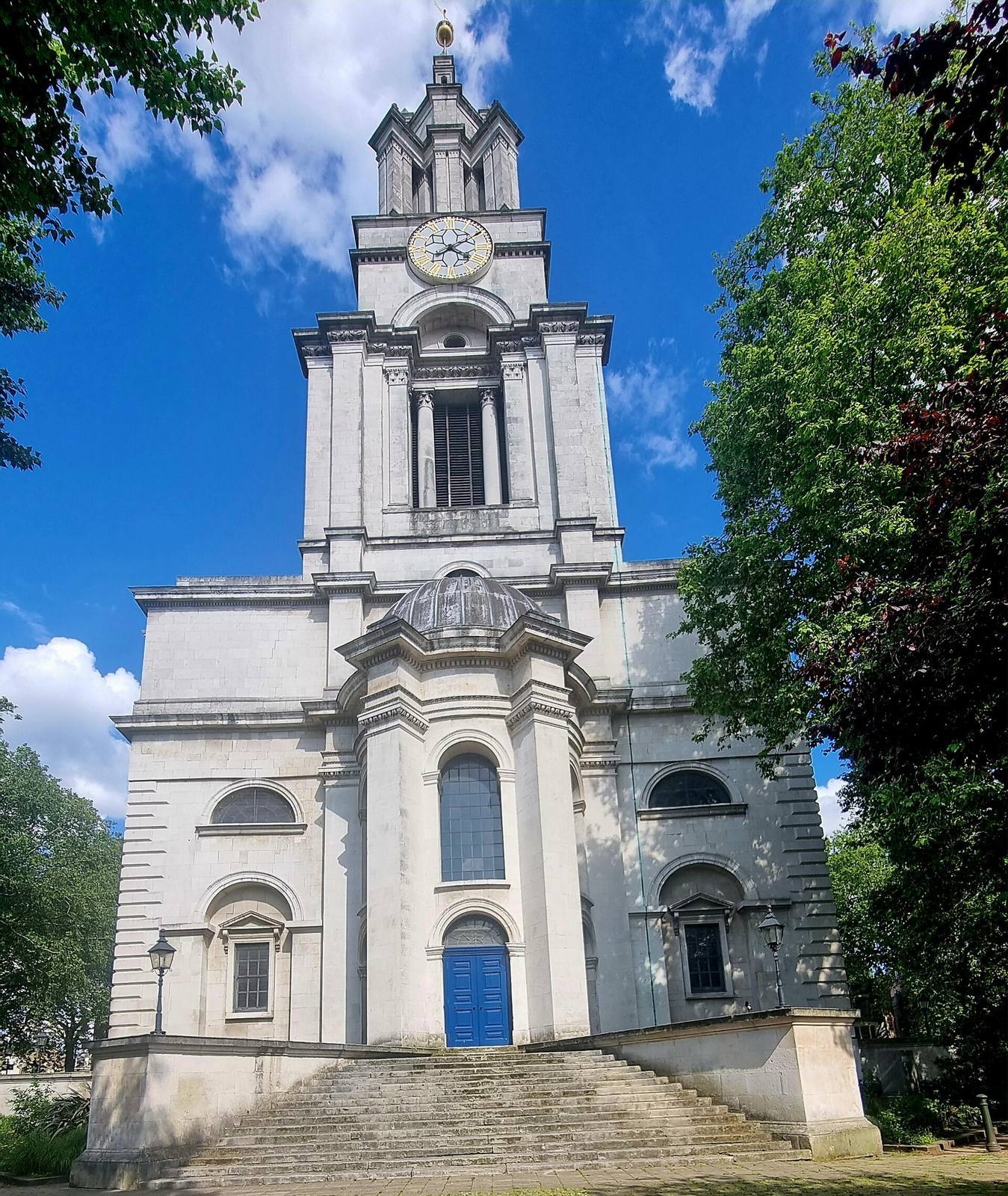
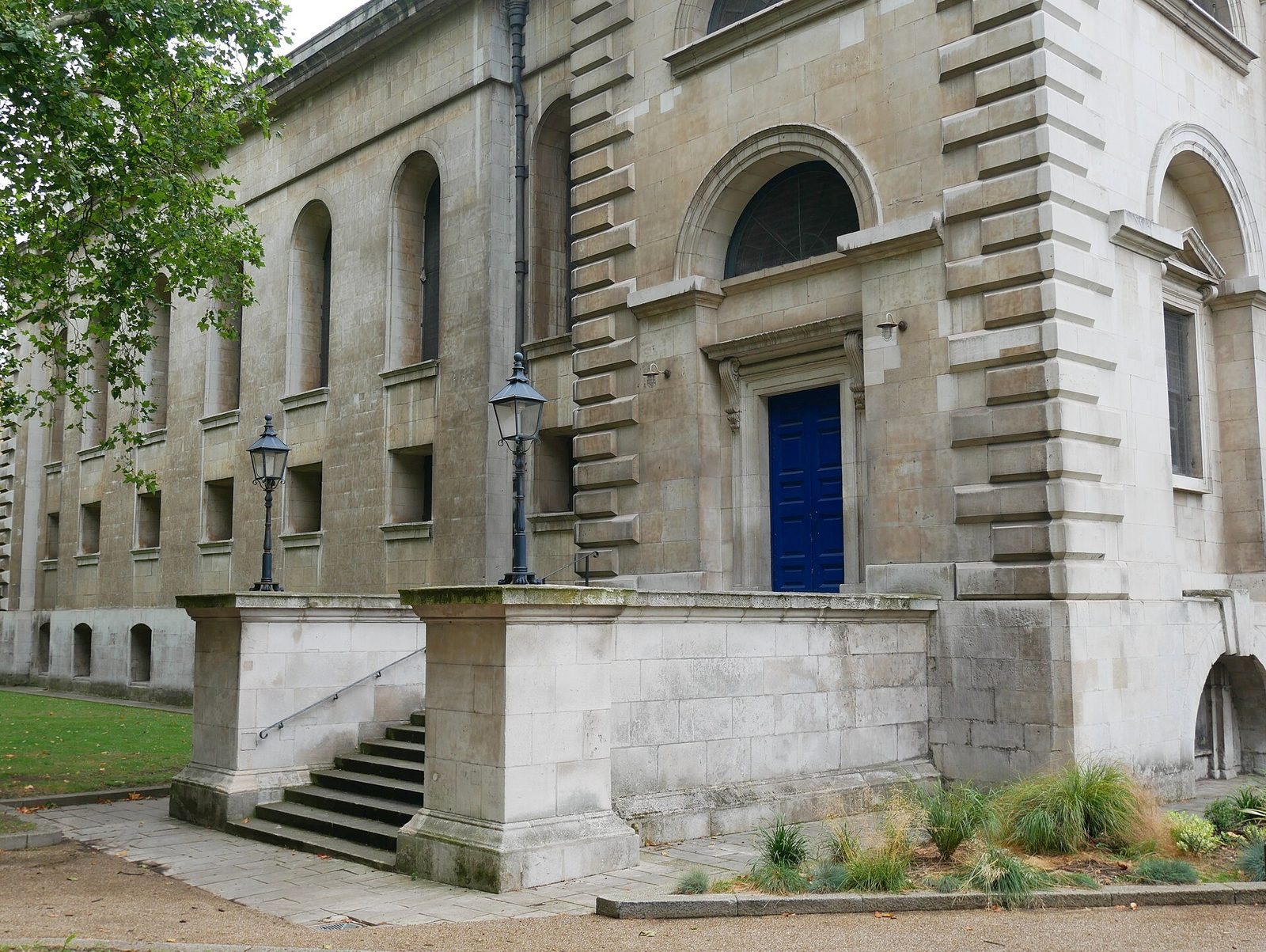
The church is a long, hall-like building arranged around four columns, with galleries running along continuous side aisles. A circular frame spans the ceiling and gives the interior a somewhat ambiguous sense of space. At the entrance end, a bar-shaped block rises into a stepped tower composition. A projecting semicircular porch is articulated with Gothic buttresses, external supports that strengthen its walls. The prominent tower carries a golden ball on its flagpole.
Churchyard garden
Fanny Wilkinson, a landscape gardener with the Metropolitan Public Gardens Association, laid out the churchyard garden and retained Hawksmoor’s stone pyramid.
Stone pyramid
Dated to about 1730, the pyramid bears the inscription “The wisdom of Solomon.”
War memorial
The churchyard also contains a white-stone war memorial dated to 1918, with a bronze figure of Christ.
Organ
Richard Bridge made the original pipe organ in 1741, and William Russell modified it in 1799. The 1850 fire destroyed that instrument. Gray and Davison made its replacement, which won first prize at the Great Exhibition of 1851, held at the Crystal Palace. The replacement organ was completely restored in 2007–09.