Herne Windmill: An Eighteenth-Century Smock Mill in Kent
Site at a Glance
- Popularity
- Low
- Country
- United Kingdom
- Primary era
- Early Modern
- Eras represented
- Early Modern, Modern
- Civilizations
- British
- Site type
- Economic
- Remains
- Production Complex
On this page7 sections
History
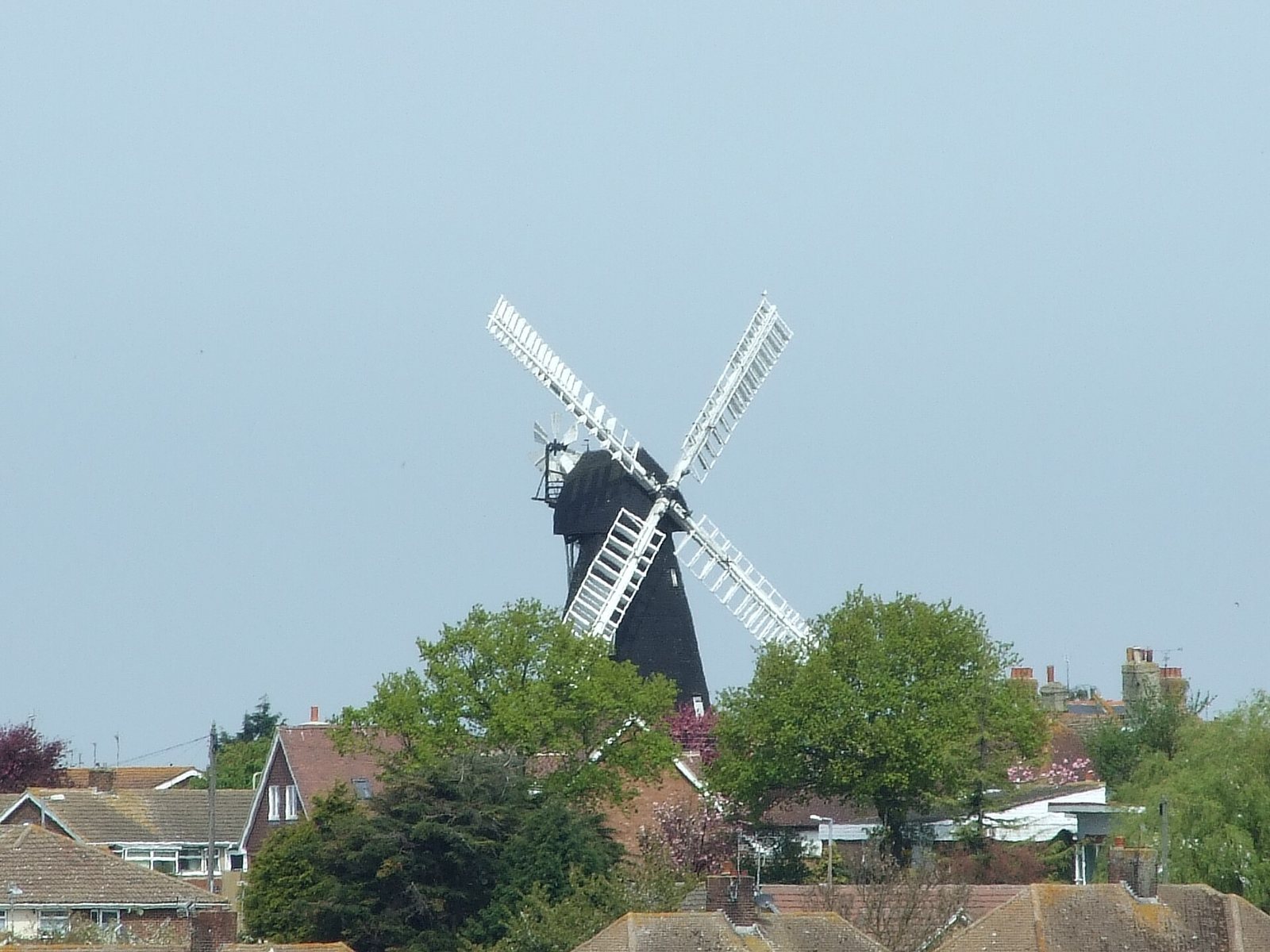
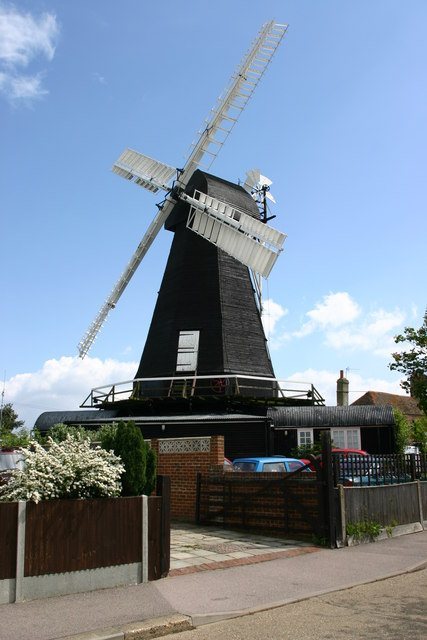
Herne Windmill is an eighteenth-century smock mill in Herne, Kent, England, built in 1789 by John Holman while he worked for Sweetlove, a millwright in Wingham. A smock mill has a fixed, many-sided body topped by a cap that turns to face the wind. The mill served as a navigational landmark for shipping and is listed at Grade I, England’s highest category of listed-building protection, reserved for buildings of exceptional interest.
Earlier mills and rebuilding
A windmill at Herne is recorded as early as 1405. An earlier post mill, whose body pivots around a central post to catch the wind, was standing in 1511. Maps by Philip Symonson in 1596, John Speed in 1611, Robert Morden in 1695, Emanuel Bowen in 1736, and Andrews, Drury and Herbert in 1769 show a mill at Herne before the 1789 rebuilding.
In 1858 the mill was raised, and a two-storey brick base was constructed beneath it. In 1931 an iron screw-like gear replaced the earlier wooden one.
Repairs and changing power
By the 1930s the mill operated with only two sails. Miller Frank Wootton sought help from the Society for the Protection of Ancient Buildings, a British historic-building conservation organization. After engineer and windmill historian Rex Wailes reported on the mill, Thomas Hunt of Soham, Cambridgeshire, fitted two sails from the Black Mill at Forncett End, Norfolk, in 1936 and made a further pair. The Society, the Duchess of Kent, and Trinity House supported the work. Trinity House, a UK authority responsible for aids to navigation, backed the project because the mill was a landmark for shipping.
The mill worked by wind until 1952, later relying partly on a steam engine and then an oil engine. An electric motor took over in 1952, and milling continued until 1980. The mill’s recorded operators include the Lawrence family and several Woottons, among them Thomas, Frank, Clive, and Robert.
New sails were fitted in 2004. They were removed on 21 May 2020, during the first COVID-19 lockdown.
Remains
Mill structure and mechanisms
Smock, cap and sails
The mill has a three-storey, eight-sided smock above a two-storey brick base. At the top, a turning cap houses the cast-iron windshaft, which transfers the sails’ rotation to the machinery. A six-bladed auxiliary rotor, called a fantail, turns the cap toward the wind. The windshaft carried four sails with adjustable shutters that controlled the wind they caught. The set fitted in 2004 measured 33 ft 3¾ in (10.15 m) long and 5 ft 10¾ in (1.80 m) wide per sail, with a total span of 68 ft 8 in (20.93 m).
Internal machinery
A working platform lies between the first and second floors. The composite brake wheel, with an iron centre and wooden rim, transfers movement to a wooden gear on a wooden upright shaft. That shaft carries a wooden wheel supported by arms radiating from its centre. The mechanism is arranged to drive three pairs of millstones from above.