Historical Town Hall in Bardejov: A Renaissance Civic Building
Site at a Glance
- Popularity
- Medium
- Country
- Slovakia
- Primary era
- Early Modern
- Eras represented
- Early Modern
- Civilizations
- Hungarian
- Site type
- Civic
- Remains
- Town Hall
On this page13 sections
History
The Historical Town Hall in Bardejov, Slovakia, is a civic building erected between 1505 and 1511, with Renaissance design incorporated into a late Gothic framework. It served as the seat of the town council and as a center for commerce and public life. The building is regarded as Slovakia’s first secular, or civic, Renaissance building.
From monastic administration to a town council
Before Bardejov had a municipal government, Cistercian monks, members of a Catholic monastic order, and their prior, a senior officer who could govern the community, administered the area and its early Slavic settlement. In 1376, King Louis I of Hungary, also known as Louis the Great, granted the settlement the privileges of a free royal town. This status gave it a measure of self-government, including the right to elect a mayor and council.
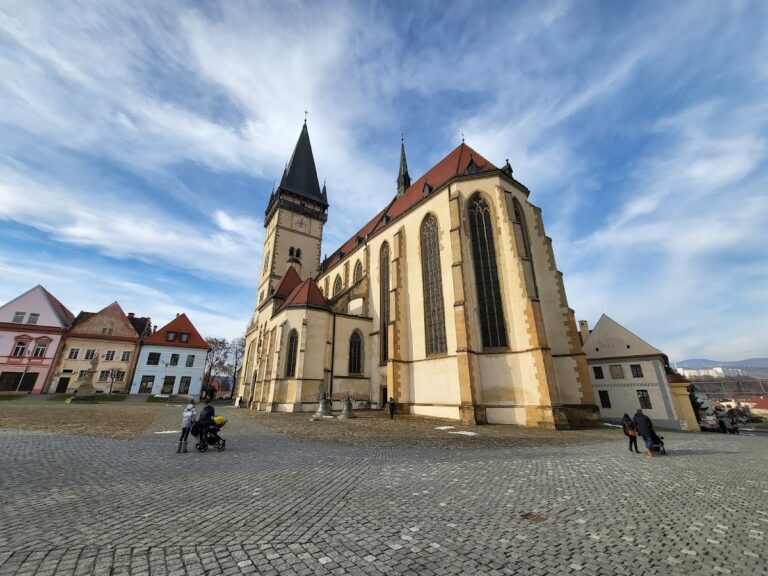
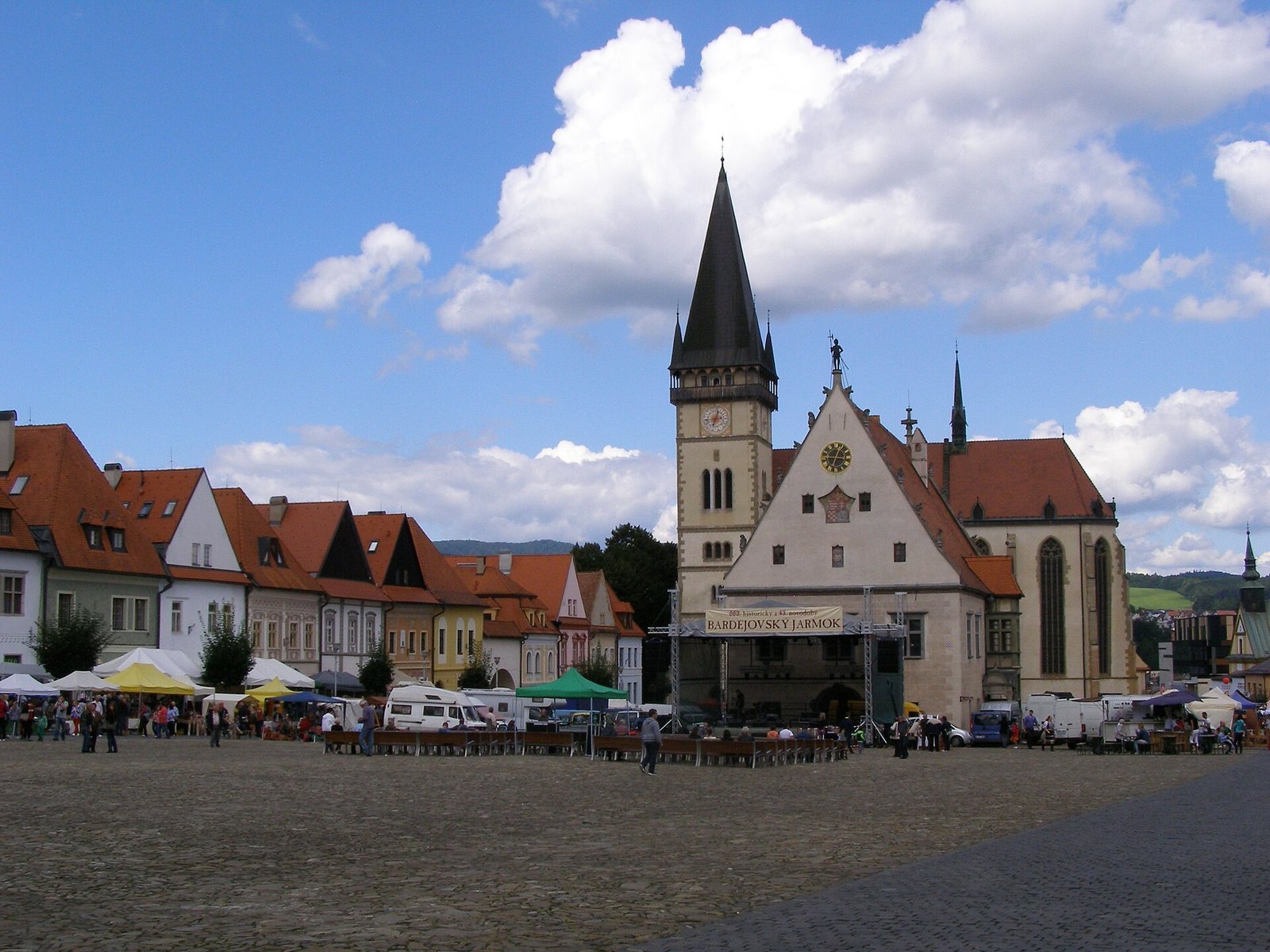
During the fifteenth century, the council met in the mayor’s official room beyond the present central square. Bardejov’s late-fifteenth-century prosperity, supported by merchants and craftspeople, led the council to commission a more representative civic building in the market square. The Town Hall’s civic role also set it in symbolic contrast with the parish church dedicated to St Giles, a widely venerated medieval Christian saint.
Construction and continued civic use
Work began in 1505, when master builder Alexander constructed the ground floor. Master Alexius was responsible for the projecting bay, windows, and portals in 1508. In 1509, Ján of Prešov completed the upper storey and built and decorated the high gables. The building’s construction is dated to 1505–1511. Local painters Theofil Stanczel and Matej Grünwald contributed to its decoration; in 1510–1511, Stanczel painted coats of arms on a gable and the Last Judgment in the council hall.
Furnishing and decoration continued after the principal building work, with further painting in 1521, 1563, and 1582. The roof above the eastern bay was completed in 1556. In 1641, Grünwald decorated its cornice with the arms of Bardejov and the country. Renovations followed in 1641 and during the eighteenth and nineteenth centuries. The ground floor was used for trade, while the upper floor held council rooms and the town treasury.
Fire, restoration, and museum use
After a fire in 1902, the building was restored and adapted in 1904–1905 for exhibitions of the Šariš Museum, a regional history and culture museum based in Bardejov. The museum was founded in 1903. An investigation in 1978–1979 uncovered the council hall’s Last Judgment mural, followed by conservation work in the 1980s and 1990s. The Town Hall continues to house the museum, including a permanent exhibition about Bardejov as a free royal town.
The building became a Slovak National Cultural Monument, a formally protected heritage property, in 1985. In 2000, it was included in the UNESCO World Heritage listing for Bardejov’s historic town ensemble.
Remains
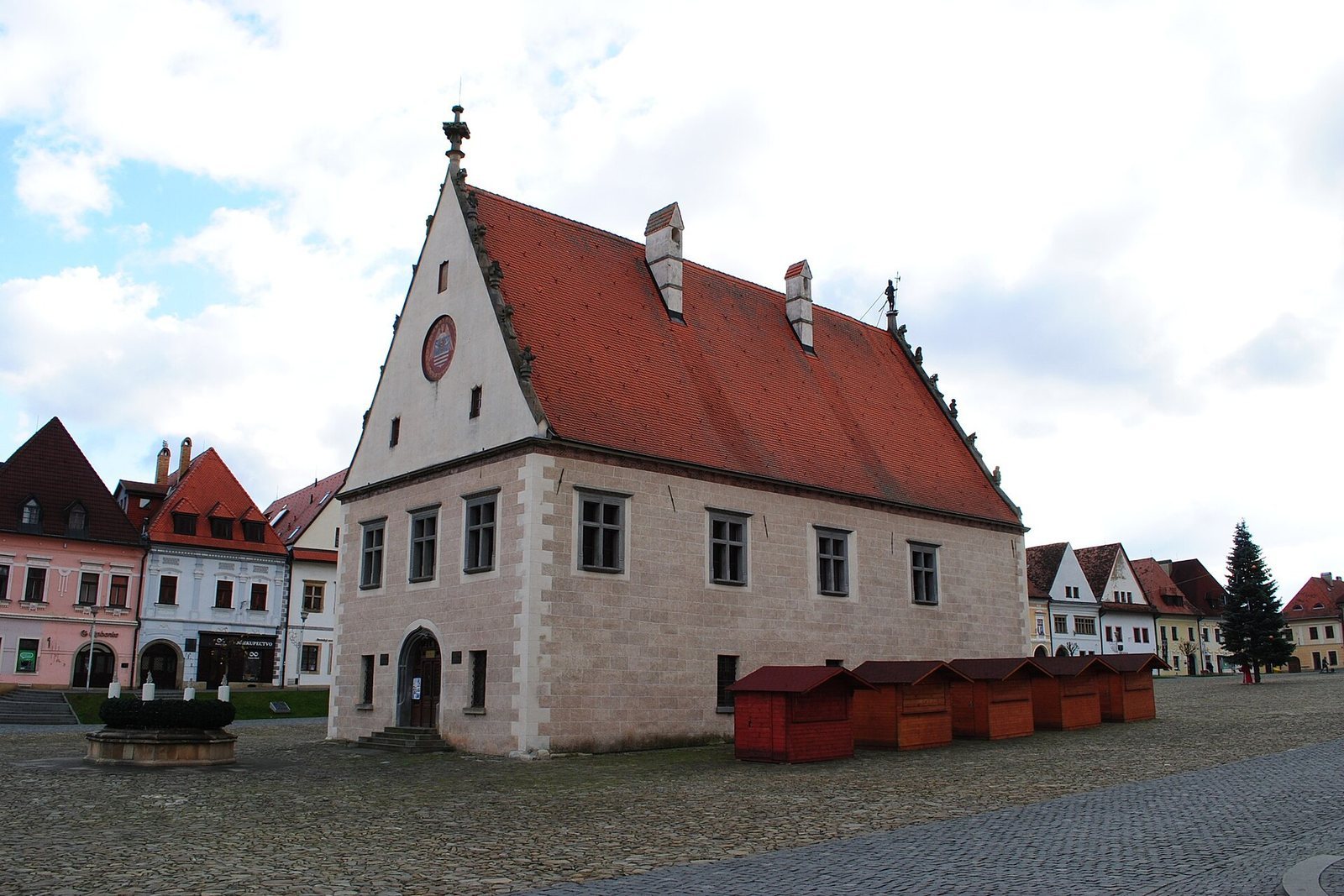
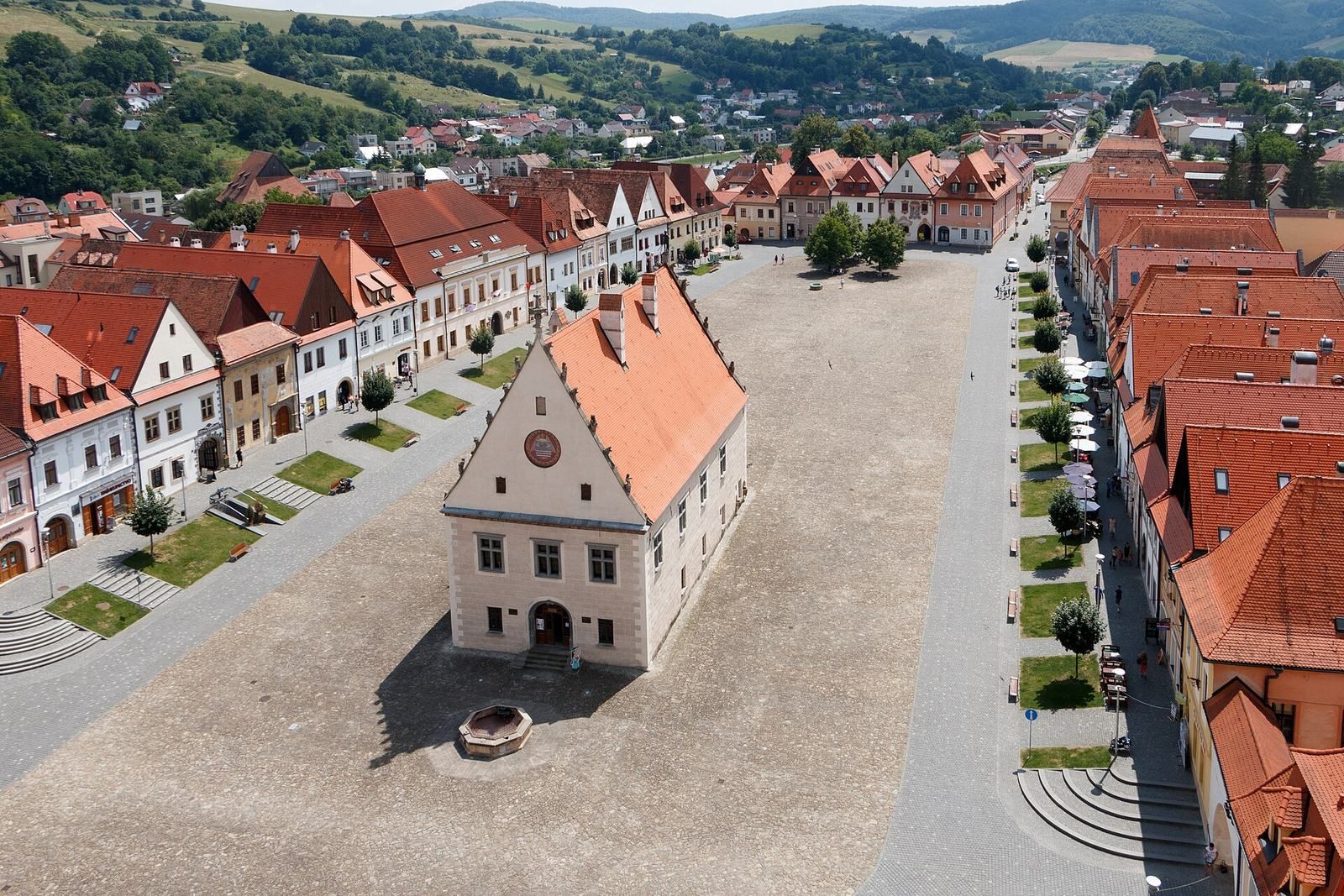
The Town Hall stands in the central part of Bardejov’s elongated market square, which slopes southward. Its regular, rectangular plan is aligned north–south along its longer axis. The two-storey masonry building has tall gables at either end and a steep roof covered with tiles. Its design combines Renaissance features with a late Gothic architectural framework.
Building form and exterior
The facades have windows of matching forms, while the roof gables and eastern side carry many of the building’s most distinctive features. A decorated bay projects from the center of the east facade, with a staircase providing access to the second floor. The south gable has four windows, a clock, and painted arms of Bardejov and Hungary; the north gable has three carved windows and the town’s coat of arms.
Decorative exterior features
The eastern bay
The bay is made of wood and displays painted coats of arms and shields marked with council members’ monograms above and below its windows. A projecting ledge decorated with reliefs completes the structure. On the eastern gable, a mural shows an angel holding Bardejov’s coat of arms. A shield nearby bears Jakub Huber’s name and the date 1641.
Gables and sculpted figures
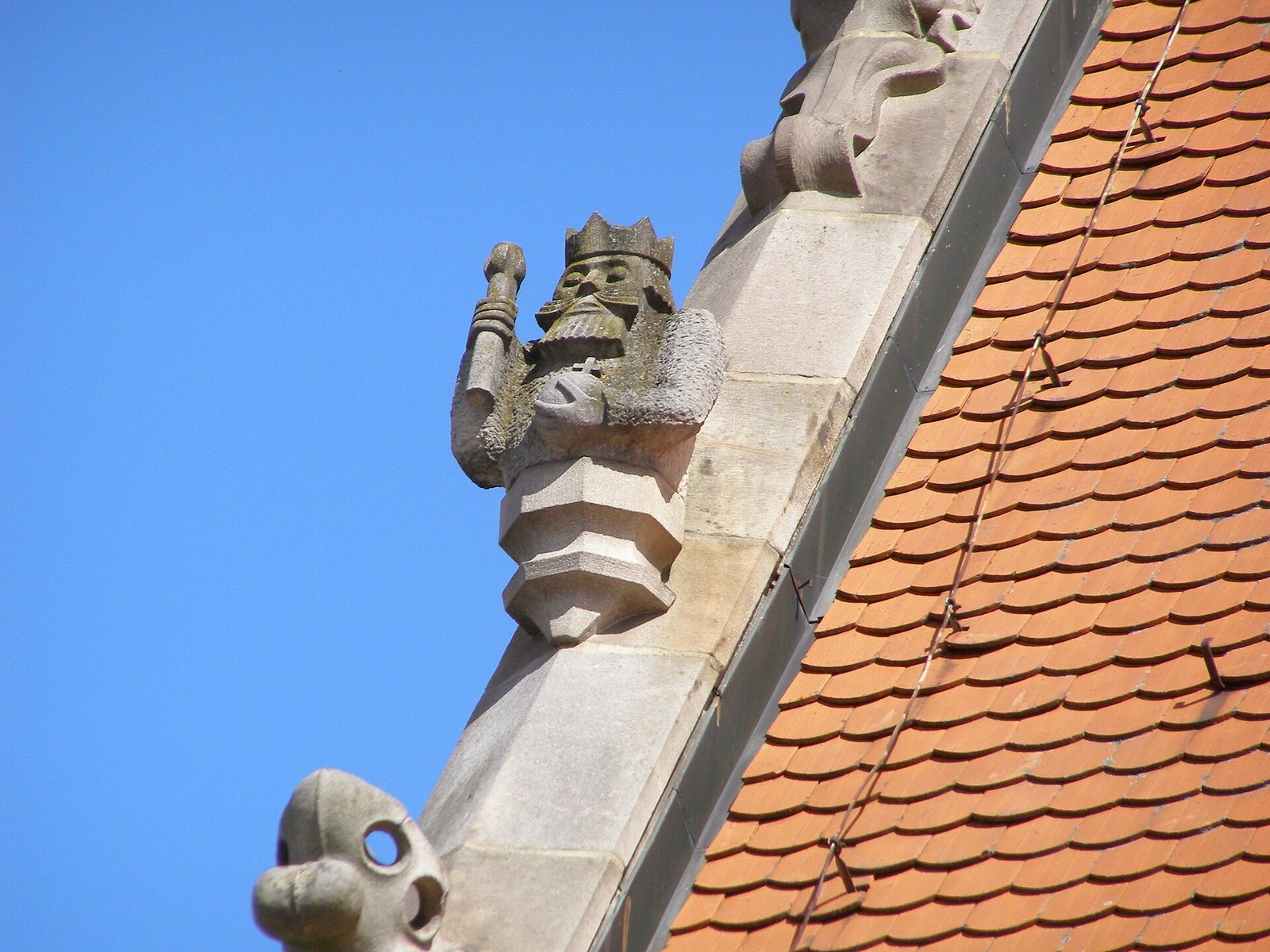
Carved groups and projecting ornaments line the edges of both gables. The south gable’s figures include a lion, a bearded man, a cat, a monkey, and a cloth merchant. On the north gable are a demon, a man holding an hourglass, a dragon, a king, a stonemason, and a man carrying a staff. Beneath the eaves, a series of 118 small figures includes representations of the town’s crafts.
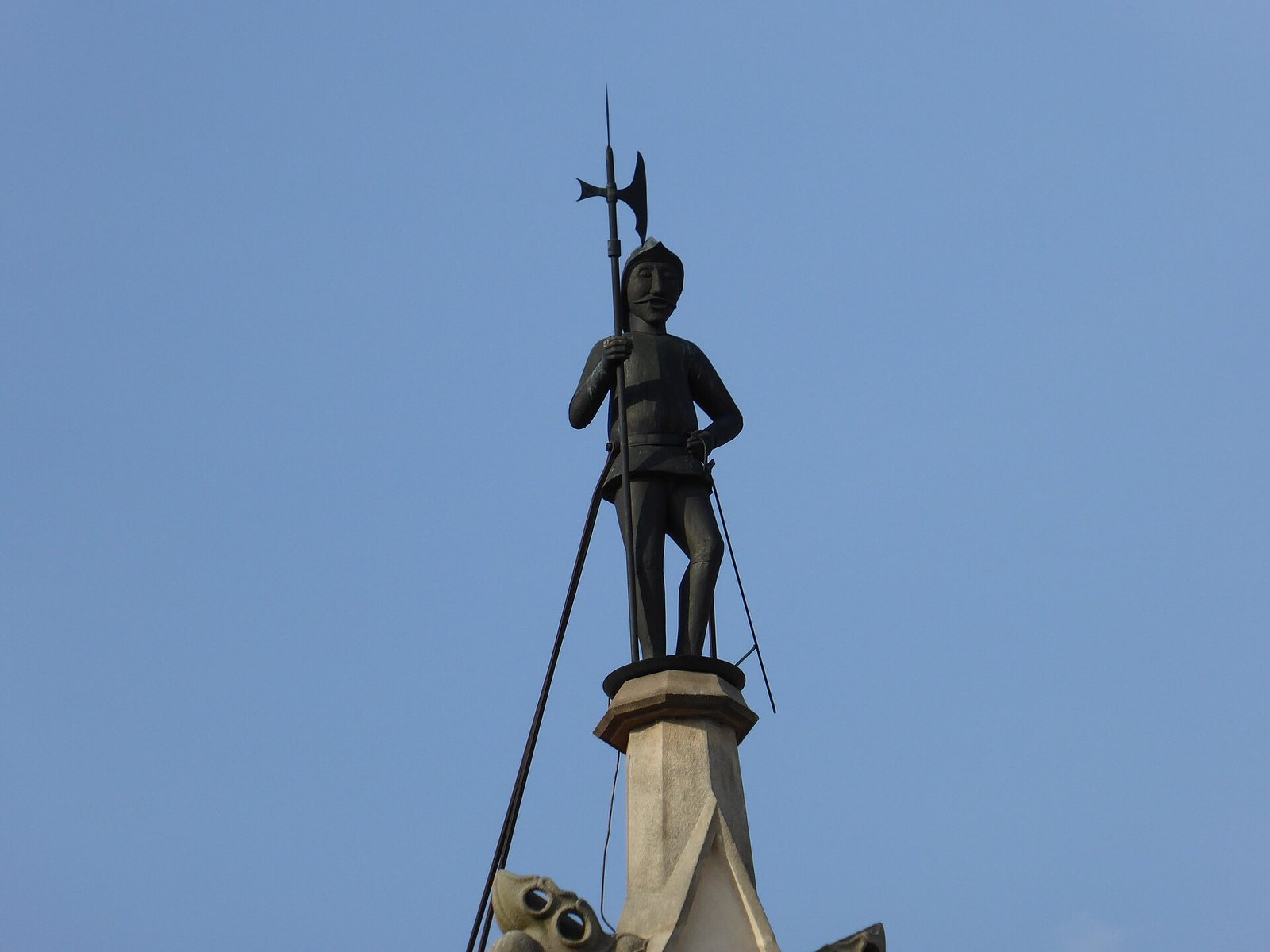
One of the small figures turns its bare backside toward passersby, facing the house where the mayor then lived. Local tradition says the masons added it in protest because the council had not paid the full agreed sum. At the peak of the south gable stands a statue of Roland, a legendary Frankish knight known from medieval epic tradition. The figure carries a halberd and is attributed to Ján of Prešov, with a date around 1509. A wooden replacement covered in copper sheet took the place of the original stone statue in 1641; the statue now in place is a copy made entirely of copper sheet.
Measures and inscriptions
Two hollow stone measures survive at the building’s southwestern corner. Used to measure grain and legumes for sale, they bear the town’s coat of arms and dates around their rims. One dates to the early sixteenth century and the other to 1620. Latin inscriptions appear on the lintel of the main portal and above the windows of the chamber over the eastern bay.
Interior and museum collections
The council hall
The interior includes decorated portals, vaulted ceilings, inlaid doors, wall paintings, and a staircase. The largest room, the council hall, retains its timber ceiling from 1508, divided into recessed panels with decoration in multiple colours. The room also contains the Last Judgment mural, painted by Theofil Stanczel in 1511, and a cabinet used to store municipal privileges.
The museum exhibition
The permanent exhibition about Bardejov as a free royal town brings together documents relating to the town’s history and government, sculptures, panel paintings, epitaphs, and rare examples of Bardejov’s book heritage. Panel paintings are pictures made on rigid supports, often wood; epitaphs are inscriptions commemorating the dead.